
Email
Email

A modern blog built with Payload CMS, Next.js, and shadcn/ui.

RSS FeedSitemap

Explore

  • Blog
  • News
  • Statistics
  • Authors

Categories

  • Automation
  • Email Marketing Tools & Platforms
  • Email Marketing Training
  • Email Marketing Benchmarks
  • Email Automation & AI
  • Email Marketing Operations & Growth
  • Email Marketing Tools & Reviews
  • Email Marketing Technology

Latest articles

  • Top Email Marketing Automation Platforms 2024Jul 21, 2026
  • Continuous Retraining in AI for Email MarketingJul 21, 2026
  • AI for Holiday Email Marketing: Boost Sales by 40%Jul 21, 2026
  • Top Email Marketing Automation Tools 2026Jul 21, 2026

Popular topics

  • #SMB Marketing Data
  • #Small Business Email Marketing
  • #SaaS Tools
  • #financial services benchmarks
  • #fund manager email
  • #Omnisend
  • #Platform Reviews
  • #Wealth Management
  • #skill development
  • #email marketing courses
  • #outsourced email teams
  • #email team scaling
  • #email outsourcing
  • #offshore email marketing
  • #cybersecurity
  • #Postscript

Stay in the loop

Join 2,000+ readers. Unsubscribe anytime.

Subscribe
Email

© 2026 Email. All rights reserved.

SitemapRSS
HomeBlogEmail Marketing StrategyContinuous Retraining in AI for Email Marketing
Email Marketing Strategy

Continuous Retraining in AI for Email Marketing

Learn why AI models need constant retraining to stay effective in email marketing. Discover best practices to maintain deliverability and ROI.

S

Sarah Mitchell

July 21, 2026

15 min read
Share:
#AI and Machine Learning#Email Deliverability#marketing automation
Illustration for continuous retraining in ai for email marketing

Stay in the loop

Get the latest posts delivered straight to your inbox. No spam, unsubscribe anytime.

Most AI-powered email marketing programs fail not because the models are bad at launch, but because they are never updated. Subscriber behavior changes. Seasonal patterns shift. Inbox algorithms evolve. A model trained on last year's engagement data will quietly drift out of alignment with your current audience, and when that happens, open rates slide, deliverability suffers, and revenue follows. Continuous retraining in AI for email marketing is the practice that prevents this, and it is one of the most overlooked levers in modern email strategy.

Key Takeaways

  • Unlike traditional software, machine learning models exist in a state of continuous silent degradation because they are optimized against historical training data at a fixed point in time, making them a snapshot of the world as it was, not as it is.
  • After each campaign, a well-architected model ingests new performance data and adjusts its predictions. Audience preferences shift over time due to fatigue with certain formats and seasonal changes, and monthly retraining ensures the model reflects current audience behavior, not last year's patterns.
  • AI-driven personalization delivers 41% revenue increases and 13.44% higher click-through rates, making continuous model improvement one of the highest-ROI investments in email marketing.
  • Retraining triggers fall into three categories: scheduled intervals, performance-based thresholds, and data distribution shifts, and each serves a different operational need.
  • The difference between AI users who see value and those who do not is not the tool. It is the depth of integration.

What Continuous Retraining Actually Means

Machine learning model retraining, also called continuous training, is the MLOps capability to automatically and continuously retrain a machine learning model on a schedule or a trigger driven by an event. It involves designing and implementing processes for the automation of model retraining over time, and it is fundamental to ensure that a model is constantly providing the most up-to-date predictions while minimizing manual interventions.

In email marketing specifically, this means the AI systems that power your send-time optimization, subject line testing, churn prediction, and content personalization need fresh data to remain accurate. AI models are trained to deliver insights from every customer interaction, and their algorithms continuously adapt and learn with each interaction, which is what allows you to get better results from your A/B email testing.

The practical gap between "deployed" and "current" is where most email programs lose performance. Teams launch an AI-driven campaign workflow, see good early results, and then leave the model untouched for months. Subscriber preferences change, new segments emerge, and the model's recommendations grow increasingly misaligned with reality.

The Model Drift Problem in Email Marketing

Model performance degrades when conditions change, customer behavior evolves, and new data patterns emerge that the training data never encountered. This is model drift in its most common form, and it is why AI maintenance is not optional but essential.

In email marketing, drift shows up in specific, measurable ways:

  • Open rate decline despite consistent sending practices
  • Click-through rates falling on content that previously performed well
  • Churn prediction failures where the model misses early disengagement signals
  • Send-time recommendations becoming less accurate as subscriber schedules shift
  • Segment composition errors as behavioral patterns in your audience evolve

User interest shifts constantly. AI can analyze data and identify micro patterns in browsing behavior, purchase cycles, and engagement levels that help marketers segment more intentionally, ensuring campaigns stay relevant. But only if the underlying model is fed new data regularly.

Invalid addresses, spam traps, and dormant contacts degrade model performance and damage deliverability. AI models trained on dirty data produce skewed outputs, since the garbage-in, garbage-out principle applies directly.

The Three Retraining Trigger Strategies

Not every model needs to be retrained on the same schedule. The timing of when it is necessary to update or retrain a model varies across use cases, and it is imperative to evaluate the appropriate frequency for each model. The three primary approaches are:

  1. Scheduled retraining. A periodic retraining schedule makes sense if the frequency is aligned with the dynamism of your domain. Otherwise, selecting a random time or milestone may expose you to risks and leave you with models that have less relevance than their previous version. For most email marketing models, monthly retraining hits the right balance between freshness and resource cost.
  2. Performance-based triggers. The second most common approach is to leverage performance-based triggers and retrain the model once you detect performance degradation. This approach assumes that you have a continuous view of model performance in production. In practice, this means monitoring open rates, click-through rates, and conversion rates against a baseline and triggering retraining when any metric drops past a defined threshold.
  3. Data distribution triggers. Instead of updating models based on a fixed schedule, this approach updates the model whenever data distributions shift and model performance decays. The training frequency is triggered by the drift detector. This is the most responsive method and works well for fast-moving ecommerce audiences.

The frequency of model retraining should be tailored to the specific dynamics of your data and business environment. By balancing regular schedules with event-driven retraining and continuous performance monitoring, you can ensure your models remain accurate and relevant.

For email personalization techniques powered by behavioral signals, data distribution triggers tend to outperform fixed schedules because they catch shifts in purchase behavior and engagement patterns before they compound into measurable deliverability damage.

What to Monitor Between Retraining Cycles

Continuous retraining in AI for email marketing is only effective when paired with equally continuous monitoring. Without a clear performance baseline, you cannot know when a model has drifted enough to warrant a retrain.

Key metrics to track between cycles:

  • Inbox placement rate. AI email deliverability optimization produces measurable impact only when performance signals improve consistently over time. The goal is stronger engagement, lower risk, and a more stable sender reputation. To evaluate impact, establish a baseline across several comparable campaigns, introduce one AI-driven change at a time, and compare sustained trends rather than single-send spikes.
  • Engagement signal distribution. AI inbox models rely heavily on subscriber engagement signals including opens, clicks, replies, forwards, and explicit "mark as important" actions to determine inbox placement. Programs with degraded list hygiene will produce engagement signal distributions that depress deliverability across the entire sending domain.
  • Churn prediction accuracy. Track whether the model's flagged at-risk subscribers are actually churning. A widening gap between prediction and outcome is a reliable drift signal.
  • Revenue per send. Despite representing just 2% of email volume, automated campaigns generate 37% of all email sales. This efficiency demonstrates the superior conversion power of triggered, behavior-based messaging and any drop in revenue per automated send deserves investigation at the model level.

You can also pair this monitoring with your broader email marketing analytics practices to catch drift early and tie retraining decisions to revenue outcomes rather than vanity metrics.

How Continuous Retraining Improves Deliverability

The connection between model freshness and inbox placement is direct. AI email deliverability refers to how artificial intelligence systems evaluate, filter, and prioritize incoming email. These systems analyze sender reputation, engagement behavior, content quality, and user preferences to determine whether a message reaches the inbox, promotions tab, or spam folder.

When your marketing AI is retrained on current engagement data, it gets better at two things that protect deliverability: identifying which subscribers are likely to engage (and therefore worth sending to) and suppressing high-risk contacts before they generate complaint signals.

AI improves deliverability by identifying and suppressing high-risk contacts before campaigns send, monitoring bounce rates and spam complaint signals in real time, and adjusting send behavior to protect sender reputation.

Programs should implement regular re-engagement and sunset workflows to remove or segment subscribers who have not engaged within defined windows, typically 90 to 180 days depending on send frequency. The deliverability cost of maintaining unengaged subscribers on active send lists exceeds the marginal revenue benefit of maintaining apparent list scale.

A continuously retrained churn model makes these sunset decisions data-driven rather than arbitrary. Instead of applying a blanket 90-day cutoff, the model can weight engagement signals individually and flag subscribers who are drifting before they cross into spam-signal territory.

Practical Retraining for Teams Without a Data Science Department

Most marketing teams running email do not have dedicated machine learning engineers. Continuous retraining in AI for email marketing does not require them. The platforms that power modern email programs, including Klaviyo, HubSpot, ActiveCampaign, and Salesforce Marketing Cloud, handle model retraining within their own infrastructure. AI algorithms continuously adapt and learn with each interaction, and AI analytics can bring in data from your customer data platform, combining customer interactions across email, website, and purchases to analyze preferences and trends.

What marketing teams do control is the quality of the data those platforms retrain on. That means:

  1. Keeping lists clean. Suppress bounced addresses, spam complainers, and long-term disengaged contacts consistently, not just quarterly.
  2. Feeding the model complete signals. Connect your email platform to purchase data, website behavior, and CRM lifecycle stage so the model trains on full-picture customer signals rather than open rates alone.
  3. Setting performance alerts. Define thresholds for open rate, click rate, and revenue per send. When a metric drops 15% below a rolling 30-day baseline, treat it as a retraining signal regardless of your scheduled cycle.
  4. Running human review alongside automated optimization. Even with AI-generated subject lines, keep a human reviewing the final output. AI models occasionally generate lines that are technically optimized for clicks but misaligned with brand voice or campaign intent. The best workflow is AI-generate, human-review, AI-optimize based on feedback.
  5. Documenting model changes. Every time a model is retrained, log what data was used, what the performance delta was before and after, and what business conditions prompted the retrain.

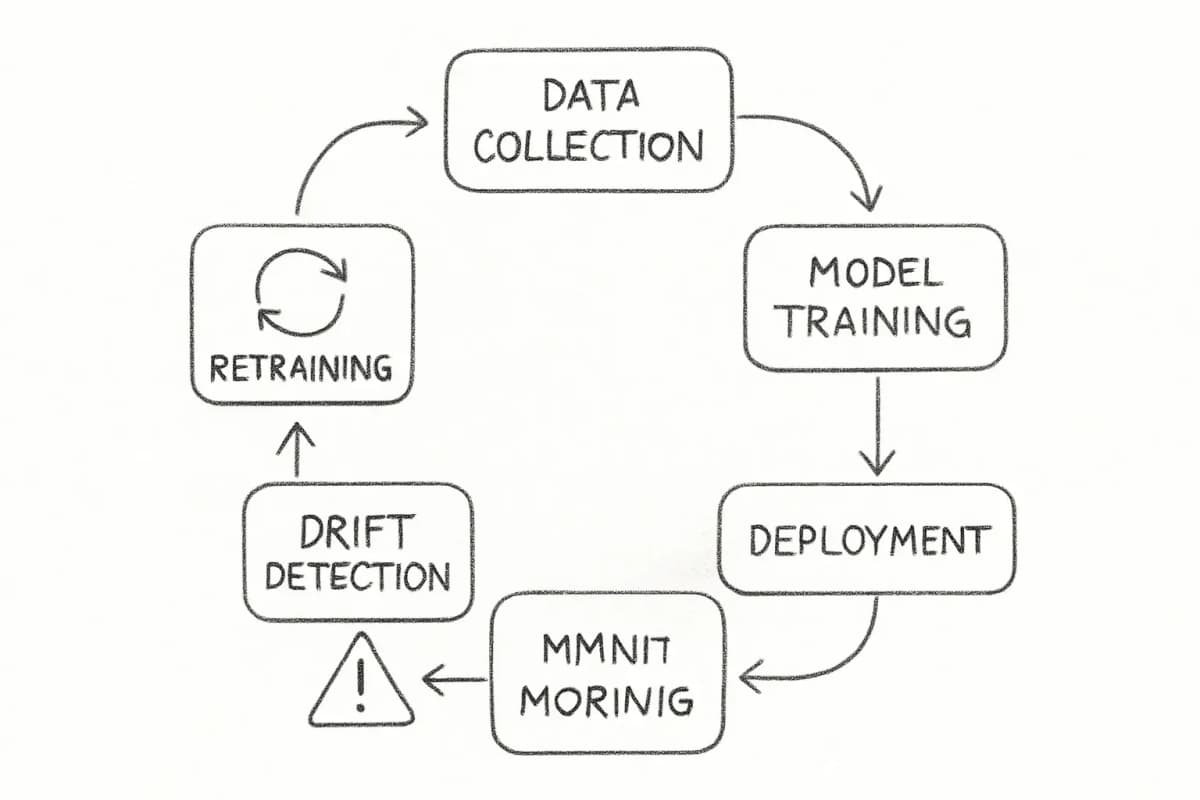
For teams building out their full AI-driven email workflow, pairing continuous retraining with thoughtful email list segmentation strategies ensures the model trains on behaviorally meaningful cohorts rather than undifferentiated lists. A circular process diagram showing the continuous retraining loop for AI email models. Six connected steps flow clockwise: (1) Data Collection from email campaigns and subscriber interactions, (2) Model Training on collected behavioral data, (3) Deployment of the trained model into production, (4) Monitoring of model performance and email metrics, (5) Drift Detection identifying when model accuracy declines, and (6) Retraining triggered to loop back to step 1. Include arrows between each step showing the continuous cycle. Add visual indicators like warning signs at the Drift Detection step and refresh symbols at Retraining to emphasize the ongoing nature of the process.
The Business Case: What Stale Models Cost You

Teams using AI for personalization, timing, and testing report compounding returns. Teams using it only to draft subject lines see limited impact. The difference between these two outcomes is depth of integration, and continuous retraining is what separates a model that compounds value from one that flatlines.

Marketers implementing AI-powered personalization report substantial performance improvements, with revenue increasing by 41% and click-through rates rising 13.44% compared to non-personalized campaigns. These numbers represent the ceiling achievable when models are current. Stale models do not just underperform: they actively mislead. They recommend send times that no longer align with subscriber schedules, flag the wrong contacts as high-value, and miss churn signals until disengagement has already cascaded into deliverability damage.

AI-generated subject lines outperform human-written ones by 26%, and that advantage compounds with dynamic send-time optimization, which adds another 14% lift when combined with AI subject lines. Both of those performance advantages erode when the underlying model trains on stale behavioral data.

The operational investment in continuous retraining, whether that means tightening your data hygiene processes, setting monitoring alerts, or upgrading to a platform with automated model refresh, pays back measurably in recovered open rate, protected inbox placement, and better revenue per send. For AI-driven email marketing examples that show these gains in practice, the pattern is consistent: the best-performing programs treat model freshness as infrastructure, not an afterthought.


Frequently Asked Questions

How often should AI models be retrained for email marketing?

In cases where consumer behavior changes rapidly, frequent retraining is crucial to adapt to new patterns, potentially on a weekly or monthly basis. For most email programs, monthly retraining is a practical starting point. High-volume ecommerce senders with fast-moving audiences may benefit from bi-weekly cycles, while low-frequency B2B programs may find quarterly retraining sufficient if paired with continuous performance monitoring.

What is model drift and how does it affect email performance?

The data a model encounters in production differs from its training data. This degradation is an inherent byproduct of AI model development since models are optimized against historical training data at a fixed point in time. User behaviors evolve and market conditions shift. In email marketing, this translates to declining accuracy in send-time predictions, weaker content recommendations, and missed churn signals.

Do I need a data science team to implement continuous retraining?

No. Most enterprise email platforms handle model retraining automatically within their infrastructure. Your responsibility as a marketer is to ensure the data quality those systems train on: clean lists, complete behavioral signals, and connected data sources. Setting performance threshold alerts is something any marketing operations team can manage without machine learning expertise.

What signals should trigger an unscheduled model retrain?

Implement continuous monitoring of model performance using metrics like accuracy, precision, recall, and F1-score. A significant drop in these metrics can signal the need for retraining. Set specific thresholds for performance metrics, and if those thresholds are breached, initiate retraining to restore the model's accuracy. In email marketing terms, watch for open rate drops of 15% or more below a 30-day rolling average, a sudden increase in unsubscribes, or a meaningful decline in revenue per automated send.


No comments yet. Be the first!

Leave a comment

Comments are reviewed before publishing.

More from

Related posts

Illustration for what is ai email marketing?
Email Marketing StrategyJul 21, 2026 11 min

What Is AI Email Marketing? How It Works

AI email marketing uses machine learning to automate campaigns, personalize content, and optimize send times. Learn how it boosts ROI and engagement.

JJames Chen
Illustration for email+marketing+automation
Email Marketing StrategyJul 21, 2026 11 min

Email Marketing Automation: Setup, Tools & Best Practices

Learn how email marketing automation saves time, boosts conversions, and scales your outreach. See setup steps, top tools, and strategies that work.

PPriya Kapoor
Illustration for saas email marketing automation
Email Marketing StrategyJul 21, 2026 2 min

SaaS Email Marketing Automation: Tools, Setup, ROI

Learn how SaaS email marketing automation saves time, improves deliverability, and increases conversions. Setup guide and platform comparison included.

MMarcus Webb
HomeBlogEmail Marketing StrategyContinuous Retraining in AI for Email Marketing
Email Marketing Strategy

Continuous Retraining in AI for Email Marketing

Learn why AI models need constant retraining to stay effective in email marketing. Discover best practices to maintain deliverability and ROI.

S

Sarah Mitchell

July 21, 2026

15 min read
Share:
#AI and Machine Learning#Email Deliverability#marketing automation
Illustration for continuous retraining in ai for email marketing

Stay in the loop

Get the latest posts delivered straight to your inbox. No spam, unsubscribe anytime.

Most AI-powered email marketing programs fail not because the models are bad at launch, but because they are never updated. Subscriber behavior changes. Seasonal patterns shift. Inbox algorithms evolve. A model trained on last year's engagement data will quietly drift out of alignment with your current audience, and when that happens, open rates slide, deliverability suffers, and revenue follows. Continuous retraining in AI for email marketing is the practice that prevents this, and it is one of the most overlooked levers in modern email strategy.

Key Takeaways

  • Unlike traditional software, machine learning models exist in a state of continuous silent degradation because they are optimized against historical training data at a fixed point in time, making them a snapshot of the world as it was, not as it is.
  • After each campaign, a well-architected model ingests new performance data and adjusts its predictions. Audience preferences shift over time due to fatigue with certain formats and seasonal changes, and monthly retraining ensures the model reflects current audience behavior, not last year's patterns.
  • AI-driven personalization delivers 41% revenue increases and 13.44% higher click-through rates, making continuous model improvement one of the highest-ROI investments in email marketing.
  • Retraining triggers fall into three categories: scheduled intervals, performance-based thresholds, and data distribution shifts, and each serves a different operational need.
  • The difference between AI users who see value and those who do not is not the tool. It is the depth of integration.

What Continuous Retraining Actually Means

Machine learning model retraining, also called continuous training, is the MLOps capability to automatically and continuously retrain a machine learning model on a schedule or a trigger driven by an event. It involves designing and implementing processes for the automation of model retraining over time, and it is fundamental to ensure that a model is constantly providing the most up-to-date predictions while minimizing manual interventions.

In email marketing specifically, this means the AI systems that power your send-time optimization, subject line testing, churn prediction, and content personalization need fresh data to remain accurate. AI models are trained to deliver insights from every customer interaction, and their algorithms continuously adapt and learn with each interaction, which is what allows you to get better results from your A/B email testing.

The practical gap between "deployed" and "current" is where most email programs lose performance. Teams launch an AI-driven campaign workflow, see good early results, and then leave the model untouched for months. Subscriber preferences change, new segments emerge, and the model's recommendations grow increasingly misaligned with reality.

The Model Drift Problem in Email Marketing

Model performance degrades when conditions change, customer behavior evolves, and new data patterns emerge that the training data never encountered. This is model drift in its most common form, and it is why AI maintenance is not optional but essential.

In email marketing, drift shows up in specific, measurable ways:

  • Open rate decline despite consistent sending practices
  • Click-through rates falling on content that previously performed well
  • Churn prediction failures where the model misses early disengagement signals
  • Send-time recommendations becoming less accurate as subscriber schedules shift
  • Segment composition errors as behavioral patterns in your audience evolve

User interest shifts constantly. AI can analyze data and identify micro patterns in browsing behavior, purchase cycles, and engagement levels that help marketers segment more intentionally, ensuring campaigns stay relevant. But only if the underlying model is fed new data regularly.

Invalid addresses, spam traps, and dormant contacts degrade model performance and damage deliverability. AI models trained on dirty data produce skewed outputs, since the garbage-in, garbage-out principle applies directly.

The Three Retraining Trigger Strategies

Not every model needs to be retrained on the same schedule. The timing of when it is necessary to update or retrain a model varies across use cases, and it is imperative to evaluate the appropriate frequency for each model. The three primary approaches are:

  1. Scheduled retraining. A periodic retraining schedule makes sense if the frequency is aligned with the dynamism of your domain. Otherwise, selecting a random time or milestone may expose you to risks and leave you with models that have less relevance than their previous version. For most email marketing models, monthly retraining hits the right balance between freshness and resource cost.
  2. Performance-based triggers. The second most common approach is to leverage performance-based triggers and retrain the model once you detect performance degradation. This approach assumes that you have a continuous view of model performance in production. In practice, this means monitoring open rates, click-through rates, and conversion rates against a baseline and triggering retraining when any metric drops past a defined threshold.
  3. Data distribution triggers. Instead of updating models based on a fixed schedule, this approach updates the model whenever data distributions shift and model performance decays. The training frequency is triggered by the drift detector. This is the most responsive method and works well for fast-moving ecommerce audiences.

The frequency of model retraining should be tailored to the specific dynamics of your data and business environment. By balancing regular schedules with event-driven retraining and continuous performance monitoring, you can ensure your models remain accurate and relevant.

For email personalization techniques powered by behavioral signals, data distribution triggers tend to outperform fixed schedules because they catch shifts in purchase behavior and engagement patterns before they compound into measurable deliverability damage.

What to Monitor Between Retraining Cycles

Continuous retraining in AI for email marketing is only effective when paired with equally continuous monitoring. Without a clear performance baseline, you cannot know when a model has drifted enough to warrant a retrain.

Key metrics to track between cycles:

  • Inbox placement rate. AI email deliverability optimization produces measurable impact only when performance signals improve consistently over time. The goal is stronger engagement, lower risk, and a more stable sender reputation. To evaluate impact, establish a baseline across several comparable campaigns, introduce one AI-driven change at a time, and compare sustained trends rather than single-send spikes.
  • Engagement signal distribution. AI inbox models rely heavily on subscriber engagement signals including opens, clicks, replies, forwards, and explicit "mark as important" actions to determine inbox placement. Programs with degraded list hygiene will produce engagement signal distributions that depress deliverability across the entire sending domain.
  • Churn prediction accuracy. Track whether the model's flagged at-risk subscribers are actually churning. A widening gap between prediction and outcome is a reliable drift signal.
  • Revenue per send. Despite representing just 2% of email volume, automated campaigns generate 37% of all email sales. This efficiency demonstrates the superior conversion power of triggered, behavior-based messaging and any drop in revenue per automated send deserves investigation at the model level.

You can also pair this monitoring with your broader email marketing analytics practices to catch drift early and tie retraining decisions to revenue outcomes rather than vanity metrics.

How Continuous Retraining Improves Deliverability

The connection between model freshness and inbox placement is direct. AI email deliverability refers to how artificial intelligence systems evaluate, filter, and prioritize incoming email. These systems analyze sender reputation, engagement behavior, content quality, and user preferences to determine whether a message reaches the inbox, promotions tab, or spam folder.

When your marketing AI is retrained on current engagement data, it gets better at two things that protect deliverability: identifying which subscribers are likely to engage (and therefore worth sending to) and suppressing high-risk contacts before they generate complaint signals.

AI improves deliverability by identifying and suppressing high-risk contacts before campaigns send, monitoring bounce rates and spam complaint signals in real time, and adjusting send behavior to protect sender reputation.

Programs should implement regular re-engagement and sunset workflows to remove or segment subscribers who have not engaged within defined windows, typically 90 to 180 days depending on send frequency. The deliverability cost of maintaining unengaged subscribers on active send lists exceeds the marginal revenue benefit of maintaining apparent list scale.

A continuously retrained churn model makes these sunset decisions data-driven rather than arbitrary. Instead of applying a blanket 90-day cutoff, the model can weight engagement signals individually and flag subscribers who are drifting before they cross into spam-signal territory.

Practical Retraining for Teams Without a Data Science Department

Most marketing teams running email do not have dedicated machine learning engineers. Continuous retraining in AI for email marketing does not require them. The platforms that power modern email programs, including Klaviyo, HubSpot, ActiveCampaign, and Salesforce Marketing Cloud, handle model retraining within their own infrastructure. AI algorithms continuously adapt and learn with each interaction, and AI analytics can bring in data from your customer data platform, combining customer interactions across email, website, and purchases to analyze preferences and trends.

What marketing teams do control is the quality of the data those platforms retrain on. That means:

  1. Keeping lists clean. Suppress bounced addresses, spam complainers, and long-term disengaged contacts consistently, not just quarterly.
  2. Feeding the model complete signals. Connect your email platform to purchase data, website behavior, and CRM lifecycle stage so the model trains on full-picture customer signals rather than open rates alone.
  3. Setting performance alerts. Define thresholds for open rate, click rate, and revenue per send. When a metric drops 15% below a rolling 30-day baseline, treat it as a retraining signal regardless of your scheduled cycle.
  4. Running human review alongside automated optimization. Even with AI-generated subject lines, keep a human reviewing the final output. AI models occasionally generate lines that are technically optimized for clicks but misaligned with brand voice or campaign intent. The best workflow is AI-generate, human-review, AI-optimize based on feedback.
  5. Documenting model changes. Every time a model is retrained, log what data was used, what the performance delta was before and after, and what business conditions prompted the retrain.

For teams building out their full AI-driven email workflow, pairing continuous retraining with thoughtful email list segmentation strategies ensures the model trains on behaviorally meaningful cohorts rather than undifferentiated lists. A circular process diagram showing the continuous retraining loop for AI email models. Six connected steps flow clockwise: (1) Data Collection from email campaigns and subscriber interactions, (2) Model Training on collected behavioral data, (3) Deployment of the trained model into production, (4) Monitoring of model performance and email metrics, (5) Drift Detection identifying when model accuracy declines, and (6) Retraining triggered to loop back to step 1. Include arrows between each step showing the continuous cycle. Add visual indicators like warning signs at the Drift Detection step and refresh symbols at Retraining to emphasize the ongoing nature of the process.

The Business Case: What Stale Models Cost You

Teams using AI for personalization, timing, and testing report compounding returns. Teams using it only to draft subject lines see limited impact. The difference between these two outcomes is depth of integration, and continuous retraining is what separates a model that compounds value from one that flatlines.

Marketers implementing AI-powered personalization report substantial performance improvements, with revenue increasing by 41% and click-through rates rising 13.44% compared to non-personalized campaigns. These numbers represent the ceiling achievable when models are current. Stale models do not just underperform: they actively mislead. They recommend send times that no longer align with subscriber schedules, flag the wrong contacts as high-value, and miss churn signals until disengagement has already cascaded into deliverability damage.

AI-generated subject lines outperform human-written ones by 26%, and that advantage compounds with dynamic send-time optimization, which adds another 14% lift when combined with AI subject lines. Both of those performance advantages erode when the underlying model trains on stale behavioral data.

The operational investment in continuous retraining, whether that means tightening your data hygiene processes, setting monitoring alerts, or upgrading to a platform with automated model refresh, pays back measurably in recovered open rate, protected inbox placement, and better revenue per send. For AI-driven email marketing examples that show these gains in practice, the pattern is consistent: the best-performing programs treat model freshness as infrastructure, not an afterthought.


Frequently Asked Questions

How often should AI models be retrained for email marketing?

In cases where consumer behavior changes rapidly, frequent retraining is crucial to adapt to new patterns, potentially on a weekly or monthly basis. For most email programs, monthly retraining is a practical starting point. High-volume ecommerce senders with fast-moving audiences may benefit from bi-weekly cycles, while low-frequency B2B programs may find quarterly retraining sufficient if paired with continuous performance monitoring.

What is model drift and how does it affect email performance?

The data a model encounters in production differs from its training data. This degradation is an inherent byproduct of AI model development since models are optimized against historical training data at a fixed point in time. User behaviors evolve and market conditions shift. In email marketing, this translates to declining accuracy in send-time predictions, weaker content recommendations, and missed churn signals.

Do I need a data science team to implement continuous retraining?

No. Most enterprise email platforms handle model retraining automatically within their infrastructure. Your responsibility as a marketer is to ensure the data quality those systems train on: clean lists, complete behavioral signals, and connected data sources. Setting performance threshold alerts is something any marketing operations team can manage without machine learning expertise.

What signals should trigger an unscheduled model retrain?

Implement continuous monitoring of model performance using metrics like accuracy, precision, recall, and F1-score. A significant drop in these metrics can signal the need for retraining. Set specific thresholds for performance metrics, and if those thresholds are breached, initiate retraining to restore the model's accuracy. In email marketing terms, watch for open rate drops of 15% or more below a 30-day rolling average, a sudden increase in unsubscribes, or a meaningful decline in revenue per automated send.

No comments yet. Be the first!

Leave a comment

Comments are reviewed before publishing.

More from

Related posts

Illustration for what is ai email marketing?
Email Marketing StrategyJul 21, 2026 11 min

What Is AI Email Marketing? How It Works

AI email marketing uses machine learning to automate campaigns, personalize content, and optimize send times. Learn how it boosts ROI and engagement.

JJames Chen
Illustration for email+marketing+automation
Email Marketing StrategyJul 21, 2026 11 min

Email Marketing Automation: Setup, Tools & Best Practices

Learn how email marketing automation saves time, boosts conversions, and scales your outreach. See setup steps, top tools, and strategies that work.

PPriya Kapoor
Illustration for saas email marketing automation
Email Marketing StrategyJul 21, 2026 2 min

SaaS Email Marketing Automation: Tools, Setup, ROI

Learn how SaaS email marketing automation saves time, improves deliverability, and increases conversions. Setup guide and platform comparison included.

MMarcus Webb