Most email programs still leave money on the table. The average business earns $36 to $42 for every dollar spent on email, but that average hides enormous variance. The top 10% of campaigns far outperform the rest, and the gap almost always comes down to a handful of advanced email marketing techniques that most teams haven't fully implemented: deep segmentation, behavioral automation, serious deliverability hygiene, AI-driven personalization, and disciplined testing. This post covers each one in enough detail to act on.
Key Takeaways
- Automated workflows generate 320% more revenue than standard promotional campaigns.
- Segmented campaigns achieve 14% higher open rates and 28% better click rates, and advanced segmentation with personalization can boost revenue by up to 760%.
- According to Validity's 2025 Email Deliverability Benchmark Report, one in six legitimate marketing emails fails to reach the inbox, with global inbox placement declining to 83.5% in 2024.
- Only about 13% of teams use advanced personalization techniques, representing a major opportunity for those willing to go further.
- Organizations using advanced analytics report up to 43% higher ROI.
1. Move Beyond Basic Segmentation
Most marketers segment by demographics. Effective marketers segment by behavior.
90% of email marketing professionals report that using subscriber segmentation to deliver targeted messages increases performance for marketing emails. But the gains are not evenly distributed. Splitting a list by job title or location produces modest lifts. Splitting it by purchase recency, browsing patterns, engagement stage, or lifecycle position produces the outsized results.
Specifically, consider these segmentation layers:
- RFM segmentation: Group subscribers by recency, frequency, and monetary value to identify your best buyers and at-risk customers separately.
- Engagement tiers: Create segments for highly engaged, moderately engaged, and inactive subscribers, then treat each differently in terms of send frequency and content type.
- Behavioral triggers: Track page visits, product views, and cart events and use them to define micro-segments in real time.
For a complete breakdown of how to build these segments, see Email List Segmentation Strategies That Boost ROI by 760%.
2. Build Behavioral Automation Flows, Not Just Drip Sequences
A drip sequence sends pre-scheduled emails on a fixed timeline. A behavioral automation flow sends emails when a subscriber does something specific. The difference in performance is significant.
Automation flows accounted for just 2% of email sends but drove 30% of revenue, earning 16 times more per send than scheduled campaigns.
The automation flows with the highest return tend to be:
- Welcome series: A welcome email achieves an impressive average open rate of 83.63%. A three-to-five email welcome sequence is one of the highest-leverage assets you can build. For step-by-step guidance, see Welcome Email Sequence Best Practices: 7 Proven Strategies.
- Abandoned cart flows: Sending three abandoned cart emails results in 69% more orders than just one email.
- Browse abandonment flows: One apparel retailer saw automated messages grow to 38% of total email revenue while representing under 3% of volume, with their browse abandonment flow driving a 4.3% conversion rate versus 1.7% for regular campaigns.
- Post-purchase sequences: Triggered by SKU or product category, these emails deliver usage tips, cross-sell recommendations, and loyalty incentives at the right moment.
- Win-back flows: Target subscribers who haven't engaged in 60 to 90 days with a re-permission campaign before removing them from your active list.
The principle across all of these is the same: send based on what the subscriber did, not on what day it is.
3. Apply Deep Personalization Beyond First-Name Tags
Adding {{first_name}} to a subject line is table stakes. Advanced email marketing techniques take personalization to the content, offer, and timing layers.
Personalized emails have a 29% higher open rate and a 41% higher click-through rate compared to non-personalized emails, and personalized subject lines are 26% more likely to be opened. More importantly, personalized emails have been shown to deliver six times more transactions than generic, non-personalized ones.
The techniques that drive those numbers:
- Dynamic content blocks: Swap out entire sections of an email based on segment, purchase history, or browsing behavior. A single campaign template can render differently for 10 different audience segments.
- Product recommendations: Use purchase history and browse data to serve individually relevant recommendations. Personalized product recommendations can increase conversion rates by 320%.
- Predicted CLV personalization: Identify high-value subscribers and offer them preferential access, early releases, or loyalty rewards before they appear in standard campaigns.
- Zero-party data collection: Use surveys, preference centers, and quizzes to collect explicit data that subscribers choose to share. This sidesteps third-party cookie deprecation entirely.
The key is not how many segments you create or how much dynamic content you add. It is about the relevance of the data you use to personalize your communications.
For hands-on examples of these techniques in action, see 7 Email Personalization Techniques That Boost Conversions 47%.
4. Treat Email Deliverability as Infrastructure, Not Afterthought
You cannot convert an email that never reached the inbox. Deliverability is not a technical side task. It is a revenue issue.
Global inbox placement rates declined to 83.5% in 2024, and spam placement nearly doubled over the course of the year, rising from 4.5% in Q1 to 8.6% in Q4.
The three authentication protocols every sender must have configured correctly:
SPF(Sender Policy Framework): Tells receiving servers which IPs are authorized to send on your behalf.DKIM(DomainKeys Identified Mail): Adds a cryptographic signature to your emails, proving the message was not altered in transit.DMARC(Domain-based Message Authentication, Reporting and Conformance): Builds on SPF and DKIM and tells receiving servers what to do if an email fails authentication checks, while providing reports on your email activity.
Fully authenticated senders are 2.7 times more likely to reach the inbox than unauthenticated senders.
This is not optional. Starting February 1, 2024, email senders who send more than 5,000 messages per day to Gmail accounts must meet authentication requirements. Following Google and Yahoo's 2024 rollout, Microsoft introduced its own email authentication rules for high-volume senders targeting Outlook.com domains, with businesses sending more than 5,000 emails a day required to comply or risk having messages throttled, sent to spam, or blocked entirely.
Beyond authentication, deliverability also depends on:
- Maintaining a spam complaint rate below 0.1% (Gmail's recommended threshold)
- Regular list hygiene to remove hard bounces and inactive addresses
- Consistent sending volume ramp-ups when using new domains or IPs
- Honoring unsubscribes promptly and including one-click unsubscribe for bulk sends
5. Use Predictive Send-Time Optimization
Picking one send time for an entire list is a blunt approach. AI predictive send time analyzes each subscriber's historical engagement patterns to predict when they're most likely to open and click, with real-world results showing an 8 to 15% improvement in open rates for most users.
AI in email marketing uses machine learning algorithms to personalize content, optimize send times, and segment audiences. Predictive AI provides insights based on historical data, while generative AI uses this information to create new, relevant content tailored to specific user needs at speed and scale.
Most major ESPs now include some version of this natively. Klaviyo's Smart Send Time, Mailchimp's Send Time Optimization, and Marketo's Engagement Engine all offer individual-level timing predictions. This works best for large lists of 50,000 or more with significant engagement history, and most ESPs include basic versions at no additional cost.
The practical application: do not apply predictive send time to transactional or time-sensitive flows like cart abandonment emails. Use it for newsletters and promotional campaigns where the window for engagement is flexible. 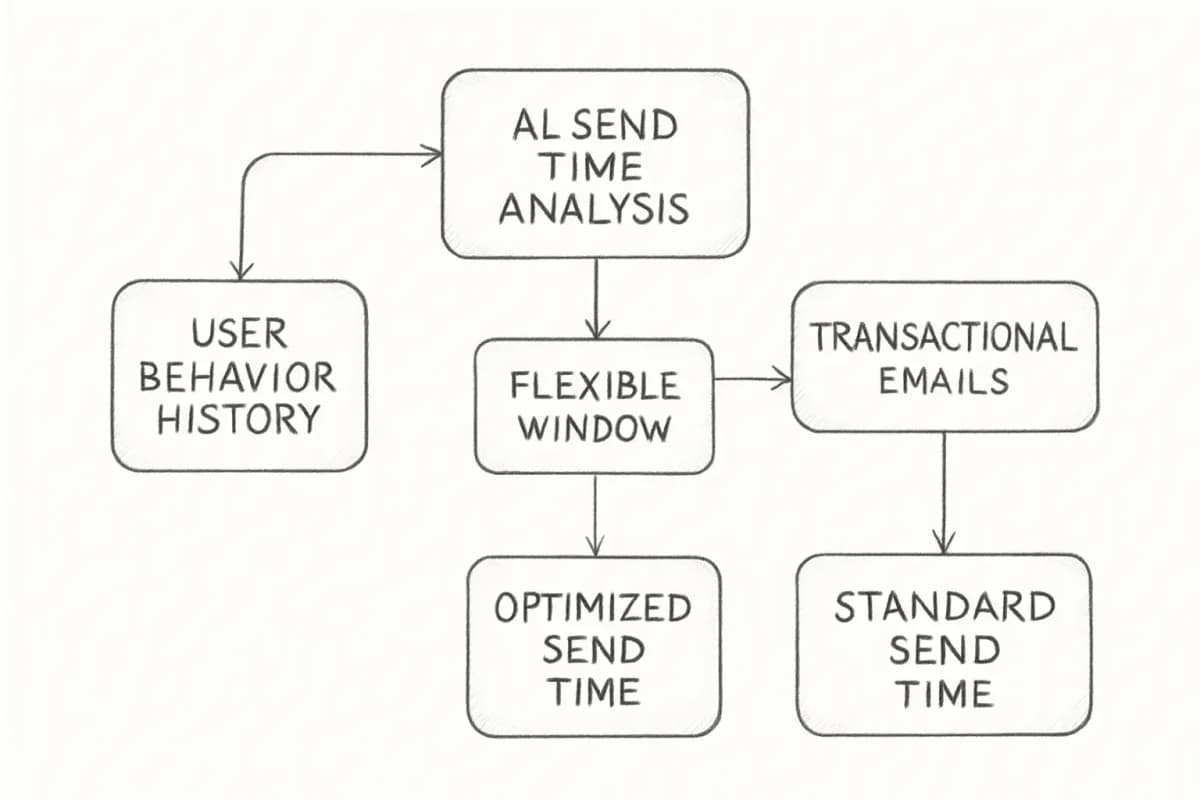
6. Run Continuous A/B Tests with a Clear Testing Hierarchy
A/B testing is common. Systematic, continuous A/B testing with documented learnings is rare, and the difference in compounding value over 12 months is significant.
Across benchmarks from Mailchimp, Klaviyo, and HubSpot, brands using AI-powered subject line optimization see open rate improvements of 35 to 95% compared to untested subject lines.
Build a testing hierarchy that starts with the highest-impact variables:
- Subject line: The most impactful variable for open rates. Test length, tone, personalization, and question versus statement formats.
- Preview text: Optimizing subject line and preheader together lifts opens 30% more than optimizing the subject line alone.
- Send time and day: Combine with predictive optimization once you have baseline data.
- CTA copy and placement: Test button text, color, and position separately across campaigns.
- Email length and layout: Long-form narrative versus short, punchy single-CTA emails perform differently across segments.
AI can automate the A/B testing process by continuously testing and optimizing email campaigns in real time, and it can handle complex multivariate testing where multiple elements within an email are simultaneously tested.
One discipline matters more than any specific test: document every result, apply learnings to future sends, and never run a campaign without testing at least one element.
7. Measure What Actually Drives Revenue
Tracking open rates alone is a vanity exercise. More than 55% of global email opens come from Apple devices using Mail Privacy Protection (MPP), which makes it harder for marketers to track user behavior accurately.
The metrics worth prioritizing:
- Revenue per email (RPE): Total revenue from a campaign divided by number of emails delivered.
- Click-to-conversion rate: Measures the percentage of clickers who complete a purchase or target action.
- List health rate: Tracks deliverability, unsubscribes, and engagement trends over time to catch problems early.
- Automation attribution: What percentage of total email revenue comes from automated flows versus broadcast campaigns.
Omnisend's 2025 data shows that automated emails reached a 38% open rate and generated $2.87 per email compared to $0.18 for broadcast campaigns, meaning attribution analysis will almost always reveal that your automated flows are dramatically under-resourced.
For a structured approach to measurement, see Email Marketing Analytics Best Practices.
Frequently Asked Questions
What makes email marketing techniques "advanced" compared to basic approaches?
Advanced email marketing techniques move beyond batch-and-blast broadcasting toward behavior-driven, data-personalized, and continuously optimized systems. The core differences are: using behavioral triggers instead of fixed schedules, personalizing content at the individual or micro-segment level rather than the list level, treating deliverability as a technical infrastructure requirement, and measuring revenue-based metrics instead of vanity metrics like raw open rates.
How much does email segmentation actually improve ROI?
Segmented campaigns achieve 14% higher open rates and 28% better click rates compared to generic sends, and advanced segmentation combined with personalization can boost revenue by up to 760%. The actual lift you see depends on how granular your segmentation is and whether your content is genuinely tailored to each segment, not just sent to a smaller slice of the same list.
Is email authentication required even for small senders?
Microsoft suggests that all senders use SPF, DKIM, and DMARC to help reduce spam and spoofing, not just those above the 5,000-per-day threshold. Even if you are below the volume triggers, operating without authentication damages your sender reputation over time and makes your emails increasingly likely to be filtered. Setting up all three protocols is a one-time technical task with permanent deliverability benefits.
What is a realistic benchmark for automated email flow performance?
Automated emails account for just 2% of sends but drive 30% of revenue, earning 16 times more per send than scheduled campaigns. For specific flows: back-in-stock emails deliver the highest conversion rate at 6.46%, while birthday messages produce an average order value more than four times higher than average. If your automated flows are not significantly outperforming your broadcast campaigns, the flows need deeper personalization or tighter trigger logic, not simply more volume.