
AI in email marketing automation has moved from experiment to standard practice. 63% of marketers now employ AI tools in their email marketing efforts, and the results are measurable: businesses that have integrated AI into their email marketing strategies have seen a 41% increase in click-through rates and a 20% rise in conversion rates. If you are trying to improve the ROI, deliverability, and efficiency of your email program, understanding how AI fits into each layer of your automation stack is not optional anymore. This guide covers exactly that.
Key Takeaways
- Automation drives 320% more revenue than manual campaigns, despite automated emails representing just 2% of total send volume.
- AI-generated subject lines outperform human-written ones by 26% on open rates, and when combined with send-time optimization, the lift compounds further.
- AI can save marketers up to 30% of their time by automating email design, content creation, and scheduling.
- Segmented email campaigns generate 760% more revenue than non-segmented broadcasts, and AI makes precise segmentation scalable for any list size.
- 70% of email marketers say that up to half of their email marketing operations will be AI-driven by the end of 2026.
What AI in Email Marketing Automation Actually Means
AI in email marketing automation is not a single feature. It is a layer of intelligence that runs across your entire email workflow, from deciding who receives a message to what it says, when it arrives, and what happens next based on how the recipient responds.
Instead of static rules and manual work, AI uses machine learning to figure out the right message for each person and when to send it, analyzing individual behavior patterns, predicting optimal engagement times, and automatically adjusting campaigns based on real-time performance data.
Three core technologies drive most of the AI capabilities you will encounter in modern email platforms:
- Natural language processing (NLP): Understands and generates email copy, adapts tone for different audience segments, and powers subject line optimization.
- Predictive analytics: Forecasts optimal send times, subject line performance, and content variations before campaigns launch.
- Machine learning: Identifies behavioral patterns at scale, enabling systems to improve with every send without requiring manual reconfiguration.
In 2025, there was a 340% increase in marketers using generative AI for tasks like copy and image generation, personalization, analyzing campaign performance, and A/B testing. The adoption curve is steep, and the gap between teams using AI effectively and those still relying on manual processes is widening.
5 Core Applications of AI in Email Automation
1. Predictive Send-Time Optimization
One of the clearest wins from AI is removing the guesswork from send timing. Instead of broadcasting at a fixed time because a blog post said so, AI models calculate the optimal delivery window for each individual subscriber by ingesting open timestamps, device usage patterns, and timezone data to select the moment engagement probability peaks. For a 10,000-contact list, this means 10,000 different delivery times, each calibrated to one person's behavior.
Most predictive send-time optimization capabilities are built directly into modern email platforms. Once enabled, the system analyzes engagement data in the background and schedules each email within a defined delivery window.
2. AI-Powered Segmentation
Manual segmentation relies on explicit attributes: location, purchase tier, or signup date. That is a starting point, not a strategy.
AI segmentation adds a predictive layer by clustering contacts based on behavioral similarity and projected intent. Common predictive segments include: likely to purchase within 14 days, at risk of churning, high engagement but no conversion, and reactivation candidates.
This behavioral depth is what separates AI segmentation from rule-based lists. Pair this with the right content strategy and the results are significant. For a deeper look at how segmentation structure drives revenue, see our guide on email list segmentation strategies that boost ROI by 760%.
3. Dynamic Content Personalization
Personalized subject lines drive 26% higher open rates, and 36% of consumers specifically cite personalized content as the reason they open a marketing email.
AI makes personalization scalable. Instead of needing to write 10 versions of an email for 10 different audiences, a marketer can write one version, then use AI to tailor a version of it for each audience or add in dynamic content.
Mailchimp's data shows that personalized product recommendation blocks increase sales conversions by 30% and click-through rates by 35%. These gains come from AI analyzing browsing history, purchase patterns, and engagement signals to surface the right product at the right moment.
For tactical implementation ideas, the 7 email personalization techniques that boost conversions 47% article covers the mechanics in detail.
4. AI-Driven Behavioral Triggers
Traditional behavioral triggers fire on a single action. Someone views a product page; they get an email. AI-powered triggers work differently.
Traditional behavioral triggers fire based on single actions, while AI behavioral triggers consider the entire customer journey, analyzing sequences of actions to determine intent and urgency. A visitor who views a product three times, compares prices, and reads reviews shows different intent than someone who quickly browses and leaves. AI adjusts the trigger timing, message tone, and content accordingly, increasing conversion rates by 156% compared to basic triggers.
5. Subject Line Generation and Testing
Generative AI tools, whether built into email platforms or used as standalone tools like Phrasee, Persado, or custom implementations, can produce multiple email copy variants, subject lines, preview text, and CTAs from simple briefs in seconds.
The speed advantage is real. A human copywriter might test three to five subject line variations. AI can generate dozens and use historical performance data to predict which will perform best before a single send goes out. eBay deployed Phrasee's AI-powered subject line system and saw a 15.8% lift in open rates and a 31% increase in clicks.
For foundational subject line principles that complement AI optimization, the email subject line best practices that boost open rates by 27% guide is worth reviewing alongside any AI tooling you use.
The ROI Case for AI Email Automation
The business case for AI in email marketing automation is grounded in consistent, cross-platform data.
Email marketing delivers an average return of $36 to $42 per dollar spent in 2026, outperforming paid search ($2), social advertising ($2.80), and display ads ($1.35). AI amplifies that baseline. Businesses using AI in email campaigns report an average ROI increase of 21%.
The automation efficiency numbers are equally compelling. Automated emails drove 37% of all ecommerce email revenue in 2024 despite representing just 2% of email volume. That is the leverage effect of well-configured automation: a small share of total send volume generating a disproportionate share of total revenue.
According to McKinsey, companies that invest in AI are seeing a revenue uplift of 3 to 15% and a sales ROI uplift of 10 to 20%. For growth teams trying to do more with constrained budgets, these are not marginal gains. 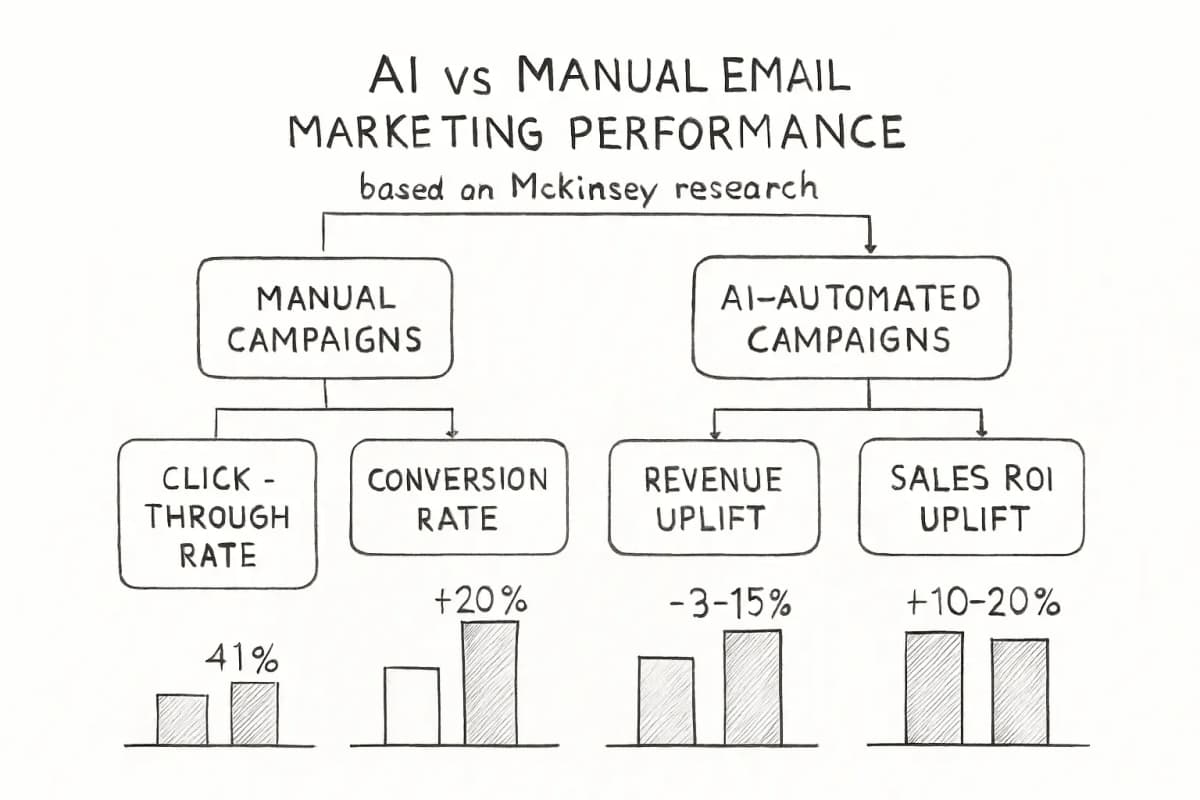
How AI Improves Email Deliverability
Deliverability is where many teams lose revenue without realizing it. Average email deliverability in 2024 was tested at around 83%, which means roughly 17% of emails never reached their intended destination.
AI addresses this at multiple layers:
- Engagement-based reputation management: Properly implemented AI improves deliverability by increasing engagement rates, since higher opens and clicks signal positive reputation to inbox providers, and reducing spam complaints because more relevant content means fewer reports.
- Spam risk detection: AI checks spam risk by analyzing structure, links, and content, ensuring your email program stays compliant. It also validates email lists, filtering out invalid addresses to protect sender reputation.
- Churn prediction to protect list health: AI churn prediction analyzes engagement patterns to identify subscribers at risk of becoming inactive before they actually disengage, looking for subtle changes in behavior like decreased open rates, longer time between clicks, or reduced website visits. Early warning signs appear 30 to 45 days before traditional churn indicators.
Deliverability is equally important to content and targeting, and it is increasingly AI-driven. AI systems monitor bounce patterns, ISP feedback loops, spam complaint rates, and engagement signals to protect sender reputation.
Challenges and Risks to Plan For
AI in email marketing automation is not plug-and-play. Teams that treat it as a set-and-forget system tend to see disappointing results. There are three categories of risk worth planning around:
Data and privacy compliance. Using AI in email marketing means handling sensitive customer data, which is a major risk if GDPR, CCPA, or CAN-SPAM compliance is not in place. Brands using AI email marketing tools must ensure data is secured, user consent is clear, and privacy is respected at every level. In 2026, the EU's AI Act is in force, and the U.S. is rolling out similar regulations at both national and state levels. These laws require email marketers to disclose their AI practices and obtain clear consent from subscribers.
Brand voice and content consistency. AI-generated content might not maintain brand voice consistency or could produce inappropriate messaging for sensitive situations. The solution is to establish clear brand guidelines for AI content generation, implement content approval workflows for sensitive campaigns, and regularly audit AI-generated content quality.
Integration complexity. Not every AI tool for email marketing works seamlessly with your CRM, email API, or legacy platforms. Integration gaps can limit automation, delay personalization, or result in fragmented workflows. Audit your martech stack before committing to any AI platform.
AI can uncover patterns and identify topics, but it cannot always tell you why something worked; marketers must still bring strategic interpretation. This balance between AI-powered email marketing and human reasoning is key to turning analytics into real action.
How to Implement AI in Your Email Automation Stack
Getting started does not require replacing your current platform or rebuilding your entire program. A staged approach works better for most teams.
- Audit your data first. AI performs only as well as the data feeding it. Clean your list, confirm CRM integrations are passing behavioral data accurately, and identify gaps in your tracking setup before activating any AI features.
- Start with send-time optimization and subject line testing. These are low-risk, high-impact starting points that do not require major workflow changes and show results within a few weeks.
- Layer in predictive segmentation. Once your data foundation is solid, activate behavioral segmentation to move beyond demographic or list-based groupings.
- Build AI-triggered lifecycle flows. Welcome sequences, cart abandonment, win-back flows, and post-purchase sequences are where AI-driven triggers generate the most disproportionate revenue.
- Measure by revenue, not vanity metrics. Metrics like revenue per email, conversions, and customer engagement offer a much clearer picture of your campaigns' performance than open rates alone, especially as Apple Mail Privacy Protection continues to inflate raw open numbers.
For a full walkthrough of connecting AI tools to your CRM for lifecycle automation, see the email marketing automation CRM setup guide.
95% of marketers who use AI or automation are more likely to say that their marketing strategy was effective. But effectiveness requires structure. The teams getting the most from AI have built it on top of a clear strategy, not instead of one.
What to Expect From AI Email Marketing in 2026 and Beyond
Gartner predicts that by 2025, 75% of organizations using AI across their marketing functions will shift the majority of their operational activities from human to machine capabilities. That shift is visible in the production data: in 2024, 62% of teams said they needed two weeks or more to produce a single email. In 2025, that dropped to only 6%.
The next wave of AI capabilities will push further into predictive territory. Predictive analytics, powered by AI, will allow marketers to anticipate customer needs before they are even expressed, creating opportunities for proactive engagement. Platforms are already experimenting with emotion-aware content, cross-channel behavioral signals, and autonomous campaign optimization that adjusts creative and targeting mid-flight without human input.
AI is not going to replace your marketing team. It is going to make your marketing team significantly more productive and your campaigns significantly more precise. The teams positioned to win are those treating AI as an execution layer on top of a well-defined strategy, not as a shortcut around needing one.
Frequently Asked Questions
What is AI in email marketing automation?
AI in email marketing automation refers to the use of machine learning, natural language processing, and predictive analytics to automate and optimize email campaigns. By analyzing customer behavior, automating content creation, and optimizing send times, AI helps marketers achieve higher engagement and conversion rates without proportionally increasing headcount or manual effort. Common applications include send-time optimization, predictive segmentation, dynamic content personalization, and AI-generated subject lines.
Does AI actually improve email ROI?
Yes, and the data is consistent across sources. Businesses using AI in email campaigns report an average ROI increase of 21%. At the automation level, automated emails drove 37% of all ecommerce email revenue in 2024 despite representing just 2% of email volume. The ROI lift comes from better targeting, more relevant content, and reduced manual production costs.
What are the biggest risks of using AI in email marketing?
The three primary risks are data privacy compliance (particularly under GDPR and CCPA), brand voice inconsistency in AI-generated content, and integration complexity with existing CRM or marketing platforms. There is also a risk of over-personalization, where customers might feel their privacy is being invaded if the personalization is too precise. Balancing relevance with respect for customer privacy is essential.
How should a small business start with AI email marketing?
Start small, optimizing subject lines or send times first, then scale AI across your email marketing strategy. Ensure clean data and privacy compliance to get the most value from your AI-powered email marketing tools. Most modern email platforms, including Mailchimp, ActiveCampaign, and Klaviyo, have AI features available at non-enterprise pricing tiers, which means you do not need a large budget to begin seeing results.
How does AI affect email deliverability?
Properly implemented AI improves deliverability by increasing engagement rates and reducing spam complaints through more relevant content. However, poorly configured AI that over-sends can harm reputation. Always pair AI automation with frequency caps, suppression rules, and regular list hygiene to protect your sender score.