
Amazon email marketing covers two distinct tracks: using Amazon Simple Email Service (SES) as a sending infrastructure for your own campaigns, and understanding what Amazon marketplace sellers can (and cannot) do when contacting buyers. Both tracks matter depending on who you are and what you're trying to accomplish.
Email marketing generates between $36 and $40 for every dollar spent, producing a return on investment of 3,600% to 4,000%, which outperforms most other marketing channels. If you're building or scaling an email program, the infrastructure you choose directly determines your costs, deliverability, and long-term results. Amazon offers tools on both ends of that equation.
Key Takeaways
- Amazon SES is a cloud-based email service provider that can integrate into any application for high-volume email automation.
- AWS SES uses a pay-as-you-go model at $0.10 per 1,000 emails, making it one of the most cost-efficient options at scale.
- Virtual Deliverability Manager is an Amazon SES feature that helps enhance email deliverability by providing insights into sending and delivery data and giving advice on how to fix issues affecting your delivery success rate and reputation.
- Fully authenticated domains (SPF+DKIM+DMARC) achieve 2.7x higher likelihood of inbox placement compared to unauthenticated emails.
- Amazon marketplace sellers face strict messaging rules: Buyer-Seller Messaging allows sellers to contact buyers to complete orders or respond to customer service questions, but the tool cannot be used for marketing and promotional purposes.
What Is Amazon Email Marketing?
The term "Amazon email marketing" refers to two separate things that are easy to conflate:
- AWS email marketing via Amazon SES: a developer-grade sending infrastructure used by businesses of any type to send high-volume campaigns, newsletters, and transactional emails.
- Amazon marketplace email: the limited, rules-governed messaging sellers can send to buyers through Seller Central's Buyer-Seller Messaging system.
Amazon email marketing services offer two distinct solutions: Amazon Simple Email Service (SES), a cloud-based infrastructure for high-volume sending, and the built-in Customer Engagement tools for Amazon marketplace sellers. Understanding the difference is foundational before building any strategy around either.
Amazon SES: What It Is and Who It's For
Amazon SES is a cloud-based email service provider that integrates into any application for high-volume email automation, covering transactional emails, marketing emails, and newsletters, on a pay-only-for-what-you-use model.
Amazon SES transacts more than a trillion emails each year for customers like Netflix, Duolingo, and Amazon Retail. That scale reflects real infrastructure, not marketing copy.
SES supports a wide range of communication needs: transactional emails triggered by user actions such as order confirmations and password resets, and marketing emails including promotional campaigns, product updates, and re-engagement efforts. When paired with a marketing platform, it becomes a cost-effective engine for reaching large audiences.
Who it suits:
- Developers and technical teams already on AWS
- SaaS companies, e-commerce businesses, and startups sending high volumes
- Businesses with seasonal spikes that want predictable, volume-based billing
The trade-off is setup work. SES requires knowledge of DNS, APIs, and AWS IAM. If your team lacks technical bandwidth, a full-featured ESP such as Mailchimp or Brevo will require less configuration.
Amazon SES Pricing: What You Actually Pay
Pricing is one of the clearest advantages of AWS email marketing.
AWS SES uses a pay-as-you-go model without upfront fees. The cost is $0.10 per 1,000 emails once you have used the free tier.
Free tier customers receive up to 3,000 message charges free each month for the first 12 months after starting to use SES. Companies that host applications on Amazon EC2 get 62,000 free emails monthly.
Compared to alternatives:
- The basic SendGrid plan at $14.95 per month permits up to 40,000 emails, while AWS SES sends the same number for $4.00.
- AWS SES's dedicated IP costs $24.95 monthly, which beats SendGrid's $30.00 price tag.
For large senders, the savings compound fast. If you cross a threshold of 50 million to 100 million emails per month, rates drop to $0.02 for every 1,000 emails sent.
The platform includes SOC II compliance and resilient encryption through TLS and AES GCM, which matters for businesses in regulated industries.
The one cost caveat: SES does not offer features typically associated with full-featured email marketing platforms, such as leads management, advanced analytics, and sophisticated campaign automation tools. You will likely need a third-party platform layered on top for list management, segmentation, and visual campaign building.
Deliverability: The Real Measure of AWS Email Marketing Performance
Raw sending costs mean nothing if your emails land in spam. Amazon SES has historically delivered solid inbox placement, but email service providers experienced declines in 2025: Amazon SES declined 14.60 percentage points in inbox placement rates in key testing environments. That decline tracks with a broader deliverability crisis driven by weak authentication.
Only 18.2% of top 10 million domains have valid DMARC records, with merely 7.6% enforcing policies. Senders without proper authentication are increasingly filtered out.
Authentication: The Non-Negotiable Foundation
DMARC is an email authentication protocol that uses SPF and DKIM to detect email spoofing and phishing. In order to comply with DMARC, messages must be authenticated through either SPF or DKIM, but ideally, when both are used with DMARC, you ensure the highest level of protection possible.
In practical terms for Amazon SES:
- SPF authorizes SES to send on behalf of your domain via a DNS TXT record.
- DKIM adds a cryptographic signature that survives forwarding.
- DMARC defines what happens when a message fails, and generates reports on authentication results.
When you accurately configure SPF, DKIM, and DMARC for Amazon SES, you can safeguard your domain against phishing and spoofing attacks, boost email deliverability and enhance trust among recipients, and obtain visibility into who is sending emails on behalf of your domain.
Major mailbox providers mandated email authentication in 2024 and 2025: Google and Yahoo required SPF, DKIM, and DMARC for senders of 5,000 or more daily emails starting February 2024, and Microsoft required DMARC for high-volume senders starting May 2025. These are not optional guidelines.
Virtual Deliverability Manager: Amazon's Deliverability Tool
For teams that want more visibility without hiring a deliverability specialist, Amazon SES includes the Virtual Deliverability Manager (VDM).
Virtual Deliverability Manager is an Amazon SES feature that helps enhance email deliverability by providing insights into sending and delivery data, and by giving advice on how to fix the issues that are negatively affecting delivery success rate and reputation.
It has two core components:
- Dashboard: Provides insights into deliverability data at the account, ISP, sending identity, and configuration set levels. It helps you quickly see problematic areas and trends, catch possible problems before they become larger deliverability issues, and calculate ideal times and dates for better customer engagement and conversions.
- Advisor: Provides recommendations to improve email sending by flagging configuration issues that are negatively affecting deliverability and reputation. It recommends solutions for issues in the infrastructure of your sending domain, IP space, and authentication records such as missing or misconfigured SPF, DMARC, or DKIM records.
Virtual Deliverability Manager costs $0.07 for each 1,000 email messages you send, in addition to other SES charges. Amazon launched a tiered pricing structure for VDM in 2025, giving customers reduced charges at higher levels of usage without requiring any change to account configuration or sending practices.
For teams building out a mature email marketing strategy template, enabling VDM from the start is the faster path to reliable inbox placement.
Amazon SES vs. Full-Featured ESPs
Amazon SES is not a direct competitor to Mailchimp or SendGrid at the product level. It operates below the marketing layer.
| Amazon SES | SendGrid | Mailchimp | |
|---|---|---|---|
| Best for | Developers, high-volume senders | Technical + marketing teams | Marketers, SMBs |
| Pricing model | Pay-per-email | Tiered plans | Contact-based tiers |
| Campaign builder | None (API/SMTP only) | Yes | Yes |
| Built-in analytics | Basic + VDM | Full dashboard | Full dashboard |
| Setup complexity | High | Medium | Low |
SES is a simple email service that does not offer options to manage email campaigns, templates, or engagement reporting via UI. Its UI is not very marketer-friendly, which is why many companies use it for sending marketing emails on the backend while managing day-to-day operations in a dedicated platform.
The common pattern among high-volume senders: use SES as the sending engine, and connect it to a front-end platform such as BigMailer, MailBluster, or a custom-built dashboard for list management, segmentation, and reporting. This gives you SES's cost efficiency with the usability of a proper marketing tool.
Effective email list segmentation strategies and email personalization techniques require solid list management capabilities. Pairing SES with a capable front-end platform is what makes those strategies executable.
Amazon Marketplace Email: What Sellers Can and Cannot Do
For sellers on the Amazon marketplace, "email marketing" operates under a completely different set of constraints. You cannot run standard promotional campaigns to your buyers through Seller Central.
Buyer-Seller Messaging allows you to contact buyers to complete orders or respond to customer service questions, but the tool should not be used for marketing and promotional purposes.
Proactive Permitted Messages can be sent via email using Amazon's templates or via the Buyer-Seller Messaging API for the following reasons: resolving an issue with order fulfillment, requesting additional information needed to complete an order, asking a return-related question, sending an invoice, requesting a product review or seller feedback, or scheduling delivery of a heavy item.
Proactive Permitted Messages must be sent within 30 days of order completion.
Amazon uses AI to scan every buyer-seller message, blocking persuasive language, external links, emojis, and incentives. Even small touches like "we're a family business" or "please leave 5 stars" can trigger blocked messages or account risk.
The practical takeaway: Amazon marketplace sellers should build their owned email marketing list outside of Amazon, through their own website, lead magnets, and direct channels. Attempting to use Buyer-Seller Messaging for promotional outreach is a policy violation with real consequences, up to and including selling privilege suspension. 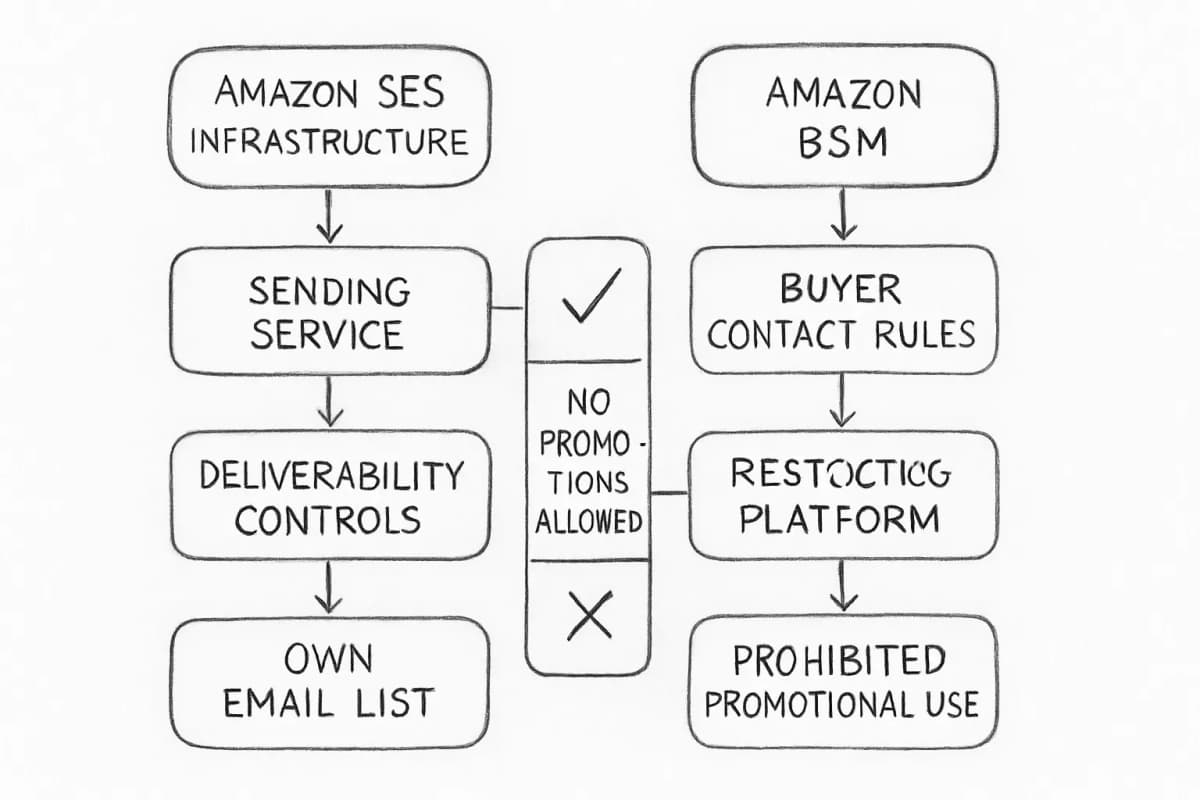
Building an Email Strategy Around Amazon Tools
Whether you use SES as your sending backbone or you sell on the Amazon marketplace, the core email marketing fundamentals remain the same.
Automated emails deliver outsized results: they account for just 2% of email sends but drive 30% of revenue, earning 16 times more per send than scheduled campaigns. The infrastructure you choose should support that automation capability.
Key steps for teams using AWS email marketing:
- Verify your domain in the SES console and configure Easy DKIM before sending a single email.
- Set up DMARC with at minimum a
p=nonepolicy to begin collecting authentication reports, then move toward enforcement. - Enable Virtual Deliverability Manager to get early warnings on reputation issues.
- Choose a front-end platform (BigMailer, MailBluster, or similar) if your team lacks engineering resources for custom list management.
- Warm up new IPs or domains gradually. New domains have no reputation history, and mailbox providers evaluate behavior over time before trusting you.
- Monitor bounce and complaint rates continuously. High bounce rates damage your sender score and can trigger account limits in SES.
Combining strong email subject line practices with a well-configured SES backend is where strategy and infrastructure intersect.
Frequently Asked Questions
What is Amazon SES used for in email marketing?
Amazon SES is used to create and send targeted marketing campaigns, newsletters, promotional offers, and engaging content to customers globally. It also delivers messages, including transactional and promotional, by configuring SES within your business's applications. It functions as infrastructure rather than a campaign management tool, so most teams pair it with a dedicated marketing platform.
Is Amazon SES a good choice for small businesses?
Since most ESPs are priced based on list size with monthly sending limits, using Amazon SES is more cost-effective for infrequent senders and high-volume campaigns. However, it requires technical setup and is less suitable for teams without a developer. Small businesses without AWS experience may find a full-featured ESP faster to deploy.
Can Amazon sellers send promotional emails to their customers?
No. Standalone "thank you" messages for customer purchases and any incentivizing language are not permitted. Marketing or promotional content is prohibited through Amazon's Buyer-Seller Messaging system. Sellers who want to run promotional email campaigns must build an independent email list and send through their own channels, completely separate from Amazon's platform.
How does authentication affect Amazon SES deliverability?
DKIM, SPF, and DMARC confirm that you are authorized to send, but they do not tell mailbox providers whether users want your emails. When you start sending from a new domain in Amazon SES, that domain has no reputation history, and mailbox providers evaluate behavioral signals before deciding placement. Authentication is the foundation, but clean lists, strong engagement, and gradual sending volume growth are what sustain deliverability over time.