
AI is no longer a speculative upgrade for email marketing. It is now the primary driver separating teams with flat engagement from those compounding revenue quarter over quarter. Businesses that have integrated AI into their email marketing strategies have seen a 41% increase in click-through rates and a 20% rise in conversion rates. If your team still sends the same message to your entire list on a fixed schedule, you are competing at a structural disadvantage.
This post covers the specific, measurable benefits of AI in email marketing, with data to back each one.
Key Takeaways
- AI-driven email marketing leads to a 13% increase in click-through rates and a 41% rise in revenue.
- Marketers implementing AI report saving up to 30% of their total working time, with some companies reducing newsletter production time by 90%.
- Organizations using AI to generate and optimize subject lines see a 26% increase in open rates compared to manually written alternatives.
- Automated emails produce 320% more revenue than non-automated messages.
- According to McKinsey, AI-driven marketing strategies can lead to a 20 to 30% increase in marketing ROI.
What "AI in Email Marketing" Actually Means
Before getting into the benefits of AI in email marketing, it helps to be precise about what AI is doing in this context. AI in email marketing refers to the use of machine learning models, predictive analytics, and generative AI systems to automate decisions and personalize content at an individual subscriber level, in real time. Predictive AI uses historical data, including past purchases, browsing behavior, and email engagement, to forecast future behavior.
Generative AI creates content, drafting subject lines, preview text, body copy, and product descriptions from prompts, and producing dozens of subject line variants for A/B testing in the time it would traditionally take a copywriter to write three.
The meaningful shift in 2025 and 2026 is that these two types are increasingly working together inside email platforms. The result is a system that writes, segments, times, and optimizes without constant manual input.
1. Higher Revenue Per Send Through Smarter Personalization
Personalization is the single highest-leverage application of AI in email. The data is clear and consistent across multiple studies.
Marketers using AI for email personalization see 41% revenue increases and 13.44% CTR improvements. That is not a marginal gain. On a list of 100,000 subscribers, a 13% CTR lift translates directly into thousands of additional clicks and a measurable lift in pipeline.
AI-powered email programs generate 41% more revenue than manual campaigns according to Salesforce benchmarks, and teams implementing the full AI stack see 3.2x higher revenue per recipient.
The mechanism is worth understanding. Personalized emails convert better because they reduce the cognitive load on the recipient. Instead of scanning a generic newsletter to find something relevant, the subscriber sees content that matches their interests, purchase history, and stage in the customer journey.
Brands using AI-driven personalization report up to 42% higher revenue, with click-through rates exceeding 13%.
For a deeper look at how personalization techniques actually work in practice, see our guide to 7 Email Personalization Techniques That Boost Conversions 47%.
2. Smarter Segmentation That Compounds Over Time
AI changes what segmentation means. Traditional segmentation puts subscribers into static buckets. AI-driven segmentation is dynamic, with models continuously scoring each subscriber on behavioral signals including conversion likelihood, predicted lifetime value, purchase frequency, content preference, and churn probability, and updating those scores as new data arrives.
The revenue impact of this shift is significant. Segmented email campaigns generate 760% more revenue than non-segmented broadcasts, and the most effective segmentation combines behavioral data with AI-predicted intent scores.
Hyper-segmented campaigns targeting micro-audiences of 500 to 2,000 contacts outperform broad segments by 3.4x on conversion rate.
This is the difference between knowing that someone bought a product once and knowing that they are "likely to repurchase in the next 14 days, based on their engagement velocity and category browsing behavior." The first produces a general promotional send. The second produces a precisely timed recommendation that arrives when the subscriber is already primed to buy.
Explore specific strategies in our full breakdown of Email List Segmentation Strategies That Boost ROI by 760%.
3. AI-Optimized Subject Lines That Win the Inbox
The subject line determines whether the rest of your email exists. Before your carefully crafted copy, your perfectly designed template, or your meticulously segmented offer ever reaches a human eye, one thing determines whether it gets opened or ignored: the subject line. In 2026, with the average professional receiving 121 emails per day, subject line optimization is the highest-leverage activity in your entire email marketing operation.
AI changes this from guesswork to a data-powered process:
- Organizations using AI to generate and optimize subject lines see a 26% increase in open rates compared to manually written alternatives.
- The advantage compounds with dynamic send-time optimization, which adds another 14% lift when combined with AI subject lines.
- Brands using AI-powered subject line optimization see open rate improvements of 35 to 95% compared to untested subject lines.
AI can generate hundreds of diverse subject line variations in seconds, allowing for rapid A/B testing and quick optimization of campaign elements. A human copywriter testing two variants on a monthly send cannot compete with a system evaluating tone, word choice, length, and personalization tokens simultaneously at scale.
4. Send-Time Optimization That Reaches Each Subscriber at the Right Moment
Sending your entire list at 10am Tuesday is a batch-and-blast strategy, not a personalized one. Send-time optimization (STO) is one of the highest-leverage AI features in email marketing. Instead of sending your entire campaign at one time to everyone, STO delivers each email when each individual subscriber is most likely to engage. The result is a 15 to 25% improvement in meaningful engagement metrics.
AI-driven predictive analytics for send-time optimization drives up to 42% better open rates. By 2026, 75% of email marketing is projected to incorporate predictive analytics.
Modern STO systems have evolved beyond simple open-rate timing. Apple Mail Privacy Protection, adopted by roughly 50% of email recipients, pre-loads tracking pixels and breaks traditional open-rate-based timing models. Modern AI STO systems have evolved to analyze click behavior, conversion timing, and reply patterns instead of relying on open signals.
5. Dramatic Time Savings and Productivity Gains
One of the most consistent benefits of AI in email marketing is what it does to production time. The numbers span multiple independent studies, and they all point in the same direction.
According to Litmus' 2025 State of Email report, the share of teams taking two weeks or more to produce a single email dropped from 62% in 2024 to just 6% in 2025. This shift is largely credited to AI and automation adoption.
Across the broader marketing function:
- Time savings remain one of AI's most tangible benefits. 67% of marketing teams report saving 10 or more hours weekly, while 68% say AI has meaningfully increased their productivity. For content creators, this translates to roughly three hours saved per piece of content.
- 83% of marketers report increased productivity after adopting AI, with only 2% reporting decreased productivity.
- Nearly three-quarters of marketing professionals identify time savings as automation's primary benefit. The elimination of repetitive tasks allows marketers to focus on strategy, creative development, and optimization rather than campaign execution.
This productivity gain becomes especially critical for small teams managing complex, multi-touch customer journeys.
6. Automated Revenue Engines That Run Without Manual Campaigns
Automation is where the ROI case for AI in email marketing becomes almost impossible to ignore. Omnisend's 2025 data shows automated emails pulling 52% higher open rates than scheduled campaigns.
Automated emails drove 332% higher click rates and 2,361% better conversion rates compared to manual sends.
Automated emails accounted for just 2% of all sends but drove 30% of total email revenue in 2025. That asymmetry is the clearest business case for AI automation in email: a small share of send volume producing a disproportionate share of revenue.
The most valuable automated flows are consistent across industries:
- Welcome sequences
- Abandoned cart recovery
- Post-purchase follow-up
- Re-engagement campaigns
- Browse abandonment
The businesses seeing the highest returns from email in 2026 are not the ones with the largest lists or the most expensive platforms. They are the ones that have built systematic, behavior-driven automation that delivers the right message to the right person at the right moment.
7. Improved Deliverability Through Predictive Monitoring
Deliverability is where AI benefits are least discussed but potentially most impactful. Approximately one in six marketing emails never reaches the recipient's inbox, with average deliverability rates hovering around 83% across major email service providers. If your personalization and automation are built on emails that land in spam, the investment is partly wasted.
AI becomes relevant to deliverability because inbox providers already use predictive models. Instead of reacting after complaint rates spike or engagement declines, AI systems analyze patterns early and surface risks before filtering intensifies.
AI can proactively help by segmenting your audience and suppressing risky contacts. An AI might analyze engagement patterns and stop emailing those who haven't opened the last 10 emails. By culling the cold segment, you avoid potential spam complaints and improve your overall engagement rate, which in turn signals to ISPs that your emails are wanted.
AI tools analyze vast datasets to identify patterns and generate tailored subject line suggestions. They can also predict how likely content is to trigger spam filters and offer suggestions for improvement, increasing inbox deliverability.
8. Better ROI Measurement and Analytical Clarity
HubSpot research found the number one email marketing KPI that saw improvement after using AI was conversion rates at 37%, with click-through rates at 33% as number two, signaling that more recipients were taking action from AI-aided emails.
AI also shifts which metrics teams prioritize. With Apple Mail Privacy Protection affecting 50% of email recipients, open rates are increasingly unreliable. Revenue per recipient, click-through rate, and conversion rate per send are the metrics that actually correlate with business outcomes.
AI is already automating 40% of routine email marketing tasks, and the most telling contrast is that AI-driven automation can cut churn by 25% while also reducing unsubscribes by 18% and improving conversion rates by 19%.
For teams tracking the right signals, AI makes the performance picture sharper and more actionable. Our post on Email Marketing Analytics Best Practices covers which metrics to prioritize in the AI era.
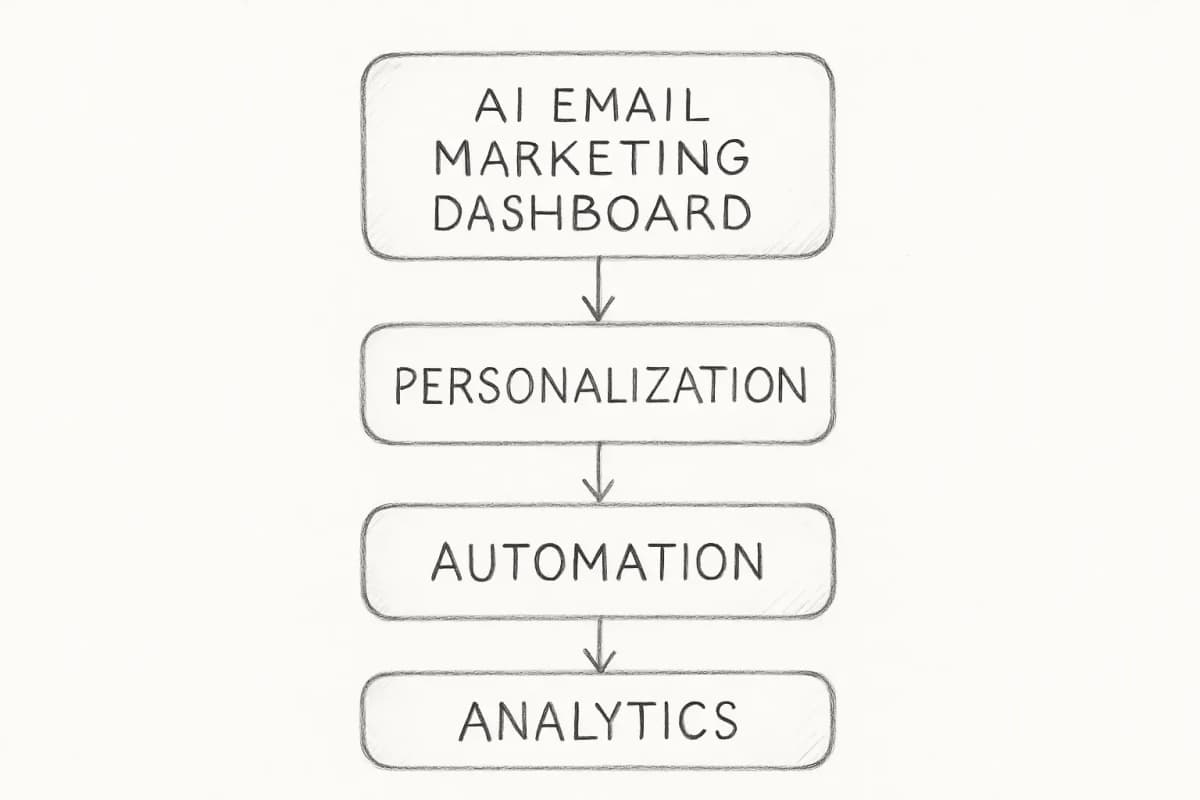
The ROI Case in Plain Numbers
To summarize what the data shows across all benefits of AI in email marketing:
- Email marketing delivers an average return of $36 to $42 per dollar spent in 2026, outperforming paid search ($2), social advertising ($2.80), and display ads ($1.35).
- The gap is widening as AI personalization lifts per-send revenue by 17 to 26%.
- Businesses using AI in email campaigns report an average ROI increase of 21%.
- According to McKinsey, companies that invest in AI are seeing a revenue uplift of 3 to 15% and a sales ROI uplift of 10 to 20%.
The channel was already the highest ROI channel in digital marketing before AI. The addition of predictive personalization, automated segmentation, and generative content has extended that lead further.
For teams looking to act on this, our AI Email Marketing Personalization Techniques guide covers implementation specifics, and Successful AI-Driven Email Marketing Examples shows how real programs are applying these capabilities.
Frequently Asked Questions
What are the main benefits of AI in email marketing?
Key benefits include better personalization, time-saving automation, campaign optimization, predictive analytics, churn reduction, and improved deliverability. In measurable terms, AI consistently lifts revenue per send, reduces production time, and improves deliverability by identifying and suppressing disengaged contacts before they damage sender reputation.
How much does AI improve email marketing ROI?
McKinsey reports that AI-driven marketing strategies can lead to a 20 to 30% increase in marketing ROI, while AI can help reduce customer acquisition costs by up to 50%. At the campaign level, businesses using AI in email campaigns report an average ROI increase of 21%.
Does AI improve email open rates?
Yes, through two main mechanisms. Organizations using AI to generate and optimize subject lines see a 26% increase in open rates, and the advantage compounds with dynamic send-time optimization, which adds another 14% lift when combined with AI subject lines. Together, these represent a compounding advantage over static, manually managed campaigns.
Is AI in email marketing only for large businesses?
No. AI capabilities in email platforms have matured significantly in 2025 and 2026. Features like send-time optimization, predictive content selection, and behavioral scoring that were once enterprise-only are now available on mid-market platforms starting at $29 per month. The barrier to entry for sophisticated automation has never been lower.