
AI-powered email marketing is no longer a competitive edge reserved for enterprise brands with large data science teams. It is now a core operating strategy, and the results separating AI-driven campaigns from manual ones are significant enough that ignoring them is a genuine business risk.
Email marketing programs that adopted AI in 2025 and early 2026 reported revenue increases averaging 41% compared to non-AI programs in the same sector. That number has a clear mechanism behind it: predictive AI answers the operational questions (when to send, to whom, at what frequency) while generative AI answers the creative questions (what subject line to test, how to personalize body copy, which call-to-action variant to try).
This post breaks down the most instructive successful AI-driven email marketing examples available, extracts the patterns behind the results, and shows you where to apply the same approaches in your own campaigns.
Key Takeaways
- AI-driven email marketing results in a 13% boost in click-through rates across campaigns.
- Farfetch's AI language optimization produced a 7.4% uplift in email opens and 25.1% lift in click rates for broadcast campaigns, and a 31.1% open rate lift in trigger and lifecycle campaigns.
- Lifestraw grew email's contribution to ecommerce revenue from 3% to 33% of total revenue in H1 2024, with a 69x platform ROI.
- BrewDog achieved a 13.8% revenue uplift through AI-powered email personalization, while On The Beach saw a 362% uplift in revenue per visitor from AI-personalized price drop campaigns.
- AI-optimized send times increase open rates by 15 to 25% versus fixed send schedules, according to Klaviyo platform benchmarks.
Why AI Makes Email Marketing More Effective
Before examining specific examples, it helps to understand what separates AI-driven email from traditional email. Traditional email campaigns tend to use manual segmentation, generic content, and predetermined send times, while AI-powered emails are highly personalized based on each recipient's preferences, behavior, and context.
According to a 2025 survey published by Tidio, 88% of marketers already use AI or marketing automation tools regularly, and generative AI adoption specifically grew 116% year-over-year between 2023 and 2024. This is no longer an experimental phase.
McKinsey estimates that applying generative AI in marketing could unlock 5 to 15% in productivity gains, worth $463 billion annually. The marketers winning with this technology are not simply using AI to write faster. They are deploying it inside structured systems that connect audience signals to content decisions automatically.
Example 1: Farfetch's AI Subject Line and Language Optimization
Farfetch, the global luxury fashion marketplace, provides one of the most documented successful AI-driven email marketing examples available. The brand partnered with Phrasee, an AI-powered tool, to optimize its email marketing content. Phrasee generated on-brand content by testing various styles, tones, and phrases to identify language that resonated best with Farfetch's audience.
The results across campaign types were measurable and consistent. Specific results from the Farfetch-Phrasee rollout include a 7.4% average uplift in email opens and 25.1% average uplift in click rates per campaign in broadcast campaigns. In trigger and lifecycle campaigns, the company saw a 31.1% average uplift in open rate and 37.9% average uplift in click rates across its abandoned browse, basket, and wish list campaigns.
Critically, every AI-generated output was reviewed to ensure it aligned with Farfetch's voice and messaging. This human review step is a consistent feature in campaigns that maintain brand integrity alongside performance. The workflow produced better numbers without training the brand to sound generic.
Example 2: Lifestraw's Revenue Transformation Through Automated Flows
Water filtration company Lifestraw transformed their email marketing performance by switching to Klaviyo from ActiveCampaign, increasing email's contribution to ecommerce revenue from just 3% to 33% of total revenue in H1 2024. Their Klaviyo ROI reached an impressive 69x in the first half of 2024, with automated flows becoming a cornerstone of their strategy.
The model here is replicable: a brand moves from a basic email setup to a platform with built-in AI capabilities, builds behavior-triggered automated flows, and measures the resulting revenue attribution. The scale of the improvement shows how much revenue a non-AI setup leaves on the table.
For teams looking to replicate this kind of result, email marketing automation best practices outlines how to structure flows from first touch through post-purchase retention.
Example 3: Saranoni's 35x ROI and AI-Optimized Sign-Up Forms
Luxury blanket maker Saranoni returned to Klaviyo after trying a lower-cost platform and found that Klaviyo's deliverability and automation capabilities were worth the investment. Within their first six months back, Saranoni achieved 35x platform ROI, with 36% of Klaviyo-attributed revenue coming from flows.
After consolidating their tech stack, they used Klaviyo AI to test and optimize email and SMS sign-up forms, coming up with 20 different variations on placement and timing across desktop and mobile pop-ups. Klaviyo AI generated all of this. In just 30 days after the winning versions went live, submissions for both forms jumped 65% from the month previous to testing.
This example illustrates that AI's impact on email marketing extends upstream from the email itself. Capturing more qualified subscribers at the list-growth stage multiplies the value of every campaign you send afterward.
Example 4: BrewDog and On The Beach Prove Personalization ROI
Two brand examples from Bloomreach demonstrate how AI-personalized email content drives measurable revenue outcomes across different industries.
BrewDog achieved a 13.8% uplift in revenue through AI-powered email personalization, tailoring campaigns based on each recipient's web activity, loyalty status, and previous purchases.
The online holiday package company On The Beach used AI to personalize its price drop email campaigns. AI monitors the price changes of each customer's customized travel package, with unique flights, hotels, dates, and more, and triggers personalized campaigns when price drops occur. This led to a 362% uplift in revenue per visitor.
The On The Beach result is particularly instructive. The AI is not generating copy; it is monitoring individual package prices and triggering personalized sends at the exact moment a price drops for that specific customer. This is an example of how AI-driven email works as a behavioral system rather than a broadcast channel. For ecommerce teams building similar trigger sequences, ecommerce email marketing strategies covers the mechanics in detail.
Example 5: Grammarly's Predictive Lead Scoring in Email Nurture
Grammarly used AI-powered lead scoring to convert free users to paid plans, achieving an 80% increase in account upgrades with the sales cycle cut by 50%. With over 30 million daily active users on their free tier, Grammarly's marketing team faced a classic problem: they were unable to identify which free users were genuinely ready to upgrade.
Grammarly's approach represents a different AI use case in email: not personalized content at the individual level, but smarter prioritization of who receives conversion-focused emails and when. The lead scoring model identifies behavioral signals that correlate with upgrade intent, then routes those users into targeted email sequences before they go cold.
The companies seeing 20 to 30% ROI lifts tend to be the ones investing in predictive capabilities, not just generative AI for content. Grammarly is a textbook case of that distinction paying off in revenue.
Example 6: ASOS and Sephora Apply AI Across the Customer Journey
Two retail brands illustrate how AI-driven email marketing works as part of a wider customer experience system.
ASOS utilized AI to personalize offers, urgency banners, and checkout messaging in real-time. As a result, the brand reduced cart abandonment by 18% and increased checkout conversion rates by 23%.
Sephora utilizes AI-powered personalization to send targeted reactivation emails that re-engage inactive customers and encourage repeat purchases. Sephora's approach to win-back emails is anchored in behavioral prediction: the AI identifies the point at which a customer's engagement trajectory signals likely lapse, then triggers retention-focused content before the relationship fully disengages.
Both examples show AI-driven email operating as part of a continuous lifecycle, not a series of stand-alone campaigns. Building campaigns this way requires thinking about email personalization techniques as infrastructure, not a feature.
The Shared Patterns Behind Every Successful Example
Looking across all these successful AI-driven email marketing examples, a consistent set of conditions appears:
- Structured workflows, not isolated AI experiments. Successful AI marketing case studies usually include structured source material, explicit brand voice rules, defined review gates, human oversight, and a measurable business outcome.
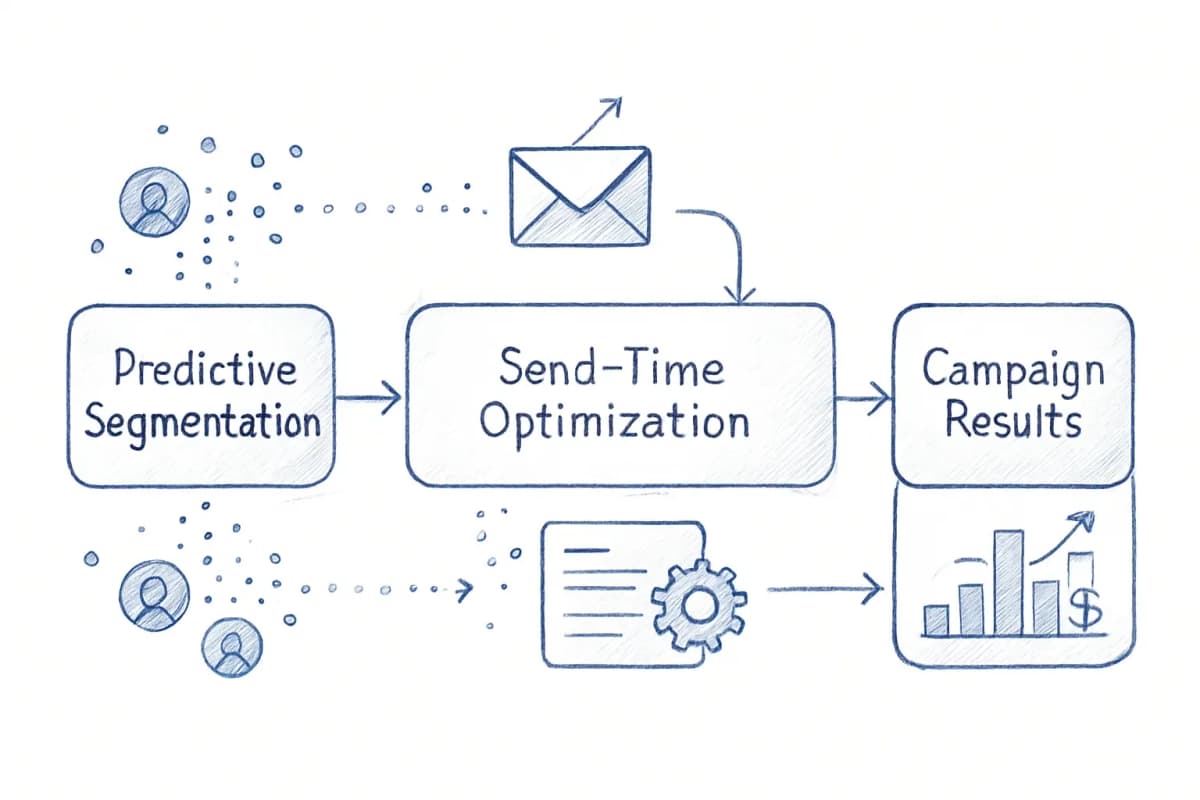
- Dynamic segmentation over static lists. One documented case showed 28% higher conversions compared to legacy segment performance, and Klaviyo's 2025 State of Email report found that brands using AI-driven segments saw revenue per recipient increase by 18 to 45% compared to traditional demographic segmentation.
- Send-time optimization as a baseline. Puma used AI-powered send-time optimization to deliver emails based on individual timing preferences and saw a 5 to 10% lift in open rates.
- Subject line testing at scale. Personalized AI-generated subject lines increase open rates by 26%, while AI optimization can boost opens by an additional 10%. Combining this with our guide on email subject line best practices gives you a complete optimization framework.
- Human review preserved. Every high-performing campaign in this list maintained human oversight of AI-generated content. The brands getting the strongest results with AI marketing are not necessarily the ones using the newest models. They are the ones building better systems around the tools they already have.
How to Apply These Lessons to Your Own Campaigns
You do not need to be Farfetch or Sephora to use AI-driven email effectively. The tactical starting points are accessible regardless of list size:
- Start with subject line optimization. This has the lowest switching cost and the fastest feedback loop. Tools like Phrasee, Persado, and native platform AI in Klaviyo or Mailchimp all provide this capability.
- Enable send-time optimization. Most major email platforms include this as a checkbox feature. Turn it on and let it run for at least four to six weeks before evaluating performance.
- Replace static segments with behavioral triggers. Move from "last 30-day openers" to signals like "browsed product category three times without purchasing" or "purchase frequency declining."
- Add predictive win-back sequences. Use churn probability scores to trigger re-engagement campaigns before a subscriber goes completely cold, not after. Assigning each subscriber a churn probability score based on declining engagement signals means high-risk subscribers trigger re-engagement sequences automatically.
- Connect AI outputs to a performance feedback loop. AI marketing ROI does not usually come from isolated content generation. It comes from improving the workflow around repeatable marketing work.
Frequently Asked Questions
What does AI actually do differently in email marketing?
Traditional email campaigns tend to use manual segmentation, generic content, and predetermined send times. AI-powered emails are highly personalized based on each recipient's preferences, behavior, and context. In practice, this means AI handles decisions like when to send, which subject line variant to test, which products to recommend, and which subscribers are likely to churn, at a scale and speed that manual processes cannot match.
Which brands have the best results with AI-driven email marketing?
Some of the strongest documented results include Lifestraw (69x platform ROI, email growing from 3% to 33% of revenue), Saranoni (35x ROI, 65% increase in form submissions), Farfetch (31.1% open rate lift in lifecycle campaigns), and On The Beach (362% revenue-per-visitor uplift from personalized price drop emails). These results share a common structure: behavioral data feeding automated, personalized workflows with human oversight of brand voice.
Do I need a large email list for AI email marketing to work?
No. AI's value is in relevance and timing, not volume. A smaller, well-segmented list with AI-optimized send times and personalized content will consistently outperform a large list receiving batch-and-blast campaigns. One documented case showed 28% higher conversions compared to legacy segment performance, with high-propensity customers identified by the AI model being five times more likely to buy than the rest of the list.
What is the biggest mistake teams make when implementing AI email marketing?
Teams that struggle with AI marketing usually treat AI as a speed tool without redesigning their review process. Generating more content faster is only valuable if the content is accurate, on-brand, and properly tested. The most successful implementations combine AI-generated output with clear brand voice guidelines, structured review gates, and a feedback loop that informs future campaigns based on measured performance.