
Email
Email

A modern blog built with Payload CMS, Next.js, and shadcn/ui.

RSS FeedSitemap

Explore

  • Blog
  • News
  • Statistics
  • Authors

Categories

  • Email Analytics & Reporting
  • Email Security and Compliance
  • Email Marketing Tools and Strategy
  • Email Automation Strategies
  • Email Database & List Building
  • Email Marketing Tools & Resources
  • Seasonal Email Marketing
  • Email Marketing Benchmarks

Latest articles

  • Email Promotion and Internet Marketing AutomationJul 19, 2026
  • Enterprise Marketing Automation Email: Strategy & SetupJul 19, 2026
  • AI and Machine Learning in Email MarketingJul 19, 2026
  • Best CRM with Email Marketing Automation 2025Jul 19, 2026

Popular topics

  • #Email Generation
  • #agency benchmarks
  • #email marketing content strategy
  • #Marketing Compliance
  • #AI Security
  • #Productivity Tools
  • #atlanta business
  • #Data-Driven Strategy
  • #Marketing Outsourcing
  • #Outsourced Email Marketing
  • #Sales Workflows
  • #automation software
  • #Back-to-School
  • #Email Software Comparison
  • #Email Branding
  • #Email Marketing Metrics

Stay in the loop

Join 2,000+ readers. Unsubscribe anytime.

Subscribe
Email

© 2026 Email. All rights reserved.

SitemapRSS
HomeBlogEmail Marketing ToolsBest AI Email Generator for Marketing Teams 2025
Email Marketing Tools

Best AI Email Generator for Marketing Teams 2025

Compare top AI email generators for marketing teams. Save time, boost open rates, and scale campaigns. Find the right tool for your strategy.

M

Marcus Webb

July 19, 2026

12 min read
Share:
#AI Email Marketing#Email Generation#marketing automation#Email Tools
Illustration for best ai email generator for marketing teams 2025

Stay in the loop

Get the latest posts delivered straight to your inbox. No spam, unsubscribe anytime.

Marketing teams are sitting on one of the most valuable channels available, and AI has made it significantly more powerful. In 2025, email remains one of the most powerful digital marketing channels, with nearly 4.6 billion global users and 375 billion emails sent per day. The issue is no longer whether email works. The issue is whether your team can produce and personalize campaigns fast enough to compete. That is where the best AI email generator for marketing teams in 2025 becomes a real operational advantage.

In 2023, 62% of marketing teams needed two or more weeks to produce a single email. By 2025, only 6% do. AI is the primary driver of that shift. But not every tool produces the same results. Choosing the right one depends on your team's workflow, existing stack, and campaign goals.

Key Takeaways

  • Nearly 63% of marketers now use AI tools in their email marketing efforts, and approximately 47% use AI specifically to generate their email campaigns.
  • AI-generated subject lines outperform human-written alternatives by 26% for open rates on average.
  • AI-driven email marketing leads to a 41% rise in revenue, proving the transformative effect on campaign performance.
  • Advanced AI adopters, those with AI woven through multiple workflow stages, are 75% more likely to achieve ROIs above 45:1.
  • The market now splits into three distinct tiers: platform AI (built into ESPs), specialist AI (standalone copy tools), and agentic AI (fully autonomous campaign execution).

Why AI Email Generation Has Gone Mainstream

49% of B2B marketers now use generative AI to create emails. This is no longer an early-adopter behavior. 95% of marketers who use generative AI for email content creation say it is effective.

The productivity argument is straightforward. Workers are approximately 33% more productive in each hour they use generative AI, and generative AI users save 5.4% of weekly work hours, approximately 2.2 hours per 40-hour week. For marketing teams juggling campaign calendars, copywriting, segmentation, and reporting simultaneously, those hours matter.

Email marketing already delivers a return of between $36 and $42 for every $1 spent, the highest ROI of any digital marketing channel. For context, paid search returns $2 per $1, social advertising $2.80, and display ads $1.35. AI amplifies that return by compressing the time between strategy and execution, and by lifting the quality of every send.

How the Market Now Splits: Three Tiers of AI Email Tools

Before picking a specific platform, it helps to understand what type of tool you need. The AI email marketing landscape in 2025 splits into three tiers. Platform AI (Mailchimp, HubSpot, ActiveCampaign, Klaviyo, Brevo, Omnisend) adds intelligence to traditional email marketing with better subject lines, smarter send times, and behavior-based automation. Specialist AI (Instantly, Jasper, Lavender) excels at one dimension, whether cold outreach volume, copywriting quality, or email coaching. Agent AI operates across the entire workflow, researching prospects, drafting personalized emails, connecting to LinkedIn and CRM, and requiring human approval before sending.

Most marketing teams need platform AI. Specialist AI tools serve as a complement when your ESP's built-in AI is not good enough for copywriting tasks.

The Best AI Email Generators for Marketing Teams in 2025

1. ActiveCampaign (Best for Full-Cycle Automation)

ActiveCampaign approaches AI email marketing as a full-cycle system rather than a set of disconnected features. Where most platforms add AI to individual steps, ActiveCampaign connects AI across the entire campaign lifecycle, from creation through segmentation, sending, and optimization.

In May 2025, ActiveCampaign introduced Active Intelligence, not just another AI feature, but a complete reimagining of how marketing automation works. Active Intelligence is a system-wide intelligence engine powered by billions of data points and dozens of specialized AI agents working together.

EmailToolTester's latest email deliverability tests scored ActiveCampaign with a 94.2% deliverability rate, in 1st place out of 15 tools tested. For teams where inbox placement directly affects revenue, this is a meaningful number.

Autonomous marketing transforms how you approach campaigns by eliminating step-by-step workflow building. Instead of manually configuring automations, you set strategic objectives through a conversational interface and AI agents take ownership of execution. These agents imagine campaign strategies, activate personalized interactions across email, SMS, and WhatsApp, and validate performance through continuous optimization.

Pricing: Plans start at $15/month for 1,000 contacts. A 14-day free trial is available.

Best for: Growth marketing teams, SaaS companies, and agencies that want CRM-driven AI across the entire campaign lifecycle.

2. Klaviyo (Best for Ecommerce Marketing Teams)

Klaviyo is an autonomous B2C CRM and AI marketing platform that unifies customer data and automates email, SMS, RCS, WhatsApp, and mobile push to drive personalized, revenue-generating campaigns. Built as both a system of record and system of action, Klaviyo combines a customer data platform, real-time signals, and AI agents to power automated insights and one-click execution.

Starting with a simple prompt, idea, or goal, Klaviyo's Composer uses your brand guidelines, content guardrails, and customer data to develop a fully realized email campaign, complete with audience suggestions and recommendations for other channels.

Massachusetts seafood retailer Svenfish now attributes 82% of their year-to-date Klaviyo-attributed revenue to using one or more of Klaviyo's AI features. Garrett Popcorn, meanwhile, used Klaviyo AI to segment their messages and saw 4x higher revenue per recipient.

Klaviyo's best AI features are predictive analytics, including expected next order date, predicted customer lifetime value, and churn risk, alongside smart send time. These directly improve targeting and deliverability.

Pricing: Free plan available; paid plans scale based on contacts and channel usage.

Best for: Ecommerce marketing teams with established customer data who want AI-driven behavioral segmentation and predictive analytics.

3. HubSpot (Best for B2B Teams with CRM Integration)

HubSpot is a marketing, sales, and CRM platform with built-in AI email writing for both marketing campaigns and sales outreach. You can use its AI to write marketing emails, sales emails, follow-ups, and subject lines directly inside the email editor or sales tools.

For sales teams, HubSpot's AI helps write one-to-one sales emails and sequences, using CRM data like contact properties and deal stage to personalize the message. This is what separates HubSpot from pure copywriting tools: the AI can reference where a contact actually is in your pipeline.

HubSpot's CRM-to-email integration is unmatched. No other tool references deal stage in an email body without webhooks. A free Smart CRM with unlimited contacts and 2,000 monthly email sends is available.

Pricing: AI email writing tools are available from $15/month.

Best for: B2B marketing and sales teams that want email generation tied directly to CRM data and deal stage.

4. Jasper (Best Standalone AI Email Copywriter)

Jasper is not an email platform; it is an AI writing tool that excels at generating email copy. If your bottleneck is writing compelling subject lines, body copy, and CTAs rather than automation or deliverability, Jasper fills that gap better than any ESP's built-in AI.

Testing Jasper across email copy A/B testing generated 10 subject line variants and 5 body copy versions for a product launch email. The Brand Voice feature maintained consistent tone across all variants, and the template library provided frameworks for welcome sequences, re-engagement, and promotional campaigns. Quality was noticeably higher than what Mailchimp or ActiveCampaign's built-in AI produced.

Jasper is a marketing-focused content platform that helps teams and creators produce emails, sales copy, newsletters, and long-form content without starting from scratch. It is built for people who want consistent quality and brand voice across their messaging.

Pricing: Starts at $39/month for 1 user; team accounts from $99/month.

Best for: Marketing teams that already have an ESP but need significantly better AI-generated copy, particularly agencies managing multiple brand voices.

5. Brevo (Best Budget Option for Smaller Teams)

Brevo includes an AI email generator inside its platform that helps you create email copy, subject lines, and content blocks without using external tools. You start with a short explanation of what your email should say, and the AI turns that into a clean draft you can refine.

Brevo offers the most generous free tier of any email marketing platform, with a free plan including 300 emails per day, a Starter plan from $9/month, and Business from $18/month. For teams watching margins, that pricing structure is hard to argue with.

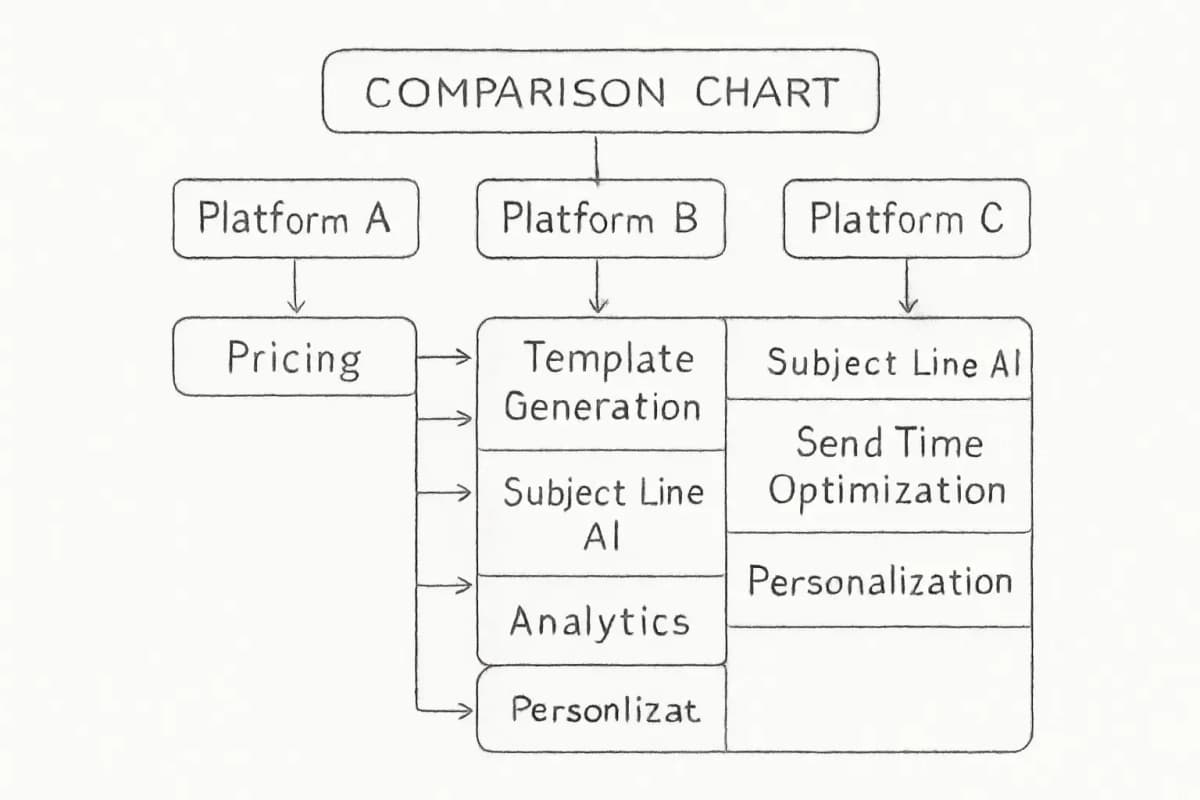
Best for: Small businesses and early-stage marketing teams that want AI-assisted email creation without committing to an enterprise tool budget. Comparison chart with three columns representing different AI email generator platforms. Each column shows platform name at top, pricing tier below (ranging from budget-friendly to enterprise), and key AI features listed in rows such as template generation, subject line optimization, send time optimization, and personalization capabilities. Use a clean table or card-based layout with visual hierarchy to show feature availability across platforms.
What to Look for When Choosing an AI Email Generator

Litmus found that nearly 70% of email marketers expect up to half of their email operations to be AI-driven by the end of 2026. But jumping on every new feature or buzzword without thinking through how it supports your goals and workflows costs you time, budget, and strategic focus. Teams need to start with a clear sense of what they are trying to do before throwing AI tools into the mix.

Before selecting a platform, evaluate these criteria:

  • CRM and ESP integration depth. Integration depth varies significantly from basic contact sync to bidirectional data flow that updates both systems in real time. For B2B teams, integration depth matters more than the existence of an integration; a shallow sync creates the same adoption problems as no integration at all.
  • AI learning vs. static generation. Some tools generate content from a prompt without learning from your account. Others, like ActiveCampaign's Active Intelligence, continuously improve based on your contact engagement data. The latter compounds in value over time.
  • Brand voice consistency. The right AI email generator should work directly in your inbox or CRM, and the ability to easily shift tone is crucial for professional communication.
  • Deliverability support. AI-powered deliverability tools should monitor your sending reputation and automatically make adjustments to improve inbox placement.
  • Compliance features. Make sure the tool aligns with GDPR, CAN-SPAM, or CCPA. Look for features like consent tracking and secure data handling.

For teams thinking about how AI email personalization ties into campaign performance, the tool you choose needs to support dynamic content and behavioral triggers, not just static copy generation.

Pairing AI Email Generators with Smart Segmentation

The biggest lift from any AI email generator comes when you combine it with proper audience segmentation. Segmented campaigns drive a 760% increase in revenue, according to Campaign Monitor. Automated emails generate 16x more revenue per send than scheduled campaigns, despite representing just 2% of email volume.

An AI tool that generates strong copy but sends it to the wrong audience will still underperform. The tools that close this gap, particularly ActiveCampaign and Klaviyo, use AI not just for content generation but for audience building. The AI also generates segments from natural-language prompts. Describe the audience you want and it builds the segment, drawing on engagement history, lifecycle stage, and account-level signals.

Pairing AI-generated content with a structured email list segmentation strategy is where the real performance gains appear. The copy improves click rates; the segmentation improves the relevance of who receives it.

Similarly, strong subject lines produced by AI tools work best when grounded in the email subject line best practices that actually influence behavior, such as personalization tokens, specificity, and appropriate urgency.

Common Pitfalls to Avoid

While most marketers can identify ROI from their email program, 22% of respondents report struggling with measuring or proving ROI. When it comes to personalization, the top challenges are developing personalized content efficiently (17%), collecting and analyzing the data needed for personalization (16%), and measuring the impact of personalization on email performance (15%).

A few patterns consistently limit results:

  1. Using AI without clean data. AI generates better output when it has accurate contact data to work with. Poor data means generic personalization.
  2. Skipping human review. Before scaling, have your team check AI suggestions to ensure they align with your tone, message, and brand voice.
  3. Treating subject line AI as a one-and-done. AI-generated subject lines are starting points. Test them. AI-generated subject lines outperform human-written subject lines by 26% for open rates on average. Combined with dynamic send-time optimization, the total lift reaches 40%.
  4. Ignoring deliverability. Only 83.1% of marketing emails successfully land in recipient inboxes, meaning nearly one in six emails either gets filtered to spam or bounces entirely. Major inbox providers continue implementing stricter filtering algorithms and authentication requirements. No amount of great AI copy overcomes landing in spam.

Frequently Asked Questions

What is the best AI email generator for small marketing teams in 2025?

For small teams with limited budgets, Brevo offers the most accessible entry point with AI subject line suggestions, send-time optimization, and a free plan that includes 300 emails per day. Teams that need more sophisticated automation at a low cost should evaluate ActiveCampaign's $15/month starter plan, which includes core AI features. ActiveCampaign is a strong choice for growth marketing teams that want high-quality AI email marketing with the full customer journey in mind. SMBs benefit from enterprise-level intelligence without enterprise-level complexity.

Can AI email generators actually improve deliverability?

Yes, but indirectly. AI tools that optimize send timing, suppress likely churners before they flag your emails as spam, and generate higher-engagement copy all feed positive signals to inbox providers. Better targeting means predictive churn risk lets you suppress subscribers before they complain, and smart send time improves engagement rates. Both feed positive signals to mailbox providers. The underlying deliverability infrastructure (authentication, domain reputation) still requires separate attention.

Is Jasper better than my ESP's built-in AI for email copy?

In most cases, yes, for pure copywriting quality. Jasper is an AI writing tool that excels at generating email copy. If your bottleneck is writing compelling subject lines, body copy, and CTAs rather than automation or deliverability, Jasper fills that gap better than any ESP's built-in AI. However, Jasper is not an email sending platform. Teams typically use it alongside their ESP rather than instead of it.

How do I measure the ROI of an AI email generator?

Track three measurement layers: pipeline attribution (which email campaigns generate qualified pipeline, not just opens and clicks), response rate lift (AI-optimized campaigns compared against manual baselines), and time saved on manual tasks like segmentation, list building, and variant testing. Start by benchmarking your current email performance before introducing any AI tool, then measure the delta at 30 and 90 days. For a deeper framework on tracking these outcomes, the email marketing analytics best practices guide covers the specific metrics worth monitoring.


No comments yet. Be the first!

Leave a comment

Comments are reviewed before publishing.

More from

Related posts

Illustration for best ai email marketing platforms 2025
Email Marketing ToolsJul 18, 2026 12 min

Best AI Email Marketing Platforms 2025

Compare top AI email marketing platforms for 2025. See automation features, pricing, and ROI benchmarks to pick the right tool for your business.

JJames Chen
Illustration for best platform for email marketing automation
Email Marketing ToolsJul 18, 2026 13 min

Best Platform for Email Marketing Automation

Compare top email marketing automation platforms by features, pricing, and deliverability. Find the right tool for your business needs and ROI goals.

SSarah Mitchell
Illustration for best companies for email marketing automation
Email Marketing ToolsJul 18, 2026 13 min

Best Companies for Email Marketing Automation

Compare top email marketing automation platforms. See features, pricing, and ROI for HubSpot, Klaviyo, ActiveCampaign, and more. Find the right fit for your business.

SSarah Mitchell
HomeBlogEmail Marketing ToolsBest AI Email Generator for Marketing Teams 2025
Email Marketing Tools

Best AI Email Generator for Marketing Teams 2025

Compare top AI email generators for marketing teams. Save time, boost open rates, and scale campaigns. Find the right tool for your strategy.

M

Marcus Webb

July 19, 2026

12 min read
Share:
#AI Email Marketing#Email Generation#marketing automation#Email Tools
Illustration for best ai email generator for marketing teams 2025

Stay in the loop

Get the latest posts delivered straight to your inbox. No spam, unsubscribe anytime.

Marketing teams are sitting on one of the most valuable channels available, and AI has made it significantly more powerful. In 2025, email remains one of the most powerful digital marketing channels, with nearly 4.6 billion global users and 375 billion emails sent per day. The issue is no longer whether email works. The issue is whether your team can produce and personalize campaigns fast enough to compete. That is where the best AI email generator for marketing teams in 2025 becomes a real operational advantage.

In 2023, 62% of marketing teams needed two or more weeks to produce a single email. By 2025, only 6% do. AI is the primary driver of that shift. But not every tool produces the same results. Choosing the right one depends on your team's workflow, existing stack, and campaign goals.

Key Takeaways

  • Nearly 63% of marketers now use AI tools in their email marketing efforts, and approximately 47% use AI specifically to generate their email campaigns.
  • AI-generated subject lines outperform human-written alternatives by 26% for open rates on average.
  • AI-driven email marketing leads to a 41% rise in revenue, proving the transformative effect on campaign performance.
  • Advanced AI adopters, those with AI woven through multiple workflow stages, are 75% more likely to achieve ROIs above 45:1.
  • The market now splits into three distinct tiers: platform AI (built into ESPs), specialist AI (standalone copy tools), and agentic AI (fully autonomous campaign execution).

Why AI Email Generation Has Gone Mainstream

49% of B2B marketers now use generative AI to create emails. This is no longer an early-adopter behavior. 95% of marketers who use generative AI for email content creation say it is effective.

The productivity argument is straightforward. Workers are approximately 33% more productive in each hour they use generative AI, and generative AI users save 5.4% of weekly work hours, approximately 2.2 hours per 40-hour week. For marketing teams juggling campaign calendars, copywriting, segmentation, and reporting simultaneously, those hours matter.

Email marketing already delivers a return of between $36 and $42 for every $1 spent, the highest ROI of any digital marketing channel. For context, paid search returns $2 per $1, social advertising $2.80, and display ads $1.35. AI amplifies that return by compressing the time between strategy and execution, and by lifting the quality of every send.

How the Market Now Splits: Three Tiers of AI Email Tools

Before picking a specific platform, it helps to understand what type of tool you need. The AI email marketing landscape in 2025 splits into three tiers. Platform AI (Mailchimp, HubSpot, ActiveCampaign, Klaviyo, Brevo, Omnisend) adds intelligence to traditional email marketing with better subject lines, smarter send times, and behavior-based automation. Specialist AI (Instantly, Jasper, Lavender) excels at one dimension, whether cold outreach volume, copywriting quality, or email coaching. Agent AI operates across the entire workflow, researching prospects, drafting personalized emails, connecting to LinkedIn and CRM, and requiring human approval before sending.

Most marketing teams need platform AI. Specialist AI tools serve as a complement when your ESP's built-in AI is not good enough for copywriting tasks.

The Best AI Email Generators for Marketing Teams in 2025

1. ActiveCampaign (Best for Full-Cycle Automation)

ActiveCampaign approaches AI email marketing as a full-cycle system rather than a set of disconnected features. Where most platforms add AI to individual steps, ActiveCampaign connects AI across the entire campaign lifecycle, from creation through segmentation, sending, and optimization.

In May 2025, ActiveCampaign introduced Active Intelligence, not just another AI feature, but a complete reimagining of how marketing automation works. Active Intelligence is a system-wide intelligence engine powered by billions of data points and dozens of specialized AI agents working together.

EmailToolTester's latest email deliverability tests scored ActiveCampaign with a 94.2% deliverability rate, in 1st place out of 15 tools tested. For teams where inbox placement directly affects revenue, this is a meaningful number.

Autonomous marketing transforms how you approach campaigns by eliminating step-by-step workflow building. Instead of manually configuring automations, you set strategic objectives through a conversational interface and AI agents take ownership of execution. These agents imagine campaign strategies, activate personalized interactions across email, SMS, and WhatsApp, and validate performance through continuous optimization.

Pricing: Plans start at $15/month for 1,000 contacts. A 14-day free trial is available.

Best for: Growth marketing teams, SaaS companies, and agencies that want CRM-driven AI across the entire campaign lifecycle.

2. Klaviyo (Best for Ecommerce Marketing Teams)

Klaviyo is an autonomous B2C CRM and AI marketing platform that unifies customer data and automates email, SMS, RCS, WhatsApp, and mobile push to drive personalized, revenue-generating campaigns. Built as both a system of record and system of action, Klaviyo combines a customer data platform, real-time signals, and AI agents to power automated insights and one-click execution.

Starting with a simple prompt, idea, or goal, Klaviyo's Composer uses your brand guidelines, content guardrails, and customer data to develop a fully realized email campaign, complete with audience suggestions and recommendations for other channels.

Massachusetts seafood retailer Svenfish now attributes 82% of their year-to-date Klaviyo-attributed revenue to using one or more of Klaviyo's AI features. Garrett Popcorn, meanwhile, used Klaviyo AI to segment their messages and saw 4x higher revenue per recipient.

Klaviyo's best AI features are predictive analytics, including expected next order date, predicted customer lifetime value, and churn risk, alongside smart send time. These directly improve targeting and deliverability.

Pricing: Free plan available; paid plans scale based on contacts and channel usage.

Best for: Ecommerce marketing teams with established customer data who want AI-driven behavioral segmentation and predictive analytics.

3. HubSpot (Best for B2B Teams with CRM Integration)

HubSpot is a marketing, sales, and CRM platform with built-in AI email writing for both marketing campaigns and sales outreach. You can use its AI to write marketing emails, sales emails, follow-ups, and subject lines directly inside the email editor or sales tools.

For sales teams, HubSpot's AI helps write one-to-one sales emails and sequences, using CRM data like contact properties and deal stage to personalize the message. This is what separates HubSpot from pure copywriting tools: the AI can reference where a contact actually is in your pipeline.

HubSpot's CRM-to-email integration is unmatched. No other tool references deal stage in an email body without webhooks. A free Smart CRM with unlimited contacts and 2,000 monthly email sends is available.

Pricing: AI email writing tools are available from $15/month.

Best for: B2B marketing and sales teams that want email generation tied directly to CRM data and deal stage.

4. Jasper (Best Standalone AI Email Copywriter)

Jasper is not an email platform; it is an AI writing tool that excels at generating email copy. If your bottleneck is writing compelling subject lines, body copy, and CTAs rather than automation or deliverability, Jasper fills that gap better than any ESP's built-in AI.

Testing Jasper across email copy A/B testing generated 10 subject line variants and 5 body copy versions for a product launch email. The Brand Voice feature maintained consistent tone across all variants, and the template library provided frameworks for welcome sequences, re-engagement, and promotional campaigns. Quality was noticeably higher than what Mailchimp or ActiveCampaign's built-in AI produced.

Jasper is a marketing-focused content platform that helps teams and creators produce emails, sales copy, newsletters, and long-form content without starting from scratch. It is built for people who want consistent quality and brand voice across their messaging.

Pricing: Starts at $39/month for 1 user; team accounts from $99/month.

Best for: Marketing teams that already have an ESP but need significantly better AI-generated copy, particularly agencies managing multiple brand voices.

5. Brevo (Best Budget Option for Smaller Teams)

Brevo includes an AI email generator inside its platform that helps you create email copy, subject lines, and content blocks without using external tools. You start with a short explanation of what your email should say, and the AI turns that into a clean draft you can refine.

Brevo offers the most generous free tier of any email marketing platform, with a free plan including 300 emails per day, a Starter plan from $9/month, and Business from $18/month. For teams watching margins, that pricing structure is hard to argue with.

Best for: Small businesses and early-stage marketing teams that want AI-assisted email creation without committing to an enterprise tool budget. Comparison chart with three columns representing different AI email generator platforms. Each column shows platform name at top, pricing tier below (ranging from budget-friendly to enterprise), and key AI features listed in rows such as template generation, subject line optimization, send time optimization, and personalization capabilities. Use a clean table or card-based layout with visual hierarchy to show feature availability across platforms.

What to Look for When Choosing an AI Email Generator

Litmus found that nearly 70% of email marketers expect up to half of their email operations to be AI-driven by the end of 2026. But jumping on every new feature or buzzword without thinking through how it supports your goals and workflows costs you time, budget, and strategic focus. Teams need to start with a clear sense of what they are trying to do before throwing AI tools into the mix.

Before selecting a platform, evaluate these criteria:

  • CRM and ESP integration depth. Integration depth varies significantly from basic contact sync to bidirectional data flow that updates both systems in real time. For B2B teams, integration depth matters more than the existence of an integration; a shallow sync creates the same adoption problems as no integration at all.
  • AI learning vs. static generation. Some tools generate content from a prompt without learning from your account. Others, like ActiveCampaign's Active Intelligence, continuously improve based on your contact engagement data. The latter compounds in value over time.
  • Brand voice consistency. The right AI email generator should work directly in your inbox or CRM, and the ability to easily shift tone is crucial for professional communication.
  • Deliverability support. AI-powered deliverability tools should monitor your sending reputation and automatically make adjustments to improve inbox placement.
  • Compliance features. Make sure the tool aligns with GDPR, CAN-SPAM, or CCPA. Look for features like consent tracking and secure data handling.

For teams thinking about how AI email personalization ties into campaign performance, the tool you choose needs to support dynamic content and behavioral triggers, not just static copy generation.

Pairing AI Email Generators with Smart Segmentation

The biggest lift from any AI email generator comes when you combine it with proper audience segmentation. Segmented campaigns drive a 760% increase in revenue, according to Campaign Monitor. Automated emails generate 16x more revenue per send than scheduled campaigns, despite representing just 2% of email volume.

An AI tool that generates strong copy but sends it to the wrong audience will still underperform. The tools that close this gap, particularly ActiveCampaign and Klaviyo, use AI not just for content generation but for audience building. The AI also generates segments from natural-language prompts. Describe the audience you want and it builds the segment, drawing on engagement history, lifecycle stage, and account-level signals.

Pairing AI-generated content with a structured email list segmentation strategy is where the real performance gains appear. The copy improves click rates; the segmentation improves the relevance of who receives it.

Similarly, strong subject lines produced by AI tools work best when grounded in the email subject line best practices that actually influence behavior, such as personalization tokens, specificity, and appropriate urgency.

Common Pitfalls to Avoid

While most marketers can identify ROI from their email program, 22% of respondents report struggling with measuring or proving ROI. When it comes to personalization, the top challenges are developing personalized content efficiently (17%), collecting and analyzing the data needed for personalization (16%), and measuring the impact of personalization on email performance (15%).

A few patterns consistently limit results:

  1. Using AI without clean data. AI generates better output when it has accurate contact data to work with. Poor data means generic personalization.
  2. Skipping human review. Before scaling, have your team check AI suggestions to ensure they align with your tone, message, and brand voice.
  3. Treating subject line AI as a one-and-done. AI-generated subject lines are starting points. Test them. AI-generated subject lines outperform human-written subject lines by 26% for open rates on average. Combined with dynamic send-time optimization, the total lift reaches 40%.
  4. Ignoring deliverability. Only 83.1% of marketing emails successfully land in recipient inboxes, meaning nearly one in six emails either gets filtered to spam or bounces entirely. Major inbox providers continue implementing stricter filtering algorithms and authentication requirements. No amount of great AI copy overcomes landing in spam.

Frequently Asked Questions

What is the best AI email generator for small marketing teams in 2025?

For small teams with limited budgets, Brevo offers the most accessible entry point with AI subject line suggestions, send-time optimization, and a free plan that includes 300 emails per day. Teams that need more sophisticated automation at a low cost should evaluate ActiveCampaign's $15/month starter plan, which includes core AI features. ActiveCampaign is a strong choice for growth marketing teams that want high-quality AI email marketing with the full customer journey in mind. SMBs benefit from enterprise-level intelligence without enterprise-level complexity.

Can AI email generators actually improve deliverability?

Yes, but indirectly. AI tools that optimize send timing, suppress likely churners before they flag your emails as spam, and generate higher-engagement copy all feed positive signals to inbox providers. Better targeting means predictive churn risk lets you suppress subscribers before they complain, and smart send time improves engagement rates. Both feed positive signals to mailbox providers. The underlying deliverability infrastructure (authentication, domain reputation) still requires separate attention.

Is Jasper better than my ESP's built-in AI for email copy?

In most cases, yes, for pure copywriting quality. Jasper is an AI writing tool that excels at generating email copy. If your bottleneck is writing compelling subject lines, body copy, and CTAs rather than automation or deliverability, Jasper fills that gap better than any ESP's built-in AI. However, Jasper is not an email sending platform. Teams typically use it alongside their ESP rather than instead of it.

How do I measure the ROI of an AI email generator?

Track three measurement layers: pipeline attribution (which email campaigns generate qualified pipeline, not just opens and clicks), response rate lift (AI-optimized campaigns compared against manual baselines), and time saved on manual tasks like segmentation, list building, and variant testing. Start by benchmarking your current email performance before introducing any AI tool, then measure the delta at 30 and 90 days. For a deeper framework on tracking these outcomes, the email marketing analytics best practices guide covers the specific metrics worth monitoring.

No comments yet. Be the first!

Leave a comment

Comments are reviewed before publishing.

More from

Related posts

Illustration for best ai email marketing platforms 2025
Email Marketing ToolsJul 18, 2026 12 min

Best AI Email Marketing Platforms 2025

Compare top AI email marketing platforms for 2025. See automation features, pricing, and ROI benchmarks to pick the right tool for your business.

JJames Chen
Illustration for best platform for email marketing automation
Email Marketing ToolsJul 18, 2026 13 min

Best Platform for Email Marketing Automation

Compare top email marketing automation platforms by features, pricing, and deliverability. Find the right tool for your business needs and ROI goals.

SSarah Mitchell
Illustration for best companies for email marketing automation
Email Marketing ToolsJul 18, 2026 13 min

Best Companies for Email Marketing Automation

Compare top email marketing automation platforms. See features, pricing, and ROI for HubSpot, Klaviyo, ActiveCampaign, and more. Find the right fit for your business.

SSarah Mitchell