
AI is no longer an experimental add-on in email marketing. 63% of marketers now use AI tools for their email marketing efforts, and the results justify the shift. Automated emails generate 320% more revenue than non-automated emails, and AI-driven email marketing results in a 13% boost in click-through rates. If you're still running campaigns on manual timers and generic copy, you're leaving measurable performance gains on the table.
This guide covers the best AI marketing tools for email campaigns in 2025 and 2026, how each one works, who it's built for, and how to match the right tool to your situation.
Key Takeaways
- AI adoption has surged to 63% of marketers, with 87% of AI adopters specifically applying it to email marketing.
- Automated emails generate 320% more revenue than non-automated campaigns, making automation the highest-leverage investment in your email stack.
- AI can save marketers up to 30% of their time by automating email design, content creation, and scheduling.
- Businesses using AI in email campaigns report an average ROI increase of 21%.
- The best AI marketing tools for email campaigns fall into two categories: platforms with AI baked in (Klaviyo, ActiveCampaign, HubSpot) and standalone AI writing tools (Jasper, Copy.ai) that complement any sending platform.
Why AI Has Become Central to Email Campaign Performance
The average email marketing ROI is $36 for every $1 spent, which is a 3,500% return. AI raises that ceiling further by improving three things that directly determine campaign performance: content relevance, send timing, and audience targeting.
Traditional email marketing sends one campaign to a segment. AI email marketing researches each recipient individually and adapts content, timing, and channel accordingly.
By 2026, 89% of marketing experts expect up to 75% of email strategy operations to be fully AI-driven. The tools that exist today are already moving in that direction. Here's what the best of them actually do.
1. Klaviyo: Best for E-commerce Brands Needing Predictive Analytics
Klaviyo is the most data-rich option for e-commerce teams. Klaviyo unifies email, SMS, RCS, WhatsApp, and mobile push into a single marketing automation platform with AI-driven segmentation and predictive analytics.
Its AI suite, called K:AI, is one of the most mature in the category. K:AI scores every customer on lifetime value, churn risk, and purchase patterns, so you always know who to target and who's ready to buy.
Klaviyo's best AI features are predictive analytics, including expected next order date, predicted CLV, and churn risk, alongside smart send time. These directly improve targeting and deliverability.
Klaviyo's Segments AI lets marketers create precise audience segments simply by describing them in natural language. Instead of manually defining filters and conditions, you can type prompts like "customers who purchased in the last 90 days but have not engaged with our last two campaigns" and let AI build the segment instantly.
The predictive analytics features are where Klaviyo earns its reputation with serious e-commerce teams. Klaviyo's Predictive Analytics uses historical purchase and engagement data to forecast key customer metrics, such as Customer Lifetime Value (CLV), likelihood to purchase again, and churn probability.
Best for: E-commerce brands with at least 12 months of order data. Predictions are surprisingly accurate for stores with 12 or more months of order data and 1,000 or more customers. For newer stores, predictions are unreliable.
Pricing: The free tier caps at 250 active profiles and 500 email sends per month. Pricing scales steeply, reaching $150 per month at 10,000 contacts and $720 per month at 50,000 contacts for email alone.
For a deeper look at how AI personalization works within email flows, see our guide on AI email marketing personalization techniques.
2. ActiveCampaign: Best for B2B Teams and Complex Automations
ActiveCampaign is an email marketing and automation platform especially strong for lifecycle campaigns and deeper automation logic. It's a good fit for teams that want to automate journeys end-to-end and tie email activity back to pipeline.
ActiveCampaign offers seven core AI features: AI Campaign Builder for generating personalized email campaigns, AI Automation Builder using natural language prompts, AI Brand Kits for brand consistency, AI-Suggested Segments for intelligent customer segmentation, Predictive Sending for optimal timing, Campaign Reporting Co-pilot for performance insights, and AI Content Generator for email text creation.
Its standout feature is Predictive Sending. Predictive Sending analyzes when each contact is most likely to engage, then automatically sends at those optimal times, boosting customers' click-through rates by 17% on average.
ActiveCampaign's engagement scoring is one of the best implementations available because it includes score decay. A contact who was active six months ago but silent since then gradually drops in score without requiring manual configuration. This matches how mailbox providers actually evaluate engagement.
Best for: B2B companies and service businesses on Plus or Professional plans.
Pricing: ActiveCampaign uses contact-based pricing starting at $15 per month for 1,000 contacts on the Starter plan, $49 per month for the Plus plan with CRM features, and $79 per month for the Professional plan with full predictive AI capabilities.
3. HubSpot (Breeze AI): Best for Teams Already in the HubSpot Ecosystem
HubSpot's AI layer, called Breeze, is a unified platform across marketing, sales, and service. Breeze is HubSpot's built-in AI platform designed to help marketing, sales, and customer service teams grow faster without adding headcount.
Breeze includes AI agents that work autonomously, an AI assistant for everyday tasks, and over 100 embedded AI features across the HubSpot platform. Customers using Breeze have seen results including 70% of customer conversations resolved automatically and 4x more leads created on average.
For email specifically, Marketing Studio provides a collaborative AI-assisted campaign canvas; Segments and Personalization delivers audience discovery and tailored pages and CTAs; AI-Powered Email builds individualized messages using CRM context.
The AI assistant, Breeze, instantly accesses HubSpot's Smart CRM to gather context. It analyzes conversational insights from recent sales calls and support chats, past interactions including email opens and link clicks, Smart CRM signals like firmographic data and deal stage, and contact data including job title and industry.
HubSpot is especially strong if you're already using HubSpot, since email, automation, contacts, and pipeline all live in the same place.
Best for: B2B teams running integrated marketing and sales workflows inside HubSpot.
Pricing: HubSpot Breeze AI capabilities are bundled into HubSpot's existing tiered subscription plans. Advanced tools are available in Professional and Enterprise plans.
4. Jasper: Best Dedicated AI Writing Tool for Email Copy
Jasper is not an email sending platform. It's an AI writing tool designed for marketing teams that need high-quality, on-brand email copy at scale.
Jasper excels at generating email copy. If your bottleneck is writing compelling subject lines, body copy, and CTAs rather than automation or deliverability, Jasper fills that gap better than any ESP's built-in AI.
When tested for email copy A/B testing, Jasper generated 10 subject line variants and 5 body copy versions for a product launch email. The Brand Voice feature maintained consistent tone across all variants, and the template library provided frameworks for welcome sequences, re-engagement, and promotional campaigns. Quality was noticeably higher than what Mailchimp or ActiveCampaign's built-in AI produced.
The Brand Voice feature is what separates Jasper from cheaper tools. Instead of rewriting prompts every time you want Jasper to sound like your brand, you train it once. You feed it samples of your existing content including blog posts, emails, and ad copy, and Jasper analyzes the tone, vocabulary, and style. From that point forward, every output defaults to your brand's voice rather than generic AI prose.
Jasper offers over 100 purpose-built marketing apps for specific short-form writing tasks, including ad copy, email subject lines, product descriptions, and social media posts.
Best for: Email work that is content marketing, including newsletters, drip campaigns, and product emails, where brand consistency, editorial quality, and team review workflows matter.
Pricing: The Pro Plan starts at $69 per month for one user, or $59 per month if paid annually, providing access to the Canvas, the main apps, and limited Jasper IQ features including 2 Brand Voices and 5 Knowledge Assets. 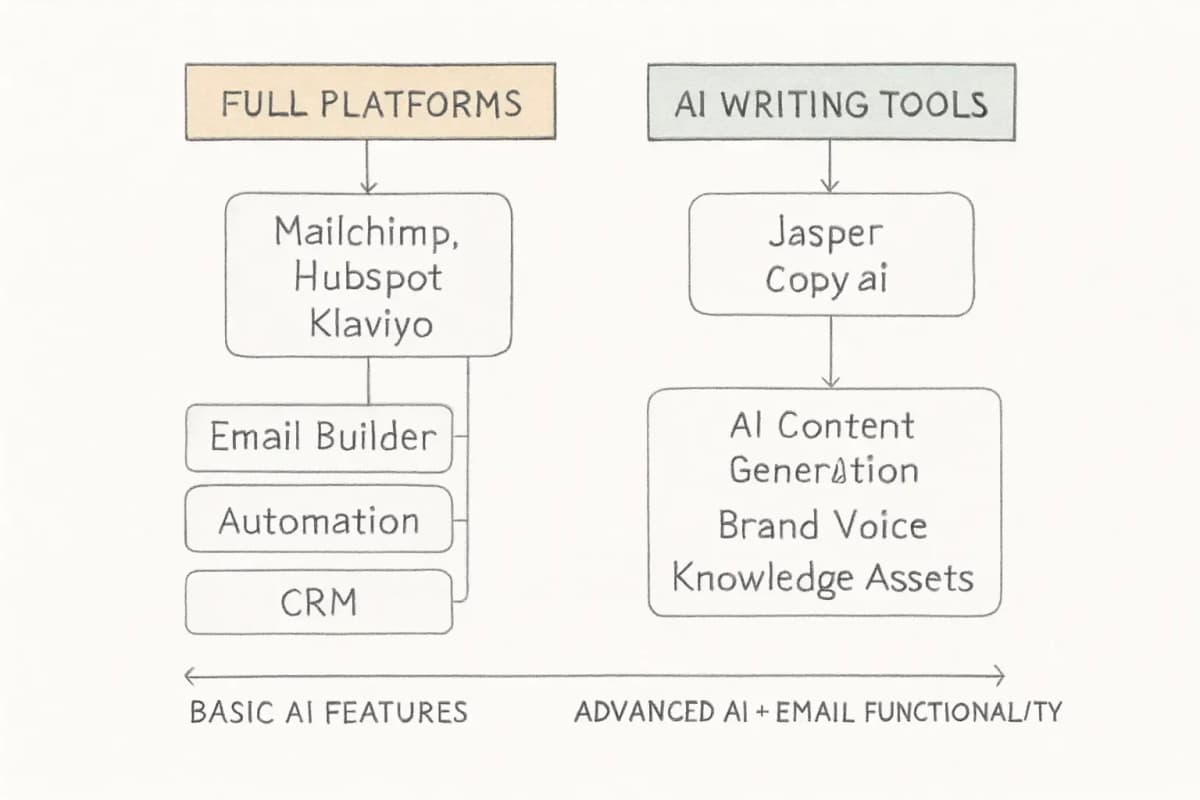
5. Mailchimp: Best Entry-Level Option with Built-In AI
For teams new to AI-assisted email marketing, Mailchimp remains a functional starting point. Mailchimp remains the default starting point for email marketing, and its AI features have gotten meaningfully better. The AI Content Optimizer analyzes your draft against industry benchmarks and suggests subject lines, send times, and content length adjustments.
Mailchimp's AI suggests optimal send times based on subscriber timezone data and predicted engagement patterns. The Customer Journey Builder lets you branch based on purchase behavior, so if someone bought within 48 hours, they received a different follow-up than someone who just browsed.
The honest limitation: AI personalization is limited to merge tags and segment-based variants with no individual-level content adaptation. Automation becomes expensive at scale, reaching $350 per month for Premium.
Best for: Small businesses and teams sending straightforward newsletters with moderate segmentation needs.
6. GetResponse: Best Mid-Market All-in-One Option
GetResponse is best at providing user-friendly tools for creating engaging email marketing campaigns. It suits small to medium businesses or entrepreneurs looking for an all-in-one email marketing solution and offers tools for crafting automated email sequences.
GetResponse features Perfect Timing and Time Travel delivery tools to ensure emails are sent at the most effective times, and it comes equipped with an AI email generator that enables users to create emails within seconds.
The best AI email marketing tools include ActiveCampaign, Klaviyo, and GetResponse. These platforms offer powerful AI functionality for writing emails, building automations, displaying personalized product recommendations, and more.
Best for: Growing teams that need automation, AI writing assistance, and landing pages without a complex setup.
How to Choose the Right AI Email Marketing Tool
No single tool is universally best. Your choice comes down to four factors:
- Primary use case: Cold outreach vs. lifecycle marketing vs. e-commerce automation
- List size and data depth: AI predictions require enough historical data to be accurate
- Budget: Per-seat writing tools cost less upfront; full platforms scale with contact volume
- Tech stack: If you're already in HubSpot, Breeze is the path of least resistance
AI email marketing models need engagement history, CRM data, intent signals, and technographic profiles to produce reliable predictions. Data quality is the limiting factor, not the AI itself; models perform only as well as the data feeding them.
For teams focused on improving list quality and targeting before adding AI tools, the foundation starts with smart segmentation. Check out our guide on email list segmentation strategies that boost ROI by 760% to build that base first.
Once your list is healthy, AI tools for email campaign templates can help you scale creative output without adding headcount.
What to Measure When Using AI Email Tools
Track three measurement layers: pipeline attribution (which email campaigns generate qualified pipeline, not just opens and clicks), response rate lift (AI-optimized campaigns compared against manual baselines), and time saved on manual tasks like segmentation, list building, and variant testing.
65% of marketers advocate using AI as an assistive tool but oppose fully hands-off deployment. That's the right posture. Use AI to draft, time, and personalize. Keep a human in the loop for brand voice, compliance, and strategic decisions.
The goal is not to remove judgment from your campaigns. It's to give your team more time to apply that judgment where it matters.
Frequently Asked Questions
What is the best AI marketing tool for email campaigns?
There is no single best answer. For e-commerce, Klaviyo leads on predictive analytics and lifecycle automation. For B2B teams with complex sales workflows, ActiveCampaign or HubSpot are stronger fits. For teams that need high-quality email copy without changing their sending platform, Jasper is the best standalone writing tool. Match the tool to your use case, not a ranking list.
Do AI email tools actually improve open rates and click-through rates?
Yes, with measurable data to support it. ActiveCampaign's Predictive Sending boosts customers' click-through rates by 17% on average by analyzing when each contact is most likely to engage and sending at those optimal times. Using AI for subject line optimization can boost open rates by up to 10%. Results depend on data quality and list size.
How much does AI email marketing software cost?
Costs vary widely by category. Full platforms like ActiveCampaign start at $15 per month for small lists, while Klaviyo starts at $20 per month. AI writing tools like Jasper start at $59 per month (billed annually) for one user. Enterprise-level platforms like HubSpot and ZoomInfo use custom pricing. Most offer free trials, and AI features are often gated to mid-tier or higher plans.
Is AI-generated email copy good enough to send without editing?
Not reliably. AI subject line generation and AI-generated email content are usable but produce generic output that needs heavy editing. The practical approach is to use AI for drafts, structure, and subject line variants, then edit for brand voice, specificity, and context. The majority of marketers advocate using AI as an assistive tool. The guidance is to use AI to draft emails, then refine. Don't send anything without a human voice check, and keep tone, clarity, and brand voice consistent.