
Email
Email

A modern blog built with Payload CMS, Next.js, and shadcn/ui.

RSS FeedSitemap

Explore

  • Blog
  • News
  • Statistics
  • Authors

Categories

  • Email Analytics & Reporting
  • Email Security and Compliance
  • Email Marketing Tools and Strategy
  • Email Automation Strategies
  • Email Database & List Building
  • Email Marketing Tools & Resources
  • Seasonal Email Marketing
  • Email Marketing Benchmarks

Latest articles

  • Email Promotion and Internet Marketing AutomationJul 19, 2026
  • Enterprise Marketing Automation Email: Strategy & SetupJul 19, 2026
  • AI and Machine Learning in Email MarketingJul 19, 2026
  • Best CRM with Email Marketing Automation 2025Jul 19, 2026

Popular topics

  • #Email Generation
  • #agency benchmarks
  • #email marketing content strategy
  • #Marketing Compliance
  • #AI Security
  • #Productivity Tools
  • #atlanta business
  • #Data-Driven Strategy
  • #Marketing Outsourcing
  • #Outsourced Email Marketing
  • #Sales Workflows
  • #automation software
  • #Back-to-School
  • #Email Software Comparison
  • #Email Branding
  • #Email Marketing Metrics

Stay in the loop

Join 2,000+ readers. Unsubscribe anytime.

Subscribe
Email

© 2026 Email. All rights reserved.

SitemapRSS
HomeBlogAI and AutomationChatGPT for Email Marketing: Strategies That Work
AI and Automation

ChatGPT for Email Marketing: Strategies That Work

Learn how to use ChatGPT for email marketing to write copy faster, segment audiences, and boost engagement. Expert strategies and practical examples included.

S

Sarah Mitchell

July 18, 2026

12 min read
Share:
#ChatGPT#Email Copywriting#marketing automation#AI Tools
Illustration for chat gpt email marketing

Stay in the loop

Get the latest posts delivered straight to your inbox. No spam, unsubscribe anytime.

Over 51% of generative AI users in email marketing use ChatGPT, making it the most widely adopted AI tool in the discipline. That number tells you something important: chat gpt email marketing is no longer an experiment. It is a core workflow for teams that want to produce more, test faster, and personalize at a scale that was impractical just two years ago.

But adoption rates do not equal results. The teams seeing real gains from chat gpt email marketing are not just pasting prompts and sending. They are applying structured strategies: precise prompting, audience-first segmentation, systematic A/B testing, and human editorial review before anything hits an inbox. This guide breaks down exactly how those strategies work.


Key Takeaways

  • 95% of marketers find using generative AI for email creation "effective," while 54% find it "very effective," according to HubSpot.
  • AI-driven campaigns can increase email open rates by up to 41% in certain industries.
  • AI-generated subject lines outperform human-written ones by 26%; combined with AI-powered send-time optimization, the total open rate lift reaches 40%.
  • 76% of marketing teams now produce and send a marketing email within 3 days, compared to 62% of teams that took two weeks or more in 2024, a shift driven largely by AI.
  • ChatGPT is a drafting and ideation engine, not a replacement for strategy. Human review, brand-voice guidance, and real campaign data are what make AI outputs worth sending.

Why ChatGPT Has Become Central to Email Marketing

The scale of ChatGPT's adoption inside marketing teams reflects a practical reality. 77% of marketing professionals report they have used ChatGPT, and 93% of companies already using ChatGPT say they plan to expand its use.

Email is a natural fit. Writing is the dominant work use case for ChatGPT, making up 40% of work messages. And email marketing requires an enormous volume of writing: subject lines, preview text, body copy, CTAs, re-engagement sequences, welcome flows, and A/B variants. ChatGPT handles first drafts of all of it quickly.

AI-powered email marketing leads to a 41% increase in revenue, according to Adobe, and 87% of marketers use AI to ramp up their email marketing, per Master of Code.

Email itself also remains the highest-ROI digital channel. On average, email marketing delivers a return of between $36 and $42 for every $1 spent, compared to $2 for paid search, $2.80 for social advertising, and $1.35 for display ads. When you layer AI-assisted production into a channel with that kind of return, efficiency gains compound quickly.


1. Subject Line Generation and Testing

Subject lines are where chat gpt email marketing delivers the most measurable and immediate value. 47% of email recipients open an email based solely on the subject line. That single metric justifies spending real time on subject line quality, and ChatGPT makes it practical to produce and test far more variations.

You can use ChatGPT to generate variations of subject lines, body copy, and calls to action, and it can also aid in interpreting A/B testing results and identifying patterns that may bring higher open rates.

The prompt structure matters. A vague prompt produces generic output. A precise one produces usable copy. Here is a format that works:

"Write 10 subject lines for an email about [offer]. Include 3 curiosity-based, 3 benefit-driven, 3 urgency-based, and 1 question-based. Target audience: [describe]. Keep all under 50 characters."

Testing different variations of subject lines is essential for finding the one that resonates most with your target audience. You can try different lengths, tones, levels of personalization, and urgency to see which combination works best.

For deeper subject line guidance, see our resource on email subject line best practices that boost open rates.


2. Personalized Email Copy at Scale

Personalization drives measurable revenue. Brands using AI-driven personalization report up to 42% higher revenue, with click-through rates exceeding 13%. The challenge has always been producing personalized content at volume. That is the problem ChatGPT solves.

With ChatGPT email personalization, you can generate relevant messages for different audience segments. The tool will adjust your templates to reflect users' pain points, interests, and demographics, and if you guide it with a proper prompt, it can even assist with audience segmentation itself.

The key is feeding the model the right context. Include:

  • A description of the audience segment (role, industry, buying stage, or behavior trigger)
  • The goal of the email (click, purchase, reply, or re-engage)
  • Tone and voice instructions specific to your brand
  • Any dynamic fields you want inserted (first name, company, product they viewed)

AI can imitate your writing style, but it cannot feel your brand voice unless you teach it. The more clearly you describe your brand personality, the closer the output will sound to something you'd actually send. That is why every prompt should include tone and voice instructions.

For more on personalization techniques that translate into conversions, read 7 email personalization techniques that boost conversions 47%.


3. Automated Email Sequence Planning

One of the strongest use cases for chat gpt email marketing is sequence planning. Automated workflows generate 320% more revenue than standard promotional campaigns. Building those workflows used to require significant time and copywriting resources. ChatGPT shortens that process considerably.

ChatGPT can work out an entire outreach campaign based on the goals you share in a prompt. Need help building an effective onboarding or re-engagement sequence? The AI will quickly provide a relevant message chain, from initial contact to engaging follow-ups.

Effective sequence prompts should specify:

  1. The subscriber's entry point (new signup, post-purchase, free trial start, or cart abandonment)
  2. The number of emails and the spacing between them
  3. The objective of each email in the sequence
  4. The CTA for each step

For example, you can prompt: "Create a month's worth of email content for a fashion e-commerce business targeting women aged 25 to 35, aimed at driving engagement and sales through a mix of promotional and entertaining emails, in a trendy and confident but approachable tone."

ChatGPT will produce a working structure in minutes. The copy still needs your editorial judgment and brand voice review before it goes live.


4. A/B Testing at Scale

A/B testing is a vital part of content marketing, but coming up with variations to trial can be tedious. One of the best uses of ChatGPT is creating variations of subject lines, body copy, CTAs, and other content elements.

Where teams previously tested one or two subject line variants per campaign, ChatGPT makes it practical to test five or more. The same applies to CTA copy, preview text, and email opening lines.

ChatGPT can create variations tailored to specific audience segments or testing criteria, and it can also interpret data, help identify winning combinations, and explain why they were most effective. For actual split testing and statistical significance measurement, you still need a dedicated email platform with A/B testing features. ChatGPT handles the creative side; your platform handles the data.

A practical approach:

  • Use ChatGPT to generate five subject line variants for each campaign
  • Ask it to explain the psychology behind each variant
  • Run two to three in your platform and let engagement data decide the winner
  • Feed the winning patterns back into future prompts

5. Segmentation Strategy and Audience Research

Once you establish the factors defining your target audience, you can ask ChatGPT for strategies to help you segment them, which means you can send targeted, personalized content to the people it will resonate with most, and then incorporate those insights into your email marketing strategy to refine your email segments.

ChatGPT cannot replace actual subscriber data from your CRM. Out of the box, ChatGPT does not know your CRM, ad spend, or revenue. Without your data, it cannot forecast with precision or segment by high-value cohorts. But it is excellent for identifying segment criteria, drafting audience personas, and suggesting segmentation frameworks based on industry type, funnel stage, or purchase behavior that you then verify against your own data.

Ask it questions like:

  • "What segments would matter most for a SaaS product targeting mid-market HR teams?"
  • "What email content types should I use for subscribers at the consideration stage?"
  • "What behavioral triggers should I set up for an e-commerce store with average order values over $150?"

For a deeper look at how segmentation drives revenue, see our guide on email list segmentation strategies that boost ROI by 760%.


6. Campaign Auditing and Performance Analysis

You can also use ChatGPT to audit and assess your email campaigns, which provides an objective overview of your email marketing and offers recommendations to improve future campaigns.

Paste your email copy, subject line, preview text, and a summary of your campaign metrics into ChatGPT with a prompt like:

"Review the following email campaign and provide actionable feedback to improve future campaigns, prioritized by impact. Consider subject line clarity, CTA strength, personalization, and email structure."

To understand trends and patterns across a range of campaigns, ask ChatGPT to analyze email performance during a specific quarter, and based on the response you can get a holistic view of your subscriber journey and identify which content drives the highest engagement and ties to overall revenue.

This is particularly useful for teams without a dedicated analyst. You get structured, actionable feedback on copy quality and campaign structure in minutes.


7. What ChatGPT Cannot Do for Your Email Program

ChatGPT is a capable drafting tool. It is not a strategist, a deliverability expert, or a brand guardian. Understanding those limits prevents wasted effort and poor-quality sends.

Research published in the Journal of Digital and Social Media Marketing found that ChatGPT falls short in understanding consumer needs and preferences, has potential to generate misleading or inaccurate information, and has implications for branding and communication strategies.

The authors call for responsible implementation of generative AI in marketing with human oversight, domain-specific fine-tuning, and prompt engineering.

Specific areas where ChatGPT needs human reinforcement:

  • Brand voice: AI-produced content can sound like it was written by someone who has never been introduced to your brand when ChatGPT is used without embedding your unique brand voice.
  • Deliverability: ChatGPT does not know your sender reputation, bounce history, or spam filter triggers. Compliance checks for GDPR, CAN-SPAM, and CASL need human verification.
  • Real data: ChatGPT generates copy based on training data, not your subscriber behavior. Always layer actual campaign data on top of AI suggestions.
  • Accuracy: ChatGPT speeds briefs, outlines, and drafts, but it still needs human touch, strong facts, and clear intent. Treat it like a fast junior copywriter who works all day, not a strategist who owns your brand voice.

The output of any chat gpt email marketing workflow should pass through at least one round of human review before sending, especially for compliance, factual claims, and brand tone.
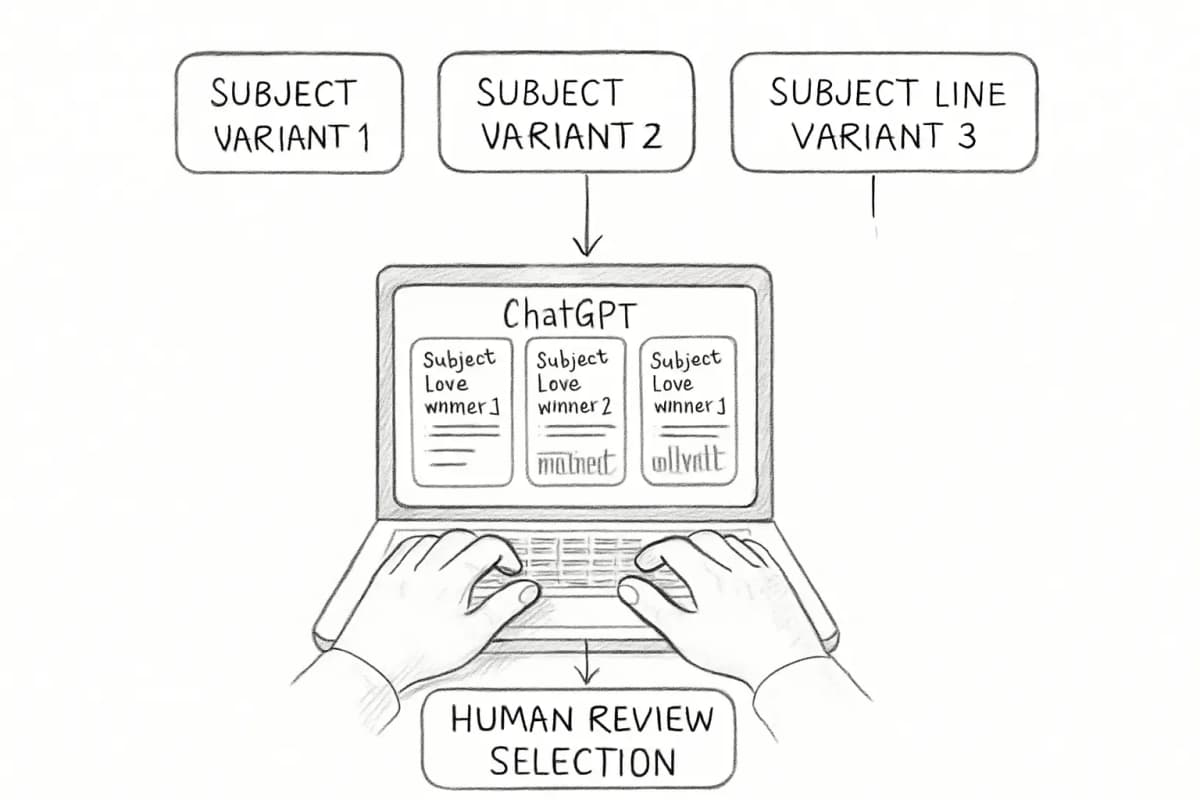

A marketer's laptop screen showing a ChatGPT email drafting interface with multiple subject line variants displayed side by side in a comparison view. The screen shows 3-4 different subject line options generated by AI, each with performance metrics or engagement predictions. The marketer's hands are visible at the keyboard, suggesting active review and selection of the best variant. The visual emphasizes the human review step in the AI email workflow process.


Building a Repeatable ChatGPT Email Workflow

The teams getting the most from chat gpt email marketing have turned it into a consistent process rather than an ad hoc tool. If you write emails regularly, build a prompt library: a database of instructions that generate high-quality drafts for your recurring campaigns. Start by cataloguing prompts for common email flows such as welcome series, re-engagement, follow-ups, post-webinar thank-yous, abandoned carts, and seasonal promotions, and save each prompt that delivers great results.

A basic workflow structure:

  1. Define the brief: audience segment, goal, funnel stage, tone
  2. Generate with ChatGPT: subject lines, preview text, body copy, CTA variants
  3. Edit for brand voice: check against your style guide and past high-performing emails
  4. Run A/B tests: test two to three subject line variants per campaign
  5. Feed results back: update your prompt library based on what wins

The key is in how well you guide ChatGPT. The more specific and detailed your prompts are, the better your emails will sound and perform.

For teams building or refining their broader AI email strategy, see how to leverage AI in your email marketing and our roundup of AI tools for email campaign templates.


Frequently Asked Questions

Does ChatGPT actually improve email open rates?

Emails with AI-generated subject lines see an open rate increase of 5% to 10%, and AI-generated subject lines outperform human-written ones by 26% overall; combined with AI-powered send-time optimization, the total open rate lift reaches 40%. Results vary by industry, list quality, and how much human refinement goes into the AI output before sending.

What is the best way to prompt ChatGPT for email marketing?

Be specific about your audience, goal, tone, and constraints. Include the subscriber segment, the email's objective, the desired word count, and any brand voice cues. The best email marketing ChatGPT prompts are adapted and customized based on brand, audience, and campaign objectives. Vague prompts return generic copy. Detailed prompts return usable first drafts.

Can ChatGPT write a full email automation sequence?

Yes. With the right prompts, ChatGPT can generate full email sequences, automations, and workflows. Provide the entry trigger, number of emails, spacing, and objective for each step. The output will need human review for brand voice, compliance, and accuracy before you load it into your automation platform.

What are the main risks of using ChatGPT for email marketing?

The primary risks are generic brand voice, factual inaccuracies, and compliance gaps. Research highlights ChatGPT's limitations in understanding consumer preferences, its potential to generate misleading information, and ethical concerns including deceptive practices and data security issues. These risks are manageable with thorough prompt engineering, an internal style guide, and a mandatory human review step before any email is sent.


No comments yet. Be the first!

Leave a comment

Comments are reviewed before publishing.

More from

Related posts

Illustration for role of ai in email marketing
AI and AutomationJul 17, 2026 13 min

Role of AI in Email Marketing: Benefits and Strategies

Discover how AI transforms email marketing with personalization, automation, and predictive analytics. Learn strategies to boost ROI and engagement.

RRachel Torres
Illustration for ai impact on email marketing
AI and AutomationJul 17, 2026 13 min

AI Impact on Email Marketing: ROI and Strategy

Discover how AI transforms email marketing through personalization, automation, and deliverability. Learn actionable strategies to boost campaign ROI.

PPriya Kapoor
HomeBlogAI and AutomationChatGPT for Email Marketing: Strategies That Work
AI and Automation

ChatGPT for Email Marketing: Strategies That Work

Learn how to use ChatGPT for email marketing to write copy faster, segment audiences, and boost engagement. Expert strategies and practical examples included.

S

Sarah Mitchell

July 18, 2026

12 min read
Share:
#ChatGPT#Email Copywriting#marketing automation#AI Tools
Illustration for chat gpt email marketing

Stay in the loop

Get the latest posts delivered straight to your inbox. No spam, unsubscribe anytime.

Over 51% of generative AI users in email marketing use ChatGPT, making it the most widely adopted AI tool in the discipline. That number tells you something important: chat gpt email marketing is no longer an experiment. It is a core workflow for teams that want to produce more, test faster, and personalize at a scale that was impractical just two years ago.

But adoption rates do not equal results. The teams seeing real gains from chat gpt email marketing are not just pasting prompts and sending. They are applying structured strategies: precise prompting, audience-first segmentation, systematic A/B testing, and human editorial review before anything hits an inbox. This guide breaks down exactly how those strategies work.


Key Takeaways

  • 95% of marketers find using generative AI for email creation "effective," while 54% find it "very effective," according to HubSpot.
  • AI-driven campaigns can increase email open rates by up to 41% in certain industries.
  • AI-generated subject lines outperform human-written ones by 26%; combined with AI-powered send-time optimization, the total open rate lift reaches 40%.
  • 76% of marketing teams now produce and send a marketing email within 3 days, compared to 62% of teams that took two weeks or more in 2024, a shift driven largely by AI.
  • ChatGPT is a drafting and ideation engine, not a replacement for strategy. Human review, brand-voice guidance, and real campaign data are what make AI outputs worth sending.

Why ChatGPT Has Become Central to Email Marketing

The scale of ChatGPT's adoption inside marketing teams reflects a practical reality. 77% of marketing professionals report they have used ChatGPT, and 93% of companies already using ChatGPT say they plan to expand its use.

Email is a natural fit. Writing is the dominant work use case for ChatGPT, making up 40% of work messages. And email marketing requires an enormous volume of writing: subject lines, preview text, body copy, CTAs, re-engagement sequences, welcome flows, and A/B variants. ChatGPT handles first drafts of all of it quickly.

AI-powered email marketing leads to a 41% increase in revenue, according to Adobe, and 87% of marketers use AI to ramp up their email marketing, per Master of Code.

Email itself also remains the highest-ROI digital channel. On average, email marketing delivers a return of between $36 and $42 for every $1 spent, compared to $2 for paid search, $2.80 for social advertising, and $1.35 for display ads. When you layer AI-assisted production into a channel with that kind of return, efficiency gains compound quickly.


1. Subject Line Generation and Testing

Subject lines are where chat gpt email marketing delivers the most measurable and immediate value. 47% of email recipients open an email based solely on the subject line. That single metric justifies spending real time on subject line quality, and ChatGPT makes it practical to produce and test far more variations.

You can use ChatGPT to generate variations of subject lines, body copy, and calls to action, and it can also aid in interpreting A/B testing results and identifying patterns that may bring higher open rates.

The prompt structure matters. A vague prompt produces generic output. A precise one produces usable copy. Here is a format that works:

"Write 10 subject lines for an email about [offer]. Include 3 curiosity-based, 3 benefit-driven, 3 urgency-based, and 1 question-based. Target audience: [describe]. Keep all under 50 characters."

Testing different variations of subject lines is essential for finding the one that resonates most with your target audience. You can try different lengths, tones, levels of personalization, and urgency to see which combination works best.

For deeper subject line guidance, see our resource on email subject line best practices that boost open rates.


2. Personalized Email Copy at Scale

Personalization drives measurable revenue. Brands using AI-driven personalization report up to 42% higher revenue, with click-through rates exceeding 13%. The challenge has always been producing personalized content at volume. That is the problem ChatGPT solves.

With ChatGPT email personalization, you can generate relevant messages for different audience segments. The tool will adjust your templates to reflect users' pain points, interests, and demographics, and if you guide it with a proper prompt, it can even assist with audience segmentation itself.

The key is feeding the model the right context. Include:

  • A description of the audience segment (role, industry, buying stage, or behavior trigger)
  • The goal of the email (click, purchase, reply, or re-engage)
  • Tone and voice instructions specific to your brand
  • Any dynamic fields you want inserted (first name, company, product they viewed)

AI can imitate your writing style, but it cannot feel your brand voice unless you teach it. The more clearly you describe your brand personality, the closer the output will sound to something you'd actually send. That is why every prompt should include tone and voice instructions.

For more on personalization techniques that translate into conversions, read 7 email personalization techniques that boost conversions 47%.


3. Automated Email Sequence Planning

One of the strongest use cases for chat gpt email marketing is sequence planning. Automated workflows generate 320% more revenue than standard promotional campaigns. Building those workflows used to require significant time and copywriting resources. ChatGPT shortens that process considerably.

ChatGPT can work out an entire outreach campaign based on the goals you share in a prompt. Need help building an effective onboarding or re-engagement sequence? The AI will quickly provide a relevant message chain, from initial contact to engaging follow-ups.

Effective sequence prompts should specify:

  1. The subscriber's entry point (new signup, post-purchase, free trial start, or cart abandonment)
  2. The number of emails and the spacing between them
  3. The objective of each email in the sequence
  4. The CTA for each step

For example, you can prompt: "Create a month's worth of email content for a fashion e-commerce business targeting women aged 25 to 35, aimed at driving engagement and sales through a mix of promotional and entertaining emails, in a trendy and confident but approachable tone."

ChatGPT will produce a working structure in minutes. The copy still needs your editorial judgment and brand voice review before it goes live.


4. A/B Testing at Scale

A/B testing is a vital part of content marketing, but coming up with variations to trial can be tedious. One of the best uses of ChatGPT is creating variations of subject lines, body copy, CTAs, and other content elements.

Where teams previously tested one or two subject line variants per campaign, ChatGPT makes it practical to test five or more. The same applies to CTA copy, preview text, and email opening lines.

ChatGPT can create variations tailored to specific audience segments or testing criteria, and it can also interpret data, help identify winning combinations, and explain why they were most effective. For actual split testing and statistical significance measurement, you still need a dedicated email platform with A/B testing features. ChatGPT handles the creative side; your platform handles the data.

A practical approach:

  • Use ChatGPT to generate five subject line variants for each campaign
  • Ask it to explain the psychology behind each variant
  • Run two to three in your platform and let engagement data decide the winner
  • Feed the winning patterns back into future prompts

5. Segmentation Strategy and Audience Research

Once you establish the factors defining your target audience, you can ask ChatGPT for strategies to help you segment them, which means you can send targeted, personalized content to the people it will resonate with most, and then incorporate those insights into your email marketing strategy to refine your email segments.

ChatGPT cannot replace actual subscriber data from your CRM. Out of the box, ChatGPT does not know your CRM, ad spend, or revenue. Without your data, it cannot forecast with precision or segment by high-value cohorts. But it is excellent for identifying segment criteria, drafting audience personas, and suggesting segmentation frameworks based on industry type, funnel stage, or purchase behavior that you then verify against your own data.

Ask it questions like:

  • "What segments would matter most for a SaaS product targeting mid-market HR teams?"
  • "What email content types should I use for subscribers at the consideration stage?"
  • "What behavioral triggers should I set up for an e-commerce store with average order values over $150?"

For a deeper look at how segmentation drives revenue, see our guide on email list segmentation strategies that boost ROI by 760%.


6. Campaign Auditing and Performance Analysis

You can also use ChatGPT to audit and assess your email campaigns, which provides an objective overview of your email marketing and offers recommendations to improve future campaigns.

Paste your email copy, subject line, preview text, and a summary of your campaign metrics into ChatGPT with a prompt like:

"Review the following email campaign and provide actionable feedback to improve future campaigns, prioritized by impact. Consider subject line clarity, CTA strength, personalization, and email structure."

To understand trends and patterns across a range of campaigns, ask ChatGPT to analyze email performance during a specific quarter, and based on the response you can get a holistic view of your subscriber journey and identify which content drives the highest engagement and ties to overall revenue.

This is particularly useful for teams without a dedicated analyst. You get structured, actionable feedback on copy quality and campaign structure in minutes.


7. What ChatGPT Cannot Do for Your Email Program

ChatGPT is a capable drafting tool. It is not a strategist, a deliverability expert, or a brand guardian. Understanding those limits prevents wasted effort and poor-quality sends.

Research published in the Journal of Digital and Social Media Marketing found that ChatGPT falls short in understanding consumer needs and preferences, has potential to generate misleading or inaccurate information, and has implications for branding and communication strategies.

The authors call for responsible implementation of generative AI in marketing with human oversight, domain-specific fine-tuning, and prompt engineering.

Specific areas where ChatGPT needs human reinforcement:

  • Brand voice: AI-produced content can sound like it was written by someone who has never been introduced to your brand when ChatGPT is used without embedding your unique brand voice.
  • Deliverability: ChatGPT does not know your sender reputation, bounce history, or spam filter triggers. Compliance checks for GDPR, CAN-SPAM, and CASL need human verification.
  • Real data: ChatGPT generates copy based on training data, not your subscriber behavior. Always layer actual campaign data on top of AI suggestions.
  • Accuracy: ChatGPT speeds briefs, outlines, and drafts, but it still needs human touch, strong facts, and clear intent. Treat it like a fast junior copywriter who works all day, not a strategist who owns your brand voice.

The output of any chat gpt email marketing workflow should pass through at least one round of human review before sending, especially for compliance, factual claims, and brand tone.


A marketer's laptop screen showing a ChatGPT email drafting interface with multiple subject line variants displayed side by side in a comparison view. The screen shows 3-4 different subject line options generated by AI, each with performance metrics or engagement predictions. The marketer's hands are visible at the keyboard, suggesting active review and selection of the best variant. The visual emphasizes the human review step in the AI email workflow process.


Building a Repeatable ChatGPT Email Workflow

The teams getting the most from chat gpt email marketing have turned it into a consistent process rather than an ad hoc tool. If you write emails regularly, build a prompt library: a database of instructions that generate high-quality drafts for your recurring campaigns. Start by cataloguing prompts for common email flows such as welcome series, re-engagement, follow-ups, post-webinar thank-yous, abandoned carts, and seasonal promotions, and save each prompt that delivers great results.

A basic workflow structure:

  1. Define the brief: audience segment, goal, funnel stage, tone
  2. Generate with ChatGPT: subject lines, preview text, body copy, CTA variants
  3. Edit for brand voice: check against your style guide and past high-performing emails
  4. Run A/B tests: test two to three subject line variants per campaign
  5. Feed results back: update your prompt library based on what wins

The key is in how well you guide ChatGPT. The more specific and detailed your prompts are, the better your emails will sound and perform.

For teams building or refining their broader AI email strategy, see how to leverage AI in your email marketing and our roundup of AI tools for email campaign templates.


Frequently Asked Questions

Does ChatGPT actually improve email open rates?

Emails with AI-generated subject lines see an open rate increase of 5% to 10%, and AI-generated subject lines outperform human-written ones by 26% overall; combined with AI-powered send-time optimization, the total open rate lift reaches 40%. Results vary by industry, list quality, and how much human refinement goes into the AI output before sending.

What is the best way to prompt ChatGPT for email marketing?

Be specific about your audience, goal, tone, and constraints. Include the subscriber segment, the email's objective, the desired word count, and any brand voice cues. The best email marketing ChatGPT prompts are adapted and customized based on brand, audience, and campaign objectives. Vague prompts return generic copy. Detailed prompts return usable first drafts.

Can ChatGPT write a full email automation sequence?

Yes. With the right prompts, ChatGPT can generate full email sequences, automations, and workflows. Provide the entry trigger, number of emails, spacing, and objective for each step. The output will need human review for brand voice, compliance, and accuracy before you load it into your automation platform.

What are the main risks of using ChatGPT for email marketing?

The primary risks are generic brand voice, factual inaccuracies, and compliance gaps. Research highlights ChatGPT's limitations in understanding consumer preferences, its potential to generate misleading information, and ethical concerns including deceptive practices and data security issues. These risks are manageable with thorough prompt engineering, an internal style guide, and a mandatory human review step before any email is sent.

No comments yet. Be the first!

Leave a comment

Comments are reviewed before publishing.

More from

Related posts

Illustration for role of ai in email marketing
AI and AutomationJul 17, 2026 13 min

Role of AI in Email Marketing: Benefits and Strategies

Discover how AI transforms email marketing with personalization, automation, and predictive analytics. Learn strategies to boost ROI and engagement.

RRachel Torres
Illustration for ai impact on email marketing
AI and AutomationJul 17, 2026 13 min

AI Impact on Email Marketing: ROI and Strategy

Discover how AI transforms email marketing through personalization, automation, and deliverability. Learn actionable strategies to boost campaign ROI.

PPriya Kapoor