
Affiliate email marketing sits at the intersection of two of the most reliable revenue channels in digital marketing. When done well, it lets you earn commissions from the audience you already own without spending more on acquisition. When done poorly, it erodes trust, tanks deliverability, and quietly kills your list.
This guide covers how to build a profitable affiliate email marketing program, from choosing the right offers to writing emails that convert, while keeping your list engaged for the long term.
Key Takeaways
- On average, businesses make about $36 for every $1 they spend on email marketing, making it the foundation every affiliate revenue strategy should be built on.
- Email marketing is used by roughly 23% of affiliates as a primary traffic source in 2024, which means it remains an underused edge compared to SEO and social.
- Segmented email campaigns receive 100.95% higher click rates than non-segmented ones, and segmentation is linked to a 760% increase in email revenue.
- Regulatory bodies like the FTC monitor affiliate disclosures. The rule is straightforward: if money is exchanged because of your recommendation, you must disclose it.
- Every affiliate email must lead with value first. The promotion comes second, not the other way around.
What Affiliate Email Marketing Actually Is
Affiliate email marketing means promoting third-party products or services to your email list and earning a commission when a subscriber clicks your tracked link and completes a qualifying action, usually a purchase or a sign-up.
The distinction from standard email marketing is the revenue model. You are not selling your own product. You are earning a percentage or flat fee from someone else's sale. Software and SaaS affiliate programs often pay 20 to 70% commission rates, among the highest in the industry. Finance and fintech programs commonly pay flat fees of $50 to $200 per lead.
This makes affiliate email marketing particularly attractive for content creators, newsletter publishers, and businesses with warm lists in adjacent niches. Your list is the asset. The offer just needs to fit.
Why Email Outperforms Other Affiliate Channels
About 78% of affiliates use organic SEO as their primary traffic source. That makes sense for content-driven affiliates. But SEO traffic is rented. Algorithm updates can cut it overnight.
Email is different. Unlike social media, contacts are owned by the marketer. No platform can de-index your list or cut your organic reach.
The performance data backs this up. 59% of consumers say marketing emails influence their purchase decisions, with over 50% saying they purchase from an email at least once a month. Compare that to social, where engagement is passive and intent is low.
54% of marketers say affiliate programs deliver higher ROI than paid search, justifying increased allocation. And when you layer affiliate monetization on top of an already-performing email channel, the compound effect is significant.
Customers who click through a brand's site via an affiliate publisher repeat purchases at a 21% higher rate. That repeat behavior matters because affiliate commissions are not always one-time. Many programs, particularly in SaaS, pay recurring commissions for the lifetime of the customer.
How to Choose the Right Affiliate Offers for Your List
Matching the offer to your audience is the single most important decision in affiliate email marketing. A misaligned promotion, even a well-written one, will generate unsubscribes and damage deliverability.
Here is a practical framework for evaluating offers:
- Relevance: Does the product solve a problem your subscribers actually have? Start here. A discount code for a tool your list has never asked about is noise.
- Quality: Have you used the product? Can you speak to it honestly? Subscribers can tell when a recommendation is hollow.
- Commission structure: Understand whether you're earning a one-time flat fee (CPA) or a recurring percentage (CPS). Nearly 49% of affiliate programs use flat-rate CPA payouts, while about 42% pay a percentage of each sale.
- Cookie window: A 24-hour cookie (like Amazon Associates) gives you little runway. A 30 to 90-day window lets you nurture before the sale.
- Brand trust: Promoting a brand your audience already knows shortens the trust gap. An unknown brand requires more email real estate to establish credibility.
Key growth areas in affiliate marketing right now include e-commerce, finance, health, and SaaS products. If your list sits in any of these verticals, you have access to some of the most competitive and well-paying affiliate programs available.
Segmentation: The Lever That Multiplies Affiliate Revenue
Sending the same affiliate offer to your entire list is the fastest way to make it underperform. A focused segmentation strategy drives higher engagement rates and translates into more conversions. Without proper segmentation, affiliates risk sending generic messages that create waste and lost opportunities.
The four segmentation approaches that matter most for email affiliate marketing:
- Behavioral segmentation: Analyze past purchases, site interactions, and email engagement. This data can indicate customer behavior patterns. Someone who clicked a link about email automation tools is a better target for an automation software affiliate offer than a cold subscriber.
- Demographic segmentation: This segmentation focuses on age, gender, and income level. Research shows that younger audiences and higher-income demographics often lead to better affiliate conversions.
- Engagement level: Subscribers who are heavy clickers should receive more frequent emails, while those with lower engagement are better placed in a slower nurture track. This approach ensures the sender's reputation remains strong.
- Interest-based segmentation: Use the lead magnets subscribers opted into to infer what they care about. Lead magnets are helpful during segmentation because they tell you exactly what each subscriber is interested in.
For a deeper look at building effective audience groups, see our guide on email list segmentation strategies that boost ROI by 760%.
Writing Affiliate Emails That Convert Without Burning Trust
The emails that generate the most affiliate revenue do not feel like sales emails. They feel like recommendations from someone who has done the research for you.
Structure your affiliate emails around value, not the offer:
- Open with a problem your subscriber recognizes. Make it specific.
- Introduce the solution you found. Tell a short story or share a result.
- Explain what makes this particular product or service work.
- Place your affiliate link with a clear, specific call to action.
- Keep the CTA singular. One link per email outperforms multiple competing links.
It is important not to include an affiliate link in the first email of a sequence. This helps build trust with your audience, making it easier to convert them when you finally start promoting.
Subject lines determine whether your email gets read at all. A full 64% of email recipients decide to open emails based on subject lines alone. For affiliate emails specifically, curiosity-driven subject lines work well as long as the email body delivers on the premise. Clickbait destroys trust faster than any other tactic.
For proven subject line frameworks backed by data, see our article on email subject line best practices that boost open rates by 27%.
Your call to action should be direct. "Get My Free Trial" works better than "Submit" because it tells your reader what's next. Match the CTA language to the action, not a generic verb. 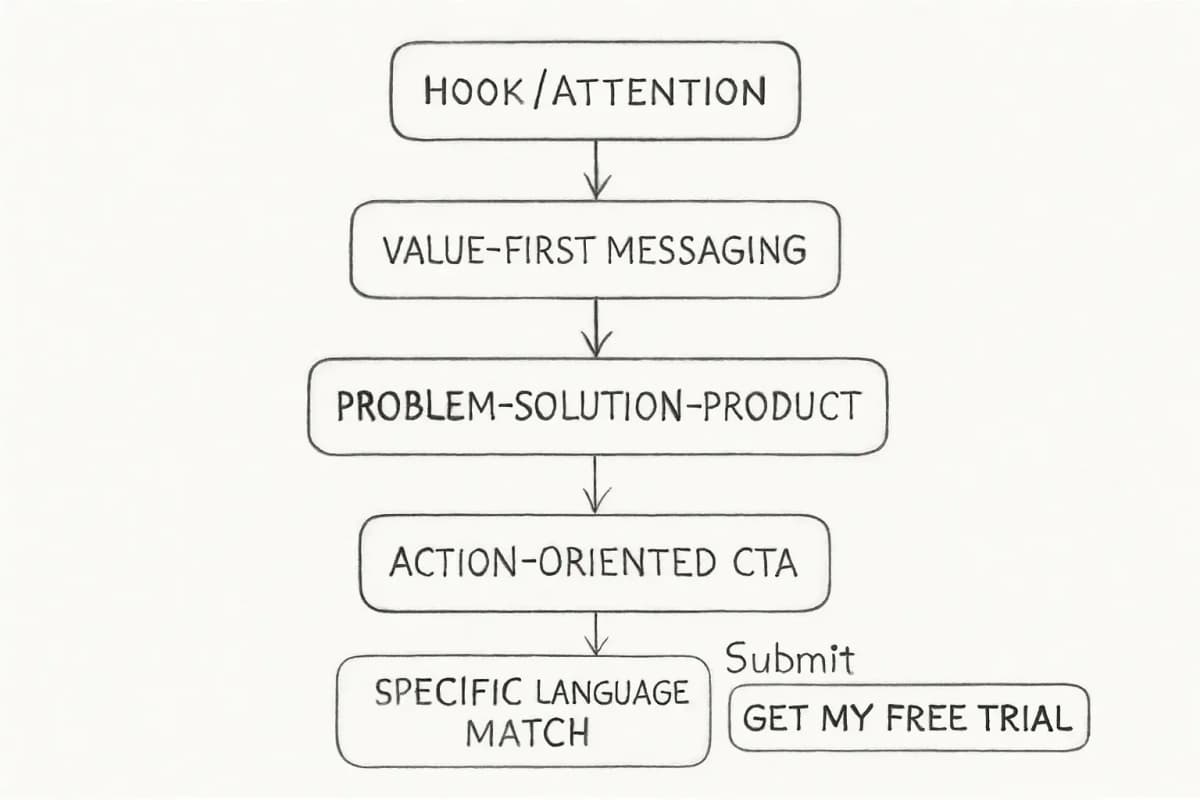
FTC Compliance and Affiliate Disclosure in Email
This is not optional. Not being transparent about affiliate marketing is not only illegal but unethical.
Regulatory bodies like the FTC monitor affiliate disclosures. The rule is straightforward: if money is exchanged because of your recommendation, you must disclose it.
The FTC can fine you up to $43,792 per violation, and every single undisclosed affiliate link could trigger a separate penalty.
In practice, your disclosure should appear at the top of the email, before the first affiliate link. It should be plain language, not buried in a footer. Something like: "This email contains affiliate links. If you purchase through them, I may earn a commission at no extra cost to you." That sentence takes three seconds to read and protects both you and your subscriber relationship.
Transparency about affiliate marketing not only keeps you legally protected, it also improves trust and click-through rate. Audiences who know you earn a commission and still read your email are far more likely to convert than audiences who feel deceived.
Metrics to Track in Affiliate Email Campaigns
Tracking the right data lets you know which emails drive commissions and which drain goodwill. Standard email metrics are necessary but not sufficient for affiliate programs.
The metrics that matter most:
- Click-through rate (CTR): In affiliate programs, CTR improvement directly impacts your earning potential because it increases the volume of qualified traffic you send to partners. By optimizing CTR, you are maximizing the return on your email list and building a more profitable affiliate business. The industry average CTR across all campaigns is approximately 2.09%.
- Revenue per email (RPE): Divide total affiliate commissions earned from a campaign by the number of emails delivered. This is your true monetization benchmark.
- Conversion rate by segment: The Data and Marketing Association found a 760% increase in email revenue from micro-segmentation. Tracking conversions by segment tells you which groups respond to which offer types.
- Unsubscribe rate per campaign: A spike here after an affiliate send signals the offer was a poor fit or the frequency was too high.
- Affiliate network stats: Open rates and clicks tell you what happened in the inbox. Your affiliate dashboard tells you what happened after the click. Both views are required.
Data is your compass in email marketing. Regularly monitor your campaign performance and analyze key metrics like open rates, CTRs, and conversions.
For a structured approach to interpreting these numbers, see our guide to email marketing analytics best practices.
Building a Sustainable Affiliate Email Program
A list that converts today but unsubscribes tomorrow has no long-term value. Sustainable affiliate email marketing requires balancing promotion with content your subscribers genuinely want.
Practical guidelines for long-term list health:
- Limit promotional frequency. A ratio of roughly 3 to 4 value-driven emails for every affiliate promotion works well for most audiences. Adjust based on your unsubscribe and engagement data.
- Only promote products you would recommend without a commission. This sounds obvious. It is violated constantly.
- Rotate offers. Repeating the same affiliate link every week trains subscribers to ignore it. Introduce new offers that match seasonal relevance or product launches.
- Use welcome sequences to set expectations. Tell new subscribers what kinds of recommendations they can expect from you. The brands that understand the importance of developing long-term relationships with their affiliates are the ones that see the best results. The same applies to your relationship with subscribers.
- Re-engage inactive segments before they become dead weight. A clean, engaged list with proper segmentation always outperforms a large, unfiltered one. Inactive subscribers and invalid addresses drag down CTR metrics and waste sending resources.
For guidance on structuring your first emails to new subscribers, our article on welcome email sequence best practices covers seven proven strategies that build trust from day one.
Frequently Asked Questions
Is affiliate email marketing legal?
Yes. Affiliate email marketing is legal when you follow FTC guidelines on disclosure, comply with CAN-SPAM regulations (including an unsubscribe mechanism and accurate sender information), and adhere to GDPR if you have subscribers in the EU. The legal risk comes from failing to disclose affiliate relationships, not from the practice itself.
How many affiliate links should I include per email?
One primary link per email is the standard recommendation. Multiple competing links dilute focus and reduce the likelihood that any single one gets clicked. If you need to reference multiple products, consider a dedicated "resources" or "tools" email where the multi-link format matches subscriber expectations.
Can I do affiliate email marketing without a large list?
Yes. List size matters far less than list quality and engagement. A highly segmented list of 2,000 engaged subscribers in a specific niche will almost always outperform a cold or generic list of 20,000. Focus on building a targeted, opt-in list and matching offers precisely to subscriber interests before scaling volume.
What is a realistic commission expectation from affiliate email marketing?
It varies significantly by niche, list engagement, and offer quality. The average affiliate marketing conversion rate is around 1 to 2%, though top affiliates can reach 5 to 10%. Applied to email, a list of 5,000 engaged subscribers, a 2% click rate, and a 2% conversion on the affiliate page would yield approximately two sales per send. Recurring SaaS commissions compound this over time. Track your revenue per email sent as your core metric, and optimize from there.