
HomeBlogEmail Automation & ToolsEmail Marketing AI Generator: Write Better Emails Fast
Email Automation & Tools

Email Marketing AI Generator: Write Better Emails Fast

Discover how AI email generators save time and boost open rates. Compare top tools, learn best practices, and automate your email content without losing your brand voice.

R

Rachel Torres

July 13, 2026

HomeBlogEmail Automation & ToolsEmail Marketing AI Generator: Write Better Emails Fast
Email Automation & Tools

Email Marketing AI Generator: Write Better Emails Fast

Discover how AI email generators save time and boost open rates. Compare top tools, learn best practices, and automate your email content without losing your brand voice.

R

Rachel Torres

July 13, 2026

15 min read
15 min read
Share:
Share:
#AI Tools#Email Content#Automation#Marketing Efficiency
Illustration for email marketing ai generator

Stay in the loop

Get the latest posts delivered straight to your inbox. No spam, unsubscribe anytime.

An email marketing AI generator is no longer a novelty for tech-forward teams. It is now the practical starting point for marketers who need to write more emails, write them faster, and make each one work harder. Approximately 47% of email marketers already use AI to generate their campaigns, and over 51% believe AI-supported email marketing outperforms traditional methods. If you are still writing every campaign manually from a blank page, you are spending time your competitors have already automated.

This guide covers what an email marketing AI generator actually does, which tools are worth your time, what the performance data says, and how to use these tools without producing generic output that kills engagement.


Key Takeaways

  • AI-driven email marketing results in a 13% boost in click-through rates.
  • Organizations using AI to generate and optimize subject lines see a 26% increase in open rates compared to manually written alternatives.
  • There was a 340% increase in marketers using generative AI in 2025, and the productivity gains are real: in 2024, 62% of teams needed two weeks or more to produce a single email. By 2025, that number dropped to only 6%.
  • AI-driven email marketing leads to a 41% rise in revenue, proving the measurable effect of AI on campaign performance.
  • 87% of marketing teams use AI for email, but only 6% qualify as high performers. The gap is not the tools; it is the workflow.

What an Email Marketing AI Generator Actually Does

An email marketing AI generator uses large language models (LLMs) and machine learning to produce email copy, subject lines, preview text, and full campaign sequences based on prompts or behavioral data. It is not magic, and it is not a replacement for strategy.

AI email marketing is the use of artificial intelligence in email marketing tasks. For example, AI can predict the best time to send an email and which products to recommend. It can also write emails and build automated workflows. As a result, you can spend less time on email marketing activities while getting better results, including higher open rates and increased revenue.

There are two primary types of AI at work in modern email platforms:

Stay in the loop

Get the latest posts delivered straight to your inbox. No spam, unsubscribe anytime.

An email marketing AI generator is no longer a novelty for tech-forward teams. It is now the practical starting point for marketers who need to write more emails, write them faster, and make each one work harder. Approximately 47% of email marketers already use AI to generate their campaigns, and over 51% believe AI-supported email marketing outperforms traditional methods. If you are still writing every campaign manually from a blank page, you are spending time your competitors have already automated.

This guide covers what an email marketing AI generator actually does, which tools are worth your time, what the performance data says, and how to use these tools without producing generic output that kills engagement.


Key Takeaways

  • AI-driven email marketing results in a 13% boost in click-through rates.
  • Organizations using AI to generate and optimize subject lines see a 26% increase in open rates compared to manually written alternatives.
  • There was a 340% increase in marketers using generative AI in 2025, and the productivity gains are real: in 2024, 62% of teams needed two weeks or more to produce a single email. By 2025, that number dropped to only 6%.
  • AI-driven email marketing leads to a 41% rise in revenue, proving the measurable effect of AI on campaign performance.
  • 87% of marketing teams use AI for email, but only 6% qualify as high performers. The gap is not the tools; it is the workflow.

What an Email Marketing AI Generator Actually Does

An email marketing AI generator uses large language models (LLMs) and machine learning to produce email copy, subject lines, preview text, and full campaign sequences based on prompts or behavioral data. It is not magic, and it is not a replacement for strategy.

AI email marketing is the use of artificial intelligence in email marketing tasks. For example, AI can predict the best time to send an email and which products to recommend. It can also write emails and build automated workflows. As a result, you can spend less time on email marketing activities while getting better results, including higher open rates and increased revenue.

There are two primary types of AI at work in modern email platforms:

  • Generative AI: Creates subject lines, preview text, body copy, and CTAs from prompts or campaign briefs.
  • Predictive AI: Analyzes behavioral data to determine the best send time, most likely audience segment, and highest-performing content variant.
  • Predictive AI analyzes behavioral data to determine when to send, who to send to, and which segment a contact belongs in. Generative AI creates the subject lines, preview text, and body copy. Combining both outperforms using either alone by addressing timing, audience, and message simultaneously.

    Most platforms today bundle both. Standalone AI writing tools like Jasper or Copy.ai handle content creation, while full ESPs like Klaviyo, ActiveCampaign, and Mailchimp combine generative and predictive capabilities inside one platform.


    The Performance Case for AI-Generated Emails

    The data supporting AI in email marketing is consistent across multiple independent sources.

    Automated emails generate 320% more revenue compared to non-automated emails. That figure alone justifies the shift from manual campaign production.

    Email marketing delivers an average return of $36 to $42 per dollar spent in 2026, outperforming paid search, social advertising, and display ads. Layer AI personalization on top of that foundation, and the returns compound.

    The gap between email and other channels is widening as AI personalization lifts per-send revenue by 17 to 26%.

    Subject line performance is where AI shows the clearest lift. Organizations using AI to generate and optimize subject lines see a 26% increase in open rates compared to manually written alternatives, and the advantage compounds with dynamic send-time optimization, which adds another 14% lift when combined with AI subject lines.

    For deeper reading on email subject line best practices that drive open rates, the fundamentals of structure and intent still apply even when AI is drafting the copy.

    Send-time optimization is the other major lever. Predictive send-time optimization calculates the individual open probability window for each subscriber based on historical behavior. Sending to each subscriber at their personal optimal time consistently produces 20 to 30 percent open rate improvements across industries.

    The compounding effect is significant. Send-time optimization might lift open rates 20 to 30%. Personalized subject lines might lift open rates another 15 to 20%. Personalized body copy might lift click-through rates 10 to 15%. Each improvement compounds on the others: more opens from timing means more people see the personalized subject line, and more clicks from personalized copy produce more conversions.


    The Best Email Marketing AI Generator Tools by Use Case

    Not all tools are built for the same job. Here is how to match the tool to your situation.

    For ecommerce brands: Klaviyo

    Klaviyo is strongest when AI copy should pull from product, purchase, and customer behavior data. It is the better fit for abandoned cart, replenishment, product recommendation, and VIP flows.

  • Generative AI: Creates subject lines, preview text, body copy, and CTAs from prompts or campaign briefs.
  • Predictive AI: Analyzes behavioral data to determine the best send time, most likely audience segment, and highest-performing content variant.
  • Predictive AI analyzes behavioral data to determine when to send, who to send to, and which segment a contact belongs in. Generative AI creates the subject lines, preview text, and body copy. Combining both outperforms using either alone by addressing timing, audience, and message simultaneously.

    Most platforms today bundle both. Standalone AI writing tools like Jasper or Copy.ai handle content creation, while full ESPs like Klaviyo, ActiveCampaign, and Mailchimp combine generative and predictive capabilities inside one platform.


    The Performance Case for AI-Generated Emails

    The data supporting AI in email marketing is consistent across multiple independent sources.

    Automated emails generate 320% more revenue compared to non-automated emails. That figure alone justifies the shift from manual campaign production.

    Email marketing delivers an average return of $36 to $42 per dollar spent in 2026, outperforming paid search, social advertising, and display ads. Layer AI personalization on top of that foundation, and the returns compound.

    The gap between email and other channels is widening as AI personalization lifts per-send revenue by 17 to 26%.

    Subject line performance is where AI shows the clearest lift. Organizations using AI to generate and optimize subject lines see a 26% increase in open rates compared to manually written alternatives, and the advantage compounds with dynamic send-time optimization, which adds another 14% lift when combined with AI subject lines.

    For deeper reading on email subject line best practices that drive open rates, the fundamentals of structure and intent still apply even when AI is drafting the copy.

    Send-time optimization is the other major lever. Predictive send-time optimization calculates the individual open probability window for each subscriber based on historical behavior. Sending to each subscriber at their personal optimal time consistently produces 20 to 30 percent open rate improvements across industries.

    The compounding effect is significant. Send-time optimization might lift open rates 20 to 30%. Personalized subject lines might lift open rates another 15 to 20%. Personalized body copy might lift click-through rates 10 to 15%. Each improvement compounds on the others: more opens from timing means more people see the personalized subject line, and more clicks from personalized copy produce more conversions.


    The Best Email Marketing AI Generator Tools by Use Case

    Not all tools are built for the same job. Here is how to match the tool to your situation.

    For ecommerce brands: Klaviyo

    Klaviyo is strongest when AI copy should pull from product, purchase, and customer behavior data. It is the better fit for abandoned cart, replenishment, product recommendation, and VIP flows.

    Klaviyo's AI toolkit, called K:AI, gives you predictive analytics for customer lifetime value and churn risk. This helps you spot your best customers and those who might be about to stop buying. It integrates deeply with Shopify, which allows it to generate personalized product recommendations based on browsing history and past purchases.

    For small teams and beginners: Mailchimp

    Mailchimp's Intuit Assist brings generative AI into automation flow templates and creates designed emails for welcome, abandoned cart, and win-back sequences. Mailchimp's value comes from speed: you can go from idea to sendable, on-brand journeys quickly and iterate from there.

    For brand-consistent content at scale: Jasper

    Jasper is a full-stack AI content platform that generates marketing copy across channels, including email campaigns, subject lines, nurture sequences, and landing pages. It is not an email-only tool. It is a content engine that happens to be very good at email because it understands brand voice and can maintain consistency across every touchpoint in a campaign.

    Jasper's Brand Voice feature lets you train the AI on your company's tone, terminology, and messaging guidelines so every piece of content, including emails, sounds like it came from the same team.

    For B2B and complex sales cycles: ActiveCampaign

    ActiveCampaign offers workflow-aware AI content generation within an automation context. ActiveCampaign is the tool of choice if you need complex automations and "next-step" logic tied to CRM data.

    For data-driven copy optimization: Anyword

    Anyword focuses on data-driven optimization, performance predictions, and custom brand models. It scores copy variants before you send, which reduces the guesswork in A/B testing.


    How to Use an Email Marketing AI Generator Without Sounding Like a Robot

    95% of marketers who use generative AI for email content creation say it is effective. But the quality gap between average and high-performing AI-assisted email is enormous, and it comes down to how you use the tool.

    Here is a practical workflow that produces better output:

    Klaviyo's AI toolkit, called K:AI, gives you predictive analytics for customer lifetime value and churn risk. This helps you spot your best customers and those who might be about to stop buying. It integrates deeply with Shopify, which allows it to generate personalized product recommendations based on browsing history and past purchases.

    For small teams and beginners: Mailchimp

    Mailchimp's Intuit Assist brings generative AI into automation flow templates and creates designed emails for welcome, abandoned cart, and win-back sequences. Mailchimp's value comes from speed: you can go from idea to sendable, on-brand journeys quickly and iterate from there.

    For brand-consistent content at scale: Jasper

    Jasper is a full-stack AI content platform that generates marketing copy across channels, including email campaigns, subject lines, nurture sequences, and landing pages. It is not an email-only tool. It is a content engine that happens to be very good at email because it understands brand voice and can maintain consistency across every touchpoint in a campaign.

    Jasper's Brand Voice feature lets you train the AI on your company's tone, terminology, and messaging guidelines so every piece of content, including emails, sounds like it came from the same team.

    For B2B and complex sales cycles: ActiveCampaign

    ActiveCampaign offers workflow-aware AI content generation within an automation context. ActiveCampaign is the tool of choice if you need complex automations and "next-step" logic tied to CRM data.

    For data-driven copy optimization: Anyword

    Anyword focuses on data-driven optimization, performance predictions, and custom brand models. It scores copy variants before you send, which reduces the guesswork in A/B testing.


    How to Use an Email Marketing AI Generator Without Sounding Like a Robot

    95% of marketers who use generative AI for email content creation say it is effective. But the quality gap between average and high-performing AI-assisted email is enormous, and it comes down to how you use the tool.

    Here is a practical workflow that produces better output:

    1. Start with a specific brief. Vague prompts produce vague copy. Specify the audience segment, the goal of the email, the one action you want the reader to take, and the tone. The more context you give the generator, the less editing you do after.
    2. Generate multiple variants. AI subject line generators produce 10 to 50 variants, test them against historical performance data, and pick the winner before the full send rolls out. Apply the same logic to body copy: generate three to five versions and identify what is working before committing.
    3. Edit for brand voice. Recipients do not care whether you used AI; they care if it reads like AI. Stiff personalization, formal spelling, and formulaic structures break trust and make your message feel like spam. Edit the draft to match how your brand actually talks.
    4. Use AI as a first draft, not a final draft. Always review and edit the content generated by an AI email writer. Think of the AI as your first draft writer: it gets the ball rolling, but you are the editor. Make sure the output aligns with your specific goals and resonates with your target audience.
    5. Train the tool on your existing content. Jasper supports brand voice training: feed it your existing emails and brand guidelines, and it generates content that matches your style. For teams that need consistent brand voice across many emails, this is valuable.
    6. Test continuously. The compounding effect of systematic testing is significant. If you test subject lines on every campaign (two to four per month) and improve open rates by two to three percent per test, within six months your baseline open rate will be 12 to 18 percent higher than where you started.
    1. Start with a specific brief. Vague prompts produce vague copy. Specify the audience segment, the goal of the email, the one action you want the reader to take, and the tone. The more context you give the generator, the less editing you do after.
    2. Generate multiple variants. AI subject line generators produce 10 to 50 variants, test them against historical performance data, and pick the winner before the full send rolls out. Apply the same logic to body copy: generate three to five versions and identify what is working before committing.
    3. Edit for brand voice. Recipients do not care whether you used AI; they care if it reads like AI. Stiff personalization, formal spelling, and formulaic structures break trust and make your message feel like spam. Edit the draft to match how your brand actually talks.
    4. Use AI as a first draft, not a final draft. Always review and edit the content generated by an AI email writer. Think of the AI as your first draft writer: it gets the ball rolling, but you are the editor. Make sure the output aligns with your specific goals and resonates with your target audience.
    5. Train the tool on your existing content. Jasper supports brand voice training: feed it your existing emails and brand guidelines, and it generates content that matches your style. For teams that need consistent brand voice across many emails, this is valuable.
    6. Test continuously. The compounding effect of systematic testing is significant. If you test subject lines on every campaign (two to four per month) and improve open rates by two to three percent per test, within six months your baseline open rate will be 12 to 18 percent higher than where you started.

    AI Personalization and Segmentation: Where the Revenue Is

    Segmented campaigns generate 760% more revenue than non-segmented campaigns. AI makes deeper segmentation practical for teams without a dedicated data analyst.

    Manual segmentation usually means "active vs. inactive" or "bought vs. didn't buy." AI segmentation clusters subscribers by purchase recency, browse behavior, email engagement velocity, and predicted lifetime value.

    A real-world example of AI personalization at scale: crafts retailer Michaels Stores incorporated generative AI into its messaging campaigns, using it to write emails and SMS communications for customer engagement. As a result, it scaled email personalization from 20% to 95%, leading to a 25% rise in click-through rates.

    This is the type of result that moves the ROI needle, not just writing speed. For a closer look at how segmentation drives revenue, see email list segmentation strategies that boost ROI.

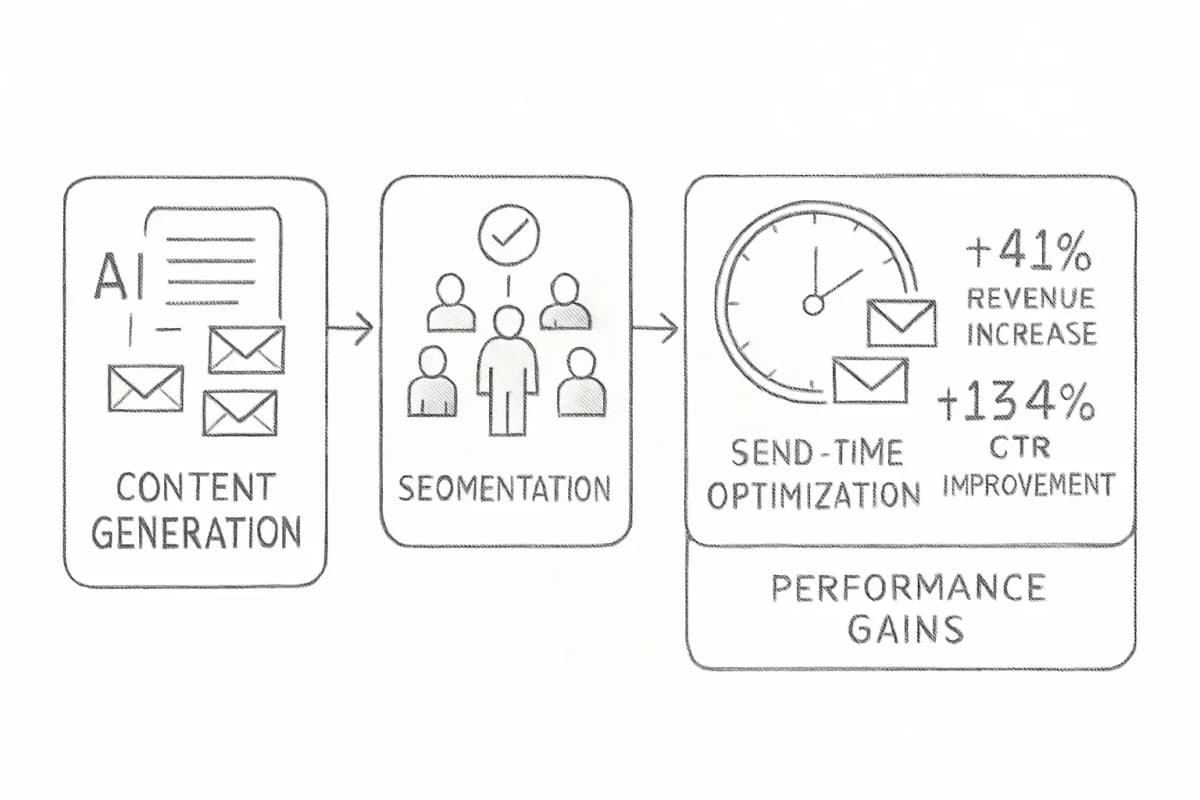
    When combined with AI personalization, the results compound further. Marketers implementing AI-powered personalization report substantial performance improvements, with revenue increasing by 41% and click-through rates rising 13.44% compared to non-personalized campaigns. AI email marketing workflow diagram showing three connected stages in a horizontal flow. Stage 1 labeled 'Content Generation' shows AI writing multiple email variations. Stage 2 labeled 'Segmentation' shows audience division into different subscriber groups based on behavior and preferences. Stage 3 labeled 'Send-time Optimization' shows emails being delivered at the optimal moment for each segment. Include visual indicators of performance metrics (41% revenue increase, 13.44% CTR improvement) appearing after the send-time optimization stage to show the compounding results of combining these AI capabilities.

    Limitations to Know Before You Rely on AI

    The adoption numbers are impressive, but the performance distribution is uneven. 87% of marketing teams use AI for email, but only 6% qualify as high performers. The gap is not the tools: it is the workflow.

    There are genuine risks to manage:

    • Hallucinations and off-brand content. More than 70% of marketers have encountered an AI-related incident including hallucinations, bias, or off-brand content. Always review AI-generated copy before sending.
    • Generic output at scale. When everyone uses the same tools with similar prompts, emails start to look alike. Differentiation comes from the inputs: your data, your audience knowledge, your brand voice.
    • Compliance requirements. Data protection laws like GDPR and CCPA require businesses that use AI for email marketing to implement double opt-in methods and promote transparency in how customer data is collected, stored, and used.
    • Over-reliance on automation. AI accelerates drafts, testing, and targeting, but humans set strategy, ensure brand voice and accuracy, and integrate email with the broader customer journey.

    AI Personalization and Segmentation: Where the Revenue Is

    Segmented campaigns generate 760% more revenue than non-segmented campaigns. AI makes deeper segmentation practical for teams without a dedicated data analyst.

    Manual segmentation usually means "active vs. inactive" or "bought vs. didn't buy." AI segmentation clusters subscribers by purchase recency, browse behavior, email engagement velocity, and predicted lifetime value.

    A real-world example of AI personalization at scale: crafts retailer Michaels Stores incorporated generative AI into its messaging campaigns, using it to write emails and SMS communications for customer engagement. As a result, it scaled email personalization from 20% to 95%, leading to a 25% rise in click-through rates.

    This is the type of result that moves the ROI needle, not just writing speed. For a closer look at how segmentation drives revenue, see email list segmentation strategies that boost ROI.

    When combined with AI personalization, the results compound further. Marketers implementing AI-powered personalization report substantial performance improvements, with revenue increasing by 41% and click-through rates rising 13.44% compared to non-personalized campaigns. AI email marketing workflow diagram showing three connected stages in a horizontal flow. Stage 1 labeled 'Content Generation' shows AI writing multiple email variations. Stage 2 labeled 'Segmentation' shows audience division into different subscriber groups based on behavior and preferences. Stage 3 labeled 'Send-time Optimization' shows emails being delivered at the optimal moment for each segment. Include visual indicators of performance metrics (41% revenue increase, 13.44% CTR improvement) appearing after the send-time optimization stage to show the compounding results of combining these AI capabilities.


    Limitations to Know Before You Rely on AI

    The adoption numbers are impressive, but the performance distribution is uneven. 87% of marketing teams use AI for email, but only 6% qualify as high performers. The gap is not the tools: it is the workflow.

    There are genuine risks to manage:

    • Hallucinations and off-brand content. More than 70% of marketers have encountered an AI-related incident including hallucinations, bias, or off-brand content. Always review AI-generated copy before sending.
    • Generic output at scale. When everyone uses the same tools with similar prompts, emails start to look alike. Differentiation comes from the inputs: your data, your audience knowledge, your brand voice.
    • Compliance requirements. Data protection laws like GDPR and CCPA require businesses that use AI for email marketing to implement double opt-in methods and promote transparency in how customer data is collected, stored, and used.
    • Over-reliance on automation. AI accelerates drafts, testing, and targeting, but humans set strategy, ensure brand voice and accuracy, and integrate email with the broader customer journey.

    For teams building out their full AI-assisted marketing approach, how to leverage AI in your email marketing covers the strategic layer that tools alone cannot replace.


    Building an AI Email Workflow That Compounds Over Time

    The teams getting the most from an email marketing AI generator are not just using it to write faster. They have restructured their workflow around what AI makes possible.

    70% of email marketers say that up to half of their email marketing operations will be AI-driven by the end of 2026. The shift is already underway. The question is whether your team is building a system or just using a feature.

    A compounding AI email workflow looks like this:

    • Use AI to generate copy and subject line variants for every send.
    • Use predictive send-time optimization to reach each subscriber at their personal best time.
    • Use AI segmentation to build behavioral clusters that would take days to create manually.
    • Run continuous A/B tests and feed results back into your prompts and brand voice training.
    • Measure not just opens and clicks, but revenue per send, conversion rate, and list health.

    Track specific metrics before and after implementation: open rates, click-through rates, conversion rates, time spent on email creation, and revenue per email. Without measurement, you cannot separate what the AI is contributing from what was already working.


    Frequently Asked Questions

    What is an email marketing AI generator?

    An email marketing AI generator is a software tool that uses artificial intelligence, typically large language models and machine learning, to create email copy including subject lines, preview text, body content, and calls-to-action. Email marketing tasks that can be done quicker with AI include email content creation (generating text such as subject lines, headings, CTAs, or entire newsletters) and backend setup, where instead of manually building contact segments and automated email funnels, you tell AI the outcome you want to achieve and it builds the segment or automation for you.

    Does AI-generated email copy actually perform better?

    AI-generated subject lines increase open rates by up to 22%, with typical improvements of 5 to 10%. AI-generated emails achieve a 9.44% CTR versus 8.46% for human-written, an 11% improvement. Performance depends heavily on the quality of inputs, how well the tool is trained on your brand voice, and how much human editing goes into the final output.

    Which email marketing AI generator is best for a small business?

    For teams building out their full AI-assisted marketing approach, how to leverage AI in your email marketing covers the strategic layer that tools alone cannot replace.


    Building an AI Email Workflow That Compounds Over Time

    The teams getting the most from an email marketing AI generator are not just using it to write faster. They have restructured their workflow around what AI makes possible.

    70% of email marketers say that up to half of their email marketing operations will be AI-driven by the end of 2026. The shift is already underway. The question is whether your team is building a system or just using a feature.

    A compounding AI email workflow looks like this:

    • Use AI to generate copy and subject line variants for every send.
    • Use predictive send-time optimization to reach each subscriber at their personal best time.
    • Use AI segmentation to build behavioral clusters that would take days to create manually.
    • Run continuous A/B tests and feed results back into your prompts and brand voice training.
    • Measure not just opens and clicks, but revenue per send, conversion rate, and list health.

    Track specific metrics before and after implementation: open rates, click-through rates, conversion rates, time spent on email creation, and revenue per email. Without measurement, you cannot separate what the AI is contributing from what was already working.


    Frequently Asked Questions

    What is an email marketing AI generator?

    An email marketing AI generator is a software tool that uses artificial intelligence, typically large language models and machine learning, to create email copy including subject lines, preview text, body content, and calls-to-action. Email marketing tasks that can be done quicker with AI include email content creation (generating text such as subject lines, headings, CTAs, or entire newsletters) and backend setup, where instead of manually building contact segments and automated email funnels, you tell AI the outcome you want to achieve and it builds the segment or automation for you.

    Does AI-generated email copy actually perform better?

    AI-generated subject lines increase open rates by up to 22%, with typical improvements of 5 to 10%. AI-generated emails achieve a 9.44% CTR versus 8.46% for human-written, an 11% improvement. Performance depends heavily on the quality of inputs, how well the tool is trained on your brand voice, and how much human editing goes into the final output.

    Which email marketing AI generator is best for a small business?

    Mailchimp is a good all-around option for small businesses, bloggers, and creators who need something simple and effective. It includes AI content tools, send-time optimization, and basic segmentation on accessible pricing tiers. Mailchimp is a good fit for small teams that need simple templates and basic AI assists. For ecommerce-focused small businesses, Klaviyo and Omnisend offer stronger behavioral automation at comparable entry-level costs.

    How do I avoid AI-generated emails that sound generic?

    The fix is in the prompt and the edit. Success comes from using verified data, focusing on small audiences, and creating clear, trustworthy, and human-sounding messages. Train your AI tool on existing high-performing emails, give it specific context about your audience and their situation, and edit every draft before sending. Tools using GPT-4 and Claude 3 with brand voice training generate remarkably human copy. The key is treating AI as a collaborator, not a replacement: use AI for drafts and structure, then add your unique insights.


    Mailchimp is a good all-around option for small businesses, bloggers, and creators who need something simple and effective. It includes AI content tools, send-time optimization, and basic segmentation on accessible pricing tiers. Mailchimp is a good fit for small teams that need simple templates and basic AI assists. For ecommerce-focused small businesses, Klaviyo and Omnisend offer stronger behavioral automation at comparable entry-level costs.

    How do I avoid AI-generated emails that sound generic?

    The fix is in the prompt and the edit. Success comes from using verified data, focusing on small audiences, and creating clear, trustworthy, and human-sounding messages. Train your AI tool on existing high-performing emails, give it specific context about your audience and their situation, and edit every draft before sending. Tools using GPT-4 and Claude 3 with brand voice training generate remarkably human copy. The key is treating AI as a collaborator, not a replacement: use AI for drafts and structure, then add your unique insights.

    No comments yet. Be the first!

    Leave a comment

    Comments are reviewed before publishing.

    No comments yet. Be the first!

    Leave a comment

    Comments are reviewed before publishing.