
An email marketing automation course is one of the most direct investments a marketer or business owner can make in measurable revenue growth. Automation is not just a time-saver. It is a revenue engine. In 2024, automated emails drove 37% of all email-generated sales despite accounting for just 2% of total email volume. If your team is still building sequences manually, every day without automation is leaving predictable revenue on the table.
This guide breaks down what an email marketing automation course actually teaches, which skills produce the highest returns, and how to apply those skills from day one.
Key Takeaways
- Automated emails generate 320% more revenue than non-automated emails.
- Welcome and abandoned cart emails alone make up 76% of all automation-related orders.
- Marketing automation courses teach email marketing strategy, customer segmentation, lead nurturing, campaign analytics, and how to build automated workflows that optimize conversion rates.
- A/B testing, a core skill taught in any credible course, can increase email marketing ROI by 83%.
- 76% of companies that invest in marketing automation generate positive ROI within the first year.
Why Automation Skills Pay Off Faster Than Any Other Email Skill
Most marketers underestimate the gap between a manually sent campaign and a well-built automated workflow. The numbers are stark.
Automated email flows, including abandoned cart and post-purchase messages, generate up to 30 times more revenue per recipient compared to standard email campaigns, largely because of their targeted nature, addressing specific customer behaviors at critical points in the customer journey.
One in three people who click on an automated message make a purchase, compared to just one in 18 for scheduled campaign messages. That conversion rate difference alone justifies dedicating serious learning time to automation.
For every dollar spent on marketing automation, companies see an average ROI of $5.44 in the first three years, and the global marketing automation market reached $6.65 billion in 2024, projected to grow to $15.58 billion by 2030. The business world is moving fast in this direction, and the skill gap remains wide.
What a Good Email Marketing Automation Course Actually Covers
Marketing automation courses help you learn email marketing strategies, customer segmentation, lead nurturing, and campaign analytics, with practical skills in building automated workflows, optimizing conversion rates, and analyzing customer behavior to enhance engagement.
A course worth your time will cover these core skill areas:
1. Workflow architecture and trigger logic
Email marketing automation is a technology that sends targeted email messages to subscribers automatically based on predefined triggers, behaviors, or schedules, so the system responds to customer actions without human intervention. Knowing how to design those trigger paths correctly is what separates effective automation from sequences that annoy subscribers.
Common triggers include signup events, purchase completions, cart abandonment, link clicks, email opens, website behavior, date-based events, and engagement patterns. Behavioral triggers typically perform better than time-based triggers for conversion rates.
2. Sequence structure and timing
Sequence length depends on the goal: welcome series typically run 3 to 5 emails over 1 to 2 weeks, abandoned cart sequences use 3 to 4 emails over 7 to 10 days, and nurture campaigns can extend 8 to 12 emails over several months with proper spacing.
3. Platform fluency
Many courses introduce tools like HubSpot, Marketo, and Mailchimp that support implementing automation strategies and measuring their effectiveness in real time. Platform-specific hands-on practice matters far more than theory.
4. Segmentation as the foundation
Every successful email marketing automation campaign framework is built on a foundation of three underlying layers: segmentation, personalization, and automation. A course that skips segmentation is incomplete. You can also explore email list segmentation strategies that boost ROI by 760% to deepen this skill alongside your coursework.
5. Deliverability and sender reputation
Email list building and cleaning are critical responsibilities for email marketers. As an email list grows, deliverability may decline. High bounce rates and spam complaints can harm sender reputation over time, making it essential to remove inactive or incorrect email addresses regularly.
The Core Automation Workflows Every Marketer Should Build First
Learning automation in the abstract is far less useful than knowing which specific workflows to build and why.
Automated emails made up just 2% of sends in 2025, with a staggering 30% revenue capture and 16x more revenue per send than scheduled campaigns.
Here are the workflows that produce the most reliable results:
- Welcome series. Welcome emails achieve an 83.6% open rate in ecommerce, the highest of any automated email type. A welcome sequence is always the first workflow to build.
- Abandoned cart recovery. Abandoned cart emails achieve an average click-through rate of 23.33%, the single highest-performing email type by click engagement across all automation types.
- Post-purchase nurture. The top 10% of email automations by performance earn $16.96 per recipient, compared to $0.95 for the top standard campaigns.
- Re-engagement sequences. These target inactive subscribers before they damage your deliverability score by lowering open rates across your list.
- Behavioral lead nurture. A B2B email marketing automation workflow is a structured sequence of emails triggered by user actions or data signals, designed to support lead nurturing, sales follow-ups, onboarding, and long buying cycles.
For teams running a CRM alongside their email platform, the email marketing automation CRM setup guide covers how to connect these systems so your behavioral triggers fire accurately. 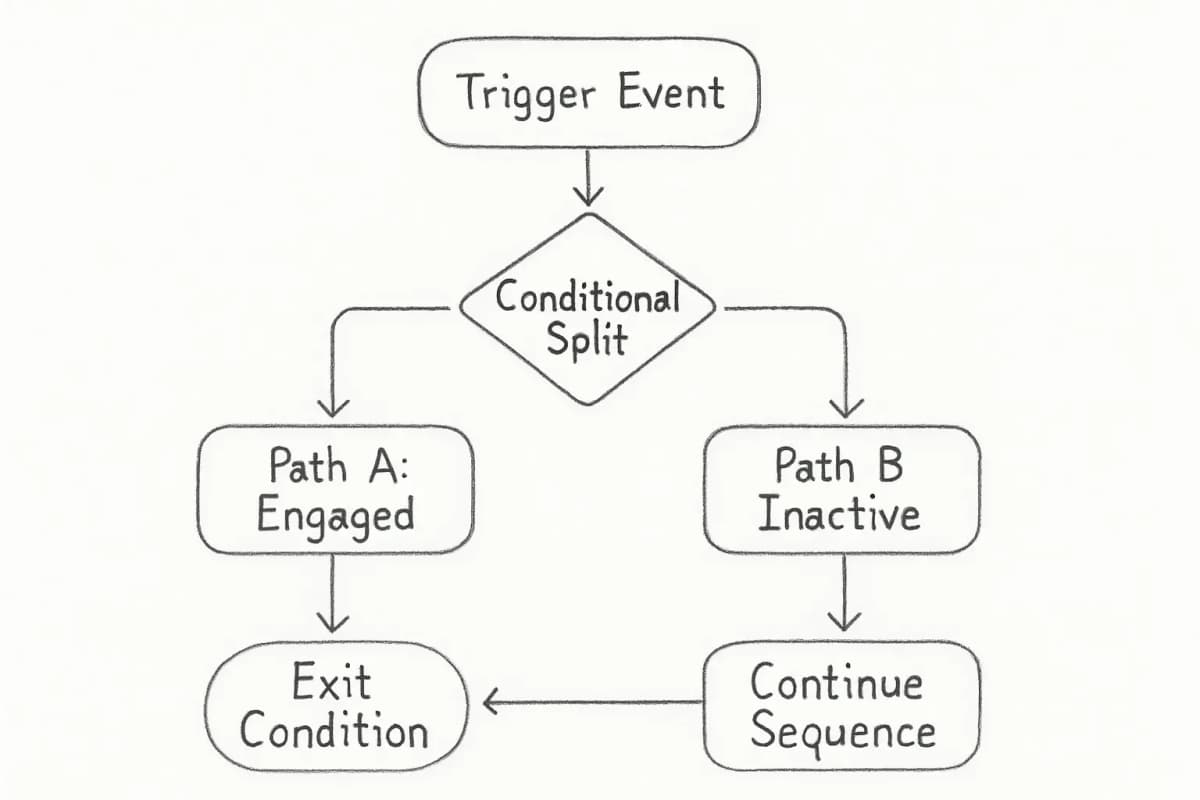
Segmentation and Personalization: The Skills That Compound Over Time
Automation without segmentation produces irrelevant messages at scale. That is worse than sending nothing.
Combining segmentation and personalization leads to better audience engagement, which sends positive signals to ISPs. That positive sender reputation keeps you out of the spam folder, meaning more people see your message.
Most email segmentation strategies fall into four categories: demographic, behavioral, lifecycle stage, and abandoned cart. A strong automation course teaches you to move beyond demographic-only segmentation into behavioral data, which is where the real performance gains live.
Effective segmentation goes beyond demographics to behavioral patterns, purchase history, and engagement levels. Dynamic segmentation updates subscriber groups based on real-time behavior.
Personalization compounds these gains further. 58% of revenue generated from email marketing is attributed to targeted and personalized campaigns. Even a small improvement in relevance at the segment level has a measurable revenue effect across a full list.
For practical techniques, the guide on email personalization techniques that boost conversions by 47% pairs well with any automation course curriculum.
Analytics: Knowing Which Numbers Actually Drive Decisions
A common gap in email marketing teams is the ability to build automation versus the ability to measure and improve it. A credible email marketing automation course covers both.
Metrics to gauge the effectiveness of segmentation and automation workflows include delivery and deliverability rate, which measures how many emails reach the primary inbox versus spam, open rates, click-through rates, conversion rates, and unsubscribe rates.
Beyond basic metrics, these patterns signal whether your automation is working:
- A/B testing can increase email marketing ROI by 83%. Businesses that never A/B test report an average ROI of 2300%, versus 4200% for those that often A/B test.
- Send welcome emails immediately, cart recovery emails within one to four hours, and nurture sequences every two to three days. Timing, tested against your actual audience, matters at least as much as copy.
- Skip vanity metrics. Connect email engagement to actual revenue, track sequence performance, and optimize based on real customer behavior.
The email marketing analytics best practices resource covers how to structure your measurement framework so every optimization decision is grounded in data.
Certifications Worth Considering
Not all certifications carry equal weight. Some teach platform-specific mechanics. Others provide transferable strategic knowledge.
The Certified Email Marketer (CEM) credential is one of the most respected vendor-neutral certifications in the email marketing industry. It covers deliverability, list hygiene, compliance with CAN-SPAM and GDPR, campaign strategy, analytics, and ethics.
HubSpot's advanced certification builds on foundational knowledge, diving deeper into marketing automation, lead nurturing, A/B testing, and advanced personalization techniques. It is ideal for those already using HubSpot who want to master more sophisticated features.
Course pricing ranges from free options at HubSpot and Google to $445 from DMI and $495 from DigitalMarketer. Time investment ranges from four hours to several days.
The right choice depends on your current platform and career focus. For those in B2B contexts, Adobe's Marketo certification is ideal for B2B email marketers and those working in enterprise environments, covering campaign setup, list management, personalization, and email best practices.
For teams building more advanced AI-driven systems, the email marketing automation tips guide covers nine practical ways to extend what you learn in a course into production workflows.
Applying Course Skills: A Practical Starting Framework
The gap between completing a course and producing results in production is real. Here is how to close it.
- Start with a welcome sequence. It has the highest baseline engagement and gives you immediate feedback on your trigger and copy decisions.
- Add abandoned cart recovery next. The revenue-per-email potential here is the highest of any standard workflow, and the setup is straightforward on most platforms.
- Build a behavioral segmentation layer. Tag subscribers based on their actions: pages visited, links clicked, products viewed. These tags power every advanced workflow you build after.
- Test systematically. A/B test subject lines, send times, content variations, and personalization depth, with a minimum of 1,000 contacts per variant for statistical significance.
- Monitor and optimize: review performance monthly, implement quarterly improvements, and conduct annual strategic overhauls based on customer behavior changes.
Even the best automation fails if emails land in spam. Use proper warm-up techniques and monitor your sending reputation to maintain inbox placement. Deliverability is not an afterthought, it is a prerequisite.
Frequently Asked Questions
What does an email marketing automation course teach?
Marketing automation courses teach email marketing strategies, customer segmentation, lead nurturing, and campaign analytics, with practical skills in creating automated workflows, optimizing conversion rates, and analyzing customer behavior to enhance engagement. Most courses also cover platform-specific tools and compliance requirements like CAN-SPAM and GDPR.
How long does it take to see results from email automation?
76% of companies that invest in marketing automation generate positive ROI within the first year. Simpler workflows like welcome sequences and abandoned cart emails typically show measurable results within the first month of deployment, assuming your list is engaged and your deliverability is healthy.
Which automation workflows should I build first?
Welcome and abandoned cart emails make up 76% of all automation-related orders. These are the two highest-priority workflows for any team getting started. Once those are running, post-purchase nurture and re-engagement sequences should follow.
Is an email marketing automation course worth the investment?
Automated emails generate 320% more revenue than non-automated emails. Given that gap, structured training that accelerates your ability to build and optimize automated workflows pays for itself quickly, particularly for teams managing lists above a few thousand subscribers. The cost of not learning automation compounds over every campaign cycle.