
Email marketing automation is one of the highest-leverage investments available to growth-focused businesses in 2025. Automated emails generate 320% more revenue than non-automated emails. When you layer a well-structured automation strategy on top of solid SEO fundamentals, the compounding effect on organic traffic, list growth, and revenue is significant. This guide covers exactly how email marketing automation and SEO work together in 2025, what the data says about each, and the specific steps you can take to make both channels reinforce each other.
Key Takeaways
- Email marketing delivers a return of between $36 and $42 for every $1 spent, the highest ROI of any digital marketing channel.
- Automated emails generate 320% more revenue than non-automated emails, making automation a core revenue driver, not just a time-saver.
- In 2025, SEO is no longer an isolated discipline. Companies that integrate SEO and automation into a unified strategy are seeing a 30% increase in organic traffic and a 20% reduction in customer acquisition costs.
- According to 39% of marketers, AI-driven hyper-personalization will have the biggest impact on the future of email marketing automation.
- Lifecycle automations beat campaign blasts. The brands winning in 2025 send fewer, better-timed, more relevant messages to smaller segments.
Why Email Marketing Automation Matters More in 2025
Over 70% of people across age groups use an email service every month, and email marketing ties with organic social media as the second most-used marketing channel across all business sizes. But reach alone does not explain why automation is now the decisive factor in email performance.
Creating more email marketing automations has consistently been a top email marketing priority, a trend reinforced year after year by the State of Email survey. The reason is simple: manual campaigns cannot compete on timing or relevance at scale.
Businesses generate an average ROI of $5.44 for every $1 spent on marketing automation. For ecommerce in particular, the numbers are higher. Automated emails drove 37% of all ecommerce email revenue in 2024 despite representing just 2% of email volume. That ratio tells you everything about efficiency.
Organizations with mature automation strategies achieve 32% higher marketing ROI, and 63% of companies outperform competitors after implementing automation.
The market reflects this confidence. The marketing automation market is projected to reach $81 billion by 2030, growing at roughly 11.5% CAGR.
How Email Automation and SEO Reinforce Each Other
Most marketing teams treat email and SEO as separate channels with separate budgets and separate teams. That separation costs them measurable organic performance.
Email marketing for SEO helps drive traffic, increase engagement, build backlinks, and amplify content reach. When combined strategically, email marketing and SEO create a powerful loop for organic growth.
Here is how the connection works in practice:
Automated emails drive qualified return traffic. When subscribers land on your website and engage with the content, this improves your SEO performance and elevates your search rankings over time. Email marketing can significantly improve engagement metrics such as time spent on a page, pages per session, and bounce rate, by driving more intentional visitors.
Email engagement data informs keyword strategy. If 73% of recipients click on a specific product or topic in your email, that signals audience interest you can use to build an SEO campaign anchored around that keyword, capturing organic traffic from people searching that term.
Automated content distribution builds backlink signals. A nurtured audience shares, links to, and references your content more often than strangers do, seeding the organic mentions and backlinks that fuel rankings.
SEO brings in new subscribers. Organic traffic can help increase your email newsletter signups, especially when paired with incentives like free ebooks or exclusive content.
For a deeper look at how to structure this kind of integrated approach, the Email Marketing Automation CRM Setup Guide covers how to connect your CRM data to your automation flows so both channels share the same behavioral signals.
The Core Automation Flows That Drive Results
Not all automation flows deliver equally. The highest-performing ones are triggered by behavior, not by a calendar.
Welcome Series
Welcome emails deliver an average open rate of 68.6%, making them one of the highest-performing automated flows. Welcome series introduce new subscribers to brand values, set expectations, and deliver immediate value through exclusive content or offers. These typically span three to five emails over seven to 14 days, progressing from introduction to product education to community building.
For proven welcome sequence structures, see the Welcome Email Sequence Best Practices: 7 Proven Strategies guide.
Abandoned Cart Recovery
Abandoned cart emails achieve conversion rates of up to 10.7%. Timing matters: shopping cart abandonment emails sent one hour after the user leaves your site are the most effective, converting 6.33% of shoppers.
Re-Engagement Campaigns
Create an automated workflow to identify contacts who have not engaged in 60 to 90 days. Send them a re-engagement campaign before removing them from your active sending list. This protects deliverability while recovering revenue that would otherwise be lost quietly.
Behavior-Triggered Sequences
In 2025, email marketers are expected to adopt more aggressive automation flows. Brands now have multiple email automation flows based on user interactions and preferences. These replace static, one-size-fits-all drip sequences with dynamic paths that respond to what each subscriber actually does.
AI and Personalization in 2025 Automation
Personalization in 2025 extends well beyond first names and segments. AI-powered tools now leverage behavioral data, purchase history, and preferences to create dynamic content that feels bespoke to each recipient.
The performance lift from AI-powered personalization is measurable. AI-generated subject lines outperform human-written subject lines by 26% for open rates on average. Combined with dynamic send-time optimization, the total lift reaches a 40% improvement.
Behavior-based personalization using purchase history data boosts CTR by up to 39%.
About 92% of marketers use automation for data analysis and reporting, but the smarter application is using that same data to inform what gets sent to whom. Segmentation drives this. Email marketing campaigns that are most effective include the strategies of segmentation (78%), message personalization (72%), and email automation (71%).
If you are building out your personalization layer, the AI Email Marketing Personalization Techniques article breaks down the specific methods that show the strongest conversion lifts.
Deliverability: The Foundation Everything Else Depends On
Automation only generates revenue if emails reach the inbox. Deliverability is not a secondary concern; it is the prerequisite.
The foundation of any email strategy is deliverability, sender reputation, authentication, and list quality. If these are broken, nothing else works.
The three non-negotiable technical requirements are:
- SPF, DKIM, and DMARC authentication. DMARC is essential if you send more than 5,000 emails at a time to Gmail or Yahoo inboxes. Even at lower volumes, proper authentication builds sender trust that protects your long-term inbox placement.
- List hygiene. A clean, segmented list tells mailbox providers that you are a responsible sender. This directly impacts your engagement rates, a major factor in deliverability. Some B2B businesses that cleaned their lists and removed just 15% of inactive contacts saw their overall deliverability improve by over 22%.
- Consistent send cadence. Email volume and frequency play a significant role in deliverability. A sudden spike in the volume of emails, especially from a new IP address, looks spammy to spam filters.
Open rates are no longer a primary metric. Inbox placement, complaints, conversions, and revenue per recipient tell the real story. Apple Mail Privacy Protection now inflates open rate data across the industry, so shift your primary tracking to click rate and revenue per recipient.
Measuring What Actually Matters
About 21% of marketing leaders still do not measure email ROI, which limits their ability to evaluate performance. That gap is a competitive advantage for teams that do measure correctly.
The metrics worth tracking in an automated email program:
- Click-to-open rate (CTOR): Measures content relevance among people who opened. Unaffected by MPP inflation.
- Revenue per recipient: The clearest indicator of automation effectiveness across flows.
- Conversion rate by flow: Tracks performance at the automation level, not just the campaign level.
- List growth rate vs. churn rate: Shows whether your acquisition and retention are in balance.
- Inbox placement rate: Requires dedicated testing tools but reflects real deliverability health.
Success is not about sending more emails. It is about sending the right emails, to the right people, at the right time. By focusing on segmentation, personalization, A/B testing, and data-driven optimization, businesses can create more relevant campaigns, improve customer engagement, and drive long-term growth.
For a full breakdown of tracking methodology, the Email Marketing Analytics Best Practices guide covers attribution modeling and which dashboards to build first.
Building Your 2025 Email Automation Strategy: A Practical Starting Point
If you are setting up or rebuilding your automation program this year, work in this order:
- Authenticate your domain. Set up SPF, DKIM, and DMARC before you build anything else.
- Clean your list. Remove hard bounces, unsubscribes, and contacts inactive for more than 90 days.
- Build your welcome series. Three to five emails over seven to fourteen days. Lead with value, not promotion.
- Set up abandonment flows. Cart and browse abandonment together typically account for a significant share of automated revenue.
- Add a re-engagement workflow. Automate win-back before list removal to recover subscribers before they go cold permanently.
- Instrument your analytics. Connect your email platform to your CRM. Track revenue by flow, not just by campaign.
- Layer in personalization. Start with behavioral triggers. Add AI-assisted send-time optimization once your baseline flows are stable.
Stop treating your email list as a sales channel only. Use automation to consistently deliver your best content to subscribers, and you will strengthen the engagement and brand signals that underpin long-term organic visibility. 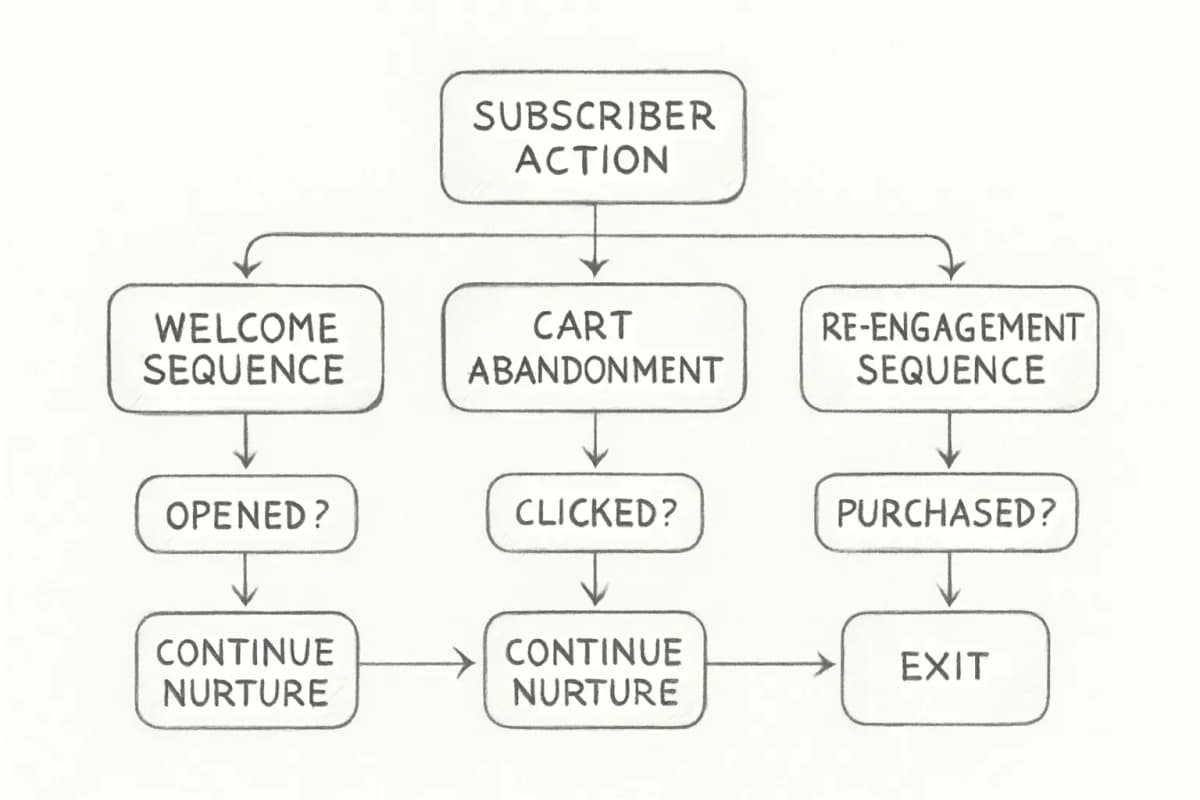
Frequently Asked Questions
What is email marketing automation SEO and why does it matter in 2025?
Email marketing automation SEO refers to the strategic integration of automated email campaigns with SEO efforts to drive organic traffic, improve engagement signals, and grow an owned audience that supports search rankings. In 2025, SEO is no longer an isolated discipline. Companies that integrate SEO and automation into a unified strategy are seeing a 30% increase in organic traffic and a 20% reduction in customer acquisition costs. The two channels reinforce each other: SEO drives subscriber acquisition, while email automation drives the repeat traffic and engagement signals that support rankings.
How much revenue can automated emails generate compared to manual campaigns?
Automated emails generate 320% more revenue than non-automated emails. For ecommerce specifically, automated emails drove 37% of all ecommerce email revenue in 2024 despite representing just 2% of email volume. The performance gap comes from timing and relevance: automated flows respond to specific behaviors, while manual campaigns are sent to broad lists on a fixed schedule.
What are the most important email deliverability practices for automated campaigns?
The three foundational requirements are domain authentication (SPF, DKIM, and DMARC), regular list hygiene, and consistent send cadence. Deliverability, sender reputation, authentication, and list quality are the foundation of any email strategy. If these are broken, nothing else works. Beyond the technical setup, prioritizing automated, trigger-based emails over mass broadcasts matters, as contextual messages often achieve double the engagement and signal to inbox providers that you are a quality sender.
How does AI improve email marketing automation results in 2025?
AI-generated subject lines outperform human-written ones by 26% for open rates on average. Combined with dynamic send-time optimization, the total lift reaches 40%. AI also enables behavioral personalization at a scale that manual segmentation cannot match. Companies using AI-driven email strategies see up to 41% more revenue than those using traditional batch-and-blast sends. The practical starting point is send-time optimization and AI-assisted subject line testing, both of which require minimal workflow changes but deliver measurable lift quickly.