
Email
Email

A modern blog built with Payload CMS, Next.js, and shadcn/ui.

RSS FeedSitemap

Explore

  • Blog
  • News
  • Statistics
  • Authors

Categories

  • Hiring & Team Building
  • Email Campaign Strategy
  • Email Design & Templates
  • Email Compliance & Legal
  • Email Deliverability & Best Practices
  • Career Development
  • Email Strategy for Finance & Professional Services
  • Email Marketing Metrics

Latest articles

  • How to Hire an Email Marketing SpecialistJul 22, 2026
  • Email Marketing Campaigns Template: Ready-to-UseJul 22, 2026
  • Canva Email Marketing Templates: Design Fast, Convert MoreJul 22, 2026
  • Email Marketing Templates for FranchisesJul 22, 2026

Popular topics

  • #Specialist Skills
  • #Team Building
  • #Templates
  • #Canva
  • #Advanced Strategies
  • #multi-location businesses
  • #Marketing Regulations
  • #Lead Follow-Up
  • #iCloud Email
  • #Marketing Management
  • #Product Launch
  • #Electrician Marketing
  • #statistics
  • #Budget-Friendly
  • #Free Resources
  • #Miami businesses

Stay in the loop

Join 2,000+ readers. Unsubscribe anytime.

Subscribe
Email

© 2026 Email. All rights reserved.

SitemapRSS
HomeBlogIndustry-Specific Email MarketingWhat Type of Content to Share for Solar Email Marketing
Industry-Specific Email Marketing

What Type of Content to Share for Solar Email Marketing

Learn the 5 essential content types that drive solar leads and conversions. ROI data, customer stories, and actionable strategies inside.

R

Rachel Torres

April 24, 2026

11 min read
Share:
#Solar Industry#Email Strategy#Lead Generation#B2B Email
Illustration for what type of content to share for solar email marketing

Stay in the loop

Get the latest posts delivered straight to your inbox. No spam, unsubscribe anytime.

Solar email marketing sits at an interesting crossroads: your product is expensive, technically complex, and bought once in a decade (or never). Unlike selling a software subscription or a physical product, solar installations involve significant investment, lengthy decision cycles, and complex technical considerations. Your email content needs to educate, build trust, and guide prospects through a journey that can span months. The wrong content mix kills conversion. The right one does the heavy lifting your sales team can't do at scale.

This guide covers exactly what type of content to share for solar email marketing: what converts at each stage of the buying cycle, what builds trust, and what keeps leads from going cold.

Key Takeaways

  • Automated nurture sequences must maintain consistent touchpoints throughout the 3 to 6 month solar buying cycle.
  • Mix educational content (incentive updates, financing explanations, ROI calculators), social proof (customer testimonials, installation showcases), and direct offers (limited-time promotions, free consultations).
  • One solar company increased email open rates by 112% and clicks by 181% through targeted email campaigns.
  • Segmenting email lists can lead to up to a 760% increase in email revenue.
  • Emails about new credits, expiring rebates, or policy changes create urgency that moves prospects from "maybe someday" to "let's schedule a site assessment." These time-sensitive emails consistently drive the highest conversion rates.

Why Solar Demands a Different Content Strategy

Most email marketing advice assumes a short buying cycle. Solar doesn't work that way.

Solar is a $15,000 to $30,000 investment. Homeowners do not decide overnight. A multi-week email sequence with savings estimates, tax credit explanations, and neighbor testimonials nurtures prospects until they are ready to commit, without requiring manual sales follow-up.

Email marketing fits well with the lengthy solar sales cycles. Emails can keep prospects engaged for weeks, and even months, as they do their solar research, consider financing options, and weigh installation nuances.

A case study from SolarCity showed a 60% increase in customer engagement via targeted email campaigns. Solar leads are more inclined to opening emails because they are curious to learn about the industry and the overall installation process before committing.

The core principle: every email you send must give a prospect a reason to stay in the conversation, even if they are three months away from buying.


1. Educational Content: The Foundation of Every Sequence

To truly stand out, your solar company marketing needs to go beyond just selling. It needs to educate. High-intent customers often spend weeks researching before they ever contact a company. By providing valuable information, you capture these prospects early in their journey.

Educational emails work at every stage, but they carry the most weight at the top of the funnel where prospects are asking basic questions: How does solar work? How much can I actually save? What incentives are available in my area?

Effective educational content for solar email marketing includes:

  • System explainers: How solar panels generate electricity, how net metering works, what affects production.
  • Savings breakdowns: Average bill reductions by system size and region.
  • Incentive guides: Federal tax credits (currently the 30% Investment Tax Credit), state rebates, and utility programs.
  • Financing explainers: Differences between purchasing, leasing, and power purchase agreements.

Give solar leads good content with which they can understand the basics of solar energy and why going solar is beneficial. For instance, a series of educational emails regarding solar panel efficiency or saving money performs well.

Keep the tone factual and specific. Leads respond to numbers ("Your zip code averages 5.2 peak sun hours daily") rather than generic claims about "clean energy savings."


2. Case Studies and Customer Success Stories

Solar installations require ongoing relationships for maintenance and support, so prospects want to know they're working with a stable, reputable company. Nothing demonstrates that more clearly than a real customer result.

Highlighting successful installations and customer testimonials builds credibility and demonstrates the tangible benefits of your products.

What makes a solar case study email effective:

  • Specific numbers: "$187 average monthly savings," "system paid back in 6.4 years."
  • Before and after bill comparisons: Actual utility bills show credibility in ways adjectives never can.
  • Local relevance: "People react to familiarity. Presenting someone from London with a case study from New York may not resonate as well as displaying a case study from the U.K. You could also choose to tailor case studies by industry or company size." The same logic applies to local markets for solar.
  • Photos of the installation: Real homes remove the abstract nature of the purchase.

Sharing testimonials from satisfied customers is one of the most reliable strategies. New buyers often use customer reviews as personal recommendations. Testimonials help you build a reputation in the industry and attract new prospects.

Aim for one case study email per month in your nurture sequence. Rotate between residential and commercial if you serve both segments.


3. Incentive and Policy Update Emails

Incentives are one of the most powerful content levers in solar email marketing. They are time-sensitive, financially concrete, and directly address the "I'll think about it later" objection.

Federal and state solar incentives change. Email campaigns about new credits, expiring rebates, or policy changes create urgency that moves prospects from "maybe someday" to "let's schedule a site assessment." These time-sensitive emails consistently drive the highest conversion rates.

Incentive emails should:

  1. Name the specific program or credit (not just "incentives are available").
  2. State the dollar value clearly and calculate it for an average system size.
  3. Explain any deadlines or step-down schedules.
  4. Close with a single, low-friction CTA, such as "Get your personalized savings estimate."

Use email to explain solar ROI, financing options, and incentives. Educated leads convert faster and with less sales resistance.

Send incentive update emails whenever there is a genuine change to the policy landscape. Do not manufacture false urgency. If a real deadline exists, state it plainly with a source.


4. Social Proof Emails: Reviews, Referrals, and Installation Showcases

In the high-stakes world of solar installation, consumer trust is paramount. Today's buyers rely heavily on online reviews to vet contractors, making review platforms a critical, high-ROI pillar of your marketing plan.

Social proof content extends well beyond static testimonials. The most effective formats for solar email marketing include:

  • Video testimonials: Adding videos can boost click rates by 65% and reduce unsubscribe rates by 26%. A 60-second video of a satisfied homeowner explaining their bill savings outperforms any written paragraph.
  • Installation photo galleries: Show the finished product on homes similar to your subscribers'.
  • Referral program announcements: Post-installation email sequences encouraging happy customers to refer friends and family generate high-quality leads at low cost.
  • Review request emails: Sent within 30 days of installation while the positive experience is fresh.

Solar panel customers can share photos before and after the installation, showcasing the ease of installation, the real-life look of the product, and the positive atmosphere.

For the email personalization techniques that make social proof emails even more effective, match testimonials to the prospect's segment, residential homeowners respond to homeowner stories, and commercial decision-makers respond to business case studies.


5. Drip Sequences Mapped to the Buying Stage

The biggest mistake solar companies make is sending the same content to every subscriber, regardless of where they are in the decision process.

The emails you send should depend on where the customer is in their decision journey and aim to add value at each point of this process.

Here is a practical sequence structure:

Early stage (weeks 1 to 3):

  • Welcome email with company overview and credibility signals
  • Educational email on how solar works and what to expect
  • Savings calculator or personalized estimate offer

Mid-stage (weeks 4 to 8):

  • Incentive breakdown email with current federal and state programs
  • Case study from a similar customer in your market
  • Financing options explained (purchase, lease, PPA)

Late stage (weeks 9 to 12+):

  • Objection-handling email (addressing payback period, roof suitability, HOA concerns)
  • Urgency email tied to a genuine deadline (rebate expiration, seasonal installation timing)
  • Direct consultation request

Drip campaigns are automated emails that educate the customer toward eventual conversion; they contain educational content, testimonials, and offers.

Solar email frequency depends on where prospects are in the decision process. Early-stage prospects benefit from weekly educational content, while later-stage prospects may prefer less frequent but more detailed communications.


6. Re-Engagement Emails for Cold Leads

Many leads go quiet not because they are uninterested, but because the timing is not right. Email re-engagement campaigns reactivate these dormant opportunities.

Re-engagement content works differently from nurture content. The goal is not to educate, it is to give a cold lead a new reason to act.

Effective re-engagement angles for solar:

  • Rate change alerts: "Utility rates in [City] went up 12% this year. Here is what that means for your potential savings."
  • New incentive notifications: A state rebate was extended or a new program launched.
  • Technology updates: Battery storage paired with solar is now more affordable.
  • A low-pressure check-in: "Have your sales team send a brief, personalized email referencing a specific piece of content they might have missed."

Keep re-engagement emails short. One strong hook, one clear CTA. If a lead re-engages, move them back into the active nurture sequence.

For a deeper look at structuring these campaigns, the email list segmentation strategies that solar companies need are directly tied to identifying which subscribers qualify as cold leads and which are still active.


7. Post-Installation Emails: The Content Most Solar Companies Skip

The customer relationship does not end at installation. You want to maintain that relationship to get both the sale and the referral.

Post-installation email content serves two goals: customer satisfaction and referral generation.

Content that performs well in the post-installation phase:

  • System monitoring guide: How to read their production data and what good numbers look like.
  • Monthly production summary: A production summary with a savings calculation that celebrates their investment.
  • Seasonal maintenance reminders: Panel cleaning tips before high-production months.
  • Referral program invitation: A structured referral program with generous incentives turns every customer into a lead generator. Post-installation referral emails are among the highest-ROI campaigns in the solar industry.
  • Upsell emails for battery storage: Relevant once energy storage costs drop or utility rates spike.
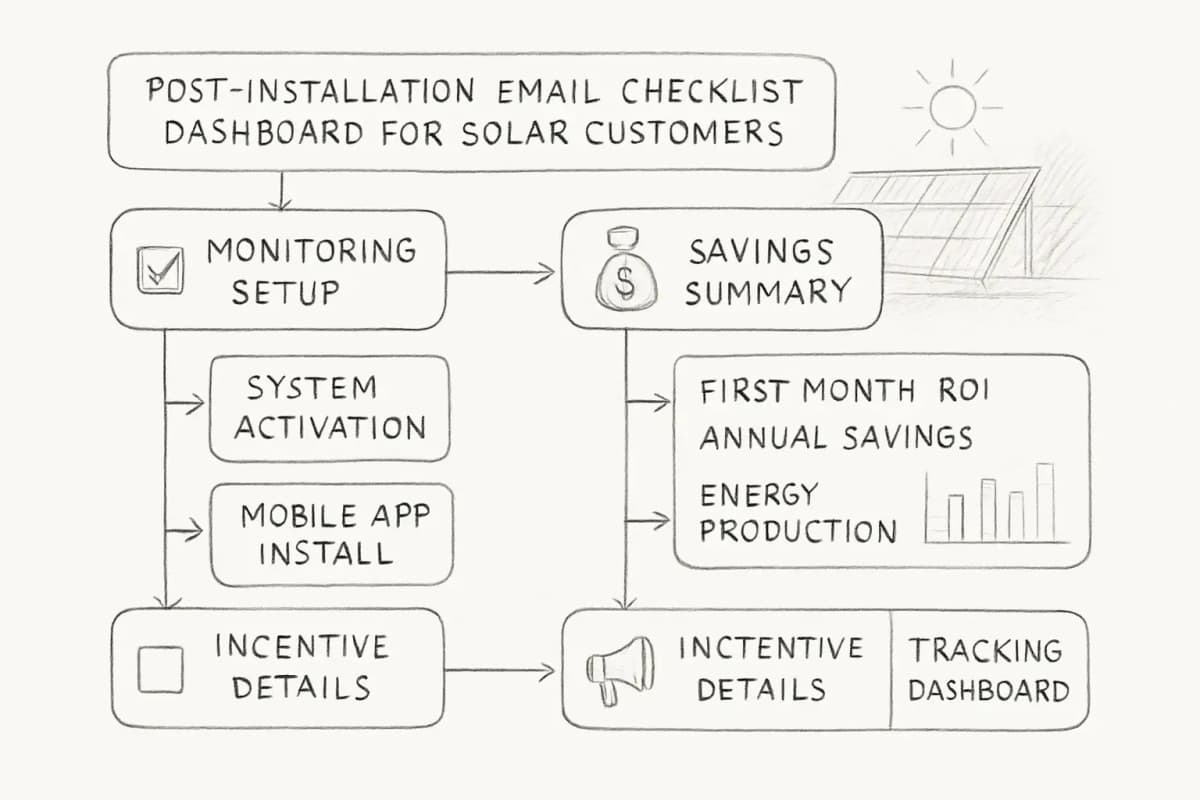
Post-installation email checklist dashboard for solar customers showing three main sections: (1) Monitoring Setup section with checkboxes for system activation, mobile app installation, and performance baseline setup; (2) Savings Summary section displaying first-month ROI metrics, annual savings projection, and energy production graphs; (3) Referral Program Touchpoints section listing referral incentive details, neighbor contact templates, and tracking dashboard. Use a clean, professional layout with checkmarks, icons, and color-coded sections (green for completed, blue for in-progress, grey for pending). Include subtle solar panel or energy imagery as background accents.

This content is also where you build the trust that fuels word-of-mouth. Solar customers are your best sales force. They save money, their neighbors notice the panels, and referral programs generate warm leads.


Segmentation: The Content You Send Matters Less Than Who Receives It

Even the best content underperforms when sent to the wrong segment. By segmenting email lists based on customer interests, behaviors, and where they stand in the buyer's journey, solar companies can tailor their messages to resonate more deeply with each recipient.

For solar, the key segmentation variables are:

  • Property type: Residential homeowners vs. commercial property owners have completely different financial priorities.
  • Engagement level: Active openers vs. cold subscribers require different content approaches.
  • Stage in buying cycle: Early awareness vs. late consideration vs. post-quote follow-up.
  • Geography: Incentives, utility rates, and peak sun hours vary significantly by location.

Solar companies using a multi-touch strategy experience up to 28% higher conversion rates than single-channel campaigns. Segmented email is the channel that makes that multi-touch strategy coherent.

For a full strategy framework, the email marketing strategy template covers how to map content to segments across the full funnel, which applies directly to how solar companies should structure their campaigns.


Frequently Asked Questions

What type of content converts best in solar email marketing?

Emails about new credits, expiring rebates, or policy changes create urgency and consistently drive the highest conversion rates. Close behind are local case studies with specific savings numbers and personalized savings estimates. In general, content that combines a financial outcome with a concrete next step (schedule an assessment, request a quote) outperforms educational content alone.

How often should a solar company send marketing emails?

For active leads, weekly touchpoints are typically appropriate. For longer-term nurture, bi-weekly or monthly contact works better. The key is providing value in every email, not just asking for the sale repeatedly.

Should solar email content differ for residential vs. commercial prospects?

Yes, significantly. B2B solar marketing involves longer sales cycles, multiple stakeholders, and data-backed messaging, focused more on ROI and scalability than the emotional appeals used in consumer solar. Residential content can lean on environmental motivation, energy independence, and household savings. Commercial content should center on payback periods, depreciation schedules, tax credit math, and operational cost reduction.

How do you re-engage cold solar leads through email?

Invite cold leads back for a new, no-commitment assessment, especially if utility rates or equipment pricing have changed since their initial contact. Tie re-engagement emails to a genuine new development, such as a rate change, a new incentive, or improved battery storage pricing, rather than sending a generic "we haven't heard from you" message. Keep these emails short and low-pressure.


No comments yet. Be the first!

Leave a comment

Comments are reviewed before publishing.

More from

Related posts

Illustration for email marketing templates for electricians
Industry-Specific Email MarketingJul 22, 2026 13 min

Email Marketing Templates for Electricians

Ready-to-use email templates designed for electricians. Drive job inquiries, retain clients, and boost revenue with templates that convert.

SSarah Mitchell
Illustration for email marketing tool for home automation & media
Industry-Specific Email MarketingJul 17, 2026 12 min

Email Marketing Tools for Home Automation and Media

Discover email marketing tools designed for home automation and media companies. Increase engagement, segment customers, and drive sales with proven strategies.

PPriya Kapoor
Illustration for examples of email marketing for restaurants
Industry-Specific Email MarketingJul 11, 2026 13 min

Email Marketing Examples for Restaurants: 7 Proven Strategies

See 7 real email marketing examples restaurants use to boost reservations and repeat orders. Learn what works and how to apply it to your restaurant.

SSarah Mitchell
HomeBlogIndustry-Specific Email MarketingWhat Type of Content to Share for Solar Email Marketing
Industry-Specific Email Marketing

What Type of Content to Share for Solar Email Marketing

Learn the 5 essential content types that drive solar leads and conversions. ROI data, customer stories, and actionable strategies inside.

R

Rachel Torres

April 24, 2026

11 min read
Share:
#Solar Industry#Email Strategy#Lead Generation#B2B Email
Illustration for what type of content to share for solar email marketing

Stay in the loop

Get the latest posts delivered straight to your inbox. No spam, unsubscribe anytime.

Solar email marketing sits at an interesting crossroads: your product is expensive, technically complex, and bought once in a decade (or never). Unlike selling a software subscription or a physical product, solar installations involve significant investment, lengthy decision cycles, and complex technical considerations. Your email content needs to educate, build trust, and guide prospects through a journey that can span months. The wrong content mix kills conversion. The right one does the heavy lifting your sales team can't do at scale.

This guide covers exactly what type of content to share for solar email marketing: what converts at each stage of the buying cycle, what builds trust, and what keeps leads from going cold.

Key Takeaways

  • Automated nurture sequences must maintain consistent touchpoints throughout the 3 to 6 month solar buying cycle.
  • Mix educational content (incentive updates, financing explanations, ROI calculators), social proof (customer testimonials, installation showcases), and direct offers (limited-time promotions, free consultations).
  • One solar company increased email open rates by 112% and clicks by 181% through targeted email campaigns.
  • Segmenting email lists can lead to up to a 760% increase in email revenue.
  • Emails about new credits, expiring rebates, or policy changes create urgency that moves prospects from "maybe someday" to "let's schedule a site assessment." These time-sensitive emails consistently drive the highest conversion rates.

Why Solar Demands a Different Content Strategy

Most email marketing advice assumes a short buying cycle. Solar doesn't work that way.

Solar is a $15,000 to $30,000 investment. Homeowners do not decide overnight. A multi-week email sequence with savings estimates, tax credit explanations, and neighbor testimonials nurtures prospects until they are ready to commit, without requiring manual sales follow-up.

Email marketing fits well with the lengthy solar sales cycles. Emails can keep prospects engaged for weeks, and even months, as they do their solar research, consider financing options, and weigh installation nuances.

A case study from SolarCity showed a 60% increase in customer engagement via targeted email campaigns. Solar leads are more inclined to opening emails because they are curious to learn about the industry and the overall installation process before committing.

The core principle: every email you send must give a prospect a reason to stay in the conversation, even if they are three months away from buying.


1. Educational Content: The Foundation of Every Sequence

To truly stand out, your solar company marketing needs to go beyond just selling. It needs to educate. High-intent customers often spend weeks researching before they ever contact a company. By providing valuable information, you capture these prospects early in their journey.

Educational emails work at every stage, but they carry the most weight at the top of the funnel where prospects are asking basic questions: How does solar work? How much can I actually save? What incentives are available in my area?

Effective educational content for solar email marketing includes:

  • System explainers: How solar panels generate electricity, how net metering works, what affects production.
  • Savings breakdowns: Average bill reductions by system size and region.
  • Incentive guides: Federal tax credits (currently the 30% Investment Tax Credit), state rebates, and utility programs.
  • Financing explainers: Differences between purchasing, leasing, and power purchase agreements.

Give solar leads good content with which they can understand the basics of solar energy and why going solar is beneficial. For instance, a series of educational emails regarding solar panel efficiency or saving money performs well.

Keep the tone factual and specific. Leads respond to numbers ("Your zip code averages 5.2 peak sun hours daily") rather than generic claims about "clean energy savings."


2. Case Studies and Customer Success Stories

Solar installations require ongoing relationships for maintenance and support, so prospects want to know they're working with a stable, reputable company. Nothing demonstrates that more clearly than a real customer result.

Highlighting successful installations and customer testimonials builds credibility and demonstrates the tangible benefits of your products.

What makes a solar case study email effective:

  • Specific numbers: "$187 average monthly savings," "system paid back in 6.4 years."
  • Before and after bill comparisons: Actual utility bills show credibility in ways adjectives never can.
  • Local relevance: "People react to familiarity. Presenting someone from London with a case study from New York may not resonate as well as displaying a case study from the U.K. You could also choose to tailor case studies by industry or company size." The same logic applies to local markets for solar.
  • Photos of the installation: Real homes remove the abstract nature of the purchase.

Sharing testimonials from satisfied customers is one of the most reliable strategies. New buyers often use customer reviews as personal recommendations. Testimonials help you build a reputation in the industry and attract new prospects.

Aim for one case study email per month in your nurture sequence. Rotate between residential and commercial if you serve both segments.


3. Incentive and Policy Update Emails

Incentives are one of the most powerful content levers in solar email marketing. They are time-sensitive, financially concrete, and directly address the "I'll think about it later" objection.

Federal and state solar incentives change. Email campaigns about new credits, expiring rebates, or policy changes create urgency that moves prospects from "maybe someday" to "let's schedule a site assessment." These time-sensitive emails consistently drive the highest conversion rates.

Incentive emails should:

  1. Name the specific program or credit (not just "incentives are available").
  2. State the dollar value clearly and calculate it for an average system size.
  3. Explain any deadlines or step-down schedules.
  4. Close with a single, low-friction CTA, such as "Get your personalized savings estimate."

Use email to explain solar ROI, financing options, and incentives. Educated leads convert faster and with less sales resistance.

Send incentive update emails whenever there is a genuine change to the policy landscape. Do not manufacture false urgency. If a real deadline exists, state it plainly with a source.


4. Social Proof Emails: Reviews, Referrals, and Installation Showcases

In the high-stakes world of solar installation, consumer trust is paramount. Today's buyers rely heavily on online reviews to vet contractors, making review platforms a critical, high-ROI pillar of your marketing plan.

Social proof content extends well beyond static testimonials. The most effective formats for solar email marketing include:

  • Video testimonials: Adding videos can boost click rates by 65% and reduce unsubscribe rates by 26%. A 60-second video of a satisfied homeowner explaining their bill savings outperforms any written paragraph.
  • Installation photo galleries: Show the finished product on homes similar to your subscribers'.
  • Referral program announcements: Post-installation email sequences encouraging happy customers to refer friends and family generate high-quality leads at low cost.
  • Review request emails: Sent within 30 days of installation while the positive experience is fresh.

Solar panel customers can share photos before and after the installation, showcasing the ease of installation, the real-life look of the product, and the positive atmosphere.

For the email personalization techniques that make social proof emails even more effective, match testimonials to the prospect's segment, residential homeowners respond to homeowner stories, and commercial decision-makers respond to business case studies.


5. Drip Sequences Mapped to the Buying Stage

The biggest mistake solar companies make is sending the same content to every subscriber, regardless of where they are in the decision process.

The emails you send should depend on where the customer is in their decision journey and aim to add value at each point of this process.

Here is a practical sequence structure:

Early stage (weeks 1 to 3):

  • Welcome email with company overview and credibility signals
  • Educational email on how solar works and what to expect
  • Savings calculator or personalized estimate offer

Mid-stage (weeks 4 to 8):

  • Incentive breakdown email with current federal and state programs
  • Case study from a similar customer in your market
  • Financing options explained (purchase, lease, PPA)

Late stage (weeks 9 to 12+):

  • Objection-handling email (addressing payback period, roof suitability, HOA concerns)
  • Urgency email tied to a genuine deadline (rebate expiration, seasonal installation timing)
  • Direct consultation request

Drip campaigns are automated emails that educate the customer toward eventual conversion; they contain educational content, testimonials, and offers.

Solar email frequency depends on where prospects are in the decision process. Early-stage prospects benefit from weekly educational content, while later-stage prospects may prefer less frequent but more detailed communications.


6. Re-Engagement Emails for Cold Leads

Many leads go quiet not because they are uninterested, but because the timing is not right. Email re-engagement campaigns reactivate these dormant opportunities.

Re-engagement content works differently from nurture content. The goal is not to educate, it is to give a cold lead a new reason to act.

Effective re-engagement angles for solar:

  • Rate change alerts: "Utility rates in [City] went up 12% this year. Here is what that means for your potential savings."
  • New incentive notifications: A state rebate was extended or a new program launched.
  • Technology updates: Battery storage paired with solar is now more affordable.
  • A low-pressure check-in: "Have your sales team send a brief, personalized email referencing a specific piece of content they might have missed."

Keep re-engagement emails short. One strong hook, one clear CTA. If a lead re-engages, move them back into the active nurture sequence.

For a deeper look at structuring these campaigns, the email list segmentation strategies that solar companies need are directly tied to identifying which subscribers qualify as cold leads and which are still active.


7. Post-Installation Emails: The Content Most Solar Companies Skip

The customer relationship does not end at installation. You want to maintain that relationship to get both the sale and the referral.

Post-installation email content serves two goals: customer satisfaction and referral generation.

Content that performs well in the post-installation phase:

  • System monitoring guide: How to read their production data and what good numbers look like.
  • Monthly production summary: A production summary with a savings calculation that celebrates their investment.
  • Seasonal maintenance reminders: Panel cleaning tips before high-production months.
  • Referral program invitation: A structured referral program with generous incentives turns every customer into a lead generator. Post-installation referral emails are among the highest-ROI campaigns in the solar industry.
  • Upsell emails for battery storage: Relevant once energy storage costs drop or utility rates spike.

Post-installation email checklist dashboard for solar customers showing three main sections: (1) Monitoring Setup section with checkboxes for system activation, mobile app installation, and performance baseline setup; (2) Savings Summary section displaying first-month ROI metrics, annual savings projection, and energy production graphs; (3) Referral Program Touchpoints section listing referral incentive details, neighbor contact templates, and tracking dashboard. Use a clean, professional layout with checkmarks, icons, and color-coded sections (green for completed, blue for in-progress, grey for pending). Include subtle solar panel or energy imagery as background accents.

This content is also where you build the trust that fuels word-of-mouth. Solar customers are your best sales force. They save money, their neighbors notice the panels, and referral programs generate warm leads.


Segmentation: The Content You Send Matters Less Than Who Receives It

Even the best content underperforms when sent to the wrong segment. By segmenting email lists based on customer interests, behaviors, and where they stand in the buyer's journey, solar companies can tailor their messages to resonate more deeply with each recipient.

For solar, the key segmentation variables are:

  • Property type: Residential homeowners vs. commercial property owners have completely different financial priorities.
  • Engagement level: Active openers vs. cold subscribers require different content approaches.
  • Stage in buying cycle: Early awareness vs. late consideration vs. post-quote follow-up.
  • Geography: Incentives, utility rates, and peak sun hours vary significantly by location.

Solar companies using a multi-touch strategy experience up to 28% higher conversion rates than single-channel campaigns. Segmented email is the channel that makes that multi-touch strategy coherent.

For a full strategy framework, the email marketing strategy template covers how to map content to segments across the full funnel, which applies directly to how solar companies should structure their campaigns.


Frequently Asked Questions

What type of content converts best in solar email marketing?

Emails about new credits, expiring rebates, or policy changes create urgency and consistently drive the highest conversion rates. Close behind are local case studies with specific savings numbers and personalized savings estimates. In general, content that combines a financial outcome with a concrete next step (schedule an assessment, request a quote) outperforms educational content alone.

How often should a solar company send marketing emails?

For active leads, weekly touchpoints are typically appropriate. For longer-term nurture, bi-weekly or monthly contact works better. The key is providing value in every email, not just asking for the sale repeatedly.

Should solar email content differ for residential vs. commercial prospects?

Yes, significantly. B2B solar marketing involves longer sales cycles, multiple stakeholders, and data-backed messaging, focused more on ROI and scalability than the emotional appeals used in consumer solar. Residential content can lean on environmental motivation, energy independence, and household savings. Commercial content should center on payback periods, depreciation schedules, tax credit math, and operational cost reduction.

How do you re-engage cold solar leads through email?

Invite cold leads back for a new, no-commitment assessment, especially if utility rates or equipment pricing have changed since their initial contact. Tie re-engagement emails to a genuine new development, such as a rate change, a new incentive, or improved battery storage pricing, rather than sending a generic "we haven't heard from you" message. Keep these emails short and low-pressure.

No comments yet. Be the first!

Leave a comment

Comments are reviewed before publishing.

More from

Related posts

Illustration for email marketing templates for electricians
Industry-Specific Email MarketingJul 22, 2026 13 min

Email Marketing Templates for Electricians

Ready-to-use email templates designed for electricians. Drive job inquiries, retain clients, and boost revenue with templates that convert.

SSarah Mitchell
Illustration for email marketing tool for home automation & media
Industry-Specific Email MarketingJul 17, 2026 12 min

Email Marketing Tools for Home Automation and Media

Discover email marketing tools designed for home automation and media companies. Increase engagement, segment customers, and drive sales with proven strategies.

PPriya Kapoor
Illustration for examples of email marketing for restaurants
Industry-Specific Email MarketingJul 11, 2026 13 min

Email Marketing Examples for Restaurants: 7 Proven Strategies

See 7 real email marketing examples restaurants use to boost reservations and repeat orders. Learn what works and how to apply it to your restaurant.

SSarah Mitchell