
Email marketing is one of the most cost-effective revenue channels available to small businesses, yet many owners either avoid it because they think it is too complex or use it badly because they lack a clear strategy. Both problems are solvable with the right approach.
For every $1 spent on email marketing, businesses see an average return of $36, representing a 3,600% ROI. Constant Contact's Small Business Now report reveals that in 2024, 53% of small business owners in the U.S., U.K., Canada, and Australia used email marketing as their most frequent strategy for finding new and retaining repeat customers. Those numbers exist for a reason. This guide breaks down what actually drives results in small business email marketing, without overcomplicating it.
Key Takeaways
- Email marketing delivers an average $36 return for every $1 spent.
- 80% of small and midsized businesses say email marketing is their most important online tool for customer retention.
- Automated emails generate 320% more revenue than non-automated emails.
- Marketers have found a 760% increase in email revenue from segmented campaigns.
- 50% of people will delete an email if it isn't optimized for mobile.
Why Small Business Email Marketing Outperforms Other Channels
Most small businesses spread their marketing budget across social media ads, paid search, and content. Email earns more, costs less, and doesn't depend on an algorithm deciding who sees your message.
Social media platforms show your content to only 2-10% of your followers due to algorithm restrictions. Even if you have 10,000 Instagram followers, only 200 to 1,000 people might actually see your post. With email, you reach 100% of your subscribers' inboxes every time you send.
Email is 40 times more effective than social media for customer acquisition. For a business watching every dollar spent on marketing, that gap matters.
59% of consumers say marketing emails influence their purchase decisions, with over 50% saying they purchase from an email at least once a month. The channel isn't just good for awareness; it directly drives sales.
Build a List Worth Sending To
A small, engaged email list outperforms a large, disengaged one every time. Before you think about campaigns, focus on building a list of people who actually want to hear from you.
Practical ways to grow a quality list:
- Add a signup form to your website homepage and key landing pages.
- Offer a lead magnet: a discount, checklist, guide, or free consultation.
- 48% of consumers surveyed happily gave their email address to receive a discount.
- Collect emails at checkout, in-store, or during any service interaction.
- Use social media to drive subscribers to an email opt-in.
Once someone subscribes, the first email you send sets the tone for everything that follows. Welcome emails achieve an average open rate of 83.63% and a click-through rate of 16.60%, with a click-to-open rate of 19.85%. That is far higher than any regular campaign you will send. Use that first email to deliver your promise, introduce your brand, and set expectations for what subscribers will receive. For a deeper look at structuring this sequence, see our guide on welcome email sequence best practices.
The Four Email Types Every Small Business Needs
You don't need a complex content calendar to start. These four types of emails cover the core of what small business email marketing requires:
- Welcome emails. Sent immediately after signup. Introduce your brand and confirm the subscriber made the right choice.
- Newsletters. Regular updates that build familiarity and keep your audience engaged between purchases.
- Promotional emails. Campaigns tied to offers, launches, or events. These drive direct revenue.
- Transactional and behavioral emails. Order confirmations, cart abandonment reminders, and re-engagement sequences. Abandoned cart emails have an open rate of 50.50%, and businesses earn an average of $3.45 in revenue per abandoned cart email recipient.
Start with welcome and promotional emails. Add behavioral automation once you have the basics working.
Use Segmentation to Send Emails People Actually Want
Sending the same message to every subscriber is the fastest way to increase unsubscribes and reduce revenue. Segmentation fixes this.
Marketers have found a 760% increase in email revenue from segmented campaigns. The reason is straightforward: relevant messages get opened and acted on.
Segmented email campaigns earn on average 14.32% more opens and 100.95% more clicks than non-segmented campaigns.
For a small business, you don't need dozens of segments. Start with three:
- New subscribers (in a welcome sequence)
- Active customers (past purchasers who engage with emails)
- Lapsed subscribers (haven't opened in 90+ days, candidate for a re-engagement sequence)
As you grow, you can add segments based on purchase behavior, location, or product interest. Our detailed breakdown of email list segmentation strategies covers how to do this systematically.
Automate the Work That Repeats
Automation is the single biggest leverage point in small business email marketing. It lets you deliver the right message at the right time without manual effort on your part.
Automated emails generate 320% more revenue than non-automated emails. Companies using marketing automation to nurture prospects see a 451% increase in qualified leads.
The five automations that deliver the most value for small businesses:
- Welcome sequence (triggered by signup)
- Abandoned cart recovery (triggered when a cart is left without purchase)
- Post-purchase follow-up (triggered after a sale, often asking for a review or offering a complementary product)
- Re-engagement campaign (triggered after a period of inactivity)
- Birthday or anniversary email (triggered by date, works well for retail and service businesses)
The top 10% of email workflows generate $16.96 in revenue per recipient, while average email flows generate $1.94. The gap between well-structured automation and basic automation is not small. Invest time in getting your workflows right rather than sending more volume. 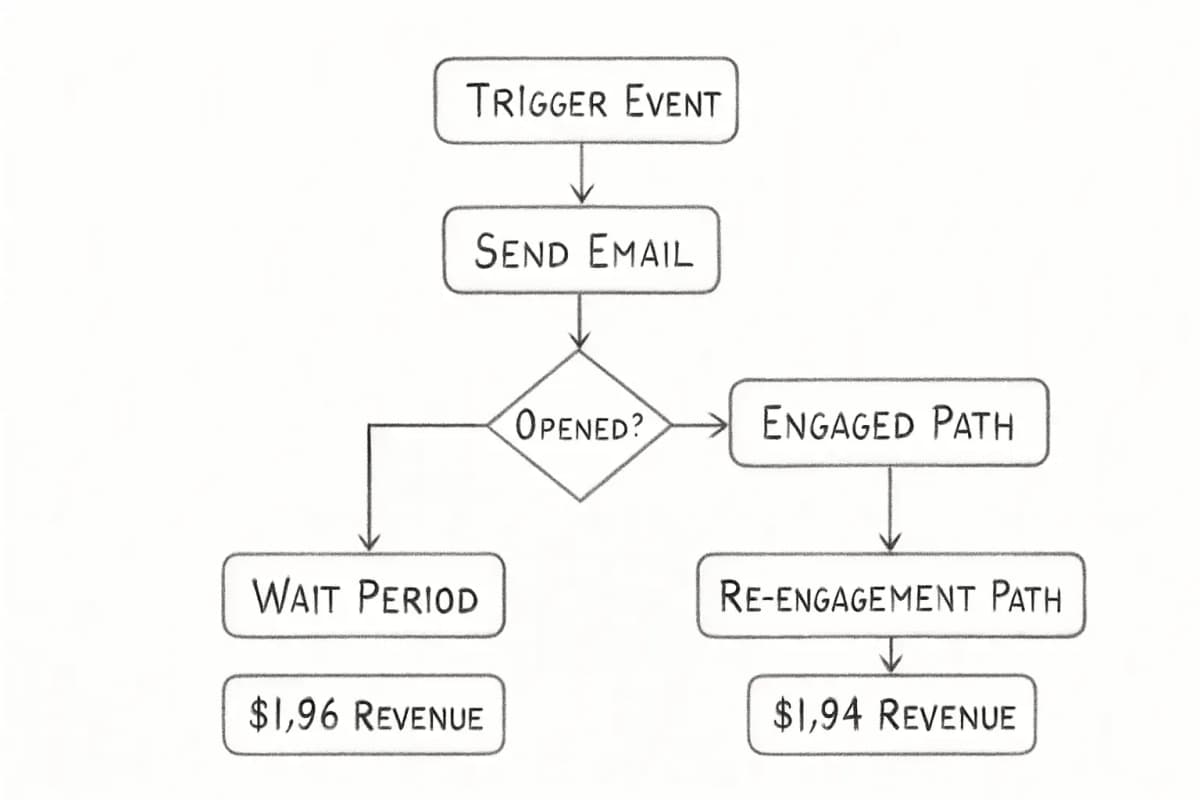
Write Subject Lines and Copy That Drive Opens and Clicks
Your subject line determines whether the email gets opened. Everything else you write is secondary to that first decision.
Personalized emails achieve an impressive open rate of 29% and a click-through rate of 41%. Simply adding a subscriber's first name to a subject line is a starting point, but behavioral personalization, referencing what someone browsed or bought, performs even better.
Practical subject line rules:
- Keep it under 50 characters so it doesn't get cut off on mobile.
- Be specific. "Your order ships Friday" outperforms "Big news inside."
- Avoid spam trigger words like "free," "guaranteed," and "act now."
- Test two versions (A/B test) whenever your platform allows it.
For preheader text, treat it as a second subject line. It appears next to or below your subject in the inbox and significantly affects open rates. For a full breakdown of what works, see our article on email subject line best practices.
In the body of the email, lead with the point. State the offer or value in the first sentence. Use short paragraphs, a single clear call-to-action, and plain language. One email, one goal.
Mobile Optimization Is Not Optional
Mobile opens account for 81% of all email opens. If your emails don't render properly on a phone, you are delivering a broken experience to most of your audience.
50% of people will delete an email if it isn't optimized for mobile.
A mobile-optimized email follows these rules:
- Single-column layout that stacks cleanly on small screens.
- Font size of at least 14px for body text, 22px for headlines.
- Buttons large enough to tap (minimum 44x44px).
- Images that scale down without breaking the layout.
- Short subject lines that don't get truncated.
Most modern email platforms (Mailchimp, Klaviyo, Brevo, Mailerlite) include mobile preview and responsive templates. Use them before every send.
Track the Right Metrics and Improve From Them
You can't improve what you don't measure. But measuring everything leads to analysis paralysis. Focus on four metrics that directly reflect campaign health.
The average email open rate in 2025 was 43.46%, a slight increase on 2024's average of 42.35%. Note that open rate data has become less reliable since Apple's Mail Privacy Protection inflates opens for Apple Mail users. Use it directionally, not as an absolute truth.
The four metrics to track:
- Click-through rate (CTR). Measures how many recipients clicked a link. A good average email click-through rate ranges from 0.77% to 4.36%, with an average across industries of around 2.62%.
- Conversion rate. How many clicks resulted in the desired action (purchase, signup, booking).
- Unsubscribe rate. A good unsubscribe rate is below 0.5%. Anything under 0.2% is considered excellent. Rising unsubscribes often signal irrelevant content or excessive frequency.
- Revenue per email. Total revenue divided by emails sent. This connects campaign activity directly to business results.
Track these after every campaign. Look for patterns across subject lines, send times, and audience segments. For a complete framework on what to track and how, see our guide on email marketing analytics best practices.
Frequently Asked Questions
How often should a small business send marketing emails?
Consistency matters more than frequency. Maintaining a balance is crucial for open rates. Too many or too frequent emails can frustrate recipients. Most marketers consider between one and three weekly emails to be the golden standard for maintaining good open rates. For most small businesses, one to two emails per week is a strong starting point. Test your frequency over time and watch unsubscribe rates for signals.
What email platform is best for small businesses?
The right platform depends on your list size, budget, and the automation features you need. Popular choices include Mailchimp, Klaviyo (strong for ecommerce), Brevo (affordable for high-volume senders), and Mailerlite (simple interface, generous free plan). Look for built-in automation workflows, segmentation tools, mobile-responsive templates, and clear deliverability reporting before committing.
What is a realistic open rate for a small business?
The average email open rate across all industries is recorded at 21.33% as of the beginning of 2024. However, small business lists that are permission-based and well-segmented often see higher rates, particularly in local service businesses, retail, and professional services. A rate above 25% is a strong result; below 15% is a signal to review subject lines, list quality, and sending frequency.
Do I need to hire someone to run email marketing for a small business?
Not at the start. Modern platforms are built for non-technical users with drag-and-drop editors and pre-built automation templates. Most small businesses can run effective campaigns with one person spending a few hours per week. As your list grows past a few thousand subscribers and you want to build more sophisticated sequences, it may be worth bringing in a specialist or using a done-for-you service. The key is to start simple, learn what works for your audience, and add complexity only when it adds clear value.