
The fitness industry is highly competitive, and keeping members engaged between workouts is where most gyms lose revenue. Industry data shows a tough reality: 40 to 65% of new gym members drop out within six months, which makes a structured retention plan essential. Fitness email marketing is one of the most cost-effective tools available to close that gap, convert trial members into paying subscribers, and keep active members coming back.
On average, businesses generate about $36 for every $1 they spend on email marketing. For a fitness business operating on predictable monthly revenue, that kind of return compounds fast when your campaigns are segmented and automated correctly.
This guide covers the specific strategies, email types, and benchmarks fitness businesses need to build a program that actually performs.
Key Takeaways
- Health and fitness businesses have a median email open rate of 48.9%, outperforming the cross-industry average of 42.35%.
- Between 40% and 65% of new gym members quit within six months, making early retention emails critical to long-term revenue.
- Automated emails generate 320% more revenue than non-automated emails, which makes automation the single highest-leverage investment in a fitness email strategy.
- Personalized gym email campaigns achieve an open rate of 42.1%, far above the general average of 25.1%.
- Segmented email campaigns can lead to a 760% increase in revenue compared to unsegmented broadcasts.
Why Fitness Email Marketing Works Differently
Email works across almost every industry, but the fitness space has a unique dynamic. Your audience made an emotional commitment when they joined. They want to achieve a goal, feel accountable, and stay motivated. Email gives you a direct channel to support that commitment week after week.
Fitness email marketing has become an indispensable tool for gym owners and fitness coaches to engage members, attract new clients, and grow their businesses. In an industry driven by motivation and consistency, email provides a direct line of communication to keep your audience informed, regularly inspired, and continuously connected to your brand.
What makes this channel particularly valuable for gyms is the data. Email gives you clean reports on opens, clicks, and conversions. You also see bookings, upgrades, and churn by segment. When you connect your email platform to your membership management system, you can trigger campaigns based on actual behavior, not just arbitrary send schedules.
The fitness industry has impressive email marketing engagement rates. The overall email campaign open rate sits at 25.1%, but the sports industry posts a higher open rate of 31.9%. That engagement advantage is worth protecting by sending relevant, well-timed content.
The 5 Email Campaigns Every Fitness Business Needs
Not all campaigns serve the same purpose. Each one below targets a specific point in the member lifecycle.
1. Welcome Sequence
This is the most important series you will send. First impressions matter. When a new member joins your email list or signs up for a membership, send a warm welcome message that thanks them, introduces your brand, and provides useful information such as class schedules, studio policies, or a special offer.
The first month sets the path. Email can suggest clear steps, simple tools, and fast answers to remove doubts. Members see value early and stay on plan. That early lift pays off for months. Retention starts here, not at renewal week.
For a strong welcome series structure, see our guide on welcome email sequence best practices.
2. Engagement and Nurture Emails
Between the initial welcome and renewal, consistent content keeps members connected to your brand. Email is an excellent tool for gyms to showcase their expertise and build trust. By sharing valuable content such as workout tips, healthy recipes, and fitness trends, gyms can position themselves as thought leaders in the industry.
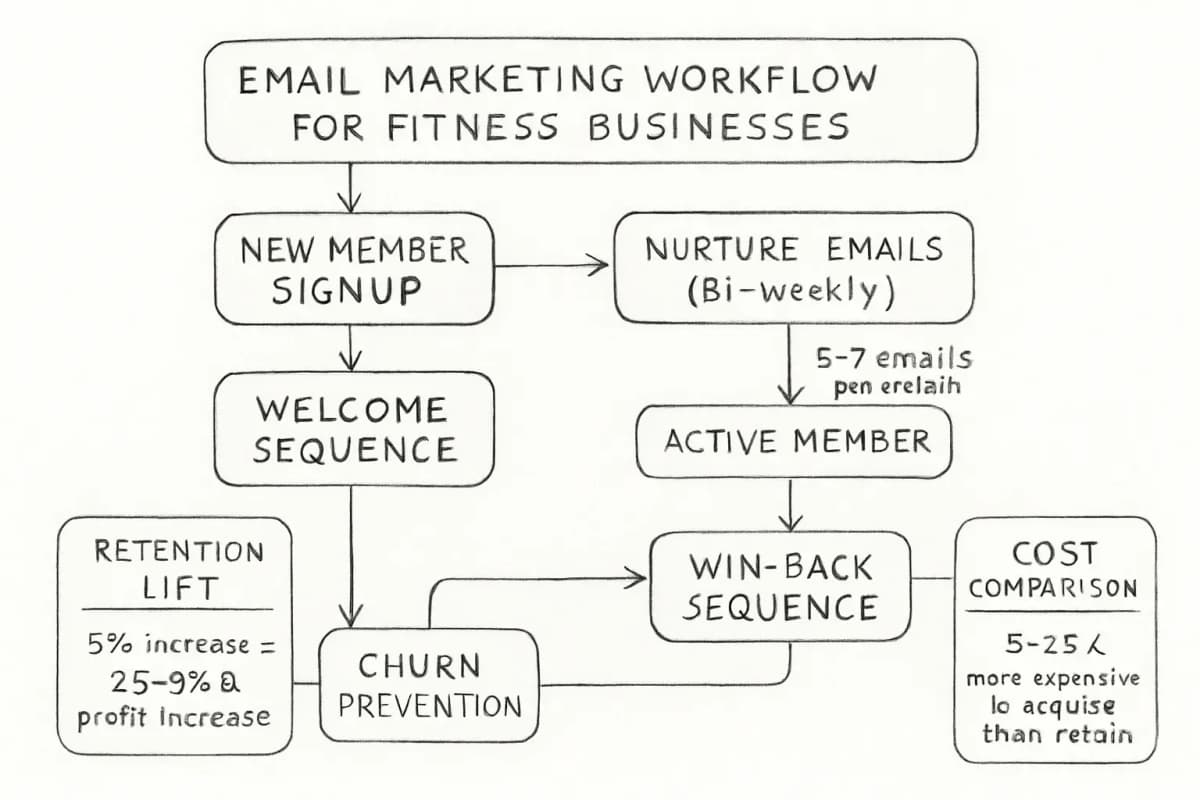
A monthly newsletter with member success stories, class spotlights, and a training tip performs well because it delivers value rather than promotion. Fitness businesses should send emails approximately bi-weekly. Research shows that 67% of fitness businesses send 5 to 7 emails per month, which averages around 1.5 to 2 per week.
3. Promotional and Offer Emails
Promotional emails drive membership upgrades, personal training packages, and seasonal campaigns. 63% of people say they open an email to find discounts, so subject lines that hint at a time-sensitive offer will outperform generic ones. Keep promotions tied to a real reason: a new year campaign, a class launch, or a member anniversary.
4. Win-Back Campaigns
Your gym's membership tends to show reduced activity rates over time. Customers lose interest because their gym becomes unengaging, but re-engagement emails restore their loyalty using exclusive offers or recollections of initial reasons for joining.
Set up win-back triggers for members who have not checked in for 14 to 30 days. A simple message offering a free personal training session can be enough to bring them back.
5. Renewal and Retention Emails
If data indicates that members often leave after three months, a targeted email campaign offering a fourth-month discount or a free personal training session can be initiated, leveraging the power of automation and personalization. Renewal sequences timed around membership milestones such as 90 days, 6 months, and 12 months keep churn predictable and manageable.
Segmentation: The Foundation of a High-Converting Fitness Email Strategy
Generic mass emails underperform in fitness. Segmentation unlocks the true power of email marketing since it allows you to send the right message to the right people. Creating customer segments helps you deliver highly personalized content that will resonate with your subscribers. The most common segments are based on demographics, location, preferences, and goals.
Practical fitness segments to build:
- New members (0 to 30 days): Onboarding, facility orientation, class booking prompts
- Active members (31 to 90 days): Progress check-ins, milestone celebrations, upsell opportunities
- At-risk members (no visit in 14 to 21 days): Re-engagement, motivational content, win-back offers
- VIP members: Loyalty rewards, early class access, referral programs
- Lapsed members (cancelled): Win-back sequences with incentives
Segmented email lists improve click-through rates by 14.32%. Combined with behavioral data, segmentation creates a 2.4x higher likelihood of purchase.
For a deeper breakdown of how to build these groups, read our guide on email list segmentation strategies that boost ROI.
Personalization Tactics That Increase Gym Member Engagement
Segmentation and personalization work together. Segmentation puts subscribers in the right bucket; personalization makes each message feel individual.
Common personalization techniques for fitness emails include using first names in email greetings, offering workout recommendations based on members' attendance records, and sending birthday greetings with a unique gift for members.
Beyond name personalization, consider:
- Behavior-triggered sends: An email triggered after a member books their first class converts better than a scheduled weekly newsletter.
- Goal-based content: A member training for a marathon needs different content than one focused on weight loss.
- Milestone recognition: A message celebrating a member's 50th class visit or 6-month anniversary builds emotional connection.
Automated reminders and push notifications increase gym attendance by 18%, helping reduce the chances of dropouts. That attendance lift directly protects your monthly recurring revenue.
Fitness Email Benchmarks: What Good Performance Looks Like
Understanding where your campaigns stand is essential before making strategic changes. Here are the benchmarks to track in 2025.
The benchmark open rate for health and fitness is 47.81% and the click rate is 1.45%.
Fitness businesses have a click rate of 1.74% and a click-to-open rate of 4.27%, compared to 2% and 5.63% overall.
Keep bounce rates under 2% to maintain sender reputation. Under 0.5% unsubscribe rate is healthy; higher rates suggest a content-audience mismatch.
Because Apple's Mail Privacy Protection inflates open rates, email marketers now prioritize click-through rates, click-to-open rates, and conversion metrics over open rates when evaluating campaign performance. For fitness businesses, track class bookings, trial sign-ups, and membership upgrades as the true conversion events.
For a complete breakdown of how to measure campaign performance, see our email marketing analytics best practices guide.
Automation Workflows That Scale Fitness Email Marketing
Manual email management does not scale once your list grows. Automation handles the consistency without adding to your workload.
Open rates rose for the fifth consecutive year, increasing from 26.6% in 2024 to 30.7% in 2025. Automations accounted for just 2% of email sends but drove 30% of revenue, earning 16 times more per send than scheduled campaigns.
Key automations to deploy for a fitness business:
- New member welcome series (days 1, 3, 7, 14, 30)
- Inactivity trigger (14 days without a check-in)
- Membership anniversary (12 months, with a loyalty reward)
- Birthday email (with a class credit or discount)
- Renewal reminder (30, 14, and 3 days before expiry)
- Post-class follow-up (ask for feedback, promote the next class)
Once onboarded, a new customer should not be left to fend for themselves. Keep members informed and engaged through automated communications sent at key moments, particularly in those first few weeks and months.
Subject Lines and Send Times for Fitness Emails
Your subject line determines whether an email gets opened or ignored. Personalized subject lines can increase open rates by 20 to 26%.
For fitness audiences, subject lines that reference a specific action, outcome, or member name consistently outperform generic options. A subject like "Alex, your next class is filling up" beats "Check out our class schedule" every time.
Research shows these times tend to work best for fitness audiences: morning emails sent between 6 and 8 AM reach early risers before their workouts. Aim to send emails in the late morning or early afternoon, particularly from Tuesday to Thursday, for better open rates.
For more tactics on writing subject lines that drive opens, read our guide on email subject line best practices.
Building and Maintaining a Quality Fitness Email List
A large list means nothing if it is full of unengaged or invalid addresses. List quality directly affects deliverability, and poor deliverability kills your sender reputation.
A well-maintained email list is the foundation of successful email marketing for fitness businesses. It ensures your messages reach the right audience, increasing the likelihood of conversions and member retention.
Practical list-building tactics for gyms:
- Collect emails at sign-up (in person and online) with a clear consent checkbox
- Offer a lead magnet such as a free workout plan, nutrition guide, or class pass for new subscribers
- Use double opt-in to confirm subscriber intent and reduce spam complaints
- Add a website pop-up for class schedule subscribers or free trial registrations
Implement a re-engagement campaign for subscribers who have not opened emails in three to six months, use double opt-in to ensure high-quality subscribers, and provide easy unsubscribe options to maintain a healthy list.
Signing up a new member can be anywhere from 5 to 25 times more expensive than retaining an existing one. And if you can increase retention rates by 5%, profits could increase by 25 to 95%. A clean, engaged email list is the lowest-cost tool for achieving that retention lift.
Frequently Asked Questions
How often should gyms send marketing emails?
Fitness businesses should send emails approximately bi-weekly. Research shows 67% of fitness businesses send 5 to 7 emails per month, which averages around 1.5 to 2 emails per week. The right frequency depends on your content quality and list engagement. Monitor unsubscribe rates closely; a spike indicates you are sending too often or content relevance has dropped.
What is a good open rate for fitness email campaigns?
The benchmark open rate for health and fitness is 47.81% and the click rate is 1.45%, based on data from 3.6 million campaigns. However, because Apple Mail Privacy Protection inflates open rates, track your click-to-open rate and downstream conversions (bookings, sign-ups) as more reliable performance indicators.
How do I reduce gym member churn using email?
The most effective approach combines early onboarding sequences with behavioral triggers. Automated engagement is a powerful gym member retention strategy because it creates consistent, personal touchpoints without adding to your workload. These systems use member data like visit history and class attendance to automatically send timely, relevant messages via SMS or email. Trigger a win-back email as soon as a member misses two or more expected visits, rather than waiting until they cancel.
What content should fitness businesses include in email newsletters?
A fitness newsletter should include a mix of valuable content such as workout tips, nutrition advice, member success stories, upcoming classes or events, and exclusive offers. Balance promotional content with educational or motivational content. A rough guide: 60% value-driven content (tips, stories, education), 40% promotional (offers, class launches, upsells).