
HomeBlogEmail StrategyHow to Plan an Email Marketing Campaign
Email Strategy

How to Plan an Email Marketing Campaign

Learn the essential steps to plan a successful email marketing campaign. From audience segmentation to performance tracking, we cover strategy, timing, and ROI.

J

James Chen

May 8, 2026

10 min read
HomeBlogEmail StrategyHow to Plan an Email Marketing Campaign
Email Strategy

How to Plan an Email Marketing Campaign

Learn the essential steps to plan a successful email marketing campaign. From audience segmentation to performance tracking, we cover strategy, timing, and ROI.

J

James Chen

May 8, 2026

10 min read
Share:
Share:
#Email Campaign Planning#Marketing Strategy#Email Best Practices#campaign management
Illustration for how do you plan an email marketing campaign?

Stay in the loop

Get the latest posts delivered straight to your inbox. No spam, unsubscribe anytime.

Email marketing delivers one of the highest returns of any digital channel. Email marketing campaigns have an average ROI of 36 times, meaning businesses earn $36 for every dollar spent on email marketing. But those results do not happen automatically. They come from deliberate planning, clear objectives, and decisions grounded in data. If you have ever asked yourself how do you plan an email marketing campaign, this guide breaks the process into eight concrete steps you can act on immediately.

Key Takeaways

  • For every $1 spent on email marketing, businesses see a return of $36, with some reports citing an average ROI of 3,800%.
  • According to the DMA, marketers have found a 760% increase in email revenue from segmented campaigns.
  • A/B testing can increase email marketing ROI by 83%.
  • Automated emails generate 320% more revenue than non-automated emails.
  • 87% of marketing leaders say email marketing is critical to the success of their company.

1. Define Your Campaign Goal Before You Do Anything Else

The most common reason email campaigns underperform is a missing or vague objective. Any email marketing goals you set should be SMART goals: Specific, Measurable, Attainable, Relevant, and Time-bound. It is not enough to simply say you want to improve your email click-through rate.

Instead, translate that vague intent into a concrete target. A well-formed goal looks like: "Increase email CTR by 1.5% over Q3 by optimizing CTA placement and copy." The success of any SMART goal starts with selecting metrics that align with your campaign's purpose. The type of email you are sending and your overall objective will determine which metrics matter most.

Common campaign goals include:

  • Lead generation: grow your list by a specific number within a set timeframe
  • Revenue: drive a defined dollar amount from a promotional sequence
  • Engagement: lift click-to-open rate for a newsletter segment
  • Retention: reduce churn by targeting lapsed customers with re-engagement flows

Your email marketing goals should align with broader business objectives. If your company is focused on expanding into a new market, your campaign goal should reflect that, not just repeat last quarter's promotional strategy.

Stay in the loop

Get the latest posts delivered straight to your inbox. No spam, unsubscribe anytime.

Email marketing delivers one of the highest returns of any digital channel. Email marketing campaigns have an average ROI of 36 times, meaning businesses earn $36 for every dollar spent on email marketing. But those results do not happen automatically. They come from deliberate planning, clear objectives, and decisions grounded in data. If you have ever asked yourself how do you plan an email marketing campaign, this guide breaks the process into eight concrete steps you can act on immediately.

Key Takeaways

  • For every $1 spent on email marketing, businesses see a return of $36, with some reports citing an average ROI of 3,800%.
  • According to the DMA, marketers have found a 760% increase in email revenue from segmented campaigns.
  • A/B testing can increase email marketing ROI by 83%.
  • Automated emails generate 320% more revenue than non-automated emails.
  • 87% of marketing leaders say email marketing is critical to the success of their company.

1. Define Your Campaign Goal Before You Do Anything Else

The most common reason email campaigns underperform is a missing or vague objective. Any email marketing goals you set should be SMART goals: Specific, Measurable, Attainable, Relevant, and Time-bound. It is not enough to simply say you want to improve your email click-through rate.

Instead, translate that vague intent into a concrete target. A well-formed goal looks like: "Increase email CTR by 1.5% over Q3 by optimizing CTA placement and copy." The success of any SMART goal starts with selecting metrics that align with your campaign's purpose. The type of email you are sending and your overall objective will determine which metrics matter most.

Common campaign goals include:

  • Lead generation: grow your list by a specific number within a set timeframe
  • Revenue: drive a defined dollar amount from a promotional sequence
  • Engagement: lift click-to-open rate for a newsletter segment
  • Retention: reduce churn by targeting lapsed customers with re-engagement flows

Your email marketing goals should align with broader business objectives. If your company is focused on expanding into a new market, your campaign goal should reflect that, not just repeat last quarter's promotional strategy.


2. Identify and Understand Your Audience

If you want to reach customers through email, the first step is understanding who they are. Getting to know your customers is important because it allows you to create relevant content for your emails.

Build detailed audience profiles before writing a single word. Include:

  • Demographics (role, industry, location, company size)
  • Behavioral signals (past purchases, pages visited, emails opened)
  • Lifecycle stage (new subscriber, active buyer, lapsed customer)
  • Stated preferences from sign-up forms or preference centers

71% of consumers expect personalized interactions from brands, and 76% get frustrated when their brand interactions are not personalized to their interests. Sending generic content to your whole list is one of the fastest ways to damage deliverability and subscriber trust.


3. Build and Segment Your Email List

A healthy mailing list is at the heart of every successful email campaign. It should include people who have opted in and genuinely want to hear from you. Purchased lists are not a shortcut. Purchased lists contain users who did not opt in to receive your messaging and are not expecting to hear from your brand. As a result, they are more likely to ignore your messages, unsubscribe, or mark your messages as spam.

Once your list is built organically, segmentation is where the real revenue gains happen. The DMA found that segmented email campaigns generate 58% of all email marketing revenue. Segmented email campaigns earn on average 14.32% more opens and 100.95% more clicks than non-segmented campaigns.

Effective segmentation criteria include:

  • Demographic data: age, location, job title
  • Behavioral data: purchase history, browsing activity, email engagement
  • Lifecycle stage: welcome series recipients vs. active buyers vs. win-back candidates
  • Preferences: content type, send frequency, product category interest

For a deep dive into proven segmentation approaches, see our guide on Email List Segmentation Strategies That Boost ROI by 760%.


4. Choose the Right Email Type for Your Goal


2. Identify and Understand Your Audience

If you want to reach customers through email, the first step is understanding who they are. Getting to know your customers is important because it allows you to create relevant content for your emails.

Build detailed audience profiles before writing a single word. Include:

  • Demographics (role, industry, location, company size)
  • Behavioral signals (past purchases, pages visited, emails opened)
  • Lifecycle stage (new subscriber, active buyer, lapsed customer)
  • Stated preferences from sign-up forms or preference centers

71% of consumers expect personalized interactions from brands, and 76% get frustrated when their brand interactions are not personalized to their interests. Sending generic content to your whole list is one of the fastest ways to damage deliverability and subscriber trust.


3. Build and Segment Your Email List

A healthy mailing list is at the heart of every successful email campaign. It should include people who have opted in and genuinely want to hear from you. Purchased lists are not a shortcut. Purchased lists contain users who did not opt in to receive your messaging and are not expecting to hear from your brand. As a result, they are more likely to ignore your messages, unsubscribe, or mark your messages as spam.

Once your list is built organically, segmentation is where the real revenue gains happen. The DMA found that segmented email campaigns generate 58% of all email marketing revenue. Segmented email campaigns earn on average 14.32% more opens and 100.95% more clicks than non-segmented campaigns.

Effective segmentation criteria include:

  • Demographic data: age, location, job title
  • Behavioral data: purchase history, browsing activity, email engagement
  • Lifecycle stage: welcome series recipients vs. active buyers vs. win-back candidates
  • Preferences: content type, send frequency, product category interest

For a deep dive into proven segmentation approaches, see our guide on Email List Segmentation Strategies That Boost ROI by 760%.


4. Choose the Right Email Type for Your Goal

Not every campaign serves the same purpose, and mixing up campaign types wastes both budget and subscriber attention. The most popular objectives for email marketing strategies are product awareness and product promotions, with 16% of email marketing professionals naming each as their top priority. Customer retention and newsletters tied as the second most popular email campaign type, with 14.6% of email marketers choosing each.

Match your goal to the right format:

GoalEmail Type
New subscriber onboardingWelcome sequence
Re-engagementWin-back campaign
RevenuePromotional or abandoned cart
Thought leadershipNewsletter
Product launchAnnouncement sequence

The top 8% of email programs, those hitting 45:1 ROI or higher, most commonly send newsletters and onboarding emails, not promotions. This is a critical insight. Relationship-building email types often outperform one-off blasts over time.

For onboarding specifically, review the Welcome Email Sequence Best Practices: 7 Proven Strategies to structure your early subscriber journey correctly.


5. Craft Your Content and Subject Line

With your audience and campaign type defined, content creation can begin. Start with your subject line because it determines whether the rest of your work gets seen. 43% of people open an email based on the subject line alone.

Key subject line principles:

  • The sweet spot for subject line length is around 41-50 characters, which produced the highest click-through rate at 17.57% in 2024.
  • Personalized subject lines increase open rates by at least 50%.
  • Avoid spam trigger words. Email spam filters have become increasingly sophisticated at detecting promotional language and pressure tactics. Even ALL CAPS subject lines or multiple exclamation marks can lower sender reputation over time.

For body content, keep copy focused on a single call to action. Every email is a chance to drive your audience toward a goal, whether that is making a purchase, signing up for an event, or simply visiting your website. By including clear calls to action in your emails, you guide readers step-by-step through the customer journey.

For more subject line guidance backed by real data, see Email Subject Line Best Practices That Boost Open Rates by 27%.


6. Set Your Send Time and Frequency

Timing does not guarantee results, but poor timing consistently hurts them. Even the perfect email can fail if it lands at the wrong moment. Emails sent at optimized times see 33% higher transaction rates.

Research-backed defaults to start testing from:

  • Sending marketing emails on Tuesdays and Thursdays between 9 AM and 11 AM results in the highest open rates, according to OptinMonster.
  • According to Mailchimp's send-time optimization data, the best time to send email newsletters is at 10 AM in the recipients' own time zones.
  • According to HubSpot's 2025 survey, 27% of US marketers report Tuesday as their highest engagement day, followed by 19% citing Monday and 17% citing Thursday.

Not every campaign serves the same purpose, and mixing up campaign types wastes both budget and subscriber attention. The most popular objectives for email marketing strategies are product awareness and product promotions, with 16% of email marketing professionals naming each as their top priority. Customer retention and newsletters tied as the second most popular email campaign type, with 14.6% of email marketers choosing each.

Match your goal to the right format:

GoalEmail Type
New subscriber onboardingWelcome sequence
Re-engagementWin-back campaign
RevenuePromotional or abandoned cart
Thought leadershipNewsletter
Product launchAnnouncement sequence

The top 8% of email programs, those hitting 45:1 ROI or higher, most commonly send newsletters and onboarding emails, not promotions. This is a critical insight. Relationship-building email types often outperform one-off blasts over time.

For onboarding specifically, review the Welcome Email Sequence Best Practices: 7 Proven Strategies to structure your early subscriber journey correctly.


5. Craft Your Content and Subject Line

With your audience and campaign type defined, content creation can begin. Start with your subject line because it determines whether the rest of your work gets seen. 43% of people open an email based on the subject line alone.

Key subject line principles:

  • The sweet spot for subject line length is around 41-50 characters, which produced the highest click-through rate at 17.57% in 2024.
  • Personalized subject lines increase open rates by at least 50%.
  • Avoid spam trigger words. Email spam filters have become increasingly sophisticated at detecting promotional language and pressure tactics. Even ALL CAPS subject lines or multiple exclamation marks can lower sender reputation over time.

For body content, keep copy focused on a single call to action. Every email is a chance to drive your audience toward a goal, whether that is making a purchase, signing up for an event, or simply visiting your website. By including clear calls to action in your emails, you guide readers step-by-step through the customer journey.

For more subject line guidance backed by real data, see Email Subject Line Best Practices That Boost Open Rates by 27%.


6. Set Your Send Time and Frequency

Timing does not guarantee results, but poor timing consistently hurts them. Even the perfect email can fail if it lands at the wrong moment. Emails sent at optimized times see 33% higher transaction rates.

Research-backed defaults to start testing from:

  • Sending marketing emails on Tuesdays and Thursdays between 9 AM and 11 AM results in the highest open rates, according to OptinMonster.
  • According to Mailchimp's send-time optimization data, the best time to send email newsletters is at 10 AM in the recipients' own time zones.
  • According to HubSpot's 2025 survey, 27% of US marketers report Tuesday as their highest engagement day, followed by 19% citing Monday and 17% citing Thursday.

These are starting points, not rules. Your specific audience may behave differently. Use your platform's analytics or send-time optimization features to test against your actual subscriber data.

On frequency: 43% of people unsubscribe because they feel they get too many emails from the same sender. Start conservatively and scale based on engagement signals rather than arbitrary volume targets.


7. A/B Test Before and After You Send

Testing is not optional if you want consistent improvement. A/B testing can increase email marketing ROI by 83%. Businesses that never A/B test report an average ROI of 2,300%, versus 4,200% for those that often A/B test.

Test one variable at a time. If you try to test more than one element of your email, how will you know which element directly impacted the outcome? The answer is you will not. So even though you might be tempted to swap out a subject line and a CTA and your design in the same test, resist the urge.

Elements worth testing systematically:

  1. Subject line (length, tone, personalization, question vs. statement)
  2. Preview text
  3. From name (personal name vs. company name)
  4. CTA button copy and placement
  5. Email length and layout
  6. Offer type (discount vs. free resource vs. urgency framing)
  7. Send day and time

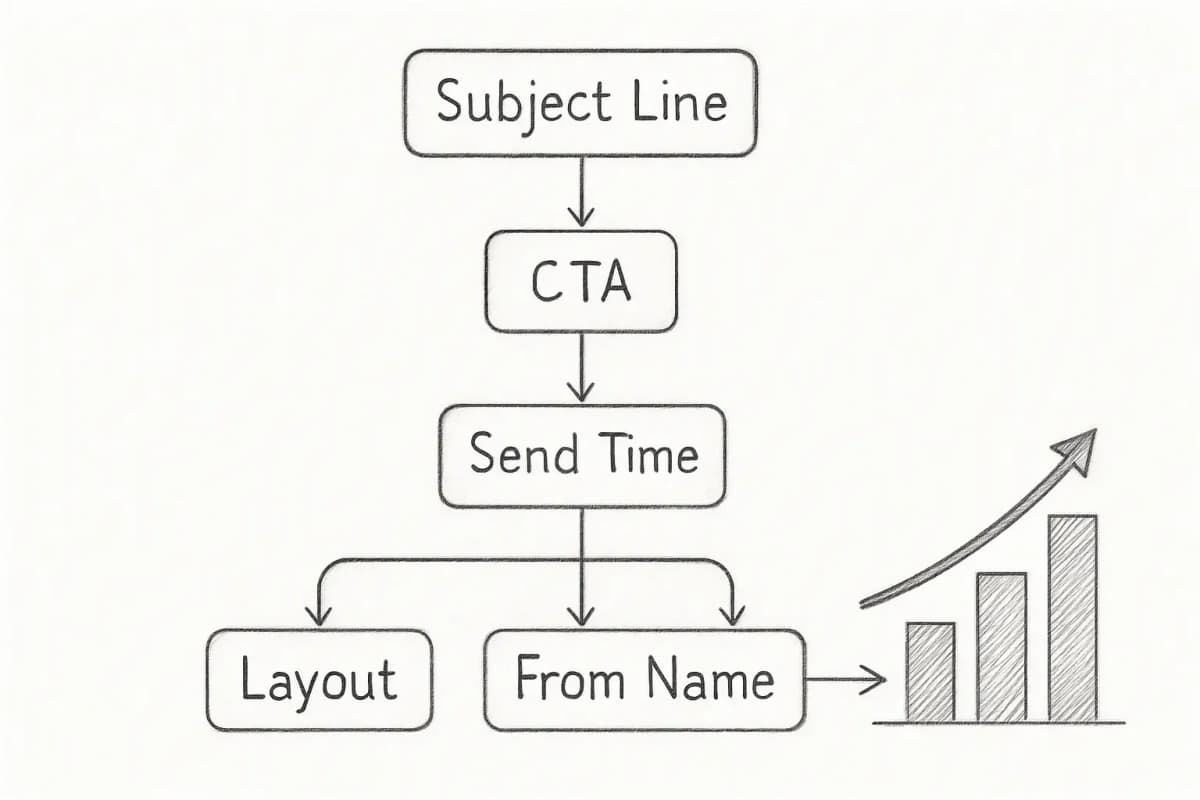
Small improvements compound into significant gains. A 2% increase in open rates might seem minor, but across thousands of emails, it translates to hundreds more potential customers seeing your message. A/B testing elements infographic showing five key email components you can test: subject line, call-to-action (CTA), send time, email layout, and from name. Each element should be displayed as a separate box or icon with a label, arranged horizontally or in a grid. Include a visual indicating that small improvements in each area compound into significant overall gains. The infographic should convey that testing these variables leads to measurable performance improvements.

8. Measure Results Against Your Original Goals

If you want to stay relevant and maximize results, make it a priority to continuously iterate and improve. Regularly analyze performance metrics, gather feedback, and adapt strategies based on evolving customer preferences and industry trends.

Track the metrics that match your campaign objective, not just open rates. Bot-driven phantom engagement has made open rates unreliable, pushing high-performing teams toward revenue per email, list churn, and lifetime value as the metrics that matter.

Metrics to track by goal type:

These are starting points, not rules. Your specific audience may behave differently. Use your platform's analytics or send-time optimization features to test against your actual subscriber data.

On frequency: 43% of people unsubscribe because they feel they get too many emails from the same sender. Start conservatively and scale based on engagement signals rather than arbitrary volume targets.


7. A/B Test Before and After You Send

Testing is not optional if you want consistent improvement. A/B testing can increase email marketing ROI by 83%. Businesses that never A/B test report an average ROI of 2,300%, versus 4,200% for those that often A/B test.

Test one variable at a time. If you try to test more than one element of your email, how will you know which element directly impacted the outcome? The answer is you will not. So even though you might be tempted to swap out a subject line and a CTA and your design in the same test, resist the urge.

Elements worth testing systematically:

  1. Subject line (length, tone, personalization, question vs. statement)
  2. Preview text
  3. From name (personal name vs. company name)
  4. CTA button copy and placement
  5. Email length and layout
  6. Offer type (discount vs. free resource vs. urgency framing)
  7. Send day and time

Small improvements compound into significant gains. A 2% increase in open rates might seem minor, but across thousands of emails, it translates to hundreds more potential customers seeing your message. A/B testing elements infographic showing five key email components you can test: subject line, call-to-action (CTA), send time, email layout, and from name. Each element should be displayed as a separate box or icon with a label, arranged horizontally or in a grid. Include a visual indicating that small improvements in each area compound into significant overall gains. The infographic should convey that testing these variables leads to measurable performance improvements.


8. Measure Results Against Your Original Goals

If you want to stay relevant and maximize results, make it a priority to continuously iterate and improve. Regularly analyze performance metrics, gather feedback, and adapt strategies based on evolving customer preferences and industry trends.

Track the metrics that match your campaign objective, not just open rates. Bot-driven phantom engagement has made open rates unreliable, pushing high-performing teams toward revenue per email, list churn, and lifetime value as the metrics that matter.

Metrics to track by goal type:

  • Lead generation: new subscribers, form completions, list growth rate
  • Revenue: revenue per email, conversion rate, average order value
  • Engagement: click-to-open rate, reply rate, forward rate
  • Deliverability: bounce rate, spam complaint rate, unsubscribe rate

A healthy bounce rate is typically under 2% for permission-based email lists. Rates above 5% signal potential deliverability issues that need immediate attention.

For a complete breakdown of how to measure and interpret campaign data, see our Email Marketing Analytics Best Practices guide.


Frequently Asked Questions

How do you plan an email marketing campaign from scratch?

Start by defining a specific, measurable goal tied to a business outcome. Then identify your target audience and build or segment your list around them. Choose the campaign type that fits your goal, write your content with one clear CTA, schedule the send based on your audience's behavior patterns, and set up tracking before you hit send.

What should be included in an email marketing campaign plan?

A complete campaign plan should cover: your campaign goal and KPIs, the target audience segment, the email type and sequence structure, content and subject line drafts, send schedule and frequency, A/B testing plan, and a defined measurement framework to evaluate results post-send.

How often should you send marketing emails?

There is no universal answer. 43% of people unsubscribe because they feel they receive too many emails from the same sender. Start with one to two emails per week for promotional campaigns and test from there. Frequency should be guided by engagement metrics: if unsubscribe rates or spam complaints rise, reduce frequency before you lose subscribers.

What metrics matter most for evaluating an email marketing campaign?

It depends on your goal. For revenue-focused campaigns, track conversion rate and revenue per email. For engagement, focus on click-to-open rate. For deliverability health, monitor bounce rate (target under 2%), spam complaint rate, and unsubscribe rate (target under 0.5% per send). The real measure of performance is what happens next. Clicks, conversions, replies, and revenue are all better metrics of success than open rates alone.


No comments yet. Be the first!

Leave a comment

Comments are reviewed before publishing.

  • Lead generation: new subscribers, form completions, list growth rate
  • Revenue: revenue per email, conversion rate, average order value
  • Engagement: click-to-open rate, reply rate, forward rate
  • Deliverability: bounce rate, spam complaint rate, unsubscribe rate

A healthy bounce rate is typically under 2% for permission-based email lists. Rates above 5% signal potential deliverability issues that need immediate attention.

For a complete breakdown of how to measure and interpret campaign data, see our Email Marketing Analytics Best Practices guide.


Frequently Asked Questions

How do you plan an email marketing campaign from scratch?

Start by defining a specific, measurable goal tied to a business outcome. Then identify your target audience and build or segment your list around them. Choose the campaign type that fits your goal, write your content with one clear CTA, schedule the send based on your audience's behavior patterns, and set up tracking before you hit send.

What should be included in an email marketing campaign plan?

A complete campaign plan should cover: your campaign goal and KPIs, the target audience segment, the email type and sequence structure, content and subject line drafts, send schedule and frequency, A/B testing plan, and a defined measurement framework to evaluate results post-send.

How often should you send marketing emails?

There is no universal answer. 43% of people unsubscribe because they feel they receive too many emails from the same sender. Start with one to two emails per week for promotional campaigns and test from there. Frequency should be guided by engagement metrics: if unsubscribe rates or spam complaints rise, reduce frequency before you lose subscribers.

What metrics matter most for evaluating an email marketing campaign?

It depends on your goal. For revenue-focused campaigns, track conversion rate and revenue per email. For engagement, focus on click-to-open rate. For deliverability health, monitor bounce rate (target under 2%), spam complaint rate, and unsubscribe rate (target under 0.5% per send). The real measure of performance is what happens next. Clicks, conversions, replies, and revenue are all better metrics of success than open rates alone.

No comments yet. Be the first!

Leave a comment

Comments are reviewed before publishing.

More from

Related posts

Illustration for gpt saas email marketing examples
Email StrategyMay 17, 2026 12 min

GPT SaaS Email Marketing Examples That Convert

See real GPT and AI SaaS email examples that drive signups and revenue. Proven templates, subject lines, and strategies for SaaS growth.

More from

Related posts

Illustration for gpt saas email marketing examples
Email StrategyMay 17, 2026 12 min

GPT SaaS Email Marketing Examples That Convert

See real GPT and AI SaaS email examples that drive signups and revenue. Proven templates, subject lines, and strategies for SaaS growth.

J
James Chen
J
James Chen
Illustration for successful email marketing campaign examples
Email StrategyMay 17, 2026 11 min

Successful Email Marketing Campaign Examples

See 7 real email marketing campaigns that drove results. Learn what worked, metrics they hit, and how to apply these tactics to your strategy.

PPriya Kapoor
Illustration for successful email marketing campaign examples
Email StrategyMay 17, 2026 11 min

Successful Email Marketing Campaign Examples

See 7 real email marketing campaigns that drove results. Learn what worked, metrics they hit, and how to apply these tactics to your strategy.

PPriya Kapoor
Illustration for email marketing best practices nonprofits
Email StrategyMay 17, 2026 10 min

Email Marketing Best Practices for Nonprofits

Learn proven email strategies nonprofits use to boost donations, engagement, and supporter retention. Increase impact with actionable tactics.

MMarcus Webb
Illustration for email marketing best practices nonprofits
Email StrategyMay 17, 2026 10 min

Email Marketing Best Practices for Nonprofits

Learn proven email strategies nonprofits use to boost donations, engagement, and supporter retention. Increase impact with actionable tactics.

MMarcus Webb