
Email
Email

A modern blog built with Payload CMS, Next.js, and shadcn/ui.

RSS FeedSitemap

Explore

  • Blog
  • News
  • Statistics
  • Authors

Categories

  • Email Analytics & Reporting
  • Email Security and Compliance
  • Email Marketing Tools and Strategy
  • Email Automation Strategies
  • Email Database & List Building
  • Email Marketing Tools & Resources
  • Seasonal Email Marketing
  • Email Marketing Benchmarks

Latest articles

  • Best CRM with Email Marketing Automation 2025Jul 19, 2026
  • Best AI Email Marketing Tools 2025Jul 19, 2026
  • Marketing Automation Email Campaigns: Setup GuideJul 19, 2026
  • Best AI Email Generator for Marketing Teams 2025Jul 19, 2026

Popular topics

  • #Email Generation
  • #agency benchmarks
  • #email marketing content strategy
  • #Marketing Compliance
  • #AI Security
  • #Productivity Tools
  • #atlanta business
  • #Data-Driven Strategy
  • #Marketing Outsourcing
  • #Outsourced Email Marketing
  • #Sales Workflows
  • #automation software
  • #Back-to-School
  • #Email Software Comparison
  • #Email Branding
  • #Email Marketing Metrics

Stay in the loop

Join 2,000+ readers. Unsubscribe anytime.

Subscribe
Email

© 2026 Email. All rights reserved.

SitemapRSS
HomeBlogEmail Marketing StrategyHow AI Is Applied in Email Marketing: 8 Practical Uses
Email Marketing Strategy

How AI Is Applied in Email Marketing: 8 Practical Uses

Discover 8 ways AI improves email marketing: segmentation, personalization, send time optimization, and more. Learn what actually works.

R

Rachel Torres

July 18, 2026

10 min read
Share:
#AI and Automation#Email Personalization#Marketing Technology
Illustration for how is ai applied in email marketing?

Stay in the loop

Get the latest posts delivered straight to your inbox. No spam, unsubscribe anytime.

AI is no longer a nice-to-have for email marketing teams. It is now the core infrastructure behind the campaigns that perform best. In 2025, 63% of marketers use AI for email campaigns, generating 13% higher click-through rates and 41% more revenue. If you have been wondering how is AI applied in email marketing, the answer covers everything from writing subject lines to predicting churn, and each application has a measurable impact on ROI.

This post breaks down the eight most practical uses of AI in email marketing, backed by current data, so you can make informed decisions about where to invest your time and budget.

Key Takeaways

  • Among companies that have adopted AI technologies, email marketing is the primary application area with an 87% deployment rate.
  • AI-driven email marketing leads to a 13% increase in click-through rates and a 41% rise in revenue.
  • In 2024, 62% of teams needed two weeks or more to produce a single email. By 2025, that number dropped to only 6%, largely due to AI-assisted workflows.
  • Triggered and automated emails represent only 2% of total email send volume, yet they account for 41% of total email revenue.
  • AI is primarily used for content personalization, retargeting, and subject line optimization. Personalization tops the list, with 50% of businesses using AI to tailor content to individual preferences. Retargeting and subject line optimization are each used by 47% of businesses.

1. AI-Powered Personalization at Scale

Personalization is where AI in email marketing delivers its clearest return. Standard name-field merges are the floor, not the ceiling.

True AI-driven hyper-personalization assembles a different email for each subscriber based on their behavioral signals: pages visited, products browsed, emails opened and clicked, recency of last purchase, and lifecycle stage. The email body, product recommendations, images, CTA copy, and even the sender name can all be dynamically swapped at the individual level, at scale, without manual effort per recipient.

The revenue impact is well documented. Marketers using AI for email personalization see 41% revenue increases and 13.44% CTR improvements. 36% of consumers now open emails specifically because of personalized content, representing a 227% year-over-year increase.

For a deeper look at how personalization tactics translate into conversions, see our guide on email personalization techniques that boost conversions.


2. Subject Line Optimization

Subject lines are tested faster and more accurately with AI than with any manual process.

Generative AI tools can produce multiple email copy variants, subject lines, preview text, and CTAs from simple briefs in seconds. The practical value is in volume and velocity. A human copywriter might draft three to five subject line variants for an A/B test. A generative AI system can produce 50 variants in the same time, all testable across audience segments simultaneously rather than sequentially.

The performance difference is significant. eBay deployed Phrasee's AI-powered subject line system and saw a 15.8% lift in open rates and a 31% increase in clicks. Across the industry, AI-optimized subject lines produce 50% higher open rates than manually written ones.

For a grounding in subject line fundamentals before layering AI on top, read our piece on email subject line best practices that boost open rates.


3. Send-Time Optimization

Most email platforms include send-time optimization (STO) as a built-in feature, yet it is consistently underused.

STO uses machine learning to predict when each individual subscriber is most likely to open and engage with an email. Rather than sending your entire list at 10 AM on Tuesday, the AI staggers delivery so each subscriber receives the email during their personal engagement window.

STO algorithms analyze each subscriber's historical behavior, including when they open emails, their time zone, whether they engage more on mobile or desktop, and typical engagement patterns across days of the week. The model builds an individual profile for each subscriber and predicts their optimal send window with increasing accuracy as more data accumulates. Most platforms require at least 30 days of engagement data per subscriber before STO predictions become reliable.

AI-optimized send-time personalization delivers a measurably higher open rate versus fixed-time sends, with most platforms reporting 15 to 25% improvement.


4. Predictive Segmentation

Traditional segmentation uses static rules like age, location, or purchase history categories. AI-driven predictive segmentation models future behavior based on real behavioral signals, not just demographic buckets.

Predictive AI uses historical data, including past purchases, browsing behavior, email engagement, and time-on-site, to forecast future behavior. It answers questions like: Which subscribers are most likely to purchase in the next 14 days? Who is at risk of unsubscribing? What product category should we recommend to this specific person?

Klaviyo's 2025 State of Email report found that brands using AI-driven segments saw revenue per recipient increase by 18 to 45% compared to traditional demographic segmentation.

Segmented email campaigns generate 30% more opens and 50% more click-throughs, according to HubSpot's 2025 State of Marketing Report. AI makes segmentation more precise and more actionable than any manual approach can achieve at scale.

For a comprehensive look at the segmentation strategies that drive the largest returns, see our post on email list segmentation strategies that boost ROI.


5. Behavioral Trigger Automation

Behavioral trigger automation is how AI converts intent signals into revenue without adding headcount. These flows run continuously based on what subscribers do, not when a marketer schedules a broadcast.

Five automated flows generate the bulk of email revenue: welcome series, cart recovery, post-purchase, re-engagement, and browse abandonment sequences drive the vast majority of automated email revenue when properly configured with behavioral triggers.

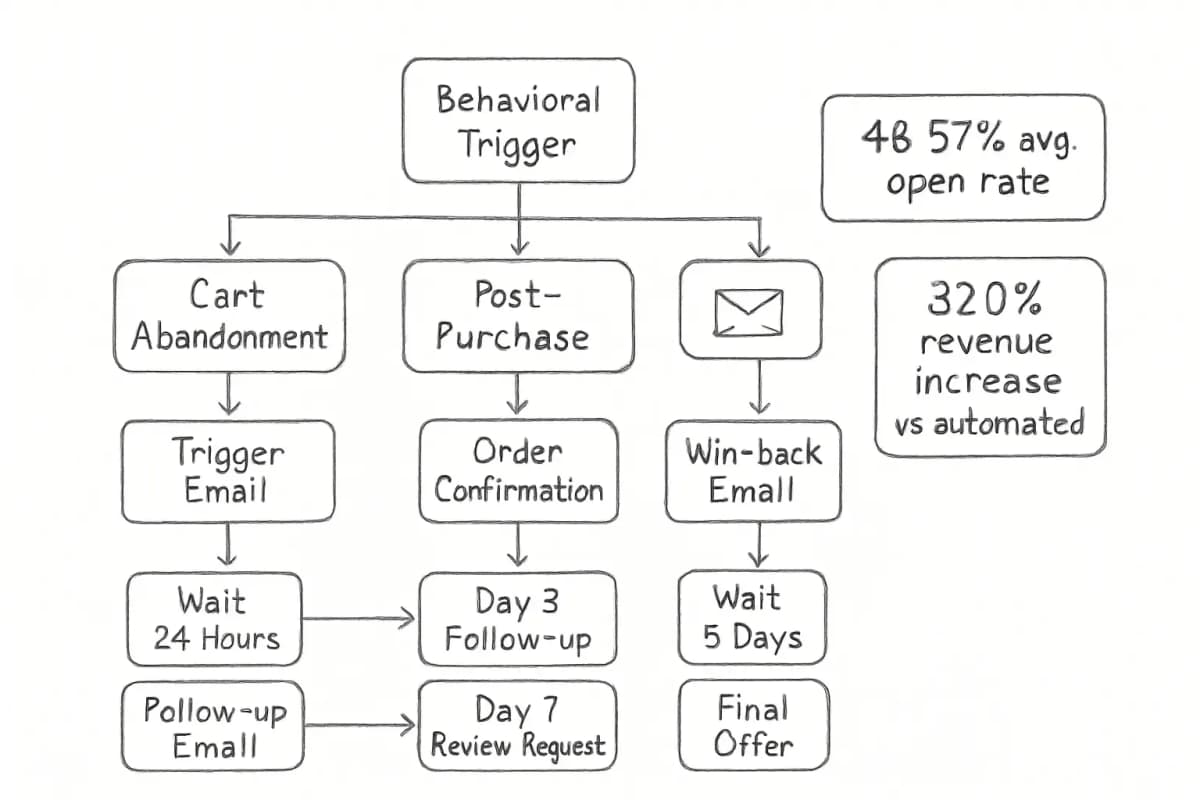
82% of marketers use automation for triggered emails, which generate 8x more opens than batch sends. Automated emails produce 320% more revenue than non-automated messages.

Automated emails achieve an average open rate of 48.57%, compared to 25.2% for manual campaign sends. Email automation workflow diagram showing three parallel triggered sequences. Starting from a central 'Behavioral Trigger' node, three paths branch out: (1) Cart Abandonment sequence with emails at key time intervals, (2) Post-Purchase sequence with order confirmation and follow-up emails, (3) Re-engagement sequence targeting inactive subscribers. Each path shows multiple email touchpoints connected by arrows, with timing indicators between steps. Include metrics callout boxes showing 48.57% average open rate for automated emails and 320% revenue increase compared to non-automated messages.
The business case is straightforward: these flows generate disproportionate revenue from a small fraction of total send volume, and AI determines the right message, timing, and content variant for each subscriber automatically.


6. AI Content Generation

In 2025, 49% of marketers use generative AI for static copy creation, and the number of marketers using AI-powered image generation has increased by 340% in the last year.

AI content generation in email marketing covers body copy drafting, CTA variations, product descriptions, plain-text versions, and preview text. The productivity gains are substantial.

In 2023, 62% of marketing teams needed two or more weeks to produce a single email. By 2025, only 6% do. That compression in production time comes primarily from AI-assisted writing and design tools entering standard workflows.

The key to using AI content generation well is treating it as a first-draft engine rather than a finished-copy machine. AI output requires a human review pass for accuracy, tone alignment, and brand voice. More than 70% of marketers have encountered an AI-related incident involving hallucinations, bias, or off-brand content. Governance matters as much as speed.


7. Predictive Churn Detection and Re-engagement

One of the least visible but highest-value applications of AI in email marketing is identifying which subscribers are about to disengage before they actually unsubscribe.

AI models identify subscribers showing early churn signals including declining engagement, increasing time between opens, and reduced website activity, before they unsubscribe or become inactive. This enables win-back sequences timed to the early stages of disengagement when re-engagement is most likely.

Churn prediction is a direct application of predictive analytics. By analyzing patterns in customer behavior, such as a decrease in engagement or purchase frequency, AI models can flag these customers and trigger re-engagement campaigns aimed at retaining them.

The results from teams using this approach are meaningful. Hydrant, a nutrition brand, used predictive churn modeling to identify at-risk subscribers and target them with tailored offers. The result was a 260% higher conversion rate on win-back emails and 310% more revenue per retained customer compared to non-AI approaches.


8. AI-Assisted Deliverability Management

Deliverability is the most undermanaged variable in email marketing. Approximately one in six marketing emails never reaches the recipient's inbox, with average deliverability rates hovering around 83% across major email service providers.

AI helps on two sides of this problem.

On the sender side, AI is most useful as automation for consistency and pattern detection, the two things that cause large deliverability issues when humans are managing email at scale. AI can warn about slow engagement declines, provider-specific issues like bounce clusters and spam complaint spikes, and which segments or templates are starting to negatively impact an otherwise good sender reputation.

On the content side, AI spam checkers offer a proactive solution by analyzing email content before you send, identifying trigger words, suspicious formatting, and authentication issues that harm deliverability.

In spam filtering, AI's advanced algorithms are capable of learning and adapting to new threats in real time, moving beyond simplistic keyword matching to understand context, sender behavior, and complex patterns, thereby providing a more robust defense against unwanted messages.

Maintaining a strong sender reputation now requires consistent authentication (SPF, DKIM, DMARC), clean list hygiene, and behavioral engagement signals. AI tools help you monitor all three continuously rather than reactively.


What This Means for Your Strategy

How is AI applied in email marketing in practical terms? It is applied across every stage of the email workflow, from content creation and segmentation to send-time decisions, deliverability monitoring, and revenue forecasting.

70% of email marketers say that up to half of their email marketing operations will be AI-driven by the end of 2026. Teams that wait to adopt these tools will not just lose a competitive edge; they will lose ground on metrics that compound over time, including list health, revenue per recipient, and subscriber lifetime value.

The practical starting point is not to adopt all eight applications at once. Start with send-time optimization (it is often a free toggle in your existing platform), then move to AI subject line testing, then behavioral triggers. Measure the incremental lift at each step before adding complexity.


Frequently Asked Questions

How is AI applied in email marketing specifically?

AI is primarily used for content personalization, retargeting, and subject line optimization. Beyond those three, it is also applied in send-time optimization, predictive segmentation, behavioral trigger automation, churn prediction, content generation, and deliverability monitoring. Each application addresses a different part of the email funnel and produces measurable improvements in engagement and revenue when implemented correctly.

Does AI actually improve email marketing ROI?

Yes, with documented results. AI-powered email programs generate 41% more revenue than manual campaigns according to Salesforce benchmarks, and teams implementing the full AI stack see 3.2x higher revenue per recipient. The ROI is highest when AI is applied to behavioral triggers and predictive segmentation rather than content generation alone.

What is the biggest risk of using AI in email marketing?

More than 70% of marketers have encountered an AI-related incident involving hallucinations, bias, or off-brand content, yet less than 35% plan to increase investment in AI governance. The risk is not the technology itself but the absence of human review. AI output should always pass through a brand and accuracy check before sending.

Can small teams apply AI in email marketing effectively?

Yes. Platforms like Mailchimp, Constant Contact, and ConvertKit offer built-in AI capabilities without requiring separate integrations or complex setups. The recommended approach is to focus on one AI feature at a time: start with send-time optimization, then gradually add subject line testing and behavioral triggers as you become comfortable with the technology.


No comments yet. Be the first!

Leave a comment

Comments are reviewed before publishing.

More from

Related posts

Illustration for marketing automation email campaigns
Email Marketing StrategyJul 19, 2026 10 min

Marketing Automation Email Campaigns: Setup Guide

Learn how to set up marketing automation email campaigns that nurture leads and boost conversions. Step-by-step strategies for busy marketers.

PPriya Kapoor
Illustration for agencia de email marketing automation
Email Marketing StrategyJul 19, 2026 12 min

Agencia de Email Marketing Automation: Guía Completa

Descubre cómo una agencia de email marketing automation optimiza campañas, aumenta conversiones y mejora ROI. Estrategias probadas para tu negocio.

JJames Chen
Illustration for how franchises can use ai in email marketing
Email Marketing StrategyJul 18, 2026 12 min

How Franchises Can Use AI in Email Marketing

Learn how franchise networks leverage AI to personalize emails, segment customers, and boost ROI across multiple locations. Strategic guide for franchise owners.

PPriya Kapoor
HomeBlogEmail Marketing StrategyHow AI Is Applied in Email Marketing: 8 Practical Uses
Email Marketing Strategy

How AI Is Applied in Email Marketing: 8 Practical Uses

Discover 8 ways AI improves email marketing: segmentation, personalization, send time optimization, and more. Learn what actually works.

R

Rachel Torres

July 18, 2026

10 min read
Share:
#AI and Automation#Email Personalization#Marketing Technology
Illustration for how is ai applied in email marketing?

Stay in the loop

Get the latest posts delivered straight to your inbox. No spam, unsubscribe anytime.

AI is no longer a nice-to-have for email marketing teams. It is now the core infrastructure behind the campaigns that perform best. In 2025, 63% of marketers use AI for email campaigns, generating 13% higher click-through rates and 41% more revenue. If you have been wondering how is AI applied in email marketing, the answer covers everything from writing subject lines to predicting churn, and each application has a measurable impact on ROI.

This post breaks down the eight most practical uses of AI in email marketing, backed by current data, so you can make informed decisions about where to invest your time and budget.

Key Takeaways

  • Among companies that have adopted AI technologies, email marketing is the primary application area with an 87% deployment rate.
  • AI-driven email marketing leads to a 13% increase in click-through rates and a 41% rise in revenue.
  • In 2024, 62% of teams needed two weeks or more to produce a single email. By 2025, that number dropped to only 6%, largely due to AI-assisted workflows.
  • Triggered and automated emails represent only 2% of total email send volume, yet they account for 41% of total email revenue.
  • AI is primarily used for content personalization, retargeting, and subject line optimization. Personalization tops the list, with 50% of businesses using AI to tailor content to individual preferences. Retargeting and subject line optimization are each used by 47% of businesses.

1. AI-Powered Personalization at Scale

Personalization is where AI in email marketing delivers its clearest return. Standard name-field merges are the floor, not the ceiling.

True AI-driven hyper-personalization assembles a different email for each subscriber based on their behavioral signals: pages visited, products browsed, emails opened and clicked, recency of last purchase, and lifecycle stage. The email body, product recommendations, images, CTA copy, and even the sender name can all be dynamically swapped at the individual level, at scale, without manual effort per recipient.

The revenue impact is well documented. Marketers using AI for email personalization see 41% revenue increases and 13.44% CTR improvements. 36% of consumers now open emails specifically because of personalized content, representing a 227% year-over-year increase.

For a deeper look at how personalization tactics translate into conversions, see our guide on email personalization techniques that boost conversions.


2. Subject Line Optimization

Subject lines are tested faster and more accurately with AI than with any manual process.

Generative AI tools can produce multiple email copy variants, subject lines, preview text, and CTAs from simple briefs in seconds. The practical value is in volume and velocity. A human copywriter might draft three to five subject line variants for an A/B test. A generative AI system can produce 50 variants in the same time, all testable across audience segments simultaneously rather than sequentially.

The performance difference is significant. eBay deployed Phrasee's AI-powered subject line system and saw a 15.8% lift in open rates and a 31% increase in clicks. Across the industry, AI-optimized subject lines produce 50% higher open rates than manually written ones.

For a grounding in subject line fundamentals before layering AI on top, read our piece on email subject line best practices that boost open rates.


3. Send-Time Optimization

Most email platforms include send-time optimization (STO) as a built-in feature, yet it is consistently underused.

STO uses machine learning to predict when each individual subscriber is most likely to open and engage with an email. Rather than sending your entire list at 10 AM on Tuesday, the AI staggers delivery so each subscriber receives the email during their personal engagement window.

STO algorithms analyze each subscriber's historical behavior, including when they open emails, their time zone, whether they engage more on mobile or desktop, and typical engagement patterns across days of the week. The model builds an individual profile for each subscriber and predicts their optimal send window with increasing accuracy as more data accumulates. Most platforms require at least 30 days of engagement data per subscriber before STO predictions become reliable.

AI-optimized send-time personalization delivers a measurably higher open rate versus fixed-time sends, with most platforms reporting 15 to 25% improvement.


4. Predictive Segmentation

Traditional segmentation uses static rules like age, location, or purchase history categories. AI-driven predictive segmentation models future behavior based on real behavioral signals, not just demographic buckets.

Predictive AI uses historical data, including past purchases, browsing behavior, email engagement, and time-on-site, to forecast future behavior. It answers questions like: Which subscribers are most likely to purchase in the next 14 days? Who is at risk of unsubscribing? What product category should we recommend to this specific person?

Klaviyo's 2025 State of Email report found that brands using AI-driven segments saw revenue per recipient increase by 18 to 45% compared to traditional demographic segmentation.

Segmented email campaigns generate 30% more opens and 50% more click-throughs, according to HubSpot's 2025 State of Marketing Report. AI makes segmentation more precise and more actionable than any manual approach can achieve at scale.

For a comprehensive look at the segmentation strategies that drive the largest returns, see our post on email list segmentation strategies that boost ROI.


5. Behavioral Trigger Automation

Behavioral trigger automation is how AI converts intent signals into revenue without adding headcount. These flows run continuously based on what subscribers do, not when a marketer schedules a broadcast.

Five automated flows generate the bulk of email revenue: welcome series, cart recovery, post-purchase, re-engagement, and browse abandonment sequences drive the vast majority of automated email revenue when properly configured with behavioral triggers.

82% of marketers use automation for triggered emails, which generate 8x more opens than batch sends. Automated emails produce 320% more revenue than non-automated messages.

Automated emails achieve an average open rate of 48.57%, compared to 25.2% for manual campaign sends. Email automation workflow diagram showing three parallel triggered sequences. Starting from a central 'Behavioral Trigger' node, three paths branch out: (1) Cart Abandonment sequence with emails at key time intervals, (2) Post-Purchase sequence with order confirmation and follow-up emails, (3) Re-engagement sequence targeting inactive subscribers. Each path shows multiple email touchpoints connected by arrows, with timing indicators between steps. Include metrics callout boxes showing 48.57% average open rate for automated emails and 320% revenue increase compared to non-automated messages.

The business case is straightforward: these flows generate disproportionate revenue from a small fraction of total send volume, and AI determines the right message, timing, and content variant for each subscriber automatically.


6. AI Content Generation

In 2025, 49% of marketers use generative AI for static copy creation, and the number of marketers using AI-powered image generation has increased by 340% in the last year.

AI content generation in email marketing covers body copy drafting, CTA variations, product descriptions, plain-text versions, and preview text. The productivity gains are substantial.

In 2023, 62% of marketing teams needed two or more weeks to produce a single email. By 2025, only 6% do. That compression in production time comes primarily from AI-assisted writing and design tools entering standard workflows.

The key to using AI content generation well is treating it as a first-draft engine rather than a finished-copy machine. AI output requires a human review pass for accuracy, tone alignment, and brand voice. More than 70% of marketers have encountered an AI-related incident involving hallucinations, bias, or off-brand content. Governance matters as much as speed.


7. Predictive Churn Detection and Re-engagement

One of the least visible but highest-value applications of AI in email marketing is identifying which subscribers are about to disengage before they actually unsubscribe.

AI models identify subscribers showing early churn signals including declining engagement, increasing time between opens, and reduced website activity, before they unsubscribe or become inactive. This enables win-back sequences timed to the early stages of disengagement when re-engagement is most likely.

Churn prediction is a direct application of predictive analytics. By analyzing patterns in customer behavior, such as a decrease in engagement or purchase frequency, AI models can flag these customers and trigger re-engagement campaigns aimed at retaining them.

The results from teams using this approach are meaningful. Hydrant, a nutrition brand, used predictive churn modeling to identify at-risk subscribers and target them with tailored offers. The result was a 260% higher conversion rate on win-back emails and 310% more revenue per retained customer compared to non-AI approaches.


8. AI-Assisted Deliverability Management

Deliverability is the most undermanaged variable in email marketing. Approximately one in six marketing emails never reaches the recipient's inbox, with average deliverability rates hovering around 83% across major email service providers.

AI helps on two sides of this problem.

On the sender side, AI is most useful as automation for consistency and pattern detection, the two things that cause large deliverability issues when humans are managing email at scale. AI can warn about slow engagement declines, provider-specific issues like bounce clusters and spam complaint spikes, and which segments or templates are starting to negatively impact an otherwise good sender reputation.

On the content side, AI spam checkers offer a proactive solution by analyzing email content before you send, identifying trigger words, suspicious formatting, and authentication issues that harm deliverability.

In spam filtering, AI's advanced algorithms are capable of learning and adapting to new threats in real time, moving beyond simplistic keyword matching to understand context, sender behavior, and complex patterns, thereby providing a more robust defense against unwanted messages.

Maintaining a strong sender reputation now requires consistent authentication (SPF, DKIM, DMARC), clean list hygiene, and behavioral engagement signals. AI tools help you monitor all three continuously rather than reactively.


What This Means for Your Strategy

How is AI applied in email marketing in practical terms? It is applied across every stage of the email workflow, from content creation and segmentation to send-time decisions, deliverability monitoring, and revenue forecasting.

70% of email marketers say that up to half of their email marketing operations will be AI-driven by the end of 2026. Teams that wait to adopt these tools will not just lose a competitive edge; they will lose ground on metrics that compound over time, including list health, revenue per recipient, and subscriber lifetime value.

The practical starting point is not to adopt all eight applications at once. Start with send-time optimization (it is often a free toggle in your existing platform), then move to AI subject line testing, then behavioral triggers. Measure the incremental lift at each step before adding complexity.


Frequently Asked Questions

How is AI applied in email marketing specifically?

AI is primarily used for content personalization, retargeting, and subject line optimization. Beyond those three, it is also applied in send-time optimization, predictive segmentation, behavioral trigger automation, churn prediction, content generation, and deliverability monitoring. Each application addresses a different part of the email funnel and produces measurable improvements in engagement and revenue when implemented correctly.

Does AI actually improve email marketing ROI?

Yes, with documented results. AI-powered email programs generate 41% more revenue than manual campaigns according to Salesforce benchmarks, and teams implementing the full AI stack see 3.2x higher revenue per recipient. The ROI is highest when AI is applied to behavioral triggers and predictive segmentation rather than content generation alone.

What is the biggest risk of using AI in email marketing?

More than 70% of marketers have encountered an AI-related incident involving hallucinations, bias, or off-brand content, yet less than 35% plan to increase investment in AI governance. The risk is not the technology itself but the absence of human review. AI output should always pass through a brand and accuracy check before sending.

Can small teams apply AI in email marketing effectively?

Yes. Platforms like Mailchimp, Constant Contact, and ConvertKit offer built-in AI capabilities without requiring separate integrations or complex setups. The recommended approach is to focus on one AI feature at a time: start with send-time optimization, then gradually add subject line testing and behavioral triggers as you become comfortable with the technology.

No comments yet. Be the first!

Leave a comment

Comments are reviewed before publishing.

More from

Related posts

Illustration for marketing automation email campaigns
Email Marketing StrategyJul 19, 2026 10 min

Marketing Automation Email Campaigns: Setup Guide

Learn how to set up marketing automation email campaigns that nurture leads and boost conversions. Step-by-step strategies for busy marketers.

PPriya Kapoor
Illustration for agencia de email marketing automation
Email Marketing StrategyJul 19, 2026 12 min

Agencia de Email Marketing Automation: Guía Completa

Descubre cómo una agencia de email marketing automation optimiza campañas, aumenta conversiones y mejora ROI. Estrategias probadas para tu negocio.

JJames Chen
Illustration for how franchises can use ai in email marketing
Email Marketing StrategyJul 18, 2026 12 min

How Franchises Can Use AI in Email Marketing

Learn how franchise networks leverage AI to personalize emails, segment customers, and boost ROI across multiple locations. Strategic guide for franchise owners.

PPriya Kapoor