
Email
Email

A modern blog built with Payload CMS, Next.js, and shadcn/ui.

RSS FeedSitemap

Explore

  • Blog
  • News
  • Statistics
  • Authors

Categories

  • Email Analytics & Reporting
  • Email Security and Compliance
  • Email Marketing Tools and Strategy
  • Email Automation Strategies
  • Email Database & List Building
  • Email Marketing Tools & Resources
  • Seasonal Email Marketing
  • Email Marketing Benchmarks

Latest articles

  • Free Email Marketing AI Tools: 7 Best PicksJul 19, 2026
  • Salesforce Email Marketing Automation ToolsJul 19, 2026
  • AI Email Writer Tools for Marketing: Automate & ScaleJul 19, 2026
  • Automation Email Marketing Service: Guide to ROIJul 19, 2026

Popular topics

  • #Email Generation
  • #agency benchmarks
  • #email marketing content strategy
  • #Marketing Compliance
  • #AI Security
  • #Productivity Tools
  • #atlanta business
  • #Data-Driven Strategy
  • #Marketing Outsourcing
  • #Outsourced Email Marketing
  • #Sales Workflows
  • #automation software
  • #Back-to-School
  • #Email Software Comparison
  • #Email Branding
  • #Email Marketing Metrics

Stay in the loop

Join 2,000+ readers. Unsubscribe anytime.

Subscribe
Email

© 2026 Email. All rights reserved.

SitemapRSS
HomeBlogCRM and Email ToolsBest CRM with Email Marketing Automation 2025
CRM and Email Tools

Best CRM with Email Marketing Automation 2025

Compare top CRM platforms with built-in email automation. Find the right tool for your business needs with our expert reviews and recommendations.

J

James Chen

July 19, 2026

12 min read
Share:
#CRM Software#Email Automation#Marketing Tools#Business Software
Illustration for best crm with email marketing automation 2025

Stay in the loop

Get the latest posts delivered straight to your inbox. No spam, unsubscribe anytime.

Choosing the best CRM with email marketing automation in 2025 is not just a software decision. It determines how well your sales and marketing teams share data, how precisely you can target contacts, and whether your campaigns generate real revenue or just deliver opens. In today's competitive landscape, juggling a separate CRM and email marketing tool creates data silos, missed opportunities, and a disjointed customer experience. The good news: a new generation of unified platforms has made it much easier to run both from a single system.

Automated emails generate 320% more revenue than non-automated emails, and for every $1 spent on email marketing, the average return is $36. Those numbers get significantly better when your email tool is connected natively to your CRM, where behavioral signals from campaigns can update deal stages, trigger follow-up sequences, and feed your lead scoring in real time.

This guide covers the top platforms, the features that actually matter, and a practical decision framework to help you pick the right fit for your business.


Key Takeaways

  • Automated emails generate 320% more revenue than non-automated emails, making email automation a direct driver of bottom-line results.
  • Businesses using CRM automation see an average increase in lead conversion rates by up to 30%, and companies that use CRM systems effectively can increase sales by up to 29%.
  • Juggling a separate CRM and email marketing tool creates data silos and a disjointed customer experience. The most effective teams use a unified platform where sales activities and marketing campaigns live together.
  • 70% of companies now use AI in their CRM, and 65% leverage generative AI for tasks like forecasting, lead scoring, and personalized outreach.
  • The best CRM with email marketing automation for your business depends on your size, use case, and primary focus: sales pipeline, automation depth, ecommerce, or budget.

Why CRM and Email Marketing Belong Together

When you combine CRM and email marketing, you get a system that automatically populates your CRM with sales leads captured via email forms and personalizes your emails with contact data. Your CRM and email marketing efforts feed into each other and enhance your sales and marketing campaigns as a whole.

With an email marketing CRM, everything is in one place. You see exactly where subscribers came from, what content they engage with, and which emails drive results. No more jumping between platforms or merging conflicting reports.

Organizations with connected CRM and marketing systems have a clearer view of how email contributes to revenue. That attribution clarity is what separates teams that optimize confidently from those that guess.

The practical benefits are concrete:

  • Improved targeting: Segment your audience using CRM data for more relevant and effective email campaigns.
  • Automated follow-ups: Set up triggered emails based on customer actions or CRM data changes.
  • Cost reduction: Eliminate the need for separate CRM and email marketing tools, potentially reducing overall software costs.
  • Better alignment: Ensure sales and marketing teams are aligned with up-to-date customer information.

For a deeper look at how to set up this kind of system from scratch, see our Email Marketing Automation CRM Setup Guide.


The 6 Best CRM Platforms with Email Marketing Automation

1. HubSpot: Best All-in-One for B2B and Scaling Teams

HubSpot offers a powerful, natively integrated suite of tools where its free CRM acts as the central hub for all marketing and sales activities. This tight integration is its standout feature, making it one of the best CRM with email marketing solutions for businesses that want a single source of truth for customer data.

Everything from an email open to a form submission is logged directly on the contact's record, providing a complete 360-degree view.

HubSpot's free plan lets you store up to 1,000 contacts in your CRM, send up to 2,000 emails per month, and set up simple marketing automations. You can start with a robust free plan and graduate to sophisticated features like visual automation workflows, lead scoring, and A/B testing as your needs grow.

Best for: B2B teams, SaaS companies, and any organization that needs revenue attribution tied directly to email activity.

Limitations: Paid tiers scale up in price quickly. Email marketing features are more limited than dedicated platforms at the lower tiers.


2. ActiveCampaign: Best for Advanced Automation

ActiveCampaign is a customer experience automation platform that excels at combining deep email marketing capabilities with a sales-focused CRM. Its core strength lies in its sophisticated automation engine, which allows for highly personalized, behavior-triggered customer journeys.

Its CRM is built directly into the marketing automation tool, creating a seamless flow of information. A lead's engagement with an email campaign can automatically update their deal stage, assign a task to a sales rep, or adjust their lead score, all without manual intervention.

Its visual automation builder offers 135+ triggers, conditional branching, and the ability to A/B test entire automation paths, not just subject lines.

Best for: Businesses sending segmented campaigns, building multi-step workflows, scoring leads, or running lifecycle sequences across more than 1,000 contacts. It is also a strong fit for SaaS companies running trial-to-paid programs and B2B services that want most of HubSpot's automation at a fraction of the cost.

Limitations: The learning curve can be steep for its most advanced automation features, and pricing is contact-based, which can become costly.


3. Brevo: Best Value for SMBs and High-Volume Senders

Brevo is an email marketing and CRM suite for small businesses and those with large contact databases but modest sending requirements and multichannel needs.

Its business model is based on the volume of emails sent rather than the size of the contact database, an advantage for companies with large contact lists but occasional campaign activity. It includes a built-in CRM with deal pipelines and lead scoring.

Brevo's free marketing platform plan includes 100,000 contacts and lets you send 300 emails a day. These can be marketing or transactional emails. Paid plans start at $8.08 per month for 5,000 emails.

Best for: Small businesses, consultants, and teams with large lists who need multichannel outreach (email, SMS, WhatsApp) at a predictable price.

Limitations: Brevo has only 40+ templates, compared to Mailchimp's 100+, and no advanced reporting on the free plan.


4. Klaviyo: Best for Ecommerce Brands

Klaviyo is a multi-channel marketing automation platform centered around customer data. Historically specialized in ecommerce email marketing, it evolved into a unified suite integrating CRM, marketing, customer service, and analytics in 2025. Klaviyo excels in advanced segmentation, deep personalization, and native integrations with ecommerce tools like Shopify, Magento, and WooCommerce.

Klaviyo uses AI to offer predictive analytics, providing insights into metrics like customer lifetime value, churn risk, and expected next order date.

Best for: Ecommerce brands with complex customer journeys, high purchase frequency, and a need to tie email revenue directly to store performance.

Limitations: Klaviyo introduced a pricing update in February 2025, charging based on active profiles. For some customers, this could raise costs by as much as 25%. It is also less suitable for B2B or non-ecommerce use cases.


5. Zoho CRM: Best for Budget-Conscious Teams in the Zoho Ecosystem

Zoho CRM is a powerhouse for small and medium-sized businesses, offering an incredibly deep and customizable platform at a competitive price point. Its strength lies in its tight integration with the broader Zoho ecosystem, particularly Zoho Campaigns for email marketing. This connection transforms the CRM into one of the best CRM with email marketing solutions for businesses that need granular control over their sales and marketing processes without the enterprise-level price tag.

Integration with Zoho CRM means automation can trigger based on sales pipeline stages, deal values, and the customer lifecycle, not just email behavior.

Best for: SMBs already invested in Zoho tools, or those who need a highly customizable platform at the lowest possible cost.

Limitations: ActiveCampaign offers more granular if/then logic. If your business model requires complex multi-branch automation, ActiveCampaign is genuinely better.


6. Salesforce Marketing Cloud: Best for Enterprise

Salesforce holds the largest share of the CRM market globally, according to IDC's 2025 rankings, and its email marketing capabilities reflect that scale.

Salesforce delivers AI-based insights as predictive recommendations using Salesforce Einstein. You can create reusable content blocks including text, HTML, images, buttons, dynamic content, and A/B testing, as well as code snippets for maximum personalization.

Best for: Large enterprises running sophisticated, multi-channel campaigns with advanced compliance requirements and complex sales cycles.

Limitations: High cost and steep learning curve make it impractical for most small businesses.


What Features Actually Matter When You Choose

Not every CRM with email marketing deserves equal weight on the same set of features. Not all CRM features are created equal. While every platform claims to offer everything you need, the reality is that some capabilities drive significantly more ROI than others.

Here is what to evaluate seriously:

  1. Automation depth: Can you build branching, conditional workflows, or are you limited to linear drip sequences? This distinction separates platforms that scale from those that plateau.
  2. Native CRM integration: What separates one platform from another is how tightly email marketing is connected to the CRM. Native email functionality keeps customer data, campaign activity, and pipeline updates in one place.
  3. Segmentation capabilities: Businesses that leverage detailed customer information such as purchase history, website interactions, and demographic data can craft relevant and timely email communications.
  4. Deliverability tools: Look for SPF/DKIM support, list cleaning features, and sender reputation monitoring built into the platform.
  5. Pricing at scale: Most platforms look affordable at 500 contacts. The test is what happens at 10,000 or 50,000. Calculate the cost at 3x your current list size before committing.
  6. AI features: ActiveCampaign's Active Intelligence layer generates full campaigns from a prompt, suggests audience segments, and uses Predictive Sending to optimize send times at the individual contact level. Most leading platforms now offer comparable AI features, so evaluate them in context of your actual workflow.

To complement your CRM setup, strong email list segmentation strategies and personalization techniques will help you get more from whichever platform you choose.


A Quick Decision Framework

Use this to cut through feature lists and match a platform to your situation:

Business TypeRecommended Platform
B2B / SaaS with revenue attribution needsHubSpot
Advanced automation, SMB to mid-marketActiveCampaign
Ecommerce (Shopify, WooCommerce)Klaviyo
SMB on a budget, large contact listBrevo or Zoho CRM
Enterprise with complex compliance needsSalesforce Marketing Cloud

Choose based on your main need: sales pipeline, marketing automation, ecommerce, or simplicity. Most platforms offer free trials or free tiers. Use them to test the interface, integrations, and team adoption before making a commitment.


The Role of AI in CRM Email Marketing Automation

AI has moved from a differentiating feature to a baseline expectation. 70% of companies use AI in their CRM, and 65% leverage generative AI for tasks like forecasting, lead scoring, and personalized outreach.

AI adoption in marketing jumped to 60% daily usage in 2025, up from 37% in 2024. Platforms are embedding AI across send-time optimization, subject line generation, contact scoring, and content personalization.

Personalization through automated systems is becoming even more critical, with studies showing that personalized emails generate 58% higher transaction rates than generic ones.

The practical implication: when comparing platforms, look at how AI is embedded into their actual workflows, not just listed as a feature. Predictive sending, AI-generated subject lines, and churn risk modeling are the most actionable capabilities at this stage.

Our guide on email marketing automation tips covers nine specific ways to put automation to work regardless of which platform you use.
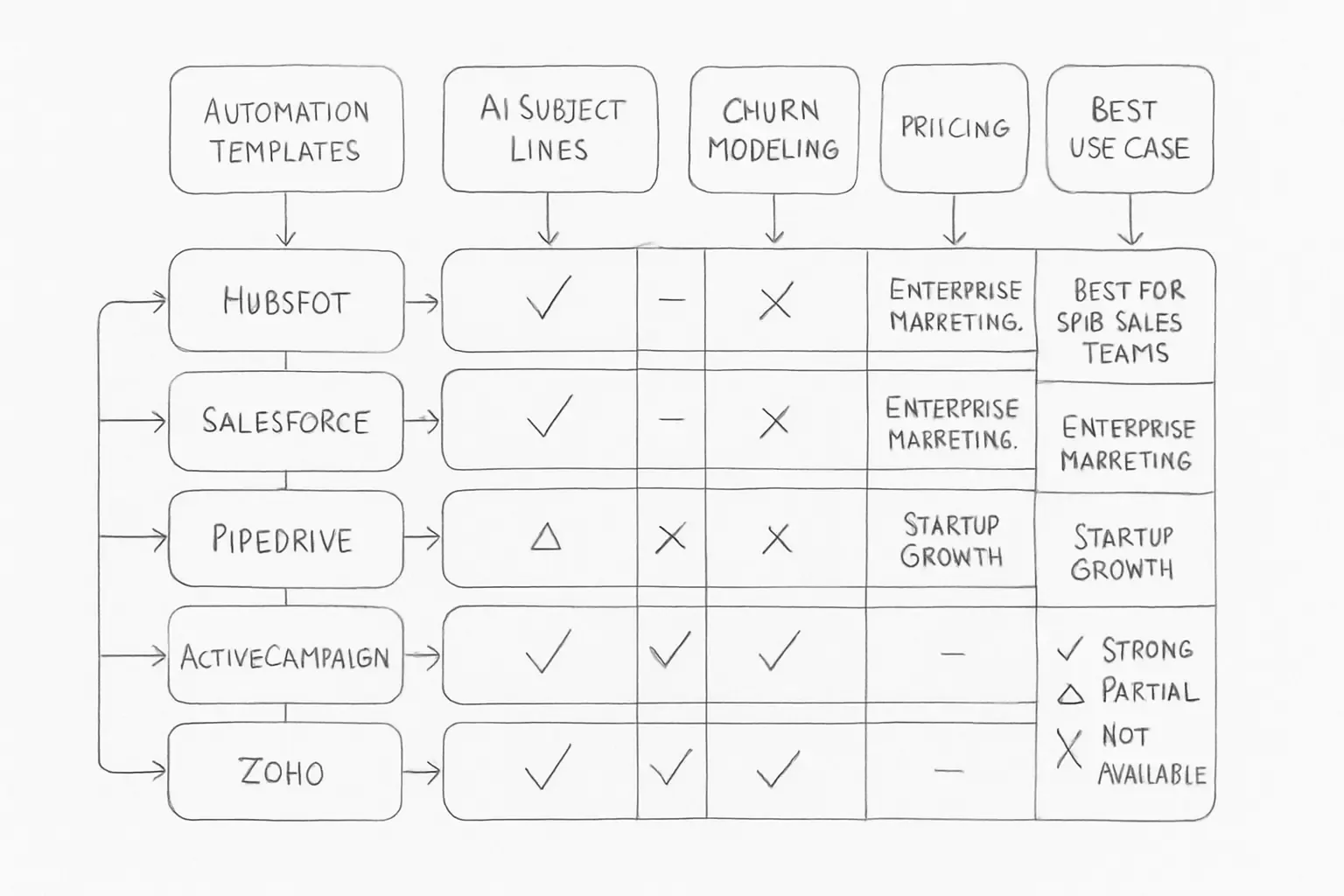

Comparison chart displaying top CRM platforms with email marketing automation capabilities. Chart should show 4-5 major platforms (such as HubSpot, Salesforce, Pipedrive, ActiveCampaign, and Zoho) in rows with columns for key features including: automation templates, AI-generated subject lines, churn risk modeling, deliverability tools, and pricing tier. Use a color-coded system (green checkmarks for strong capability, yellow for partial, red for absent) to indicate feature availability. Include a final column showing primary use case (e.g., 'Best for SMB Sales Teams', 'Enterprise Marketing', 'Startup Growth'). Add a legend explaining the color coding system.


Common Mistakes to Avoid

Even the best platform underperforms if your setup is poor. Watch for these pitfalls:

  • Choosing by feature count, not fit. A platform with 200 automation templates you never use is worse than one with 20 you actually deploy.
  • Ignoring deliverability. Poor deliverability, incorrect attribution, generic content, and inadequate testing destroy ROI. Confirm your platform supports proper authentication and list hygiene from day one.
  • Skipping the CRM connection. Running email marketing independently of your CRM removes the behavioral signal that makes automation meaningful.
  • Underestimating migration costs. Moving contacts, automations, and templates between platforms takes real time. Factor this in before switching.
  • Not testing at scale. Most platforms are priced per contact. Run your list size projections before you commit to a plan.

Frequently Asked Questions

What is the best CRM with email marketing automation for small businesses in 2025?

For small businesses, Brevo offers the best value with its all-in-one multichannel suite and intuitive user interface. HubSpot's free tier is also a strong starting point if your priority is CRM depth and you want to scale into more sophisticated automation over time. The right choice depends on whether your main constraint is budget (Brevo or Zoho), list size, or automation complexity.

How does CRM automation affect email marketing ROI?

Organizations with mature automation strategies achieve 32% higher marketing ROI. The mechanism is straightforward: CRM data allows for tighter segmentation, which enables more relevant emails, which generate higher engagement and conversion rates. CRM and marketing automation platforms help connect email activity to revenue outcomes, tracking engagement, conversions, and attribution across campaigns. Centralized data makes it easier to evaluate performance over time.

Can I use a CRM with email marketing automation for ecommerce?

Yes, and this is where the combination is arguably most powerful. Klaviyo is the market leader for Shopify email marketing; its native integration pulls product, order, and browse data, enabling highly personalized automation. Omnisend is a strong alternative for stores where Klaviyo's pricing is a concern. For most ecommerce brands, connecting purchase history, browse behavior, and cart abandonment data to your email sequences is the fastest path to measurable revenue lift.

What should I look for in a CRM email marketing platform beyond features?

Test setup time, learning curve, and interface intuitiveness. Prioritize platforms that get teams productive in hours, not weeks, and do not require extensive training. Also evaluate the quality of support on the plans you can actually afford, integration reliability with your existing stack, and pricing behavior as your contact list grows. A platform that is affordable at 1,000 contacts but doubles in price at 10,000 is a migration risk, not a long-term solution.

No comments yet. Be the first!

Leave a comment

Comments are reviewed before publishing.

HomeBlogCRM and Email ToolsBest CRM with Email Marketing Automation 2025
CRM and Email Tools

Best CRM with Email Marketing Automation 2025

Compare top CRM platforms with built-in email automation. Find the right tool for your business needs with our expert reviews and recommendations.

J

James Chen

July 19, 2026

12 min read
Share:
#CRM Software#Email Automation#Marketing Tools#Business Software
Illustration for best crm with email marketing automation 2025

Stay in the loop

Get the latest posts delivered straight to your inbox. No spam, unsubscribe anytime.

Choosing the best CRM with email marketing automation in 2025 is not just a software decision. It determines how well your sales and marketing teams share data, how precisely you can target contacts, and whether your campaigns generate real revenue or just deliver opens. In today's competitive landscape, juggling a separate CRM and email marketing tool creates data silos, missed opportunities, and a disjointed customer experience. The good news: a new generation of unified platforms has made it much easier to run both from a single system.

Automated emails generate 320% more revenue than non-automated emails, and for every $1 spent on email marketing, the average return is $36. Those numbers get significantly better when your email tool is connected natively to your CRM, where behavioral signals from campaigns can update deal stages, trigger follow-up sequences, and feed your lead scoring in real time.

This guide covers the top platforms, the features that actually matter, and a practical decision framework to help you pick the right fit for your business.


Key Takeaways

  • Automated emails generate 320% more revenue than non-automated emails, making email automation a direct driver of bottom-line results.
  • Businesses using CRM automation see an average increase in lead conversion rates by up to 30%, and companies that use CRM systems effectively can increase sales by up to 29%.
  • Juggling a separate CRM and email marketing tool creates data silos and a disjointed customer experience. The most effective teams use a unified platform where sales activities and marketing campaigns live together.
  • 70% of companies now use AI in their CRM, and 65% leverage generative AI for tasks like forecasting, lead scoring, and personalized outreach.
  • The best CRM with email marketing automation for your business depends on your size, use case, and primary focus: sales pipeline, automation depth, ecommerce, or budget.

Why CRM and Email Marketing Belong Together

When you combine CRM and email marketing, you get a system that automatically populates your CRM with sales leads captured via email forms and personalizes your emails with contact data. Your CRM and email marketing efforts feed into each other and enhance your sales and marketing campaigns as a whole.

With an email marketing CRM, everything is in one place. You see exactly where subscribers came from, what content they engage with, and which emails drive results. No more jumping between platforms or merging conflicting reports.

Organizations with connected CRM and marketing systems have a clearer view of how email contributes to revenue. That attribution clarity is what separates teams that optimize confidently from those that guess.

The practical benefits are concrete:

  • Improved targeting: Segment your audience using CRM data for more relevant and effective email campaigns.
  • Automated follow-ups: Set up triggered emails based on customer actions or CRM data changes.
  • Cost reduction: Eliminate the need for separate CRM and email marketing tools, potentially reducing overall software costs.
  • Better alignment: Ensure sales and marketing teams are aligned with up-to-date customer information.

For a deeper look at how to set up this kind of system from scratch, see our Email Marketing Automation CRM Setup Guide.


The 6 Best CRM Platforms with Email Marketing Automation

1. HubSpot: Best All-in-One for B2B and Scaling Teams

HubSpot offers a powerful, natively integrated suite of tools where its free CRM acts as the central hub for all marketing and sales activities. This tight integration is its standout feature, making it one of the best CRM with email marketing solutions for businesses that want a single source of truth for customer data.

Everything from an email open to a form submission is logged directly on the contact's record, providing a complete 360-degree view.

HubSpot's free plan lets you store up to 1,000 contacts in your CRM, send up to 2,000 emails per month, and set up simple marketing automations. You can start with a robust free plan and graduate to sophisticated features like visual automation workflows, lead scoring, and A/B testing as your needs grow.

Best for: B2B teams, SaaS companies, and any organization that needs revenue attribution tied directly to email activity.

Limitations: Paid tiers scale up in price quickly. Email marketing features are more limited than dedicated platforms at the lower tiers.


2. ActiveCampaign: Best for Advanced Automation

ActiveCampaign is a customer experience automation platform that excels at combining deep email marketing capabilities with a sales-focused CRM. Its core strength lies in its sophisticated automation engine, which allows for highly personalized, behavior-triggered customer journeys.

Its CRM is built directly into the marketing automation tool, creating a seamless flow of information. A lead's engagement with an email campaign can automatically update their deal stage, assign a task to a sales rep, or adjust their lead score, all without manual intervention.

Its visual automation builder offers 135+ triggers, conditional branching, and the ability to A/B test entire automation paths, not just subject lines.

Best for: Businesses sending segmented campaigns, building multi-step workflows, scoring leads, or running lifecycle sequences across more than 1,000 contacts. It is also a strong fit for SaaS companies running trial-to-paid programs and B2B services that want most of HubSpot's automation at a fraction of the cost.

Limitations: The learning curve can be steep for its most advanced automation features, and pricing is contact-based, which can become costly.


3. Brevo: Best Value for SMBs and High-Volume Senders

Brevo is an email marketing and CRM suite for small businesses and those with large contact databases but modest sending requirements and multichannel needs.

Its business model is based on the volume of emails sent rather than the size of the contact database, an advantage for companies with large contact lists but occasional campaign activity. It includes a built-in CRM with deal pipelines and lead scoring.

Brevo's free marketing platform plan includes 100,000 contacts and lets you send 300 emails a day. These can be marketing or transactional emails. Paid plans start at $8.08 per month for 5,000 emails.

Best for: Small businesses, consultants, and teams with large lists who need multichannel outreach (email, SMS, WhatsApp) at a predictable price.

Limitations: Brevo has only 40+ templates, compared to Mailchimp's 100+, and no advanced reporting on the free plan.


4. Klaviyo: Best for Ecommerce Brands

Klaviyo is a multi-channel marketing automation platform centered around customer data. Historically specialized in ecommerce email marketing, it evolved into a unified suite integrating CRM, marketing, customer service, and analytics in 2025. Klaviyo excels in advanced segmentation, deep personalization, and native integrations with ecommerce tools like Shopify, Magento, and WooCommerce.

Klaviyo uses AI to offer predictive analytics, providing insights into metrics like customer lifetime value, churn risk, and expected next order date.

Best for: Ecommerce brands with complex customer journeys, high purchase frequency, and a need to tie email revenue directly to store performance.

Limitations: Klaviyo introduced a pricing update in February 2025, charging based on active profiles. For some customers, this could raise costs by as much as 25%. It is also less suitable for B2B or non-ecommerce use cases.


5. Zoho CRM: Best for Budget-Conscious Teams in the Zoho Ecosystem

Zoho CRM is a powerhouse for small and medium-sized businesses, offering an incredibly deep and customizable platform at a competitive price point. Its strength lies in its tight integration with the broader Zoho ecosystem, particularly Zoho Campaigns for email marketing. This connection transforms the CRM into one of the best CRM with email marketing solutions for businesses that need granular control over their sales and marketing processes without the enterprise-level price tag.

Integration with Zoho CRM means automation can trigger based on sales pipeline stages, deal values, and the customer lifecycle, not just email behavior.

Best for: SMBs already invested in Zoho tools, or those who need a highly customizable platform at the lowest possible cost.

Limitations: ActiveCampaign offers more granular if/then logic. If your business model requires complex multi-branch automation, ActiveCampaign is genuinely better.


6. Salesforce Marketing Cloud: Best for Enterprise

Salesforce holds the largest share of the CRM market globally, according to IDC's 2025 rankings, and its email marketing capabilities reflect that scale.

Salesforce delivers AI-based insights as predictive recommendations using Salesforce Einstein. You can create reusable content blocks including text, HTML, images, buttons, dynamic content, and A/B testing, as well as code snippets for maximum personalization.

Best for: Large enterprises running sophisticated, multi-channel campaigns with advanced compliance requirements and complex sales cycles.

Limitations: High cost and steep learning curve make it impractical for most small businesses.


What Features Actually Matter When You Choose

Not every CRM with email marketing deserves equal weight on the same set of features. Not all CRM features are created equal. While every platform claims to offer everything you need, the reality is that some capabilities drive significantly more ROI than others.

Here is what to evaluate seriously:

  1. Automation depth: Can you build branching, conditional workflows, or are you limited to linear drip sequences? This distinction separates platforms that scale from those that plateau.
  2. Native CRM integration: What separates one platform from another is how tightly email marketing is connected to the CRM. Native email functionality keeps customer data, campaign activity, and pipeline updates in one place.
  3. Segmentation capabilities: Businesses that leverage detailed customer information such as purchase history, website interactions, and demographic data can craft relevant and timely email communications.
  4. Deliverability tools: Look for SPF/DKIM support, list cleaning features, and sender reputation monitoring built into the platform.
  5. Pricing at scale: Most platforms look affordable at 500 contacts. The test is what happens at 10,000 or 50,000. Calculate the cost at 3x your current list size before committing.
  6. AI features: ActiveCampaign's Active Intelligence layer generates full campaigns from a prompt, suggests audience segments, and uses Predictive Sending to optimize send times at the individual contact level. Most leading platforms now offer comparable AI features, so evaluate them in context of your actual workflow.

To complement your CRM setup, strong email list segmentation strategies and personalization techniques will help you get more from whichever platform you choose.


A Quick Decision Framework

Use this to cut through feature lists and match a platform to your situation:

Business TypeRecommended Platform
B2B / SaaS with revenue attribution needsHubSpot
Advanced automation, SMB to mid-marketActiveCampaign
Ecommerce (Shopify, WooCommerce)Klaviyo
SMB on a budget, large contact listBrevo or Zoho CRM
Enterprise with complex compliance needsSalesforce Marketing Cloud

Choose based on your main need: sales pipeline, marketing automation, ecommerce, or simplicity. Most platforms offer free trials or free tiers. Use them to test the interface, integrations, and team adoption before making a commitment.


The Role of AI in CRM Email Marketing Automation

AI has moved from a differentiating feature to a baseline expectation. 70% of companies use AI in their CRM, and 65% leverage generative AI for tasks like forecasting, lead scoring, and personalized outreach.

AI adoption in marketing jumped to 60% daily usage in 2025, up from 37% in 2024. Platforms are embedding AI across send-time optimization, subject line generation, contact scoring, and content personalization.

Personalization through automated systems is becoming even more critical, with studies showing that personalized emails generate 58% higher transaction rates than generic ones.

The practical implication: when comparing platforms, look at how AI is embedded into their actual workflows, not just listed as a feature. Predictive sending, AI-generated subject lines, and churn risk modeling are the most actionable capabilities at this stage.

Our guide on email marketing automation tips covers nine specific ways to put automation to work regardless of which platform you use.


Comparison chart displaying top CRM platforms with email marketing automation capabilities. Chart should show 4-5 major platforms (such as HubSpot, Salesforce, Pipedrive, ActiveCampaign, and Zoho) in rows with columns for key features including: automation templates, AI-generated subject lines, churn risk modeling, deliverability tools, and pricing tier. Use a color-coded system (green checkmarks for strong capability, yellow for partial, red for absent) to indicate feature availability. Include a final column showing primary use case (e.g., 'Best for SMB Sales Teams', 'Enterprise Marketing', 'Startup Growth'). Add a legend explaining the color coding system.


Common Mistakes to Avoid

Even the best platform underperforms if your setup is poor. Watch for these pitfalls:

  • Choosing by feature count, not fit. A platform with 200 automation templates you never use is worse than one with 20 you actually deploy.
  • Ignoring deliverability. Poor deliverability, incorrect attribution, generic content, and inadequate testing destroy ROI. Confirm your platform supports proper authentication and list hygiene from day one.
  • Skipping the CRM connection. Running email marketing independently of your CRM removes the behavioral signal that makes automation meaningful.
  • Underestimating migration costs. Moving contacts, automations, and templates between platforms takes real time. Factor this in before switching.
  • Not testing at scale. Most platforms are priced per contact. Run your list size projections before you commit to a plan.

Frequently Asked Questions

What is the best CRM with email marketing automation for small businesses in 2025?

For small businesses, Brevo offers the best value with its all-in-one multichannel suite and intuitive user interface. HubSpot's free tier is also a strong starting point if your priority is CRM depth and you want to scale into more sophisticated automation over time. The right choice depends on whether your main constraint is budget (Brevo or Zoho), list size, or automation complexity.

How does CRM automation affect email marketing ROI?

Organizations with mature automation strategies achieve 32% higher marketing ROI. The mechanism is straightforward: CRM data allows for tighter segmentation, which enables more relevant emails, which generate higher engagement and conversion rates. CRM and marketing automation platforms help connect email activity to revenue outcomes, tracking engagement, conversions, and attribution across campaigns. Centralized data makes it easier to evaluate performance over time.

Can I use a CRM with email marketing automation for ecommerce?

Yes, and this is where the combination is arguably most powerful. Klaviyo is the market leader for Shopify email marketing; its native integration pulls product, order, and browse data, enabling highly personalized automation. Omnisend is a strong alternative for stores where Klaviyo's pricing is a concern. For most ecommerce brands, connecting purchase history, browse behavior, and cart abandonment data to your email sequences is the fastest path to measurable revenue lift.

What should I look for in a CRM email marketing platform beyond features?

Test setup time, learning curve, and interface intuitiveness. Prioritize platforms that get teams productive in hours, not weeks, and do not require extensive training. Also evaluate the quality of support on the plans you can actually afford, integration reliability with your existing stack, and pricing behavior as your contact list grows. A platform that is affordable at 1,000 contacts but doubles in price at 10,000 is a migration risk, not a long-term solution.

No comments yet. Be the first!

Leave a comment

Comments are reviewed before publishing.