
B2B buyers prefer email above nearly every other outreach channel, and email ranks as the second most effective lead source in B2B marketing. Yet most B2B email programs underperform, not because email doesn't work, but because teams apply B2C tactics to a fundamentally different buying environment. This guide breaks down how to use email marketing for B2B businesses the right way: from building a quality list to segmenting by role, automating nurture sequences, and measuring what actually drives pipeline.
Key Takeaways
- 42% of B2B marketers cite email as their most effective marketing channel, outranked only by in-person events and webinars.
- B2B marketing emails have a slightly lower open rate than B2C (15.14% vs. 19.7%), but B2B has a higher click rate of 3.18% compared to 2.09% for B2C.
- Advanced segmentation and personalization can boost revenue by up to 760%, making it one of the highest-impact tactics available.
- Automated emails generate 320% more revenue than non-automated emails.
- 80% of new leads never translate into sales due to lack of nurturing, yet companies that excel at lead nurturing generate 50% more sales-ready leads at 33% lower cost.
How B2B Email Marketing Differs from B2C
Before building any campaign, understand the core difference: most email marketing campaigns target individuals, but B2B campaigns target companies, specifically multiple individuals within a company. A company's purchasing process involves people in all sorts of roles, and when you identify a B2B target, you're really identifying a group of targets.
In B2B, messages must convince and satisfy multiple decision-makers, prove ROI, and support a longer evaluation process. B2C email, by contrast, often aims for an impulse purchase or a quick brand-preference nudge.
This is why B2B email marketing best practices must focus on value, education, trust, and authority. You're not selling impulse purchases; you're guiding businesses toward a confident decision.
B2B emails perform better when they focus on providing information and resources. Educational content like trend reports, industry benchmarks, how-to guides, and webinar recordings help prove your brand's value to a B2B subscriber.
Build a High-Quality B2B Email List
Your list quality determines your results more than any other variable. Focus on building a list of high-quality leads who are genuinely interested in what you have to offer. A small, engaged list will always outperform a large, unresponsive one. For example, 100 active and qualified B2B subscribers can generate more conversions and revenue than 1,000 unengaged general contacts.
Never buy email lists. Prioritize organic list-building using ethical and effective strategies. Avoid purchasing email lists, as they can harm your sender reputation and overall marketing efforts. The goal is to focus on sources that attract your desired B2B audience.
Effective organic list-building methods for B2B include:
- Lead magnets tied to business value: whitepapers, benchmark reports, templates, and ROI calculators
- Gated webinars and industry research: attracts prospects actively seeking expertise
- LinkedIn content funnels: driving traffic to opt-in pages from posts and ads
- Demo and free trial sign-up flows: capturing high-intent leads directly in your product funnel
Email lists need consistent cleaning, as HubSpot research shows contact data degrades by approximately 22.5% annually. B2B email data decays at roughly 2% per month because professionals change jobs. A 10,000-contact list loses around 200 valid addresses every month without action. Schedule quarterly list audits and remove contacts who haven't engaged in 6 to 12 months.
For more guidance on building your contact database, see our guide to lead gathering tools for email lists.
Segment Your List by Role, Stage, and Firmographics
Sending the same email to your entire list is one of the fastest ways to damage deliverability and waste budget. Generic messages sent to your entire list produce generic results. Segmented campaigns routinely outperform one-size-fits-all bulk sends, driving up to 760% more revenue.
The three segmentation layers that matter most in B2B:
1. Firmographic segmentation: This method involves grouping prospects based on company size, industry, growth rate, or the technology they use. A small startup and a large enterprise have vastly different needs, and your messaging should reflect that.
2. Role-based segmentation: Your email to a VP of Marketing shouldn't read like the one you sent to a RevOps analyst. The difference is tone, proof points, and the problem you lead with.
3. Behavioral segmentation: This covers email clicks, site visits, content downloads, and webinar attendance. Someone who downloaded your pricing PDF is in a different conversation than someone who read a blog post six months ago.
Email segmentation statistics demonstrate that segmented campaigns achieve 14% higher open rates and 28% better click rates compared to generic sends.
For a deeper breakdown of segmentation strategies and how to execute them, read our post on email list segmentation strategies that boost ROI by 760%.
Personalize Beyond the First Name
B2B personalization goes far beyond inserting first names in subject lines. Effective personalization demonstrates genuine understanding of the recipient's business context and challenges.
According to McKinsey research, personalized B2B experiences, including email, deliver 40% more revenue than non-personalized approaches.
In practice, meaningful B2B personalization includes:
- Referencing the recipient's industry or company size in the body copy
- Adjusting the problem framing based on job title (a CFO cares about cost; a CTO cares about integration)
- Triggering emails based on specific behaviors, such as visiting a pricing page or attending a webinar
- Using case studies from the same industry as the recipient
Surface-level personalization is a thing of the past. Gone are the days of inserting a first name token and calling it personalization. Today's B2B buyers expect content that aligns with their industry, role, and stage in the buying journey.
Explore proven techniques in our guide to email personalization techniques that boost conversions 47%.
Build Nurture Sequences That Match the Buying Cycle
B2B deals rarely close after a single email. Most prospects interested in your company aren't ready to buy right away. Studies show that leads need eight touches on average before jumping on the first sales call.
Nurtured leads make 47% larger purchases than non-nurtured leads on average. They also produce more sales opportunities, with one study finding a 20% increase in sales opportunities from nurtured vs. non-nurtured leads.
A well-structured B2B nurture sequence covers these stages:
- Welcome series: Sets expectations, introduces your value proposition, and earns the right to continue the conversation
- Educational drip: Sends relevant content (case studies, guides, frameworks) based on the lead's stated interests or behavior
- Pain-point focused emails: Addresses specific challenges the prospect faces at their current funnel stage
- Social proof: Case studies, testimonials, and ROI data from companies similar to the prospect
- Decision-stage offer: Demo invitation, free trial, or consultation, triggered by buying signals like pricing page visits or repeated email engagement
Trigger-based automation creates responsive, personalized experiences by reacting to specific prospect behaviors. When a prospect visits your pricing page, automation can send relevant case studies. When they download a whitepaper, follow-up emails can deliver complementary resources on the same topic.
55% of replies to cold email campaigns come from follow-up emails rather than the first message, making multi-step sequences essential for effective outbound outreach.
Use Automation to Scale Without Losing Relevance
Email marketing delivers an impressive $36 return for every $1 invested, while automated nurturing emails generate 320% more revenue than manual campaigns.
Automations accounted for just 2% of email sends but drove 30% of revenue, earning 16 times more per send than scheduled campaigns. That ratio makes a strong case for investing in automation early.
Key automation workflows every B2B program should have:
- Lead magnet download sequence: A 3 to 5 email series that follows up on content downloads with related resources and a soft CTA
- Trial or demo onboarding sequence: Guides new users through activation milestones
- Re-engagement campaign: Targets contacts who have gone quiet over 60 to 90 days with a direct "are you still interested?" message
- Post-event follow-up: Sends personalized follow-ups to webinar attendees based on which sessions they watched
80% of marketing professionals agree that automation software is essential for improving lead nurturing performance. The key is building workflows that respond to actual behavior rather than just the passage of time. 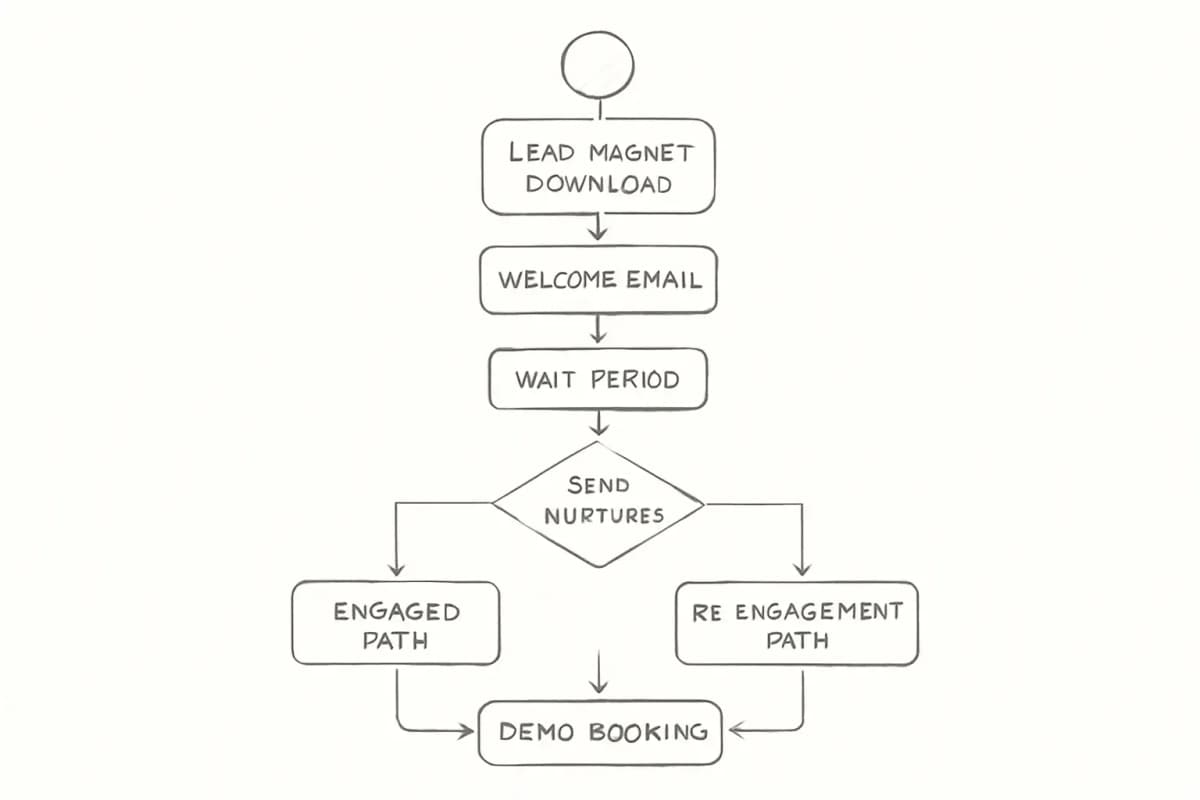
Write Subject Lines and Copy That Get B2B Opens
In B2B marketing, the inbox is still where many of the most important conversations start. While platforms like LinkedIn and paid advertising generate awareness, email is often what turns interest into actual opportunities.
Subject lines are the single biggest lever for open rates. In a B2B context, what works:
- Specificity over cleverness: "How [Company Type] teams reduced onboarding time by 40%" outperforms vague teasers
- Value framing over curiosity gaps: Decision-makers respond to clear outcomes, not mystery
- Personalization tokens used contextually: Industry or company name in the subject line, not just first name
- Short and direct: Under 50 characters tends to perform well on mobile, where more than 60% of emails are now opened, even in B2B.
For a complete breakdown of what moves the needle, read our analysis of email subject line best practices that boost open rates by 27%.
In the body copy, keep paragraphs short, lead with the outcome the reader cares about, and use a single clear CTA per email. Use only one CTA per email. Including more than one can overwhelm or confuse email recipients.
Track the Right B2B Email Metrics
Open rates are increasingly unreliable as a primary metric. Bot-driven phantom engagement has made open rates unreliable, pushing high-performing teams toward revenue per email, list churn, and lifetime value as the metrics that matter.
The metrics that actually map to B2B revenue:
- Click-to-open rate (CTOR): Measures engagement among people who actually opened your email, filtering out bot inflated opens
- Reply rate: Especially important for outbound and cold sequences; a direct signal of genuine interest
- Meeting booked rate: Connects email activity to pipeline generation
- Pipeline influenced: Tracks how many deals had email touchpoints at any stage
- Revenue per email send: The most direct measure of ROI at the campaign level
What makes email particularly valuable in the B2B context is its measurable impact on revenue. Beyond traditional metrics like opens and clicks, mature B2B programs track pipeline influence, deal velocity acceleration, and actual closed revenue attributed to email campaigns.
A/B test consistently. Behavioral triggers consistently outperform scheduled sends by three to five times in both open and click rates. Test one variable at a time: subject line, send time, CTA text, or email length. Let data drive the next iteration, not gut instinct.
Protect Your Deliverability
Even the best B2B email strategy fails if your messages don't reach the inbox. When you're sending mail to corporate email servers, your success will always be influenced and dictated by the strictness of internal policy settings set by server administrators and the email security software used to manage corporate email delivery.
Core deliverability practices for B2B senders:
- Authenticate your domain with SPF, DKIM, and DMARC records
- Warm up new sending domains gradually over 4 to 6 weeks
- Keep hard bounce rates below 2%
- Remove unengaged contacts from your active send list; segment them into a separate re-engagement campaign first
- Set clear transparency on list collection purpose and adopt permission-based sending at all times. Making consent informed rather than assumed remains the best way to reduce the risk of potential non-compliance.
- Prioritize data compliance and privacy. Adhere to GDPR, CAN-SPAM, and other regulations to protect customer trust and avoid penalties.
Combining segmentation and personalization leads to better audience engagement, which sends positive signals to ISPs. Your positive sender reputation keeps you out of the spam folder, meaning more people see your message.
Frequently Asked Questions
What types of emails work best for B2B marketing?
The email types that consistently perform well in B2B include welcome email series (which set expectations and build trust), educational and authority emails (providing insights and thought leadership), pain-point-focused drip sequences, and case study and proof emails that share real results and ROI evidence for decision-makers. Event invitations and product update emails also serve important roles in keeping contacts engaged across the buying cycle.
How often should B2B companies send marketing emails?
Frequency depends on your audience's preferences and where contacts sit in the funnel. B2B businesses typically send out one email marketing campaign every 25 days, but automated nurture sequences operate on behavior-based timing rather than a fixed calendar. Letting subscribers set their own frequency preferences through a preference center reduces unsubscribes and improves engagement quality.
How do I measure B2B email marketing ROI?
What makes email particularly valuable in the B2B context is its measurable impact on revenue. Beyond traditional metrics like opens and clicks, mature B2B programs track pipeline influence, deal velocity acceleration, and actual closed revenue attributed to email campaigns. Connect your email platform to your CRM so you can attribute pipeline and closed-won deals to specific campaigns and sequences.
What is a good click-through rate for B2B email?
The average B2B email click-through rate is 2.3%, and B2B campaigns benefit more from educational content and longer nurture sequences than B2C campaigns. However, benchmarks vary by industry and email type. Behavioral trigger emails consistently outperform newsletters and promotional sends, so track CTOR alongside raw CTR to get a more accurate picture of content performance.