
Machine learning and email marketing are no longer separate disciplines. They work together to close the gap between what you send and what your subscribers actually want, and the results show up directly in revenue. AI-powered email programs generate 41% more revenue than manual campaigns, and teams implementing the full AI stack see 3.2x higher revenue per recipient. This guide covers how machine learning works inside email marketing, where it drives real gains, and how to get started without a data science team.
Key Takeaways
- Among companies that have adopted AI technologies, email marketing is the primary application area, with an 87% deployment rate, because machine learning can analyze engagement patterns, predict optimal timing, and generate personalized content variations.
- According to McKinsey, personalized AI-powered email campaigns can achieve 5 to 8x higher ROI than traditional batch-and-blast strategies.
- Machine learning goes beyond basic segmentation by analyzing behavioral patterns, engagement timing, and content preferences. It clusters subscribers based on hundreds of data points: which links they click, how quickly they open emails, and what devices they use.
- Gmail processes over 15 billion unwanted messages daily, with AI-enhanced filters blocking more than 99.9% of spam, phishing attempts, and malware before they reach inboxes.
- Send-time optimization typically lifts open rates by 5 to 15%, a marginal gain that compounds over many sends. Pair it with strong subject lines, relevant content, and healthy list hygiene for maximum impact.
What Machine Learning Actually Does in Email Marketing
Machine learning is a form of AI that detects patterns from large data sets and improves its recommendations over time without explicit programming. Natural language processing enables computers to interpret and generate human language, which marketers use to optimize subject line wording and email copy based on tone, context, and audience preferences.
In practical terms, this means your email platform gets smarter with every campaign you send. Machine learning algorithms identify hidden patterns in successful outreach that humans might miss, such as optimal timing, messaging themes, or content types that resonate with specific personas.
AI in email marketing refers to using artificial intelligence and machine learning to automate, optimize, and personalize email campaigns. This includes everything from content generation and audience segmentation to send time optimization and predictive analytics.
The practical difference between AI and traditional email marketing is not just speed. It is the ability to act on data at a scale and with a precision that no human team can match manually.
Smarter Segmentation Through Behavioral Data
Traditional list segmentation groups subscribers by demographics: age, location, purchase history. That is a reasonable starting point, but it leaves most of your signal on the table.
Traditional segmentation divided lists by basic demographics such as age, location, and purchase history. Machine learning goes deeper, analyzing behavioral patterns, engagement timing, content preferences, and predicted future actions.
Segmented email campaigns generate 760% more revenue than non-segmented broadcasts. The most effective segmentation combines behavioral data (purchase history, browse patterns) with AI-predicted intent scores.
Machine learning models cluster subscribers by purchase propensity, churn risk, lifetime value potential, and content affinity. The result is micro-segments that reflect actual behavior rather than assumed attributes. A subscriber who consistently clicks product review links is placed in a different segment from one who only opens promotional discount emails, even if both share the same demographic profile.
For a deeper look at how segmentation strategy connects to revenue, see our guide on email list segmentation strategies that boost ROI by 760%.
Personalization at Scale: Dynamic Content and Product Recommendations
Brands using AI-driven personalization report up to 42% higher revenue, with click-through rates exceeding 13%. This alone can lift ROI by nearly 20%.
Machine learning makes this possible because it handles the personalization logic automatically. Dynamic content blocks change based on recipient data. Product recommendations reflect browsing history. Subject lines adapt to what typically drives each person to open. Send times adjust to individual engagement patterns.
Instead of creating multiple email versions targeted at different segments, you create one template that automatically adapts. AI handles the heavy lifting by analyzing the data and generating relevant content at scale.
This is where machine learning and email marketing create a compounding advantage. Each campaign teaches the model more about each subscriber, so the next campaign performs better. Over time, the personalization becomes more precise without any additional manual effort from your team.
Machine learning models trained on your historical email data generate subject lines that consistently outperform manually written alternatives. The key is training on your audience's specific response patterns, not generic best practices.
If you want to see specific techniques in action, our post on email personalization techniques that boost conversions 47% walks through the approaches that consistently deliver results.
Send-Time Optimization: What the Data Actually Shows
One of the most accessible machine learning features in email marketing is send-time optimization (STO). Most major platforms now include it, and it requires no custom development to activate.
Predictive send-time optimization is the use of AI to determine the best moment to deliver an email to each individual recipient. Instead of sending campaigns at a fixed time, STO evaluates historical engagement patterns and adjusts delivery based on when a person is most likely to open or click. STO relies on machine learning models trained on behavioral data.
The model learns from each contact's historical open patterns including time of day, day of week, and device type, and adjusts over time. It works best for campaigns where timing flexibility doesn't hurt your message, such as newsletters, nurture sequences, and promotional announcements. It is less useful for time-sensitive emails like webinar reminders or flash sales where everyone needs to receive the message within a tight window.
Real-world results confirm the value. By adopting send-time optimization and pairing it with personalized emails and in-app messages powered by machine learning, OneRoof saw a 23% increase in email click-to-open rates, a 57% uplift in unique clicks, and a 218% increase in total clicks to property listings.
Using machine learning, send-time optimization tools continually test and analyze engagement data so that over time, open and click rates increase, sender score improves, and campaigns deliver more results.
How Machine Learning Shapes Email Deliverability
Machine learning affects your deliverability from two directions: the filters that decide whether your emails reach the inbox, and the tools you can use to stay on the right side of those filters.
Traditional spam filters relied on keyword matching and simple rules. Machine learning changed everything by analyzing hundreds of features simultaneously: sender reputation, email content patterns, user engagement history, HTML structure, and sending behaviors.
In 2025, filters are smarter than ever, powered by AI, stricter authentication standards, and engagement-based scoring models that reward trusted senders and penalize those with poor reputation.
Senders without proper SPF, DKIM, and DMARC records see inbox placement rates drop to 44%, compared to 89% for fully authenticated domains. That is a 45-point gap driven entirely by authentication status, not content quality.
AI spam checkers offer a proactive solution by analyzing email content before you send, identifying trigger words, suspicious formatting, and authentication issues that harm deliverability. These tools use machine learning algorithms to simulate how spam filters evaluate your messages, providing actionable recommendations to fix problems before they impact your send.
The practical takeaway: machine learning governs both sides of deliverability. Mailbox providers use it to filter your emails, and you can use it to predict and prevent those filters from triggering.
Predictive Analytics for Churn Prevention and Re-engagement
Beyond individual campaign performance, machine learning can assess the health of your entire subscriber list and flag risks before they compound.
Machine learning models score every contact for next-best purchase, engagement likelihood, and churn risk. This lets you move from reactive re-engagement (sending a win-back campaign after someone goes cold) to proactive retention (identifying at-risk subscribers before they disengage).
Predictive analytics helps businesses cut customer churn by 15 to 25% by identifying at-risk customers early and enabling targeted retention strategies. Instead of reacting after customers leave, predictive models analyze data like usage patterns, support interactions, and financial behaviors to predict churn risks. This allows businesses to act up to 80% faster, improving retention and increasing revenue by 3 to 5%.
ML predicts the timing of churn by analyzing customer behavior patterns and identifying early warning signals, helping you determine precisely when retention campaigns should be launched to maximize their impact on at-risk customers.
For SaaS businesses in particular, this capability connects directly to renewal rates and MRR. Our SaaS email marketing strategy guide covers how to structure re-engagement sequences around predictive signals.
Automated Campaigns: Where Machine Learning Multiplies Returns
Automated email workflows powered by machine learning are not just convenient. They produce dramatically different results from manually scheduled sends.
In 2024, automated emails outperformed scheduled ones by 52% in opens, 332% in clicks, and 2361% in conversions.
Automated emails generate 320% more revenue than manual campaigns despite representing just 2% of send volume, proving the business case for AI-powered workflow automation.
The mechanism is straightforward. By analyzing massive datasets and responding in real-time, AI eliminates guesswork, bringing precision and personalization to new heights. AI identifies the ideal moment to deliver each email by learning from past user behavior, device usage, and engagement history.
Triggered workflows such as abandoned cart sequences, post-purchase follow-ups, and welcome series all benefit from machine learning because the model continuously refines the timing, frequency, and content based on what actually drives conversions for your specific audience. 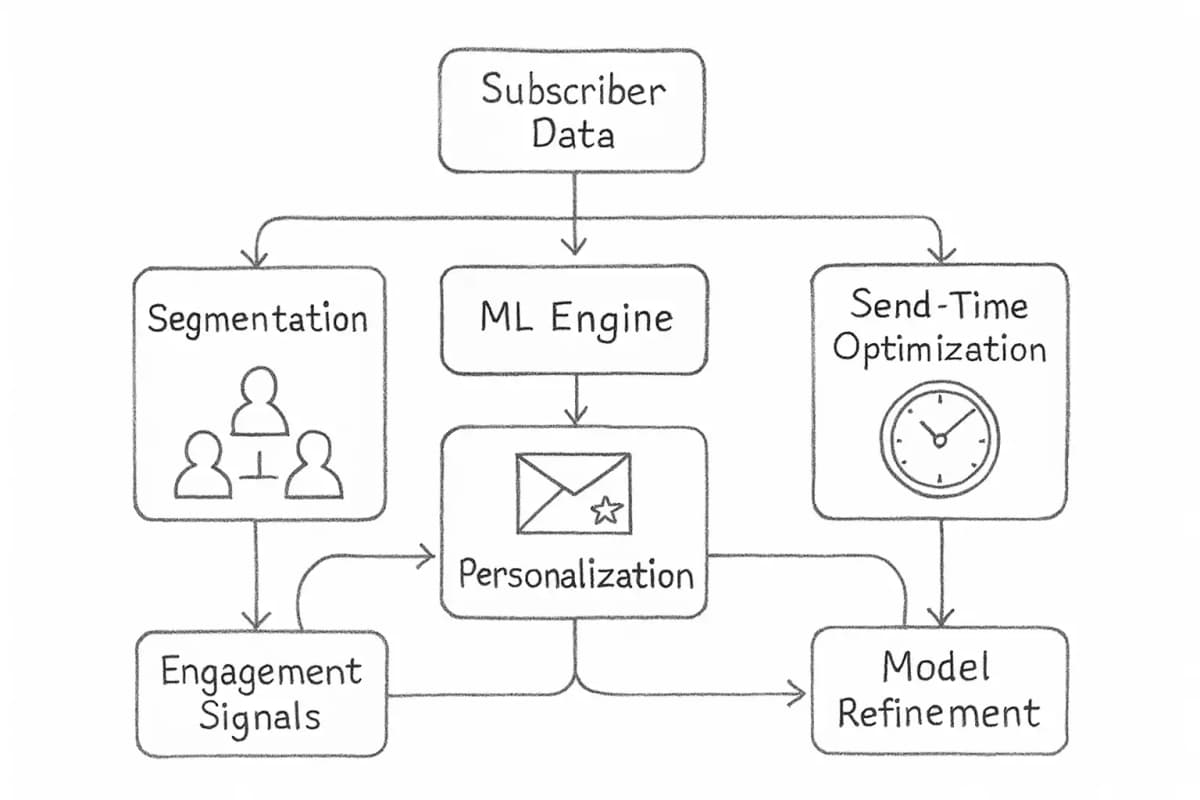
How to Implement Machine Learning in Your Email Program
You do not need data science expertise. Most capabilities are now built into email platforms or available through specialized tools. Focus on integration and optimization rather than building algorithms from scratch.
Here is a practical starting sequence:
- Audit your current platform. Start by auditing your current email platform's machine learning features. Major providers include predictive analytics, send-time optimization, and segmentation tools.
- Enable send-time optimization first. It requires no additional configuration and delivers measurable results within a few campaigns. Track click-through rate and revenue per recipient, not just open rate.
- Build behavioral segments. Use engagement data (clicks, opens, purchases, browse behavior) to replace or supplement your demographic segments.
- Set up triggered workflows. Automate welcome sequences, cart abandonment, and re-engagement flows. Let the ML layer optimize timing and frequency over time.
- Add predictive scoring. Once you have enough behavioral data, activate churn risk and propensity-to-buy scoring to prioritize your highest-value segments.
- Test subject line generation. Use ML-assisted subject line tools trained on your own historical data, not generic best-practice lists.
Machine learning quality depends entirely on data quality. Garbage in, garbage out applies absolutely here. Clean your list, verify your authentication records, and ensure your tracking is configured correctly before activating any predictive features.
Success depends on quality data and balance, avoiding over-reliance on AI and maintaining human creativity and brand voice.
Frequently Asked Questions
What is machine learning in email marketing?
Machine learning is a form of AI that detects patterns from large data sets and improves its recommendations over time without explicit programming. In email marketing, this translates to systems that analyze subscriber behavior, predict optimal send times, generate high-performing subject lines, build intelligent segments, and trigger personalized content automatically. The model gets more accurate as more campaign data flows through it.
How does machine learning improve email open rates?
ML-based tools consider thousands of subject line variations, previous performance data, and trends in audience behavior to determine what will lead to an open. These algorithms are updated on a continuous basis, learning campaign by campaign and becoming more specific to your unique audience. Combined with send-time optimization, send-time optimization typically lifts open rates by 5 to 15% on top of subject line and content improvements.
Do I need a data science team to use machine learning in email marketing?
No. You can unify your CRM data and automate workflows to use ML for dynamic personalization, send-time optimization, and predictive lead scoring without a data science team. Platforms like HubSpot, ActiveCampaign, Klaviyo, and Salesforce Marketing Cloud include these features as native tools. The skill required is knowing which features to activate and how to interpret the results, not building the models yourself.
How does machine learning affect email deliverability?
Mailbox providers now deploy AI-based filtering systems that evaluate emails in context rather than relying solely on keywords. This means your sender reputation, engagement history, and authentication setup matter more than ever. Conversely, AI spam checkers offer a proactive solution by analyzing email content before you send, identifying trigger words, suspicious formatting, and authentication issues that harm deliverability. Machine learning works on both sides of the inbox placement decision.
What metrics should I track for ML-powered email campaigns?
With Apple Mail Privacy Protection affecting 50% of email recipients, open rates are increasingly unreliable. Revenue per recipient, click-through rate, and conversion rate per send are the metrics that actually correlate with business outcomes. For churn prediction and re-engagement programs, also track list health metrics: inactive rates, re-engagement conversion rates, and subscriber lifetime value over time. For a structured approach to measurement, see our email marketing analytics best practices guide.