
Email
Email

A modern blog built with Payload CMS, Next.js, and shadcn/ui.

RSS FeedSitemap

Explore

  • Blog
  • News
  • Statistics
  • Authors

Categories

  • Hiring & Team Building
  • Email Campaign Strategy
  • Email Design & Templates
  • Email Compliance & Legal
  • Email Deliverability & Best Practices
  • Career Development
  • Email Strategy for Finance & Professional Services
  • Email Marketing Metrics

Latest articles

  • How to Hire an Email Marketing SpecialistJul 22, 2026
  • Email Marketing Campaigns Template: Ready-to-UseJul 22, 2026
  • Canva Email Marketing Templates: Design Fast, Convert MoreJul 22, 2026
  • Email Marketing Templates for FranchisesJul 22, 2026

Popular topics

  • #Specialist Skills
  • #Team Building
  • #Templates
  • #Canva
  • #Advanced Strategies
  • #multi-location businesses
  • #Marketing Regulations
  • #Lead Follow-Up
  • #iCloud Email
  • #Marketing Management
  • #Product Launch
  • #Electrician Marketing
  • #statistics
  • #Budget-Friendly
  • #Free Resources
  • #Miami businesses

Stay in the loop

Join 2,000+ readers. Unsubscribe anytime.

Subscribe
Email

© 2026 Email. All rights reserved.

SitemapRSS
HomeBlogEmail Marketing StrategyWhat Is an Onboarding Email in Marketing
Email Marketing Strategy

What Is an Onboarding Email in Marketing

Learn what onboarding emails are, why they matter for retention, and how to create sequences that convert new subscribers into engaged customers.

J

James Chen

April 24, 2026

10 min read
Share:
#Onboarding#Email Sequences#Subscriber Engagement#Best Practices
Illustration for in email marketing, what is an onboarding email?

Stay in the loop

Get the latest posts delivered straight to your inbox. No spam, unsubscribe anytime.

In email marketing, an onboarding email is a triggered message, or a series of messages, sent to a new subscriber or customer immediately after they sign up, make a purchase, or create an account. Its purpose is to orient that person, deliver early value, and guide them toward their first meaningful interaction with your brand or product. It is not a one-time welcome blast. Done well, it is a structured sequence that shapes the entire customer relationship.

Key Takeaways

  • An onboarding email sequence is a chain of emails that assist users after they have initially engaged with your brand or product, automatically triggered to send at specific points in the user's onboarding experience.
  • When executed well, onboarding email sequences can achieve open rates of up to 83% and drive engagement 3x higher than standard marketing emails.
  • The onboarding email sequence is a series of emails designed to support new users as they familiarize themselves with a product or service, typically including a welcome email, product introductions, feature walkthroughs, and educational content to guide users through their journey.
  • An onboarding email sequence usually contains around 3 to 7 emails sent over 1 to 2 weeks, designed to help users find their "aha" moment.
  • 86% of surveyed individuals said they would continue purchasing from companies that offered excellent onboarding content, and these emails made them feel welcome and educated about the company's offerings.

What an Onboarding Email Actually Is

In simple terms, an onboarding email is the first step in establishing communication and engaging with a new client, and the term also applies to the first method of communication with prospective customers. In general, it is a marketing email that helps the customer get to know your brand.

Most marketers use the terms "welcome email" and "onboarding email" interchangeably, but they are not the same thing. A welcome email sequence is typically the first 1 to 3 emails that greet new users and set expectations. An onboarding sequence is longer and more goal-oriented, guiding users through setup, activation, and early value milestones across 2 to 4 weeks. The welcome sequence is the opening chapter of the onboarding sequence.

The distinction matters because it determines how you measure success. A welcome email earns an open. An onboarding sequence earns a customer.


Why Onboarding Emails Matter for Your Business

The numbers are hard to ignore. Welcome emails generate a 68.6% average open rate compared to 19.7% for standard campaigns. That attention gap exists because intent is at its peak. A person who just signed up is actively thinking about your brand.

Onboarding email sequences capitalize on the period right after someone becomes a customer, when interest is high. Welcome emails have 86% higher open rates and are read more than regular marketing emails.

The business case goes well beyond open rates. Automated emails drive 320% more revenue than non-automated emails. And considering that in 2024, automated emails drove 37% of all email-generated sales, failing to automate your onboarding flow means leaving a significant share of potential revenue on the table.

New customers or subscribers have come to expect an onboarding email from brands. Those who receive one are more likely to engage with your brand over the long run than those who did not.

For SaaS companies specifically, the stakes are even higher. 1 in 4 users will abandon an app after just one use, illustrating how getting started with a new product can be confusing, overwhelming, or outright frustrating. A well-built onboarding sequence solves exactly that problem.


The Core Components of an Onboarding Email Sequence

Effective onboarding emails include a warm welcome, clear next steps, helpful resources, and personalized content. They show customers what to do, where to go, and set them up for their first "aha" moment with a product or service.

Here is what a well-structured sequence typically contains:

  1. The confirmation email. A confirmation email verifies that new subscribers are real and ensures that onboarding emails will reliably reach the inbox. This step maintains email list quality and reduces the chances of poor engagement.
  2. The welcome email. The welcome email should be warm, conveying excitement and gratitude for having a new customer on board. It sets expectations and creates the foundation for a long-term customer relationship. It should introduce the brand, restate the value proposition, and clearly outline what customers should expect next.
  3. Feature or product education emails. An onboarding sequence can also educate customers about your product, showing its full capabilities and how customers can maximize them.
  4. A progress or re-engagement email. A follow-up that focuses on onboarding progress and gently encourages re-engagement, with the goal of guiding trial users toward an "aha!" moment as quickly as possible.
  5. A social proof or case study email. Testimonial advertising is effective in onboarding sequences. Sharing success stories from other users can help the reader visualize how doing business with you can help them achieve their own goals.
  6. A conversion or upgrade prompt. If you want to onboard free users to a paid product, you need to send them an upgrade email, a gentle reminder to upgrade their package along with what perks they will get by doing so.

Action-Based vs. Time-Based Sequences

There are two basic types of onboarding email sequences: action-based or time-based. In action-based sequences, you send your email as a response to the activity of the user, which is why they are also known as triggered emails.

Behavior-based (action-based) sequences consistently outperform time-based drips because they respond to what the user actually does, not just how many days have passed. Trigger-based or event-based emails have higher engagement than time-based emails.

For example, if a user completes profile setup, the next email should acknowledge that progress and point to the next feature. If they have not completed setup within 48 hours, a different email should arrive with simplified instructions or a support offer.

Consider sending onboarding emails strategically over a few weeks, with a frequency of one to two emails per week. This ensures that users receive timely information without feeling overwhelmed.


Onboarding Emails vs. Other Email Sequence Types

Understanding where onboarding fits in your broader email marketing strategy prevents overlap and confusion. Here is how it compares to similar sequence types:

The welcome email sequence focuses more on brand introduction rather than product use. The abandoned cart sequence emphasizes sales recovery instead of user education. The promotional email sequence is primarily sales-driven rather than focused on user onboarding and education. The re-engagement email sequence targets disengaged users rather than guiding them through an initial experience.

The onboarding sequence sits at the intersection of education and activation. Its job is not to sell, it is to prove value quickly so that selling becomes easier later.

For deeper tactics on structuring your overall email flows, the welcome email sequence best practices guide covers the critical first emails in detail.


Best Practices That Drive Results

Send the first email immediately

Every successful sequence sends the first email within minutes of account creation. Delaying even a few hours costs you engagement. Consumer research reveals that 74% of people expect to receive a welcome email immediately after subscribing to a mailing list.

Focus each email on a single objective

Every onboarding email should encourage a single objective, such as completing sign-up, verifying an email, uploading a contact record, or connecting an integration. Use the copy of an onboarding email to drive customers to a clear CTA for completing that next step.

Personalize beyond the first name

A strong onboarding email sequence is personalized using demographic and behavioral data. Role-based personalization, where the email speaks directly to what the user is trying to accomplish, makes a measurable difference in how the message lands. Pairing this with proper list segmentation can dramatically lift results. Our guide on email list segmentation strategies explains exactly how to structure those segments.

Keep the subject line sharp

Even though onboarding emails have high open and read rates, you still need to write a subject line that entices customers to open the email. Make sure the copy is descriptive and relevant, explaining the value they will receive or posing a question that you answer in the email body. For specifics on subject line construction, see the email subject line best practices guide.

Design for mobile

Roughly 60% of email opens occur on mobile devices. As a best practice, all onboarding emails should be mobile-friendly, because customers are likely to abandon immediately if they open an impossible-to-read email on their phone.

Measure what matters

Activation rate matters more than open rate or click rate. Track how many users who receive your onboarding sequence complete your defined activation milestone, whether that is creating a project, inviting a team member, or connecting an integration.

Churn rate indicates customer retention over time. A decreasing churn rate suggests your onboarding emails are successfully building loyalty and engagement.


The Business Impact of Getting Onboarding Right

The downstream effects of a well-executed onboarding sequence compound over time. Engaging and informative onboarding emails keep users interested and active, reducing the likelihood of abandonment. Users quickly grasp the features and benefits of your product or service, leading to faster adoption and usage. Effective onboarding can also decrease the rate at which users discontinue use of your product or service.

Beyond opens, welcome emails demonstrate 42% higher engagement with future marketing communications. Subscribers receiving them are more likely to read subsequent emails from the brand, and this long-term engagement multiplier makes welcome email delivery critical for lifetime customer value.

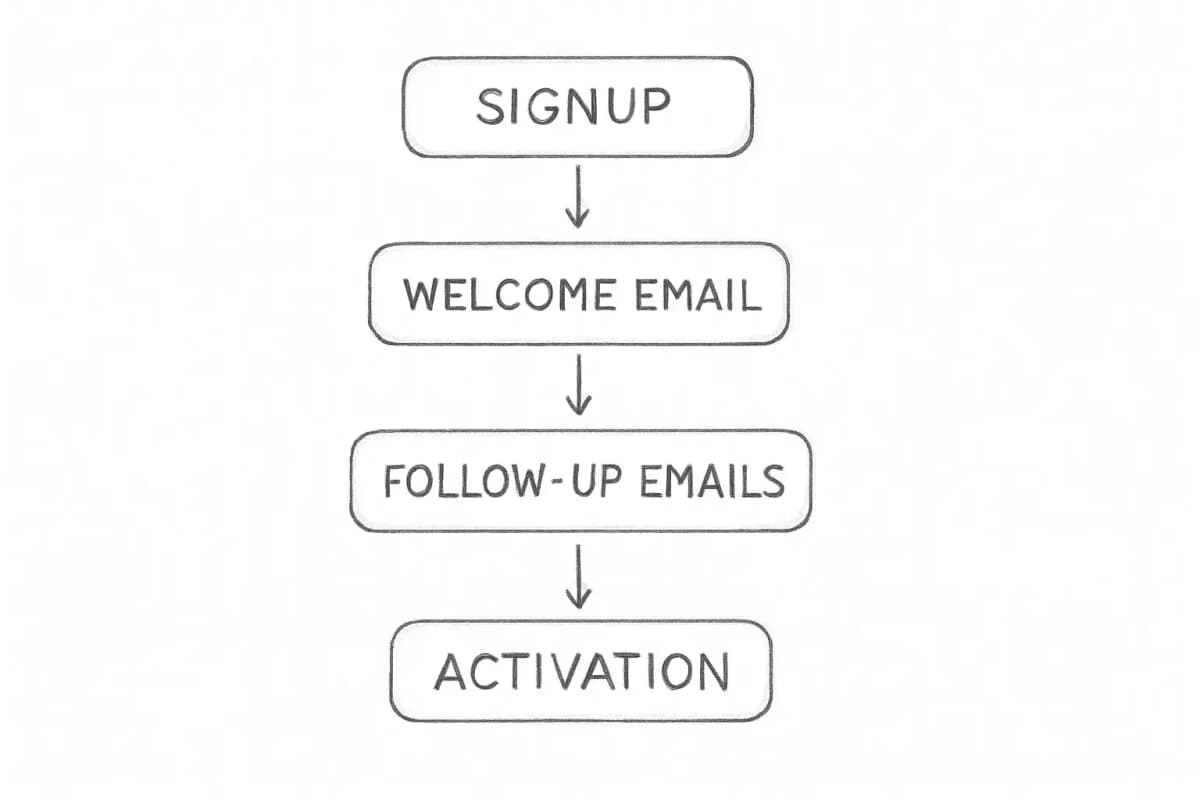
For brands running SaaS products, this translates directly to trial-to-paid conversion. When it comes to turning new signups into active users, onboarding emails are one of the highest leverage tools SaaS marketers have. A well-structured onboarding email sequence helps users experience product value early, reduces churn, and builds confidence. Onboarding email sequence funnel showing the path from signup to activation

Frequently Asked Questions

What is the difference between a welcome email and an onboarding email?

A welcome email is typically the first single message a subscriber receives after signing up, focused on brand introduction and setting expectations. An onboarding email sequence is a longer, multi-step series that guides users through activation, product education, and value realization over days or weeks. The welcome email is often the first message in a broader onboarding sequence.

How many emails should an onboarding sequence contain?

Most effective onboarding sequences contain 5 to 8 emails spread across 14 to 30 days. Product-led and self-serve products tend toward the higher end because users need more automated guidance, while sales-led products can use fewer emails since a human account manager handles part of the onboarding. The key is front-loading the sequence with 3 to 5 emails in the first week, when engagement is highest.

What metrics should I track for onboarding emails?

Track metrics in this order of importance: activation rate (users reaching your defined success milestone), time to value (how quickly they get there), trial-to-paid conversion rate if applicable, and 30-day retention. Compare these metrics for users who engage with your emails versus those who do not. If the email-engaged cohort does not outperform the others, your sequence needs work.

Should onboarding emails be automated?

Yes. You can use automation to ensure your onboarding email sequence reaches your users when they need it most. 71% of email marketers use automation, and it is becoming the industry standard for tasks like onboarding, follow-up emails, and post-purchase sequences. Automation also ensures the first email sends immediately after signup, which is when engagement is at its highest point.

How is an onboarding email sequence different from a drip campaign?

A drip campaign typically sends emails on a fixed time schedule regardless of user behavior. An onboarding sequence, at its best, is behavior-triggered, meaning emails fire based on what a user does or does not do inside your product or with previous emails. This makes onboarding sequences more contextually relevant and, as a result, more effective at driving activation and retention.


No comments yet. Be the first!

Leave a comment

Comments are reviewed before publishing.

More from

Related posts

Illustration for how to use a crm for email marketing
Email Marketing StrategyJul 22, 2026 12 min

How to Use a CRM for Email Marketing

Learn to sync your CRM with email marketing for better targeting, automation, and ROI. Step-by-step guide for marketing teams.

RRachel Torres
Illustration for 7 easy steps to successful email marketing
Email Marketing StrategyJul 22, 2026 10 min

7 Easy Steps to Successful Email Marketing

Master email marketing in 7 simple steps. Learn list building, segmentation, copywriting, and analytics to boost ROI and engagement today.

MMarcus Webb
Illustration for email marketing tips for small budget
Email Marketing StrategyJul 22, 2026 12 min

Email Marketing Tips for Small Budget

Master email marketing on a shoestring budget. Discover free tools, segmentation tactics, and ROI strategies that actually work for startups and solopreneurs.

PPriya Kapoor
HomeBlogEmail Marketing StrategyWhat Is an Onboarding Email in Marketing
Email Marketing Strategy

What Is an Onboarding Email in Marketing

Learn what onboarding emails are, why they matter for retention, and how to create sequences that convert new subscribers into engaged customers.

J

James Chen

April 24, 2026

10 min read
Share:
#Onboarding#Email Sequences#Subscriber Engagement#Best Practices
Illustration for in email marketing, what is an onboarding email?

Stay in the loop

Get the latest posts delivered straight to your inbox. No spam, unsubscribe anytime.

In email marketing, an onboarding email is a triggered message, or a series of messages, sent to a new subscriber or customer immediately after they sign up, make a purchase, or create an account. Its purpose is to orient that person, deliver early value, and guide them toward their first meaningful interaction with your brand or product. It is not a one-time welcome blast. Done well, it is a structured sequence that shapes the entire customer relationship.

Key Takeaways

  • An onboarding email sequence is a chain of emails that assist users after they have initially engaged with your brand or product, automatically triggered to send at specific points in the user's onboarding experience.
  • When executed well, onboarding email sequences can achieve open rates of up to 83% and drive engagement 3x higher than standard marketing emails.
  • The onboarding email sequence is a series of emails designed to support new users as they familiarize themselves with a product or service, typically including a welcome email, product introductions, feature walkthroughs, and educational content to guide users through their journey.
  • An onboarding email sequence usually contains around 3 to 7 emails sent over 1 to 2 weeks, designed to help users find their "aha" moment.
  • 86% of surveyed individuals said they would continue purchasing from companies that offered excellent onboarding content, and these emails made them feel welcome and educated about the company's offerings.

What an Onboarding Email Actually Is

In simple terms, an onboarding email is the first step in establishing communication and engaging with a new client, and the term also applies to the first method of communication with prospective customers. In general, it is a marketing email that helps the customer get to know your brand.

Most marketers use the terms "welcome email" and "onboarding email" interchangeably, but they are not the same thing. A welcome email sequence is typically the first 1 to 3 emails that greet new users and set expectations. An onboarding sequence is longer and more goal-oriented, guiding users through setup, activation, and early value milestones across 2 to 4 weeks. The welcome sequence is the opening chapter of the onboarding sequence.

The distinction matters because it determines how you measure success. A welcome email earns an open. An onboarding sequence earns a customer.


Why Onboarding Emails Matter for Your Business

The numbers are hard to ignore. Welcome emails generate a 68.6% average open rate compared to 19.7% for standard campaigns. That attention gap exists because intent is at its peak. A person who just signed up is actively thinking about your brand.

Onboarding email sequences capitalize on the period right after someone becomes a customer, when interest is high. Welcome emails have 86% higher open rates and are read more than regular marketing emails.

The business case goes well beyond open rates. Automated emails drive 320% more revenue than non-automated emails. And considering that in 2024, automated emails drove 37% of all email-generated sales, failing to automate your onboarding flow means leaving a significant share of potential revenue on the table.

New customers or subscribers have come to expect an onboarding email from brands. Those who receive one are more likely to engage with your brand over the long run than those who did not.

For SaaS companies specifically, the stakes are even higher. 1 in 4 users will abandon an app after just one use, illustrating how getting started with a new product can be confusing, overwhelming, or outright frustrating. A well-built onboarding sequence solves exactly that problem.


The Core Components of an Onboarding Email Sequence

Effective onboarding emails include a warm welcome, clear next steps, helpful resources, and personalized content. They show customers what to do, where to go, and set them up for their first "aha" moment with a product or service.

Here is what a well-structured sequence typically contains:

  1. The confirmation email. A confirmation email verifies that new subscribers are real and ensures that onboarding emails will reliably reach the inbox. This step maintains email list quality and reduces the chances of poor engagement.
  2. The welcome email. The welcome email should be warm, conveying excitement and gratitude for having a new customer on board. It sets expectations and creates the foundation for a long-term customer relationship. It should introduce the brand, restate the value proposition, and clearly outline what customers should expect next.
  3. Feature or product education emails. An onboarding sequence can also educate customers about your product, showing its full capabilities and how customers can maximize them.
  4. A progress or re-engagement email. A follow-up that focuses on onboarding progress and gently encourages re-engagement, with the goal of guiding trial users toward an "aha!" moment as quickly as possible.
  5. A social proof or case study email. Testimonial advertising is effective in onboarding sequences. Sharing success stories from other users can help the reader visualize how doing business with you can help them achieve their own goals.
  6. A conversion or upgrade prompt. If you want to onboard free users to a paid product, you need to send them an upgrade email, a gentle reminder to upgrade their package along with what perks they will get by doing so.

Action-Based vs. Time-Based Sequences

There are two basic types of onboarding email sequences: action-based or time-based. In action-based sequences, you send your email as a response to the activity of the user, which is why they are also known as triggered emails.

Behavior-based (action-based) sequences consistently outperform time-based drips because they respond to what the user actually does, not just how many days have passed. Trigger-based or event-based emails have higher engagement than time-based emails.

For example, if a user completes profile setup, the next email should acknowledge that progress and point to the next feature. If they have not completed setup within 48 hours, a different email should arrive with simplified instructions or a support offer.

Consider sending onboarding emails strategically over a few weeks, with a frequency of one to two emails per week. This ensures that users receive timely information without feeling overwhelmed.


Onboarding Emails vs. Other Email Sequence Types

Understanding where onboarding fits in your broader email marketing strategy prevents overlap and confusion. Here is how it compares to similar sequence types:

The welcome email sequence focuses more on brand introduction rather than product use. The abandoned cart sequence emphasizes sales recovery instead of user education. The promotional email sequence is primarily sales-driven rather than focused on user onboarding and education. The re-engagement email sequence targets disengaged users rather than guiding them through an initial experience.

The onboarding sequence sits at the intersection of education and activation. Its job is not to sell, it is to prove value quickly so that selling becomes easier later.

For deeper tactics on structuring your overall email flows, the welcome email sequence best practices guide covers the critical first emails in detail.


Best Practices That Drive Results

Send the first email immediately

Every successful sequence sends the first email within minutes of account creation. Delaying even a few hours costs you engagement. Consumer research reveals that 74% of people expect to receive a welcome email immediately after subscribing to a mailing list.

Focus each email on a single objective

Every onboarding email should encourage a single objective, such as completing sign-up, verifying an email, uploading a contact record, or connecting an integration. Use the copy of an onboarding email to drive customers to a clear CTA for completing that next step.

Personalize beyond the first name

A strong onboarding email sequence is personalized using demographic and behavioral data. Role-based personalization, where the email speaks directly to what the user is trying to accomplish, makes a measurable difference in how the message lands. Pairing this with proper list segmentation can dramatically lift results. Our guide on email list segmentation strategies explains exactly how to structure those segments.

Keep the subject line sharp

Even though onboarding emails have high open and read rates, you still need to write a subject line that entices customers to open the email. Make sure the copy is descriptive and relevant, explaining the value they will receive or posing a question that you answer in the email body. For specifics on subject line construction, see the email subject line best practices guide.

Design for mobile

Roughly 60% of email opens occur on mobile devices. As a best practice, all onboarding emails should be mobile-friendly, because customers are likely to abandon immediately if they open an impossible-to-read email on their phone.

Measure what matters

Activation rate matters more than open rate or click rate. Track how many users who receive your onboarding sequence complete your defined activation milestone, whether that is creating a project, inviting a team member, or connecting an integration.

Churn rate indicates customer retention over time. A decreasing churn rate suggests your onboarding emails are successfully building loyalty and engagement.


The Business Impact of Getting Onboarding Right

The downstream effects of a well-executed onboarding sequence compound over time. Engaging and informative onboarding emails keep users interested and active, reducing the likelihood of abandonment. Users quickly grasp the features and benefits of your product or service, leading to faster adoption and usage. Effective onboarding can also decrease the rate at which users discontinue use of your product or service.

Beyond opens, welcome emails demonstrate 42% higher engagement with future marketing communications. Subscribers receiving them are more likely to read subsequent emails from the brand, and this long-term engagement multiplier makes welcome email delivery critical for lifetime customer value.

For brands running SaaS products, this translates directly to trial-to-paid conversion. When it comes to turning new signups into active users, onboarding emails are one of the highest leverage tools SaaS marketers have. A well-structured onboarding email sequence helps users experience product value early, reduces churn, and builds confidence. Onboarding email sequence funnel showing the path from signup to activation


Frequently Asked Questions

What is the difference between a welcome email and an onboarding email?

A welcome email is typically the first single message a subscriber receives after signing up, focused on brand introduction and setting expectations. An onboarding email sequence is a longer, multi-step series that guides users through activation, product education, and value realization over days or weeks. The welcome email is often the first message in a broader onboarding sequence.

How many emails should an onboarding sequence contain?

Most effective onboarding sequences contain 5 to 8 emails spread across 14 to 30 days. Product-led and self-serve products tend toward the higher end because users need more automated guidance, while sales-led products can use fewer emails since a human account manager handles part of the onboarding. The key is front-loading the sequence with 3 to 5 emails in the first week, when engagement is highest.

What metrics should I track for onboarding emails?

Track metrics in this order of importance: activation rate (users reaching your defined success milestone), time to value (how quickly they get there), trial-to-paid conversion rate if applicable, and 30-day retention. Compare these metrics for users who engage with your emails versus those who do not. If the email-engaged cohort does not outperform the others, your sequence needs work.

Should onboarding emails be automated?

Yes. You can use automation to ensure your onboarding email sequence reaches your users when they need it most. 71% of email marketers use automation, and it is becoming the industry standard for tasks like onboarding, follow-up emails, and post-purchase sequences. Automation also ensures the first email sends immediately after signup, which is when engagement is at its highest point.

How is an onboarding email sequence different from a drip campaign?

A drip campaign typically sends emails on a fixed time schedule regardless of user behavior. An onboarding sequence, at its best, is behavior-triggered, meaning emails fire based on what a user does or does not do inside your product or with previous emails. This makes onboarding sequences more contextually relevant and, as a result, more effective at driving activation and retention.

No comments yet. Be the first!

Leave a comment

Comments are reviewed before publishing.

More from

Related posts

Illustration for how to use a crm for email marketing
Email Marketing StrategyJul 22, 2026 12 min

How to Use a CRM for Email Marketing

Learn to sync your CRM with email marketing for better targeting, automation, and ROI. Step-by-step guide for marketing teams.

RRachel Torres
Illustration for 7 easy steps to successful email marketing
Email Marketing StrategyJul 22, 2026 10 min

7 Easy Steps to Successful Email Marketing

Master email marketing in 7 simple steps. Learn list building, segmentation, copywriting, and analytics to boost ROI and engagement today.

MMarcus Webb
Illustration for email marketing tips for small budget
Email Marketing StrategyJul 22, 2026 12 min

Email Marketing Tips for Small Budget

Master email marketing on a shoestring budget. Discover free tools, segmentation tactics, and ROI strategies that actually work for startups and solopreneurs.

PPriya Kapoor