
If you run a business in Cheshire, whether it is a retail shop in Chester, a professional services firm in Macclesfield, or a hospitality venue in Knutsford, email marketing is one of the most measurable and cost-effective channels available to you. For every $1 spent on email marketing, businesses see a return of $36, representing an ROI of 3,600%. No other digital channel delivers that consistently, including paid social and PPC. The practical question is not whether email marketing works. It is how Cheshire businesses can build a strategy that actually reaches inboxes, converts subscribers, and compounds results over time.
This guide covers the full picture: the case for email marketing in Cheshire's business environment, how to structure a local strategy, and the technical and legal requirements that apply specifically to UK senders.
Key Takeaways
- Email marketing returns $36 for every $1 spent on average, making it one of the highest-ROI channels for local businesses.
- Advanced segmentation and personalization can boost revenue by up to 760%, making audience targeting the single highest-impact tactic.
- Welcome emails achieve an average open rate of 83.63%; automating this first touchpoint is a quick and high-return priority.
- UK businesses must comply with both UK GDPR and PECR when sending marketing emails, and failure to do so risks fines and deliverability damage.
- SPF, DKIM, and DMARC are now mandatory, enforced by Google and Yahoo since February 2024, making technical authentication non-negotiable.
Why Email Marketing Matters for Cheshire Businesses
Cheshire is one of the most economically active counties in the North West of England, with a broad mix of professional services, retail, hospitality, manufacturing, and logistics businesses. SMEs account for 99.8% of the UK business population, and at the start of 2024 there were an estimated 5.5 million UK private sector businesses. The vast majority operate on limited marketing budgets, which makes email's cost-to-return ratio especially relevant.
A Constant Contact report reveals that in 2024, 53% of small business owners in the UK used email marketing as the most frequent strategy for finding new customers and retaining repeat ones. That figure is rising, and for good reason. Unlike social media, where algorithm changes can cut your organic reach overnight, email gives you a direct line to people who have already expressed interest in your business.
60% of consumers prefer email as their primary channel for communicating with brands. For a Cheshire business trying to build long-term relationships with local customers, that preference is a clear signal about where to invest.
Building a Local Email Marketing Strategy
A generic email strategy rarely works for local businesses. The more your messaging reflects the specific context of your audience, such as their location, the local calendar, and the problems they face in their region, the better your results.
A practical email marketing strategy for Cheshire businesses should cover four core areas:
- List building: Use website sign-up forms, in-store capture methods, and events to grow a permission-based list. Never add contacts without their consent.
- Audience segmentation: Group your subscribers by purchase history, location within the county, service type, or engagement level.
- Content planning: Map campaigns to the local business calendar, including regional events, seasonal peaks, and community moments.
- Measurement: Track click-through rates, conversions, and revenue attributed to email, not just open rates (which are now unreliable due to Apple Mail Privacy Protection).
For a deeper framework, see our Email Marketing Strategy Template for 2025, which gives you a structured approach you can adapt directly to a local business context.
Segmentation: The Biggest Lever You Are Not Pulling Hard Enough
Most local businesses send the same email to everyone on their list. That is the single biggest reason campaigns underperform.
Segmented campaigns achieve 14% higher open rates and 28% better click rates compared to generic sends, and advanced segmentation can boost revenue by up to 760%. That is not a marginal gain. It is a transformational one.
For a Cheshire business, useful segmentation criteria include:
- Location: Separate Chester customers from Warrington or Macclesfield audiences when promoting location-specific offers or events.
- Purchase history: Distinguish first-time buyers from repeat customers and lapsed ones.
- Service or product category: A law firm might segment by practice area; a restaurant by delivery versus dine-in customers.
- Engagement level: Send re-engagement campaigns to inactive subscribers before removing them.
According to HubSpot, 65% of marketers say their segmented emails have better open rates. If you are not segmenting, you are doing the same work for a fraction of the results.
Read our detailed breakdown of Email List Segmentation Strategies That Boost ROI by 760% for step-by-step guidance.
Automation: Getting More Results Without More Work
Automation is where email marketing scales. Once you build the sequences, they run in the background while you run your business.
Automated emails, such as welcome messages and cart abandonment reminders, generate 320% more revenue than non-automated emails. The highest-priority automation for most Cheshire businesses:
Welcome Sequences
Welcome emails achieve an average open rate of 83.63% and a click-through rate of 16.60%, with a click-to-open rate of 19.85%. That is the most engaged your audience will ever be. A well-constructed welcome sequence introduces your business, sets expectations, and moves subscribers toward a first purchase or enquiry.
Welcome sequences often perform best with 4 to 6 emails. Start with a confirmation email, follow with your story and value proposition, and then move into a relevant offer or call to action.
For a practical blueprint, see our Welcome Email Sequence Best Practices: 7 Proven Strategies.
Behavioural Triggers
Behavioral triggers deliver messages when recipients are most engaged and receptive, and triggered sequences deliver 152% higher click-through rates. For local businesses, this includes:
- Post-enquiry follow-ups
- Post-purchase review requests
- Appointment reminders
- Anniversary or loyalty emails
Re-engagement Campaigns
Before you remove inactive subscribers, send a re-engagement sequence. A clean list protects your deliverability. Removing contacts who do not respond is better for your sender reputation than continuing to email people who ignore you.
Subject Lines and Personalization: The Difference Between Opened and Ignored
Personalized subject lines can increase open rates by 20 to 26%. For a local business in Cheshire, personalization does not need to be complex. Using the subscriber's first name, referencing their location, or tailoring content to their past behaviour are all effective.
71% of consumers expect personalized interactions from brands, and 76% get frustrated when their interactions are not personalized to their interests. That frustration shows up as unsubscribes and ignored emails.
Subject line strategy is just as important as the content of the email itself. A great subject line is specific, creates curiosity or urgency without being deceptive, and feels relevant to the reader. Our guide on Email Subject Line Best Practices That Boost Open Rates by 27% covers the specific techniques that consistently outperform generic approaches.
UK GDPR and PECR: What Cheshire Businesses Must Know
Email marketing in the UK is governed by two overlapping frameworks: UK GDPR (the UK's post-Brexit version of the EU regulation) and PECR (Privacy and Electronic Communications Regulations). Both apply to any business emailing UK residents.
PECR governs electronic marketing communications, including email. It sets specific rules on consent and the use of personal data alongside UK GDPR. Under PECR, explicit opt-in consent is required for most marketing emails, and clear and affirmative permission from subscribers is essential.
Key requirements for Cheshire businesses:
- Consent: You must have a lawful basis to email contacts. For most marketing emails to consumers, this means explicit opt-in consent.
- Unsubscribe: PECR requires that every marketing email include a clear and easy-to-use unsubscribe link.
- Data records: Implement double opt-in as a best practice for UK subscribers, and maintain records of consent including timestamps, IP addresses, and the specific terms agreed upon.
- Data access rights: Subscribers have the right to access, correct, and request deletion of their data.
Since Brexit, the UK has maintained its own version of the General Data Protection Regulation known as UK GDPR. The requirements closely mirror the EU GDPR, but businesses operating in both markets need to ensure they meet both.
Non-compliance is not a minor risk. European data protection authorities issued a record $1.76 billion in fines in 2022, a 50% increase from the previous year. The ICO in the UK has similar enforcement powers.
Email Deliverability: Making Sure Your Emails Actually Arrive
A well-written, well-targeted email is worthless if it lands in spam. Deliverability is the technical discipline of ensuring your emails reach the inbox.
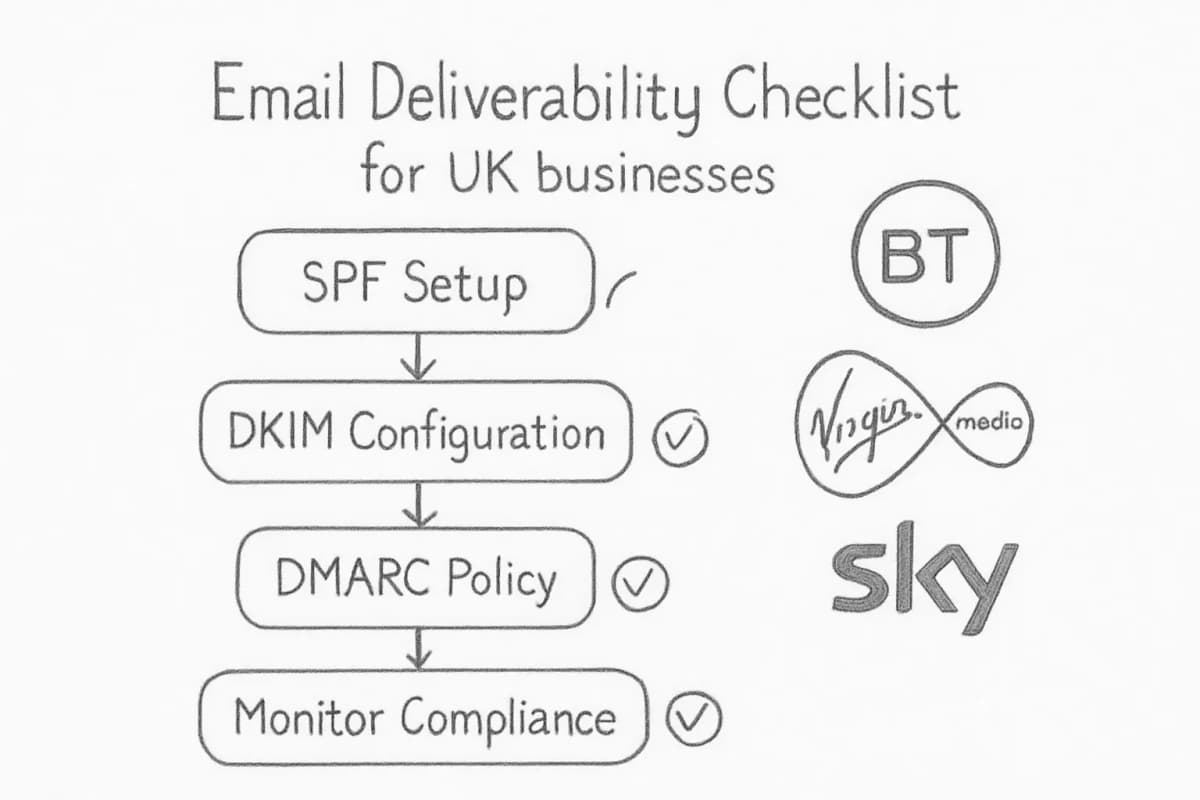
Five factors control deliverability: sender reputation, authentication (SPF, DKIM, DMARC, BIMI), engagement signals, content signals, and sending volume ramp-up.
The most important change in recent years:
SPF, DKIM, and DMARC are now mandatory, enforced by Google and Yahoo since February 2024. If you have not configured these authentication records on your sending domain, your emails are at a significantly higher risk of being filtered or rejected.
Additional deliverability priorities for UK businesses:
- List hygiene: Remove hard bounces immediately and suppress contacts who have not engaged in six to twelve months.
- Spam complaint rate: Keep spam complaint rates under 0.08%. Gmail enforces at 0.1%.
- Sending consistency: Sudden volume spikes trigger spam filters. Ramp up gradually when starting with a new domain or IP.
- ISP awareness: The UK has several large internet service providers, such as BT, Virgin Media, and Sky, each with their own spam filters and rules, making achieving good email deliverability more complicated than in some other markets.
Measuring What Matters: Beyond Open Rates
Privacy changes from major inbox providers, new deliverability rules from Google and Yahoo, and the rise of artificial intelligence are all reshaping how marketers measure campaigns. Traditional metrics like open rates are becoming less reliable, while personalization, automation, and deliverability are becoming more important than ever.
The metrics that give Cheshire businesses the clearest picture of email performance:
- Click-through rate (CTR): The percentage of recipients who clicked a link. More reliable than open rate.
- Click-to-open rate (CTOR): Clicks as a percentage of openers. Measures content relevance.
- Conversion rate: How many email recipients completed the desired action (enquiry, purchase, booking).
- Revenue per email: Total revenue attributed to a campaign divided by emails sent.
- List growth rate: Net new subscribers minus unsubscribes and bounces.
- Unsubscribe rate: A rising rate is a signal that your content or frequency is off.
A/B testing increases email ROI by 37% compared to brands that never test. Testing subject lines, send times, calls to action, and content formats should be a regular part of your process, not an occasional experiment.
Frequently Asked Questions
What makes email marketing different for a local Cheshire business compared to a national brand?
The core principles are the same, but local businesses have advantages that national brands cannot easily replicate. You can reference local events, use community knowledge, and build genuine familiarity with your audience. A Cheshire-based business emailing customers in Chester or Wilmslow can speak directly to their local context, which creates a level of relevance that large brands struggle to match. The key is to lean into that specificity rather than writing generic campaigns that could have been sent by anyone.
Do I need to comply with UK GDPR even if I only email local customers?
Yes. Following Brexit, the UK implemented its own version of GDPR, known as UK GDPR, on January 1, 2021. It applies to any business handling the personal data of UK residents, regardless of the size of the business or the geographic scope of the list. Consent must be clear, records must be kept, and subscribers must be able to unsubscribe easily.
How often should a Cheshire small business send marketing emails?
Sending 5 to 8 emails per month shows the highest ROI of about $48 per $1 spent. However, frequency should match the expectations you set at sign-up and the value you are delivering. For many local businesses, one to two emails per week is sustainable and effective. Dropping to fewer than one per month risks losing the relationship entirely. The top reasons customers unsubscribe include sending too many emails (26%) and sending emails that are irrelevant to them (21%). Relevance matters more than volume.
What email platform should a Cheshire business use?
The right platform depends on your list size, budget, and technical needs. Most small businesses in Cheshire will be well served by established platforms such as Mailchimp, Klaviyo, ActiveCampaign, or Brevo (formerly Sendinblue). All of these support UK GDPR compliance features including consent management, unsubscribe handling, and data export. Choose a platform that includes automation, segmentation, and analytics as standard, not as paid add-ons. For help comparing options and understanding what features matter most, see our guide to Email Marketing Tips for Small Business Owners.