
Email
Email

A modern blog built with Payload CMS, Next.js, and shadcn/ui.

RSS FeedSitemap

Explore

  • Blog
  • News
  • Statistics
  • Authors

Categories

  • CRM & Email Marketing Tools
  • Email Analytics & Reporting
  • Email Security & Compliance
  • Email Automation
  • Email List Building
  • Seasonal & Holiday Email Marketing
  • Email Marketing Benchmarks & Statistics
  • Email Design & Personalization

Latest articles

  • Best Free AI Email Marketing Tools in 2024Jul 20, 2026
  • Email Marketing Automation by ConversionJul 20, 2026
  • Email Marketing Automation Comparison: 2024Jul 20, 2026
  • Email and Marketing Automation Meaning: A GuideJul 20, 2026

Popular topics

  • #deliverability and segmentation
  • #beauty brand email strategy
  • #skincare email marketing
  • #Marketing
  • #email engagement metrics
  • #Content Generation
  • #Sales Efficiency
  • #Cyber Monday Trends
  • #Email Campaign Benchmarks
  • #Holiday Marketing Statistics
  • #BFCM Email Strategy
  • #Enterprise Email
  • #credit card marketing
  • #Business Software
  • #CRM Software
  • #MarTech

Stay in the loop

Join 2,000+ readers. Unsubscribe anytime.

Subscribe
Email

© 2026 Email. All rights reserved.

SitemapRSS
HomeBlogEmail Marketing ToolsAI Email Writer Tools for Marketing: Automate & Scale
Email Marketing Tools

AI Email Writer Tools for Marketing: Automate & Scale

Discover the best AI email writer tools for marketing. Automate campaigns, save time, and boost engagement. Compare top platforms with real ROI data.

J

James Chen

July 19, 2026

12 min read
Share:
#AI Tools#Email Automation#Content Generation#Marketing Efficiency
Illustration for automatic email writer ai tools for marketing

Stay in the loop

Get the latest posts delivered straight to your inbox. No spam, unsubscribe anytime.

Marketers who still write every email from scratch are working against a compounding disadvantage. In past years, 62% of teams spent two weeks or more producing a single email. By 2025, that number dropped to just 6%, a shift largely credited to AI and automation adoption. The gap between those using automatic email writer AI tools for marketing and those who are not has never been wider, and it shows directly in revenue.

This guide covers how these tools work, what they can and cannot do, which platforms lead the category in 2025 and 2026, and how to integrate them into a marketing workflow that actually scales.


Key Takeaways

  • Automated emails generate 320% more revenue than manual campaigns, despite representing just 2% of send volume.
  • 63% of marketers now use AI tools in their email marketing efforts, and approximately 47% use AI specifically to generate their email campaigns.
  • In 2025, 49% of marketers use generative AI for static email copy, and 41% use it for dynamic written content such as real-time personalization.
  • HubSpot research found the top email marketing KPI to improve after AI adoption was conversion rates (37%), followed by click-through rates (33%).
  • AI-generated drafts still require human review. AI systems carry real risks of hallucination, plagiarism, and bias, which means human intervention is needed before content reaches your audience.

What Automatic Email Writer AI Tools Actually Do

An automatic email writer AI tool is not simply a spell-checker or a template library. It is software that helps plan, write, and send emails automatically, using AI to draw insights from data such as open rates, clicks, and customer behavior to tailor subject lines, send times, and even message tone.

The better platforms do more than generate words. They generate subject lines, body copy, and calls-to-action based on historical performance data. AI transforms email marketing by automating complex tasks, analyzing vast amounts of customer data, and delivering personalized experiences at scale, allowing brands to focus on strategy and creativity while AI handles execution.

There is an important distinction worth understanding before choosing a tool. An AI email writer is not the same as your automation. Your automated flows decide when a message sends, who gets it, and what triggers it. An AI email writer handles what the message says. You will usually run both together, with AI-drafted copy inside your flows, but they solve different problems.


The Business Case: Why the Numbers Are Compelling

The ROI argument for using automatic email writer AI tools for marketing does not depend on hype. It is grounded in measurable performance data.

Businesses using automated flows generate an average of 320% more revenue from email than those using only manual campaigns. Automated emails drove 37% of all email-generated sales in 2024, despite making up only 2% of total email volume.

AI personalization compounds these gains further. Marketers implementing AI-powered personalization report revenue increasing by 41% and click-through rates rising 13.44% compared to non-personalized campaigns.

The productivity case is equally strong. Marketers using AI for email creation save up to 30% of total time, with some reporting 90% reductions in newsletter production time. A Forrester Total Economic Impact study on GetResponse MAX customers found that marketing teams implementing automation reduce campaign assembly effort by 73%.

For teams managing email marketing automation CRM setups or scaling content across segments, this kind of time recapture directly translates to capacity for higher-value strategic work.


The Leading AI Email Writer Tools in 2025 and 2026

Platform-Native AI Writers

Most major email service providers now include AI writing features built directly into their editors.

Klaviyo is the most advanced for e-commerce. Klaviyo's AI marketing agent, Composer, writes from your actual segments, catalog, and performance history rather than generic best practices. Paste a URL and Composer learns your voice and catalog, then drafts campaigns, flows, and sign-up forms built around your real products and customer segments. Features like Smart Send Time use machine learning to deliver emails when each subscriber is most likely to engage, while predictive analytics estimate things like future purchases or churn risk. On average, Klaviyo users earn 63x ROI on their email marketing.

HubSpot integrates AI writing across its full marketing and sales stack. HubSpot's AI email writing software creates emails based on user prompts or drafts replies based on user inquiries, using machine learning and natural language processing to gather information, process requests, and generate text. HubSpot's free plan includes email marketing, a CRM, basic AI email writing, forms, and contact management with 1,000 contacts and 2,000 emails per month.

MailerLite offers a practical AI writing assistant with subject line generation using GPT models. The email editor includes over 20 pre-built content modules and has A/B testing to experiment with variations of AI-generated content. By connecting MailerLite to an AI chatbot via MCP, you can move beyond generic text generation and start automating and optimizing your entire content creation workflow with suggestions based on campaign performance and subscriber data.

GetResponse has an AI subject line and email generator powered by OpenAI's GPT technology. Add keywords about your email, select your business type and preferences, and you get five subject line variations to choose from or A/B test. GetResponse pricing starts at $19 per month for the Email Marketing plan with 1,000 contacts and the AI email generator.

Standalone AI Email Writing Tools

Jasper sits on the other end of the spectrum. Jasper is not an email platform. It is an AI writing tool that excels at generating email copy. If your bottleneck is writing compelling subject lines, body copy, and CTAs rather than automation or deliverability, Jasper fills that gap better than any ESP's built-in AI.

Copy.ai specializes in marketing copywriting and offers brand voice training, learning your company's tone and style to maintain consistency across all generated content. Copy.ai pricing starts at $49 a month for 5 users with no limits on word count or projects.

AnyWord takes a data-driven angle. It has 7 templates for emails, an email copy generator, predictive performance scores, and a rewrite tool. The predictive performance score predicts how well the email copy will perform before you send it.


Core Use Cases for AI Email Writers in Marketing

Understanding where these tools add the most value helps teams prioritize adoption sensibly.

Subject line generation. Using AI for subject line optimization can boost open rates by up to 10%. Most platforms now offer multi-variant subject line suggestions based on your audience data. This pairs directly with email subject line best practices that boost open rates.

Body copy at scale. Automated content creation enables writing targeted content for different groups or segments faster. By making slight adjustments to a prompt, you can create content that tells loyal customers they will get early access to a sale. Creating these extra versions takes just minutes.

Behavioral automation sequences. Email automation workflows are sequences of emails automatically sent based on specific triggers like subscriber behavior, time intervals, or data changes. They guide customers through personalized journeys from initial signup to purchase and beyond. AI now writes the copy inside these flows dynamically.

Send-time optimization. AI send-time optimization lifts open rates by 26%. Machine learning models that predict when each subscriber is most likely to open and engage can boost open rates by 26% and click-through rates by 41% compared to fixed-schedule sends.

Analytics-driven content iteration. AI is especially good at sifting through large amounts of email data and calling out patterns most teams would not catch. At least 41% of companies are using AI-driven analytics, starting with segmentation and targeting, then moving into send-time optimization, behavioral prediction, and journey mapping.


What AI Email Writers Cannot Do Well (Yet)

The adoption case is strong, but so are the caveats. Many AI email tools claim to be AI-powered but rely on basic automation rather than deep personalization. Understanding the limits before investing saves time and avoids brand risk.

Hallucination is a real operational hazard. Generative AI tools are known to "hallucinate." They may make up convincing-sounding statements without any evidence to back them up. Any factual claim in AI-generated email copy needs human verification before sending.

Brand voice drift is a common failure mode. AI can accelerate content production, but without structured internal knowledge, it risks diluting your brand's distinctive voice. The fix is giving the tool documented tone guidelines and examples, not expecting it to infer your voice from a prompt alone.

Generic prompts produce generic output. The difference between "let AI write the whole email blast" and "use AI for a first pass, then rewrite for voice, examples, and specific offers" is everything. AI-generated content should be treated as first drafts and improved through human editing. The first approach leads to generic content that readers skim and forget.

Governance is underinvested. Over 70% of marketers have encountered an AI-related incident including hallucinations, bias, or off-brand content, yet less than 35% plan to increase investment in AI governance.

The practical implication: automatic email writer AI tools for marketing work best as drafting accelerators, not publishing autopilots.


How to Integrate AI Email Writers Into Your Marketing Stack

Adopting these tools successfully is less about the technology and more about the workflow around it.

  1. Audit where time is actually lost. Identify whether your bottleneck is subject line ideation, body copy drafts, segmentation, or send-time decisions. Different tools solve different problems.
  2. Document your brand voice before you prompt. Create a short reference document with tone descriptors, example sentences, and phrases to avoid. Feed this into every AI prompt or brand voice training module.
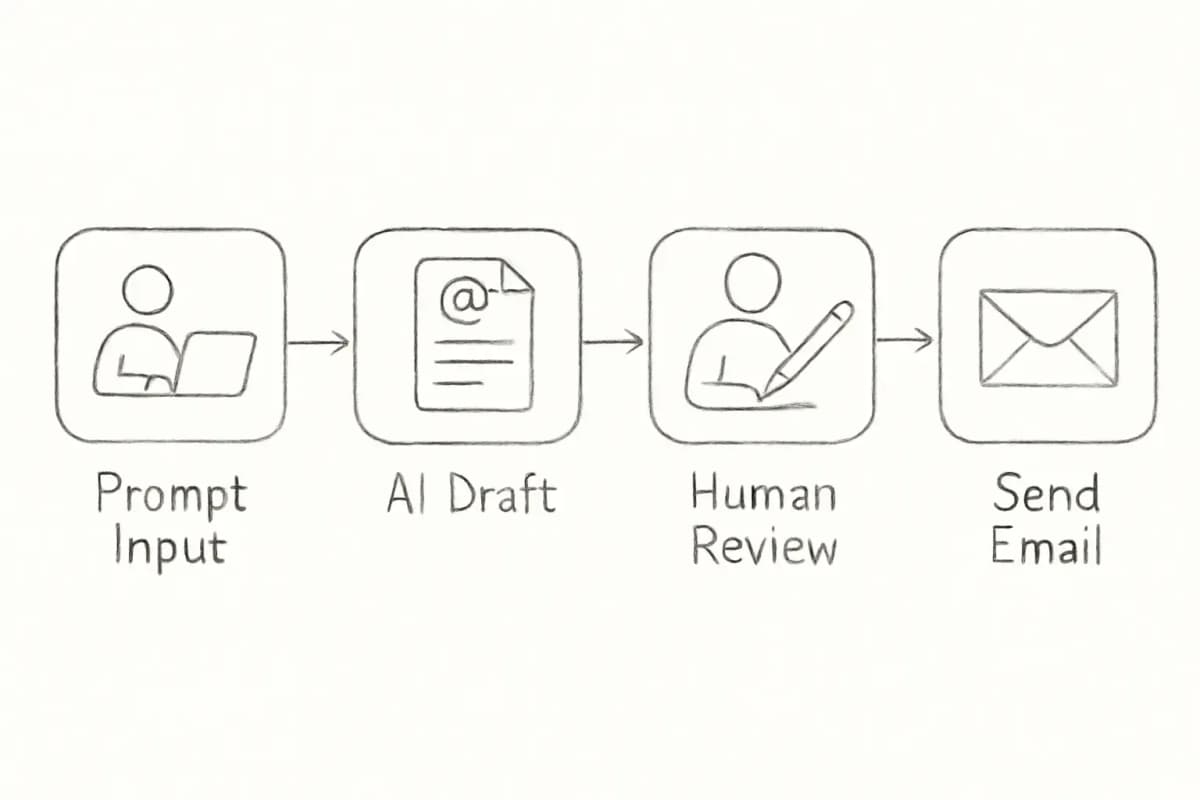
  3. Use AI for first drafts, humans for final review. Set an internal standard that no AI-generated email goes out without a human reading it for accuracy, brand alignment, and factual claims.
  4. Combine writing tools with segmentation. AI-written copy performs significantly better when it goes to the right audience. Email list segmentation strategies are what enable the AI's personalization to actually land.
  5. Build automated sequences around behavioral triggers. Common triggers include signup events, purchase completions, cart abandonment, link clicks, email opens, and website behavior. Behavioral triggers typically perform better than time-based triggers for conversion rates.
  6. Measure revenue per email, not just open rates. Measure automated email sequence performance using conversion rate, revenue per email, click-to-conversion rate, and sequence completion rate.

For teams looking at more advanced autonomous applications, AI-driven email marketing examples show how brands are moving beyond basic copy generation into full campaign orchestration. AI email writer workflow diagram showing four sequential steps: a user entering a prompt into an AI tool, the AI generating an email draft, a human marketer reviewing and editing the draft, and finally sending the completed email to subscribers. Use arrows to connect each step left to right, with icons or visual indicators for each stage (prompt input, draft generation, human review, send).

The Emerging Category: AI Marketing Agents

The category is moving fast. The next evolution involves AI agents that can analyze complex behavioral signals, predict user needs, and dynamically personalize content for micro-segments or even individual recipients in real-time.

Litmus' 2025 State of Email research found that nearly 70% of email marketers expect up to half of their email operations to be AI-driven by the end of 2026.

The industry is shifting from batch-and-blast to per-recipient intelligence. Traditional email marketing sends one campaign to a segment. AI email marketing researches each recipient individually and adapts content, timing, and channel accordingly.

Platforms like Klaviyo's Composer and emerging agentic tools are already closing the gap between these two models. Composer builds the audience, drafts channel-appropriate copy across email and text, coordinates the timing, and stages it all for review, with AI-drafted copy running inside automated flows, informed by your data and shaped by your results.


Frequently Asked Questions

What is an automatic email writer AI tool for marketing?

An AI email writing software is a machine-learning-powered tool that uses artificial intelligence to help businesses automate part of the email copywriting process. These tools generate subject lines, body copy, and calls-to-action based on prompts, historical performance data, and audience behavior. They range from standalone writing assistants like Jasper and Copy.ai to platform-native tools built into ESPs like Klaviyo, HubSpot, and GetResponse.

Do AI email writers improve open rates and conversions?

Yes, when used correctly. AI-driven email marketing results in a 13% boost in click-through rates, showcasing the measurable impact on campaign performance. AI send-time optimization alone lifts open rates by 26% and click-through rates by 41% compared to fixed-schedule sends. Results depend heavily on the quality of your audience segmentation and how much human refinement goes into the AI's output.

What are the biggest risks of using AI to write marketing emails?

The three main risks are hallucination (factually incorrect content), brand voice drift (copy that sounds generic or inconsistent), and over-reliance without human oversight. Risks include AI hallucinations, data security and privacy vulnerabilities, copyright challenges, compliance issues, and bias in outputs. Countermeasures include fact-checking, claim detection tools, curated datasets, enterprise-grade security features, and custom AI training.

How should I choose between a standalone AI writer and a platform-native tool?

Choose based on where your bottleneck sits. Jasper is best for marketing teams that already have an ESP but need better AI-generated email copy, including subject lines, body text, and CTAs that outperform what their current platform's AI produces. If you want copy, automation, segmentation, and analytics in one place, a platform-native tool like Klaviyo or HubSpot is more practical. While some email marketing services offer AI features for free, most make sophisticated features like AI-powered automation builders paid features on premium plans.


No comments yet. Be the first!

Leave a comment

Comments are reviewed before publishing.

More from

Related posts

Illustration for best free ai email marketing tools
Email Marketing ToolsJul 20, 2026 15 min

Best Free AI Email Marketing Tools in 2024

Compare top free AI email marketing tools to boost campaigns without spending. Find the right fit for your business needs and budget.

RRachel Torres
Illustration for top sms and email marketing automation tools
Email Marketing ToolsJul 20, 2026 11 min

Top SMS and Email Marketing Automation Tools

Compare the best SMS and email marketing automation platforms to boost ROI. Find the right tool for your team with our detailed breakdown.

MMarcus Webb
Illustration for free email marketing ai tools
Email Marketing ToolsJul 19, 2026 12 min

Free Email Marketing AI Tools: 7 Best Picks

Discover 7 free email marketing AI tools to automate campaigns, write copy, and improve deliverability. No credit card required.

PPriya Kapoor
HomeBlogEmail Marketing ToolsAI Email Writer Tools for Marketing: Automate & Scale
Email Marketing Tools

AI Email Writer Tools for Marketing: Automate & Scale

Discover the best AI email writer tools for marketing. Automate campaigns, save time, and boost engagement. Compare top platforms with real ROI data.

J

James Chen

July 19, 2026

12 min read
Share:
#AI Tools#Email Automation#Content Generation#Marketing Efficiency
Illustration for automatic email writer ai tools for marketing

Stay in the loop

Get the latest posts delivered straight to your inbox. No spam, unsubscribe anytime.

Marketers who still write every email from scratch are working against a compounding disadvantage. In past years, 62% of teams spent two weeks or more producing a single email. By 2025, that number dropped to just 6%, a shift largely credited to AI and automation adoption. The gap between those using automatic email writer AI tools for marketing and those who are not has never been wider, and it shows directly in revenue.

This guide covers how these tools work, what they can and cannot do, which platforms lead the category in 2025 and 2026, and how to integrate them into a marketing workflow that actually scales.


Key Takeaways

  • Automated emails generate 320% more revenue than manual campaigns, despite representing just 2% of send volume.
  • 63% of marketers now use AI tools in their email marketing efforts, and approximately 47% use AI specifically to generate their email campaigns.
  • In 2025, 49% of marketers use generative AI for static email copy, and 41% use it for dynamic written content such as real-time personalization.
  • HubSpot research found the top email marketing KPI to improve after AI adoption was conversion rates (37%), followed by click-through rates (33%).
  • AI-generated drafts still require human review. AI systems carry real risks of hallucination, plagiarism, and bias, which means human intervention is needed before content reaches your audience.

What Automatic Email Writer AI Tools Actually Do

An automatic email writer AI tool is not simply a spell-checker or a template library. It is software that helps plan, write, and send emails automatically, using AI to draw insights from data such as open rates, clicks, and customer behavior to tailor subject lines, send times, and even message tone.

The better platforms do more than generate words. They generate subject lines, body copy, and calls-to-action based on historical performance data. AI transforms email marketing by automating complex tasks, analyzing vast amounts of customer data, and delivering personalized experiences at scale, allowing brands to focus on strategy and creativity while AI handles execution.

There is an important distinction worth understanding before choosing a tool. An AI email writer is not the same as your automation. Your automated flows decide when a message sends, who gets it, and what triggers it. An AI email writer handles what the message says. You will usually run both together, with AI-drafted copy inside your flows, but they solve different problems.


The Business Case: Why the Numbers Are Compelling

The ROI argument for using automatic email writer AI tools for marketing does not depend on hype. It is grounded in measurable performance data.

Businesses using automated flows generate an average of 320% more revenue from email than those using only manual campaigns. Automated emails drove 37% of all email-generated sales in 2024, despite making up only 2% of total email volume.

AI personalization compounds these gains further. Marketers implementing AI-powered personalization report revenue increasing by 41% and click-through rates rising 13.44% compared to non-personalized campaigns.

The productivity case is equally strong. Marketers using AI for email creation save up to 30% of total time, with some reporting 90% reductions in newsletter production time. A Forrester Total Economic Impact study on GetResponse MAX customers found that marketing teams implementing automation reduce campaign assembly effort by 73%.

For teams managing email marketing automation CRM setups or scaling content across segments, this kind of time recapture directly translates to capacity for higher-value strategic work.


The Leading AI Email Writer Tools in 2025 and 2026

Platform-Native AI Writers

Most major email service providers now include AI writing features built directly into their editors.

Klaviyo is the most advanced for e-commerce. Klaviyo's AI marketing agent, Composer, writes from your actual segments, catalog, and performance history rather than generic best practices. Paste a URL and Composer learns your voice and catalog, then drafts campaigns, flows, and sign-up forms built around your real products and customer segments. Features like Smart Send Time use machine learning to deliver emails when each subscriber is most likely to engage, while predictive analytics estimate things like future purchases or churn risk. On average, Klaviyo users earn 63x ROI on their email marketing.

HubSpot integrates AI writing across its full marketing and sales stack. HubSpot's AI email writing software creates emails based on user prompts or drafts replies based on user inquiries, using machine learning and natural language processing to gather information, process requests, and generate text. HubSpot's free plan includes email marketing, a CRM, basic AI email writing, forms, and contact management with 1,000 contacts and 2,000 emails per month.

MailerLite offers a practical AI writing assistant with subject line generation using GPT models. The email editor includes over 20 pre-built content modules and has A/B testing to experiment with variations of AI-generated content. By connecting MailerLite to an AI chatbot via MCP, you can move beyond generic text generation and start automating and optimizing your entire content creation workflow with suggestions based on campaign performance and subscriber data.

GetResponse has an AI subject line and email generator powered by OpenAI's GPT technology. Add keywords about your email, select your business type and preferences, and you get five subject line variations to choose from or A/B test. GetResponse pricing starts at $19 per month for the Email Marketing plan with 1,000 contacts and the AI email generator.

Standalone AI Email Writing Tools

Jasper sits on the other end of the spectrum. Jasper is not an email platform. It is an AI writing tool that excels at generating email copy. If your bottleneck is writing compelling subject lines, body copy, and CTAs rather than automation or deliverability, Jasper fills that gap better than any ESP's built-in AI.

Copy.ai specializes in marketing copywriting and offers brand voice training, learning your company's tone and style to maintain consistency across all generated content. Copy.ai pricing starts at $49 a month for 5 users with no limits on word count or projects.

AnyWord takes a data-driven angle. It has 7 templates for emails, an email copy generator, predictive performance scores, and a rewrite tool. The predictive performance score predicts how well the email copy will perform before you send it.


Core Use Cases for AI Email Writers in Marketing

Understanding where these tools add the most value helps teams prioritize adoption sensibly.

Subject line generation. Using AI for subject line optimization can boost open rates by up to 10%. Most platforms now offer multi-variant subject line suggestions based on your audience data. This pairs directly with email subject line best practices that boost open rates.

Body copy at scale. Automated content creation enables writing targeted content for different groups or segments faster. By making slight adjustments to a prompt, you can create content that tells loyal customers they will get early access to a sale. Creating these extra versions takes just minutes.

Behavioral automation sequences. Email automation workflows are sequences of emails automatically sent based on specific triggers like subscriber behavior, time intervals, or data changes. They guide customers through personalized journeys from initial signup to purchase and beyond. AI now writes the copy inside these flows dynamically.

Send-time optimization. AI send-time optimization lifts open rates by 26%. Machine learning models that predict when each subscriber is most likely to open and engage can boost open rates by 26% and click-through rates by 41% compared to fixed-schedule sends.

Analytics-driven content iteration. AI is especially good at sifting through large amounts of email data and calling out patterns most teams would not catch. At least 41% of companies are using AI-driven analytics, starting with segmentation and targeting, then moving into send-time optimization, behavioral prediction, and journey mapping.


What AI Email Writers Cannot Do Well (Yet)

The adoption case is strong, but so are the caveats. Many AI email tools claim to be AI-powered but rely on basic automation rather than deep personalization. Understanding the limits before investing saves time and avoids brand risk.

Hallucination is a real operational hazard. Generative AI tools are known to "hallucinate." They may make up convincing-sounding statements without any evidence to back them up. Any factual claim in AI-generated email copy needs human verification before sending.

Brand voice drift is a common failure mode. AI can accelerate content production, but without structured internal knowledge, it risks diluting your brand's distinctive voice. The fix is giving the tool documented tone guidelines and examples, not expecting it to infer your voice from a prompt alone.

Generic prompts produce generic output. The difference between "let AI write the whole email blast" and "use AI for a first pass, then rewrite for voice, examples, and specific offers" is everything. AI-generated content should be treated as first drafts and improved through human editing. The first approach leads to generic content that readers skim and forget.

Governance is underinvested. Over 70% of marketers have encountered an AI-related incident including hallucinations, bias, or off-brand content, yet less than 35% plan to increase investment in AI governance.

The practical implication: automatic email writer AI tools for marketing work best as drafting accelerators, not publishing autopilots.


How to Integrate AI Email Writers Into Your Marketing Stack

Adopting these tools successfully is less about the technology and more about the workflow around it.

  1. Audit where time is actually lost. Identify whether your bottleneck is subject line ideation, body copy drafts, segmentation, or send-time decisions. Different tools solve different problems.
  2. Document your brand voice before you prompt. Create a short reference document with tone descriptors, example sentences, and phrases to avoid. Feed this into every AI prompt or brand voice training module.
  3. Use AI for first drafts, humans for final review. Set an internal standard that no AI-generated email goes out without a human reading it for accuracy, brand alignment, and factual claims.
  4. Combine writing tools with segmentation. AI-written copy performs significantly better when it goes to the right audience. Email list segmentation strategies are what enable the AI's personalization to actually land.
  5. Build automated sequences around behavioral triggers. Common triggers include signup events, purchase completions, cart abandonment, link clicks, email opens, and website behavior. Behavioral triggers typically perform better than time-based triggers for conversion rates.
  6. Measure revenue per email, not just open rates. Measure automated email sequence performance using conversion rate, revenue per email, click-to-conversion rate, and sequence completion rate.

For teams looking at more advanced autonomous applications, AI-driven email marketing examples show how brands are moving beyond basic copy generation into full campaign orchestration. AI email writer workflow diagram showing four sequential steps: a user entering a prompt into an AI tool, the AI generating an email draft, a human marketer reviewing and editing the draft, and finally sending the completed email to subscribers. Use arrows to connect each step left to right, with icons or visual indicators for each stage (prompt input, draft generation, human review, send).


The Emerging Category: AI Marketing Agents

The category is moving fast. The next evolution involves AI agents that can analyze complex behavioral signals, predict user needs, and dynamically personalize content for micro-segments or even individual recipients in real-time.

Litmus' 2025 State of Email research found that nearly 70% of email marketers expect up to half of their email operations to be AI-driven by the end of 2026.

The industry is shifting from batch-and-blast to per-recipient intelligence. Traditional email marketing sends one campaign to a segment. AI email marketing researches each recipient individually and adapts content, timing, and channel accordingly.

Platforms like Klaviyo's Composer and emerging agentic tools are already closing the gap between these two models. Composer builds the audience, drafts channel-appropriate copy across email and text, coordinates the timing, and stages it all for review, with AI-drafted copy running inside automated flows, informed by your data and shaped by your results.


Frequently Asked Questions

What is an automatic email writer AI tool for marketing?

An AI email writing software is a machine-learning-powered tool that uses artificial intelligence to help businesses automate part of the email copywriting process. These tools generate subject lines, body copy, and calls-to-action based on prompts, historical performance data, and audience behavior. They range from standalone writing assistants like Jasper and Copy.ai to platform-native tools built into ESPs like Klaviyo, HubSpot, and GetResponse.

Do AI email writers improve open rates and conversions?

Yes, when used correctly. AI-driven email marketing results in a 13% boost in click-through rates, showcasing the measurable impact on campaign performance. AI send-time optimization alone lifts open rates by 26% and click-through rates by 41% compared to fixed-schedule sends. Results depend heavily on the quality of your audience segmentation and how much human refinement goes into the AI's output.

What are the biggest risks of using AI to write marketing emails?

The three main risks are hallucination (factually incorrect content), brand voice drift (copy that sounds generic or inconsistent), and over-reliance without human oversight. Risks include AI hallucinations, data security and privacy vulnerabilities, copyright challenges, compliance issues, and bias in outputs. Countermeasures include fact-checking, claim detection tools, curated datasets, enterprise-grade security features, and custom AI training.

How should I choose between a standalone AI writer and a platform-native tool?

Choose based on where your bottleneck sits. Jasper is best for marketing teams that already have an ESP but need better AI-generated email copy, including subject lines, body text, and CTAs that outperform what their current platform's AI produces. If you want copy, automation, segmentation, and analytics in one place, a platform-native tool like Klaviyo or HubSpot is more practical. While some email marketing services offer AI features for free, most make sophisticated features like AI-powered automation builders paid features on premium plans.

No comments yet. Be the first!

Leave a comment

Comments are reviewed before publishing.

More from

Related posts

Illustration for best free ai email marketing tools
Email Marketing ToolsJul 20, 2026 15 min

Best Free AI Email Marketing Tools in 2024

Compare top free AI email marketing tools to boost campaigns without spending. Find the right fit for your business needs and budget.

RRachel Torres
Illustration for top sms and email marketing automation tools
Email Marketing ToolsJul 20, 2026 11 min

Top SMS and Email Marketing Automation Tools

Compare the best SMS and email marketing automation platforms to boost ROI. Find the right tool for your team with our detailed breakdown.

MMarcus Webb
Illustration for free email marketing ai tools
Email Marketing ToolsJul 19, 2026 12 min

Free Email Marketing AI Tools: 7 Best Picks

Discover 7 free email marketing AI tools to automate campaigns, write copy, and improve deliverability. No credit card required.

PPriya Kapoor