
Tampa is one of the fastest-growing business markets in the Southeast, and that growth creates real competition for customer attention. For businesses operating here, whether in healthcare, real estate, hospitality, or technology, email marketing is one of the most cost-effective channels available. It does not require paid media spend to reach an existing audience, and when done correctly, the return is substantial.
Email marketing generates between $36 and $40 for every dollar spent, translating to a 3,600 to 4,000 percent return on investment, outperforming most other marketing channels by a significant margin. For Tampa businesses competing in a growing, crowded market, that math matters.
This guide covers everything you need to build an effective Tampa email marketing strategy: why the channel fits Tampa's business environment, what the data says about performance, and what specific tactics move the needle on ROI.
Key Takeaways
- Email delivers an average ROI of $36 for every $1 spent, according to Litmus (2024).
- Marketers have found a 760% increase in email revenue from segmented campaigns, according to DMA.
- Automated emails account for just 2% of email sends but drive 30% of revenue, earning 16x more per send than scheduled campaigns.
- Fully authenticated B2B senders using SPF, DKIM, and DMARC are 2.7 times more likely to reach the inbox than unauthenticated senders.
- 42% of marketers say email is their most effective channel, far ahead of social media and paid search, which both sit at just 16%.
Why Tampa Businesses Should Prioritize Email Marketing
Tampa is closing 2025 with one of the strongest regional economies in the country, with job growth staying ahead of the national average, commercial investment picking up across key sectors, and new migration pushing demand that few metro areas can match.
Tampa has emerged as one of the Southeast's fastest-growing business cities, home to a major financial services sector including Raymond James, Citigroup, and USAA, a thriving healthcare economy at Tampa General and Moffitt Cancer Center, and a hospitality industry boosted by Busch Gardens and the Riverwalk.
Tampa is home to a variety of agencies and businesses that serve industries including healthcare, real estate, finance, and e-commerce. Each of these sectors has customers with distinct buying cycles and communication preferences. Email is well-suited to serve all of them, because it lets you control the message, timing, and audience without depending on a social algorithm or paying per click.
Small businesses use email for 81% of customer acquisition and 80% for retention. For Tampa's large small business community, that positions email as the backbone of customer relationships, not just a promotional channel.
Email is 40 times more effective at acquiring new customers than social media, according to McKinsey and Company (2024). That single stat reframes the conversation: email is not supplemental to your marketing strategy. For most Tampa businesses, it should be the center of it.
Building a List Worth Sending To
A Tampa email marketing program is only as strong as the list behind it. A large, poorly acquired list will cost you money in platform fees and damage your sender reputation. A smaller, well-built list of engaged subscribers will outperform it every time.
Start with these list-building fundamentals:
- Use a confirmed opt-in process. Ask subscribers to confirm their address after signing up. This removes invalid addresses before they hurt your deliverability and filters for subscribers who genuinely want your emails.
- Offer genuine value for sign-ups. Statista found that 48% of consumers surveyed are happy to give their email address to receive a discount. For Tampa retailers, restaurants, and hospitality businesses, a first-purchase discount or exclusive offer is a proven lead magnet.
- Capture emails at every touchpoint. Your website, checkout flow, events, and even in-store locations are all opportunities to grow your list.
- Never buy a list. Purchased lists damage sender reputation fast and produce no measurable ROI. Build your list organically.
For more on growing and managing a quality list, see our guide on lead gathering tools for email lists.
Segmentation: The Highest-ROI Tactic You May Be Underusing
Segmentation separates the businesses that send emails from the ones that drive revenue through email. When you send the same message to your entire list, you are wasting the potential of everyone who does not fit that message.
According to DMA, marketers have found a 760% increase in email revenue from segmented campaigns. That figure is not a typo. It reflects the difference between a generic blast and a targeted message sent to the right person at the right moment.
78% of marketers believe that subscriber segmentation is the most effective email marketing strategy.
Practical segments for Tampa businesses include:
- Geographic micro-segments: Tampa's neighborhoods (Ybor City, Hyde Park, South Tampa, St. Pete, Brandon) have distinct demographics. If your business has multiple locations or serves specific zip codes, segment accordingly.
- Purchase behavior: Separate first-time buyers from repeat customers. The messaging for each group should be completely different.
- Engagement level: Separate active openers from dormant subscribers and treat them differently. Run re-engagement campaigns before removing unresponsive contacts.
- Industry or role (B2B): If you sell to other businesses, segment by company size, industry, or decision-maker role.
- Lead source: Someone who found you through a referral has different intent than someone who downloaded a resource. Segment accordingly.
Segmented email campaigns can drive 30% more opens and 50% more click-throughs than non-segmented ones.
For a full breakdown of how to implement segmentation, see email list segmentation strategies that boost ROI by 760%.
Automation: The Engine Behind Scalable Email ROI
Manual campaigns have a ceiling. Automation removes it. For Tampa businesses that want to scale their email program without scaling their team, behavioral automation sequences are the answer.
Automated emails account for just 2% of email sends but drive 30% of revenue, earning 16 times more per send than scheduled campaigns.
Automated emails drive 320% more revenue than non-automated emails, according to Campaign Monitor (2024).
The automations with the clearest ROI for most businesses:
- Welcome sequences: Welcome emails have an average open rate of 69%, reaching up to 80%. This is your highest-engagement moment with a new subscriber. Use it to introduce your brand, set expectations, and move them toward a first purchase or conversion.
- Abandoned cart emails: Abandoned cart email campaigns have an open rate of 50.50%, according to a 2024 email marketing report from Klaviyo, and businesses earn an average of $3.45 in revenue per abandoned cart email recipient.
- Post-purchase sequences: Follow up after a sale to reduce buyer's remorse, encourage reviews, and set up a repeat purchase.
- Re-engagement campaigns: Before removing inactive contacts, run a targeted win-back sequence. A simple subject line like "Still want to hear from us?" can reactivate a meaningful percentage of dormant subscribers.
- Birthday and anniversary emails: Birthday messages produce an average order value more than 4 times higher than average, at $744.37.
For Tampa service businesses, healthcare providers, and hospitality operators, timed automations that align with seasonal patterns, local events, or appointment cycles add an additional layer of relevance.
Read more on structuring your first automation: welcome email sequence best practices.
Subject Lines and Personalization: The Metrics That Drive Clicks
Getting into the inbox is only half the challenge. Getting the email opened is the other half. Subject lines and personalization are the two variables with the largest measurable impact on open rates.
Personalization, using recipient names, referencing past purchases, or tailoring content to expressed preferences, increases open rates by 82% compared to generic messaging.
Personalized subject lines are 26% more likely to generate opens.
Beyond the first name: effective personalization in Tampa email marketing means referencing local context, behavioral data, and customer history. A Tampa real estate agency sending an email that references the specific neighborhood a subscriber inquired about will dramatically outperform one sending a generic "homes for sale" message.
Personalization in email body content can lead to a 28.57% increase in click-throughs.
For subject line tactics that move the needle on open rates, see email subject line best practices that boost open rates by 27%.
Additional send-time and format considerations:
- Tuesday sends saw higher click-through rates at approximately 2.73%, while Thursday had higher open rates at approximately 18.6%.
- 50% of email users worldwide delete emails that are not mobile-optimized, according to Campaign Monitor (2024). Every email you send must render correctly on mobile before it goes out.
- Including a call-to-action button in your emails instead of a text link can increase conversion rates by up to 28%.
Deliverability: The Foundation Tampa Businesses Cannot Skip
You can have the best subject line and the most targeted segment in Florida, but if your email lands in spam, none of it matters. Deliverability is the unglamorous prerequisite to everything else.
Google and Yahoo require DMARC for bulk senders sending 5,000 or more messages per day since February 2024, and Microsoft began rejecting non-compliant email in May 2025.
SPF, DKIM, and DMARC are DNS-based protocols that tell mailbox providers which servers are allowed to send email for your domain (SPF), prove that messages were not tampered with (DKIM), and define what to do when checks fail (DMARC).
Every Tampa business doing email marketing needs to have all three configured correctly. This is not optional. Fully authenticated B2B senders using SPF, DKIM, and DMARC are 2.7 times more likely to reach the inbox than unauthenticated senders.
Beyond authentication, deliverability depends on list hygiene:
- Remove hard bounces immediately after every send.
- Suppress unsubscribes within 10 business days (required for bulk Gmail senders).
- Run re-engagement campaigns on inactive subscribers, then remove those who still do not respond.
- Keep your spam complaint rate below 0.1% for Gmail senders.
Roughly 7% of emails now land in spam, directly reducing ROI. For Tampa businesses investing in email marketing strategy, deliverability discipline is where ROI is protected or lost. 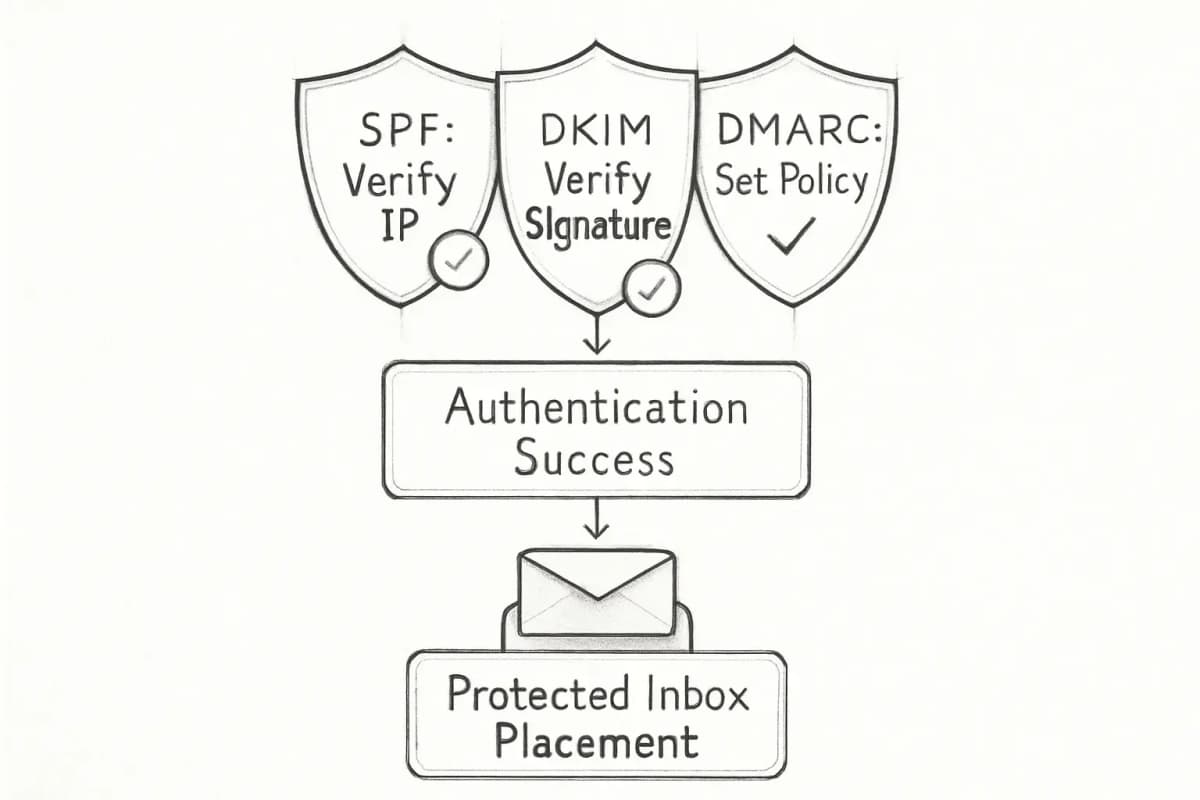
Industry-Specific Considerations for Tampa Email Marketing
Tampa's economy spans several distinct sectors, and the best email strategy reflects the nature of each business.
Healthcare and medical practices: The Tampa Bay area is poised for significant economic developments in 2025, with key industries like technology, real estate, and tourism leading the charge. Healthcare is a major employer in the region, and practices benefit from appointment reminder sequences, patient education content, and re-engagement campaigns for lapsed patients. HIPAA compliance governs what patient data can be used, so work with your ESP to ensure compliant configurations.
Hospitality and tourism: Hillsborough County finished FY2025 with more than $1.2 billion in taxable hotel revenue, the third straight year above the billion-dollar mark, and Tourism Development Tax collections topped $70 million for the first time. Tampa's hospitality sector has real scale. Hotels, restaurants, and tour operators can use email to drive repeat bookings, promote seasonal packages, and build loyalty programs. Read our detailed guide on hotel email marketing best practices.
Real estate: Tampa's real estate market is active, with the Tampa-St. Petersburg-Clearwater metropolitan area expected to experience a 1.4% increase in home prices by August 2025, following a slight decline in 2024. Real estate professionals can use email to nurture long buying cycles with market updates, new listing alerts, and neighborhood-specific content.
Technology and SaaS: The technology sector is booming in Tampa, with numerous startups and tech companies establishing their presence. For SaaS businesses, onboarding sequences, feature announcement emails, and trial-to-paid conversion campaigns are the highest-value automations. See our SaaS email marketing strategy guide for a full breakdown.
Retail and ecommerce: Statista reports that the average ROI for email marketing is $36 for every dollar spent, and some industries do even better, with a $45 ROI for every dollar spent by retail, ecommerce, and consumer goods businesses.
Measuring What Matters: Email Analytics for Tampa Businesses
Despite the very high return on investment, some companies struggle to calculate the actual ROI of their email marketing. Less than 13% have stated that they analyze their ROI well or very well, and a surprising 50% have admitted to measuring the ROI poorly, very poorly, or not at all.
Measurement is not optional. If you cannot attribute revenue to your email program, you cannot make decisions that improve it.
The metrics that matter most:
- Open rate: A signal of subject line quality and list health. In 2025, the average open rate across industries is about 42.35%.
- Click-through rate (CTR): Measures relevance of your content and strength of your CTA.
- Click-to-conversion rate: The percentage of clicks that result in a purchase, booking, or lead. This is the closest metric to direct revenue.
- Revenue per email: Divide total email-attributed revenue by total emails sent.
- Unsubscribe rate: A rising unsubscribe rate signals frequency or relevance problems.
- Deliverability/inbox placement rate: Monitor bounce rates and spam complaint rates to protect your sender reputation.
Email accounts for 25% of overall revenue for businesses using it strategically, according to eMarketer (2025). If your tracking does not reflect that, the attribution model is the problem, not the channel.
Frequently Asked Questions
How much does Tampa email marketing cost?
The cost depends on your list size, platform choice, and whether you manage campaigns in-house or with an agency. Most email service providers charge between $20 and $800 per month for small to mid-size lists. Agency management adds to that cost but often delivers faster results through strategic expertise. The key benchmark: for every $1 spent on email marketing, businesses see an average return of $36, according to Litmus (2024). Even a modest monthly investment can produce positive ROI when the strategy is sound.
How often should Tampa businesses send marketing emails?
Frequency depends on your audience and content quality. Sending emails once a month has the highest open rate at 28%, and sending 2 to 4 emails per month has the second-highest open rate. For most local businesses, 2 to 4 sends per month balances consistency with subscriber tolerance. Behavioral automations like abandoned cart or welcome sequences run on trigger, so they sit outside this frequency consideration.
What email marketing platform is best for Tampa small businesses?
There is no universal answer, because the best platform depends on your list size, budget, integration needs, and level of automation required. Popular options include Klaviyo for ecommerce, Mailchimp for general use, ActiveCampaign for automation-heavy programs, and Constant Contact for simplicity. Evaluate platforms on deliverability track record, segmentation tools, automation capabilities, and reporting depth before committing.
What is the most common email marketing mistake Tampa businesses make?
Sending the same email to everyone on the list is the most common and most costly mistake. It suppresses open rates, accelerates unsubscribes, and wastes the potential of your entire database. According to DMA, marketers who segment their lists see a 760% increase in email revenue. Segmentation requires upfront effort, but the return is measurable and consistent.
Does email marketing work for B2B businesses in Tampa?
Yes, and the data supports it strongly. According to a 2023 B2B marketing survey, 50% of B2B marketers say email marketing is the most impactful channel in their multi-channel marketing strategy. For Tampa's growing professional services, technology, and healthcare B2B sector, email is the primary channel for lead nurturing, relationship maintenance, and thought leadership distribution. B2B sequences require longer nurture timelines and more educational content, but the fundamentals of segmentation, personalization, and deliverability apply equally.