Kubota dealers operate in one of the most relationship-driven industries in equipment sales, where a customer's decision to buy a tractor, compact utility vehicle, or construction machine can take months and involve multiple touchpoints. Today's customers research online before making purchasing decisions, making email campaigns essential for lead generation and nurturing in the agricultural equipment space. And the numbers back that up: email marketing campaigns have an average ROI of 36 times, meaning businesses earn $36 for every dollar they spend on email marketing.
For Kubota dealers specifically, email is not just a broadcast tool. It is a precision instrument for moving buyers from initial inquiry to signed deal, retaining service customers, and re-engaging lapsed contacts. This guide covers the kubota dealer email marketing best practices that move the needle on revenue, not just open rates.
Key Takeaways
- Kubota dealers already lead the industry in multi-channel responsiveness, using a combination of calls, texts, and emails more often than competing brands. Email is core to that advantage.
- Using segmented email campaigns can lead to a 760% increase in revenue, making list segmentation one of the highest-leverage moves a Kubota dealer can make.
- Despite representing only 2% of email volume, automated messages generated 37% of all email-attributed sales in 2024.
- Automotive-adjacent industries get the highest revenue per email recipient of any industry, with automations returning $5.47 on average per recipient.
- Informative content consistently outperforms pure promotion in the equipment sector, and customer education builds the long-term trust that drives large-ticket sales.
Why Email Outperforms Other Channels for Kubota Dealers
Despite the rise of social media and other platforms like texting, live calls, and direct mail, email campaigns remain a reliable high-ROI channel for dealerships to connect directly with their customers.
The Kubota buying cycle is not an impulse purchase. A farmer upgrading to a new compact tractor or a landscaping company shopping for a commercial zero-turn mower typically evaluates options over weeks or months. Automated but customized email sequences and CRM systems help nurture these leads, since potential customers need different information at each stage of their buyer's journey.
Making a purchase decision today requires dealers to employ multiple customer touchpoints beyond traditional print, radio, and TV. Email fits into that mix because it is direct, personal, cost-effective, and measurable in ways that print or billboards simply are not.
59% of B2B marketers rate email as their most effective channel for prospecting, and for a Kubota dealer selling to farmers, contractors, and municipalities, that applies directly.
1. Segment Your List by Customer Type and Purchase Stage
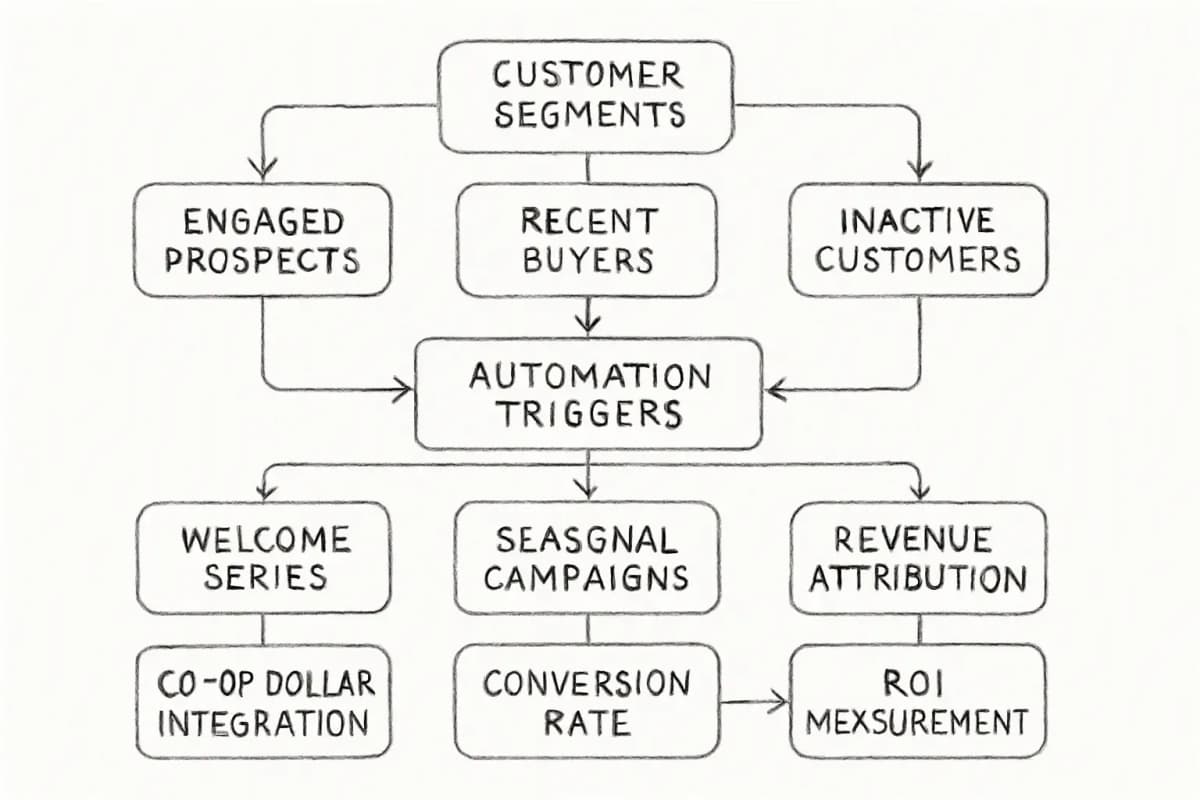
Batch-and-blast emails are the single biggest waste of a dealer's email budget. While 57% of dealers send monthly emails, most see mediocre results because they don't segment. Recent buyers, active shoppers, and lapsed customers need different messages, timing, and offers. Segmented campaigns convert significantly better.
For a Kubota dealership, the core segments to build are:
- New leads from website inquiries or trade show sign-ups
- Active shoppers browsing specific equipment categories
- Recent buyers ready for service reminders or accessory upsells
- Lapsed customers who have not visited or serviced in 12+ months
- Commercial/fleet buyers (contractors, municipalities, landscapers)
- Residential buyers (homeowners, hobby farmers)
You can further personalize using location-based offers, tailored service specials based on proximity to your dealership, and purchase anniversary messages as customers approach typical trade-in milestones.
For a deeper playbook on building these audience groups, see Email List Segmentation Strategies That Boost ROI by 760%.
2. Build Automated Sequences for Every Stage of the Buyer Journey
Manual email follow-up does not scale, and it is consistently slower than what wins deals. Automated email campaigns generate $5.47 per recipient versus $0.16 for standard campaigns, representing a 34x performance improvement.
The key automated sequences every Kubota dealer should have running are:
Welcome sequence: Welcome emails see more than 8 out of 10 people opening them, resulting in 4x as many opens and 10x more clicks than other email types. When someone fills out a contact form or signs up at your dealership, that is the moment of peak interest. Use it.
Service reminder sequence: Triggered service reminder emails launch the moment a vehicle crosses a mileage threshold or a time interval expires. These reminders weave in service pricing, recommended parts, and availability in a way that feels like friendly advice rather than a sales push.
Post-purchase nurture: Follow up after service to thank customers, include a satisfaction survey, and suggest the next service. Then trigger emails based on mileage or time since their last visit.
Win-back campaign: Email lapsed customers special offers, new inventory that matches their previous purchase, and a compelling reason to come back. "Your trade-in might be worth more now" outperforms generic "it's been a while" messaging.
For a structured approach to building these sequences, see Welcome Email Sequence Best Practices: 7 Proven Strategies.
3. Make Every Email Relevant to the Customer's Equipment and Situation
A key lesson from Kubota dealer marketing is that informative content outperforms promotional content almost 3 to 1. While posts about specific deals on Kubota products moved the needle, general informative content generated far more engagement. Customers found more value in information about the products they already owned than information about savings on new products.
This principle translates directly to email. A customer who bought a Kubota BX-series tractor last year wants emails about maintenance schedules, compatible attachments, and seasonal tips, not a pitch for a machine they just purchased. A well-crafted email campaign can do more than sell products. Monthly newsletters featuring farming tips, equipment maintenance advice, and industry updates keep your audience engaged, foster trust, and encourage repeat business, turning one-time buyers into lifelong customers.
Content ideas that work for Kubota dealer email lists:
- Seasonal maintenance checklists (pre-winter storage, spring startup)
- Attachment compatibility guides for specific Kubota models
- Financing update emails when rates shift
- "Parts in stock" alerts for high-demand items
- Equipment demo event invitations
- Trade-in value estimators
Send personalized emails for maintenance reminders, in-season upgrades, special offers, and new product launches, showing customers that you understand and care about their day-to-day challenges.
4. Write Subject Lines That Get Opened
Your email's value is zero if it is never opened. If your email isn't opened, it's worthless. Subject lines are the first and sometimes only impression you make.
For Kubota dealers, specificity wins. "Your BX2380 is due for a 200-hour service" outperforms "Don't forget about your tractor." "Winter storage prep for Kubota owners" outperforms "Important seasonal tips."
Data-backed subject line principles:
- Email subject lines with the recipient's first name have a 26% higher open rate.
- Specificity around the customer's actual equipment creates immediate relevance.
- Questions that surface a real problem ("Is your loader attachment ready for mud season?") tend to outperform declarative subject lines.
- Keep subject lines under 50 characters for full mobile display.
For a full breakdown of what works, see Email Subject Line Best Practices That Boost Open Rates by 27%.
5. Optimize for Mobile, Every Time
Over 60% of automotive emails are opened on mobile devices. The mobile-first nature of email consumption requires responsive design and mobile-optimized landing experiences. Dealerships must ensure seamless transitions from mobile email opens to mobile-optimized inventory pages, service scheduling tools, and contact forms to maximize conversion opportunities.
50% of people will delete an email if it isn't optimized for mobile. That means a non-responsive template is not a preference issue. It is a deliverability and revenue problem.
Mobile optimization checklist for Kubota dealer emails:
- Single-column layout that renders cleanly on a 375px screen
- Minimum 16px body font, 20px+ for headlines
- Buttons at least 44x44 pixels with clear tap targets
- Images with descriptive alt text for users with images disabled
- A single, clear call to action per email (not three competing buttons)
Emails with single calls-to-action increase clicks by 371% versus emails with multiple competing CTAs. Pick one goal per email and design toward it.
6. Use Transactional Emails as a Secondary Marketing Channel
Transactional emails include communications like appointment reminders, where the customer is already expecting contact. These are a great place to insert promotional banners for trade-up programs or other ongoing specials. By grabbing a bit of screen real estate toward the bottom of a standard communication, you can promote an ongoing program without the risk of sending it as a promotional email that could lead to the customer unsubscribing.
This is an underused strategy for Kubota dealers. A service confirmation email already has strong open rates. Adding a brief mention of a current parts promotion or an upcoming demo event costs nothing and reaches a highly engaged reader.
The average open rate for transactional emails, such as order confirmations and service notifications, is 47.1%, far above the industry average for marketing emails. That attention is valuable real estate.
7. Track the Metrics That Connect to Revenue
Bot-driven phantom engagement has made open rates unreliable, pushing high-performing teams toward revenue per email, list churn, and lifetime value as the metrics that matter.
For a Kubota dealership, the metrics that matter are:
- Revenue per email sent (total email-attributed sales divided by sends)
- Service appointment conversions from service reminder campaigns
- Parts revenue traced to email promotions
- Lead-to-visit rate from inquiry nurture sequences
- Unsubscribe rate per campaign (a spike signals messaging mismatch)
Track how much you spend to get each service booking, how much money each email brings in, and how the campaign affects long-term customer spending. Also measure parts sales that come from your emails, and keep an eye on overall campaign costs versus returns.
Connect your email platform to your CRM so attribution is clear. Tag every email with UTM parameters so you can see traffic sources in Google Analytics. Use your CRM to track which customers received specific emails and whether they visited or purchased.
For a complete breakdown of what to measure and how, see Email Marketing Analytics Best Practices.
8. Leverage Kubota's Co-op Programs and Brand Assets
Kubota offers Co-op Advertising programs to its dealerships, and those programs can offset the cost of digital marketing, including email platforms and campaign production. Dealers who apply co-op funds to email marketing are effectively getting subsidized access to one of the highest-ROI channels available.
Kubota provides tools that allow each dealer to customize marketing materials to create local content on-the-fly using approved creative, while allowing certain elements to be customized within approved templates using brand assets, without risking consistency and brand compliance.
That means your email templates can carry Kubota's brand equity while featuring your local inventory, pricing, and team. This combination of national brand credibility and local relevance is precisely what converts fence-sitters.
Dealer Spike, a digital marketing partner, works with Kubota among over 100 OEM programs, meaning dealers can apply co-op dollars to website and email marketing products so they don't leave money on the table.
Putting It Together: A Simple Email Calendar for Kubota Dealers
Consistency matters more than volume. Consider what frequency of communication your customers will tolerate, segment out marketing emails to only the base of customers most likely to respond to them, and give your campaigns room to breathe. The last thing you want is for customers who might have responded later to get annoyed and unsubscribe.
A practical monthly cadence for most Kubota dealers:
- Week 1: Service reminder batch (triggered by service history data)
- Week 2: Educational or seasonal content email (non-promotional)
- Week 3: Inventory highlight or promotion (segmented by equipment interest)
- Week 4: Parts or accessory spotlight (targeted to recent buyers)
Layer on top of this a continuous welcome sequence for new contacts and a quarterly re-engagement campaign for lapsed subscribers. That is a full email program that does not overwhelm your list.
Brands that regularly A/B test their emails achieve 83% higher ROI than those that never test. Run one test per campaign, whether it is subject line, send time, or CTA copy, and apply what you learn.
Frequently Asked Questions
How often should a Kubota dealer send marketing emails?
Frequency depends on relevance and the segment. Recent buyers and active prospects can handle 2 to 3 emails per week if the content is valuable. Service audiences respond to triggered maintenance-need emails. Lapsed customers warrant 1 to 2 emails per month, and a general list once monthly. Irrelevance is the real problem, not frequency. When every email is relevant to the reader's situation, higher frequency becomes an asset rather than a liability.
What types of emails generate the most revenue for equipment dealers?
In 2024, automated emails drove 37% of all email-generated sales despite accounting for just 2% of email volume. For Kubota dealers specifically, service reminders, post-purchase nurture sequences, and parts promotions tied to service history consistently outperform generic blast campaigns. Service reminder emails achieve 34.5% booking conversion rates, making them a critical revenue driver for the service department.
How should a Kubota dealer build its email list ethically and effectively?
Start with every customer interaction: service appointments, equipment purchases, financing applications, trade show visits, and demo events. Don't just collect email addresses. Gather additional customer data like equipment interests, current machine owned, and anticipated purchase timeline to enable better segmentation later. Avoid purchased lists. They damage your sender reputation, harm deliverability, and produce no qualified leads.
What is the biggest email marketing mistake Kubota dealers make?
Most dealers treat email like a broadcast tool, batch-blasting the same message to everyone once a month. Meanwhile, competitors use email as a precision instrument: segmenting audiences, automating triggers, personalizing messaging, and watching customers arrive at the dealership with intent already formed. Treating every customer the same regardless of what they own, what they have inquired about, or when they last visited is the fastest way to train your list to ignore you.