10 Labor Day Email Marketing Examples That Drive Sales
See 10 proven Labor Day email marketing examples that boost engagement and conversions. Get templates, subject lines, and strategies you can use today.
Labor Day is one of the most commercially significant weekends on the US retail calendar. It is the second-largest sale date of the year, after Black Friday. For email marketers, that distinction matters: it means consumers arrive at their inboxes already primed to spend. CivicScience data from 2024 show that nearly 23% of US adults with definite plans intended to shop the Labor Day sales, up from 17% in 2023 and 16% in 2022. The window to capture that intent is narrow, competition in the inbox is high, and generic blasts get ignored.
The 10 labor day email marketing examples below are drawn from real campaigns across multiple industries. Each one solves a distinct conversion problem, and each pattern is one you can deploy in your own campaigns.
Key Takeaways
Labor Day falls on the first Monday of September and functions as the informal end-of-summer sales anchor before Q4.
Brands that sent emails on the Wednesday before Labor Day saw 18% higher open rates than those who sent later in the week, according to Klaviyo data.
Campaigns that used urgency-based subject lines and limited-time offers achieved 4 to 8% conversion rates, according to Flowium research.
Personalized subject lines, segmented lists, and countdown timers consistently separate high-performing Labor Day campaigns from the inbox noise.
The top three product categories Labor Day shoppers actively seek are apparel (30%), electronics and tech (22%), and furniture, mattresses, or home goods (17%).
Why Labor Day Email Marketing Deserves a Dedicated Strategy
The three-day weekend is known for large sales as it marks the bridge between summer and fall, when many retailers need to clear stock for new seasonal products. It also coincides with Back to School and Back to College, with a combined planned spend of $2,257 per person.
Most Labor Day sale shopping now occurs online, with in-store shopping intent falling to just 35% of shoppers, down from 40% the previous year. That shift directly benefits email: it is the channel that meets online shoppers exactly where they are.
A well-crafted Labor Day marketing email can do more than highlight exclusive deals. It can strengthen brand loyalty, re-engage past customers, and attract new ones through strategic messaging and compelling offers.
10 Labor Day Email Marketing Examples That Drive Sales
See 10 proven Labor Day email marketing examples that boost engagement and conversions. Get templates, subject lines, and strategies you can use today.
Labor Day is one of the most commercially significant weekends on the US retail calendar. It is the second-largest sale date of the year, after Black Friday. For email marketers, that distinction matters: it means consumers arrive at their inboxes already primed to spend. CivicScience data from 2024 show that nearly 23% of US adults with definite plans intended to shop the Labor Day sales, up from 17% in 2023 and 16% in 2022. The window to capture that intent is narrow, competition in the inbox is high, and generic blasts get ignored.
The 10 labor day email marketing examples below are drawn from real campaigns across multiple industries. Each one solves a distinct conversion problem, and each pattern is one you can deploy in your own campaigns.
Key Takeaways
Labor Day falls on the first Monday of September and functions as the informal end-of-summer sales anchor before Q4.
Brands that sent emails on the Wednesday before Labor Day saw 18% higher open rates than those who sent later in the week, according to Klaviyo data.
Campaigns that used urgency-based subject lines and limited-time offers achieved 4 to 8% conversion rates, according to Flowium research.
Personalized subject lines, segmented lists, and countdown timers consistently separate high-performing Labor Day campaigns from the inbox noise.
The top three product categories Labor Day shoppers actively seek are apparel (30%), electronics and tech (22%), and furniture, mattresses, or home goods (17%).
Why Labor Day Email Marketing Deserves a Dedicated Strategy
The three-day weekend is known for large sales as it marks the bridge between summer and fall, when many retailers need to clear stock for new seasonal products. It also coincides with Back to School and Back to College, with a combined planned spend of $2,257 per person.
Most Labor Day sale shopping now occurs online, with in-store shopping intent falling to just 35% of shoppers, down from 40% the previous year. That shift directly benefits email: it is the channel that meets online shoppers exactly where they are.
A well-crafted Labor Day marketing email can do more than highlight exclusive deals. It can strengthen brand loyalty, re-engage past customers, and attract new ones through strategic messaging and compelling offers.
The examples below are organized by the specific tactic each campaign uses to drive revenue.
1. The Sitewide Sale Email (Hurley)
The simplest Labor Day email format is often the strongest. Hurley's approach puts a sitewide sale front and center with zero friction: the email announces a site-wide sale with no discount code required, removing the friction of remembering and entering a code at checkout, and uses a single "SHOP NOW" CTA that takes subscribers directly to the sale.
What to steal: Lead with your biggest offer in the first 100 pixels. Remove any step between the click and the discounted product page. One CTA, one destination.
2. The VIP Early Access Email (Helix Sleep)
VIP customers deserve heightened appreciation and special care. Rewarding your best customers not only shows appreciation for their patronage but also builds long-term relationships and drives revenue. Helix Sleep directs this approach specifically to VIPs, encouraging them to shop early.
The brand adds a layer of reassurance by highlighting a 100-day sleep trial, and includes a specialist review at the bottom of the email to build purchase confidence.
What to steal: Segment your most valuable customers before the sale starts and give them 24 to 48 hours of exclusive access. The exclusivity itself becomes part of the offer. For more on how to build these segments effectively, read our guide on email list segmentation strategies that boost ROI by 760%.
3. The BOGO Last-Chance Email (Tommie Copper)
Tommie Copper promoted a BOGO (Buy One, Get One Free) campaign on best-selling products. The brand then sent a last-chance email to motivate last-minute shoppers to claim the offer, with "Shop now" CTAs throughout. The BOGO offer applied specifically to best sellers, making the promotion feel more valuable and exclusive.
The brand also used "Did you know?" sections throughout the email to address common customer concerns and build trust before the final CTA.
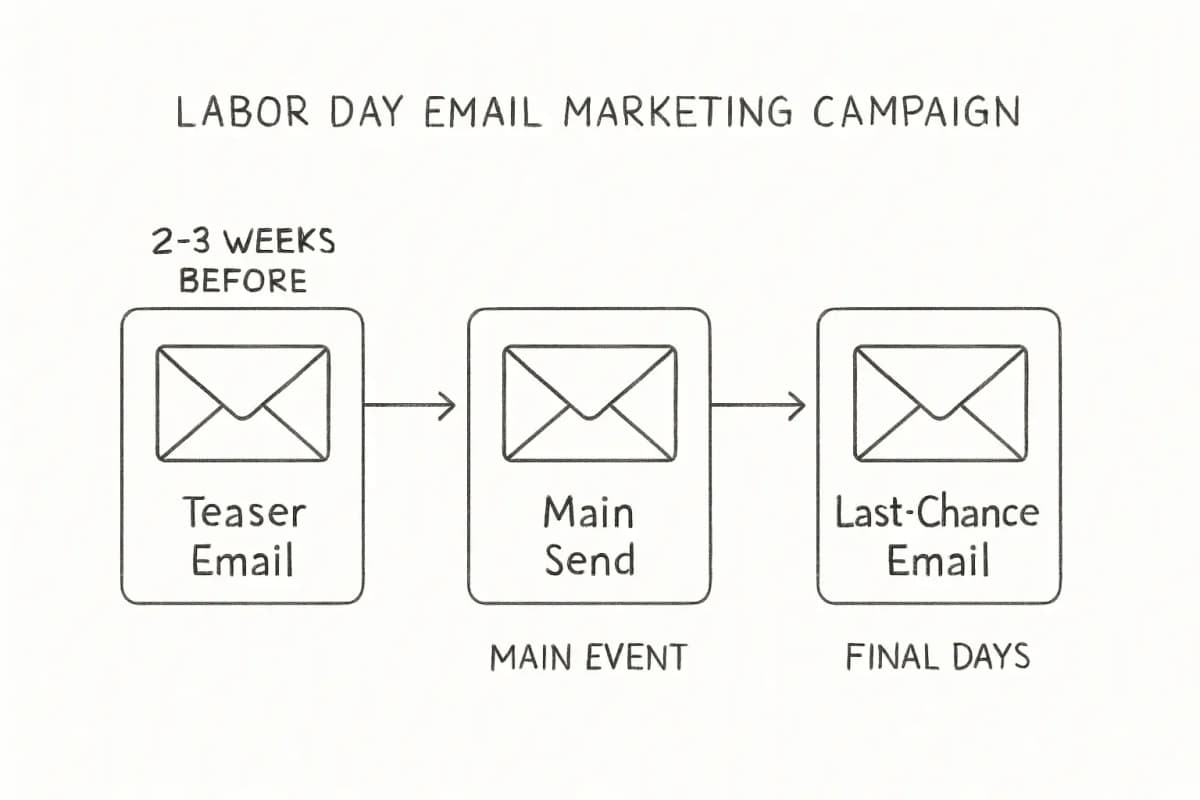
What to steal: Structure your Labor Day campaign as a sequence, not a single send. A teaser, a main promotion, and a last-chance email routinely outperform single-blast campaigns.
4. The Countdown Timer Email (Miracle Noodle)
This Labor Day example stands out thanks to its simplicity and countdown timer, which urges readers to take action. Miracle Noodle pairs a clear CTA with a visible discount code and a live countdown to the sale deadline.
Countdown timers work because they convert abstract deadlines into concrete, visible pressure. A ticking clock is a direct signal for limited-time offers. A sense of urgency is what separates maybe-shoppers from paying customers. Countdown timers also build trust: no one wants to buy an item only to see it discounted again days later.
What to steal: Place the timer above the fold so subscribers see it before they read anything else. Match the timer's end date to an actual offer expiration, not a rolling promotion.
5. The Brand Collaboration and Giveaway Email (Lasso)
Collaboration is a win-win approach in marketing. It brings like-minded businesses together to share resources, increase brand exposure, and grow influence. Lasso, an athletic compression sock brand, collaborates with seven other brands to offer a bundled pack of sporting goods.
The email leads with a bold "LABOR DAY GIVEAWAY" banner, signaling a free-to-enter incentive that draws clicks from subscribers who are not yet ready to purchase.
What to steal: If your average order value makes a straight discount expensive, a co-branded giveaway gives you engagement data and new audience reach without the same margin hit.
6. The Gift-With-Purchase Email (Vrai and Oro)
Fine jewelry brand Vrai and Oro integrates a customer appreciation angle into its Labor Day campaign by offering a gift to customers who spend $450, including a choice of gold color for the free Line Threaders included with qualifying purchases.
This tactic works because it raises average order value while making the customer feel recognized rather than sold to. Giving back to customers is a way to make a Labor Day campaign more meaningful. Demonstrating appreciation helps foster loyalty and enhances brand image.
What to steal: Set your gift threshold slightly above your current average order value to lift AOV without heavily discounting your core catalog.
7. The Catalog-Style Labor Day Email (Edloe Finch)
Furniture brand Edloe Finch earned a high click rate with its Labor Day marketing email for several reasons: the discount, length of the sale, and CTA button are all above the fold. The email features no fewer than 10 high-quality product shots, all showcasing bestselling products in context. Subscribers can assess how a sofa or dining table looks in situ without clicking through to the site. Important logistics information, including shipping, returns, financing, and customer service details, appears in the footer.
What to steal: Use your Labor Day email as a catalog for higher-consideration purchases. Reduce the cognitive load on the subscriber by answering logistics questions inside the email itself.
8. The End-of-Summer Seasonal Email (Pauli and Sisters)
The Labor Day email from Pauli and Sisters uses a contrasting color palette to play on the themes of a long summer that is almost over. The messaging nudges subscribers to "moisturize your Summer skin," directly connecting the product to the time of year. Visually, the email uses a black background in the lower half to make the offer stand out.
This approach works for brands that do not run traditional sales. Instead of leading with a discount, the email frames the product as a seasonal necessity.
What to steal: If a deep discount does not fit your brand positioning, use the seasonal moment itself as the hook. Connect the product directly to what the subscriber is experiencing right now.
9. The Free Shipping Incentive Email (Clayton and Crume / Best Swimwear)
Leather goods brand Clayton and Crume removes a common buying obstacle by waiving shipping costs and including three free products with every order, which also allows buyers to experience the quality of their materials firsthand.
Best Swimwear uses a different angle: the brand targets last-minute shoppers by promising pre-Labor Day delivery. The email was sent the Tuesday before Labor Day with the subject line "Free 2 Day Shipping on Orders $50+."
Research indicates that 88% of shoppers say free shipping makes them more likely to buy.
What to steal: Free shipping is not just a perk at this point, it is a conversion lever. If you can offer it, make it the headline of your email, not a footnote in the footer.
10. The Back-to-School Hybrid Email (High Sierra / Romwe)
In some states, children are already back to school by Labor Day; in others, they are not. Regardless, Labor Day is part of the broader back-to-school sales period. High Sierra markets backpacks to people of all ages but uses Labor Day to specifically target students with relevant products.
Romwe, an alternative fashion brand, takes a combined approach: promoting both fall and summer clothes within a single Labor Day email campaign.
What to steal: If your catalog spans multiple categories, use segmentation to show the most relevant products to each subscriber group rather than sending one generic mix. For a deeper look at personalization techniques that lift conversions, see our article on email personalization techniques that boost conversions 47%.
How to Time Your Labor Day Email Sequence
Start with teaser emails two to three weeks in advance to build anticipation, followed by your main promotions a week before and throughout the three-day weekend. Send last-chance reminders on Labor Day itself and the day after, using urgency-driven messaging to capture last-minute shoppers.
The best send times are typically mid-morning (10 to 11 AM) on weekdays and early afternoon (1 to 2 PM) on weekends. For Labor Day specifically, Friday afternoon before the holiday weekend and Saturday morning tend to perform well.
Your subject line is the first decision subscribers make. Using recipient names, location data, or purchase history to personalize subject lines can increase open rates by up to 26%. For a full breakdown of subject line tactics, our guide on email subject line best practices that boost open rates by 27% covers the mechanics in detail.
After each campaign, measure what matters. A/B test subject lines to determine which drives more opens, testing urgency-focused against curiosity-driven lines. Experiment with CTA placement: test positioning at the top versus the bottom, or try multiple CTAs throughout to find the most effective layout.
Frequently Asked Questions
When should I start sending Labor Day emails?
Begin your campaign preparation two to three weeks before Labor Day. Build anticipation with preview emails and early access offers before the main promotion launches.
What types of offers work best in Labor Day emails?
Straightforward promotions with a discount work well, as do less ordinary tactics like bundle offers and giveaways. Free shipping incentives, BOGO deals, and gift-with-purchase thresholds consistently perform across categories. The offer format should match your margin structure and brand positioning.
How do I make my Labor Day email stand out in a crowded inbox?
With inboxes flooded with holiday promotions, standing out requires a combination of the right subject line, eye-catching visuals, and a clear value proposition. Segment your list so each subscriber receives an offer relevant to their past behavior, use a countdown timer to create real urgency, and keep your primary CTA singular and prominent.
Should I send Labor Day emails to my entire list?
Sending to your entire list without segmentation is the fastest route to elevated unsubscribes and lower deliverability. Audience segmentation is a crucial strategy for Labor Day campaigns. It makes your campaigns highly targeted and ensures subscribers receive content relevant to them. When subscribers receive emails about products that address their specific needs, they are far more likely to convert. Build distinct segments by purchase history, engagement level, and product interest before you send a single campaign.
The examples below are organized by the specific tactic each campaign uses to drive revenue.
1. The Sitewide Sale Email (Hurley)
The simplest Labor Day email format is often the strongest. Hurley's approach puts a sitewide sale front and center with zero friction: the email announces a site-wide sale with no discount code required, removing the friction of remembering and entering a code at checkout, and uses a single "SHOP NOW" CTA that takes subscribers directly to the sale.
What to steal: Lead with your biggest offer in the first 100 pixels. Remove any step between the click and the discounted product page. One CTA, one destination.
2. The VIP Early Access Email (Helix Sleep)
VIP customers deserve heightened appreciation and special care. Rewarding your best customers not only shows appreciation for their patronage but also builds long-term relationships and drives revenue. Helix Sleep directs this approach specifically to VIPs, encouraging them to shop early.
The brand adds a layer of reassurance by highlighting a 100-day sleep trial, and includes a specialist review at the bottom of the email to build purchase confidence.
What to steal: Segment your most valuable customers before the sale starts and give them 24 to 48 hours of exclusive access. The exclusivity itself becomes part of the offer. For more on how to build these segments effectively, read our guide on email list segmentation strategies that boost ROI by 760%.
3. The BOGO Last-Chance Email (Tommie Copper)
Tommie Copper promoted a BOGO (Buy One, Get One Free) campaign on best-selling products. The brand then sent a last-chance email to motivate last-minute shoppers to claim the offer, with "Shop now" CTAs throughout. The BOGO offer applied specifically to best sellers, making the promotion feel more valuable and exclusive.
The brand also used "Did you know?" sections throughout the email to address common customer concerns and build trust before the final CTA.
What to steal: Structure your Labor Day campaign as a sequence, not a single send. A teaser, a main promotion, and a last-chance email routinely outperform single-blast campaigns.
4. The Countdown Timer Email (Miracle Noodle)
This Labor Day example stands out thanks to its simplicity and countdown timer, which urges readers to take action. Miracle Noodle pairs a clear CTA with a visible discount code and a live countdown to the sale deadline.
Countdown timers work because they convert abstract deadlines into concrete, visible pressure. A ticking clock is a direct signal for limited-time offers. A sense of urgency is what separates maybe-shoppers from paying customers. Countdown timers also build trust: no one wants to buy an item only to see it discounted again days later.
What to steal: Place the timer above the fold so subscribers see it before they read anything else. Match the timer's end date to an actual offer expiration, not a rolling promotion.
5. The Brand Collaboration and Giveaway Email (Lasso)
Collaboration is a win-win approach in marketing. It brings like-minded businesses together to share resources, increase brand exposure, and grow influence. Lasso, an athletic compression sock brand, collaborates with seven other brands to offer a bundled pack of sporting goods.
The email leads with a bold "LABOR DAY GIVEAWAY" banner, signaling a free-to-enter incentive that draws clicks from subscribers who are not yet ready to purchase.
What to steal: If your average order value makes a straight discount expensive, a co-branded giveaway gives you engagement data and new audience reach without the same margin hit.
6. The Gift-With-Purchase Email (Vrai and Oro)
Fine jewelry brand Vrai and Oro integrates a customer appreciation angle into its Labor Day campaign by offering a gift to customers who spend $450, including a choice of gold color for the free Line Threaders included with qualifying purchases.
This tactic works because it raises average order value while making the customer feel recognized rather than sold to. Giving back to customers is a way to make a Labor Day campaign more meaningful. Demonstrating appreciation helps foster loyalty and enhances brand image.
What to steal: Set your gift threshold slightly above your current average order value to lift AOV without heavily discounting your core catalog.
7. The Catalog-Style Labor Day Email (Edloe Finch)
Furniture brand Edloe Finch earned a high click rate with its Labor Day marketing email for several reasons: the discount, length of the sale, and CTA button are all above the fold. The email features no fewer than 10 high-quality product shots, all showcasing bestselling products in context. Subscribers can assess how a sofa or dining table looks in situ without clicking through to the site. Important logistics information, including shipping, returns, financing, and customer service details, appears in the footer.
What to steal: Use your Labor Day email as a catalog for higher-consideration purchases. Reduce the cognitive load on the subscriber by answering logistics questions inside the email itself.
8. The End-of-Summer Seasonal Email (Pauli and Sisters)
The Labor Day email from Pauli and Sisters uses a contrasting color palette to play on the themes of a long summer that is almost over. The messaging nudges subscribers to "moisturize your Summer skin," directly connecting the product to the time of year. Visually, the email uses a black background in the lower half to make the offer stand out.
This approach works for brands that do not run traditional sales. Instead of leading with a discount, the email frames the product as a seasonal necessity.
What to steal: If a deep discount does not fit your brand positioning, use the seasonal moment itself as the hook. Connect the product directly to what the subscriber is experiencing right now.
9. The Free Shipping Incentive Email (Clayton and Crume / Best Swimwear)
Leather goods brand Clayton and Crume removes a common buying obstacle by waiving shipping costs and including three free products with every order, which also allows buyers to experience the quality of their materials firsthand.
Best Swimwear uses a different angle: the brand targets last-minute shoppers by promising pre-Labor Day delivery. The email was sent the Tuesday before Labor Day with the subject line "Free 2 Day Shipping on Orders $50+."
Research indicates that 88% of shoppers say free shipping makes them more likely to buy.
What to steal: Free shipping is not just a perk at this point, it is a conversion lever. If you can offer it, make it the headline of your email, not a footnote in the footer.
10. The Back-to-School Hybrid Email (High Sierra / Romwe)
In some states, children are already back to school by Labor Day; in others, they are not. Regardless, Labor Day is part of the broader back-to-school sales period. High Sierra markets backpacks to people of all ages but uses Labor Day to specifically target students with relevant products.
Romwe, an alternative fashion brand, takes a combined approach: promoting both fall and summer clothes within a single Labor Day email campaign.
What to steal: If your catalog spans multiple categories, use segmentation to show the most relevant products to each subscriber group rather than sending one generic mix. For a deeper look at personalization techniques that lift conversions, see our article on email personalization techniques that boost conversions 47%.
How to Time Your Labor Day Email Sequence
Start with teaser emails two to three weeks in advance to build anticipation, followed by your main promotions a week before and throughout the three-day weekend. Send last-chance reminders on Labor Day itself and the day after, using urgency-driven messaging to capture last-minute shoppers.
The best send times are typically mid-morning (10 to 11 AM) on weekdays and early afternoon (1 to 2 PM) on weekends. For Labor Day specifically, Friday afternoon before the holiday weekend and Saturday morning tend to perform well.
Your subject line is the first decision subscribers make. Using recipient names, location data, or purchase history to personalize subject lines can increase open rates by up to 26%. For a full breakdown of subject line tactics, our guide on email subject line best practices that boost open rates by 27% covers the mechanics in detail.
After each campaign, measure what matters. A/B test subject lines to determine which drives more opens, testing urgency-focused against curiosity-driven lines. Experiment with CTA placement: test positioning at the top versus the bottom, or try multiple CTAs throughout to find the most effective layout.
Frequently Asked Questions
When should I start sending Labor Day emails?
Begin your campaign preparation two to three weeks before Labor Day. Build anticipation with preview emails and early access offers before the main promotion launches.
What types of offers work best in Labor Day emails?
Straightforward promotions with a discount work well, as do less ordinary tactics like bundle offers and giveaways. Free shipping incentives, BOGO deals, and gift-with-purchase thresholds consistently perform across categories. The offer format should match your margin structure and brand positioning.
How do I make my Labor Day email stand out in a crowded inbox?
With inboxes flooded with holiday promotions, standing out requires a combination of the right subject line, eye-catching visuals, and a clear value proposition. Segment your list so each subscriber receives an offer relevant to their past behavior, use a countdown timer to create real urgency, and keep your primary CTA singular and prominent.
Should I send Labor Day emails to my entire list?
Sending to your entire list without segmentation is the fastest route to elevated unsubscribes and lower deliverability. Audience segmentation is a crucial strategy for Labor Day campaigns. It makes your campaigns highly targeted and ensures subscribers receive content relevant to them. When subscribers receive emails about products that address their specific needs, they are far more likely to convert. Build distinct segments by purchase history, engagement level, and product interest before you send a single campaign.