The most successful email marketing campaigns share a common thread: they treat every send as a conversation, not a broadcast. For every $1 spent on email marketing, the average return is $40. Yet most businesses leave that return on the table by copying generic templates instead of studying what actually works. This breakdown of successful email marketing campaign examples goes beyond surface-level inspiration. It covers the mechanics, the numbers, and the decisions behind campaigns that consistently outperform benchmarks, so you can apply the same thinking to your own strategy.
Key Takeaways
- Automated emails generate 320% more revenue than non-automated emails, and the average ROI for email marketing is $36 for every $1 spent.
- Three-email abandoned cart sequences generated $24.9 million compared to just $3.8 million for single emails in Klaviyo's analysis, a 6.5x revenue difference.
- Welcome emails achieve average open rates of 69% to 80%, making them the highest-performing automated email type.
- According to Klaviyo's industry benchmarks, the top 10% of emails convert 5x more subscribers and drive 9x more revenue per recipient.
- The most effective email marketing strategies involve segmentation (78%), message personalization (72%), and email automation (71%).
1. The Anatomy of a High-Performing Email Campaign
Before diving into specific examples, it helps to understand what separates campaigns that drive revenue from those that just fill inboxes.
Successful campaigns share three core elements. First, they use data to create relevant experiences, not just inserting a first name, but tailoring content based on purchase history and browsing behavior. Second, they leverage automation to respond instantly to customer actions. Third, they connect to broader business goals, tracking real revenue impact rather than just open rates.
The world's top-performing brands go beyond basic batch-and-blast sending, using personalized content, targeted segmentation, and powerful automation to create campaigns that feel both relevant and engaging. They focus on building relationships that keep customers coming back.
This shift in thinking, from campaign to conversation, is what distinguishes the examples below.
2. Welcome Email Sequences: The Highest-ROI Starting Point
No campaign type consistently outperforms a well-built welcome sequence. According to a study by Invesp, welcome emails generate 4x the open rates and 5x the click rates of standard marketing emails, making them a high-impact first touchpoint.
The welcome series is the most critical automated email flow for any brand. It is the first direct conversation you have with a new subscriber. This multi-email sequence, typically 3 to 5 emails, introduces your brand story and drives the first purchase.
What makes a welcome sequence work:
- Deliver the promised incentive in email one. Subscribers signed up with an expectation. Meeting it immediately sets a positive precedent.
- The first email should deliver the promised incentive instantly. Subsequent emails should introduce the brand's mission and showcase top products with social proof.
- Time emails thoughtfully. Klaviyo recommends creating a flow triggered by a subscribe action, with time delays of 1 to 2 days between emails.
For a detailed playbook on structuring these sequences, see Welcome Email Sequence Best Practices: 7 Proven Strategies.
3. Abandoned Cart Emails: Recovering Revenue You Already Earned
Abandoned cart emails are among the most clear-cut examples of email marketing that works, because the subscriber has already signaled purchase intent.
According to Statista, the online shopping cart abandonment rate in 2024 is around 70%. That represents an enormous pool of revenue that is recoverable with the right follow-up.
Abandoned cart emails achieve 50.5% open rates on Klaviyo, with top 10% performers reaching 65.34%. Multi-email sequences multiply results: three-email flows generated $24.9 million compared to $3.8 million for single emails in Klaviyo's analysis.
The most effective structure for abandoned cart flows:
- Email 1 (within 1 hour): A simple reminder with the product image and a direct link back to the cart. Emails sent within one hour can increase conversion rates by up to 20%.
- Email 2 (24 hours later): Add social proof, such as reviews or ratings. This targets non-openers with a slightly different angle.
- Email 3 (48 to 72 hours later): Include an incentive, such as free shipping or a limited-time discount, as a final nudge.
Most brands recover just 3% to 5% of abandoned carts, leaving significant room for improvement. Industry leaders achieve 10% to 14% recovery rates, up to four times the typical rate. The gap is almost always tied to timing, sequence length, and inbox placement.
4. Spotify Wrapped: Personalization at Scale
Spotify's annual Wrapped campaign is one of the most studied successful email marketing campaign examples in the industry. It works because it takes first-party data and turns it into something subscribers actually want to open.
While it's fun and entertaining, Wrapped is also a highly strategic marketing campaign designed to engage users, strengthen brand loyalty, and dominate social media for weeks.
The numbers are striking. Wrapped 2025 reached 200 million engaged users in approximately 24 hours, a 19% increase year-over-year. In the first week of December 2020, Spotify saw a 21% increase in mobile app downloads after Wrapped was released, largely driven by FOMO and the viral nature of social sharing.
The lesson here is not that you need Spotify's data infrastructure. It is that Spotify Wrapped is just one example of how modern marketing teams leverage first-party customer data to create hyper-personalized user experiences. Any marketing team can create similar product utilization experiences using the engagement data they already collect.
What you can replicate:
- Pull behavioral data you already have (purchases, clicks, content viewed) and reflect it back to the subscriber.
- Frame the email as a celebration or insight, not a sales pitch.
- Build in social sharing to extend organic reach beyond your list.
5. PUMA: Hyper-Personalized Segmentation Across 27 Markets
PUMA's email campaign, executed in partnership with SAP Emarsys, demonstrates how segmentation and automation can scale without sacrificing relevance.
PUMA's challenge was clear: they needed to connect with a diverse customer base across 27 markets while ensuring each interaction felt personal and relevant. With such a vast audience, segmentation and automation became the key to success. PUMA created dynamic email campaigns where every single email, whether sent to thousands or millions, was unique to the recipient.
As PUMA's CRM Manager stated: "If we send half a million emails, we're sending half a million different emails."
This approach illustrates the direct link between personalization and performance. Marketers report a 760% increase in email revenue from emails with personalized subject lines. That multiplier scales even further when personalization extends into the email body and product recommendations.
For practical techniques you can implement today, see 7 Email Personalization Techniques That Boost Conversions 47%.
6. Seasonal and Holiday Campaigns: Timing as a Performance Driver
Seasonal campaigns consistently produce spikes in engagement when brands match the energy of the moment rather than just slapping a holiday banner on a standard newsletter.
A survey found that 68% of shoppers pay more attention to brand emails during the holidays, with certain occasions like Black Friday boosting website visits by up to 20%.
A standout example of this type comes from skincare brand 100% Pure. They transformed the 12 Days of Christmas into a 12-day email marketing campaign. It combined urgency with FOMO because the offer on day one was limited to that day only. Each email communicated the day's offer clearly. They limited each of the 12 deals to 24 hours, encouraging subscribers to check their inbox every day.
Key mechanics driving this campaign's success:
- Daily urgency: A new offer each day created habitual inbox checking.
- FOMO-driven structure: Missing a day meant missing the deal permanently.
- Clear, low-friction emails: Each message communicated a single offer with a single action.
Timing and context are critical for relevance. When you send an email is just as important as what's in it.
7. Re-Engagement Campaigns: Recovering Inactive Subscribers
A stale list is a deliverability risk and a revenue leak. Re-engagement campaigns address both.
43% of people unsubscribe because they feel they get too many emails from the same sender. Before assuming a subscriber is gone for good, a structured re-engagement sequence can surface those who are simply disengaged rather than disinterested.
Effective re-engagement campaigns share a few common elements:
- A direct acknowledgment: "We've noticed you haven't opened our emails lately" works better than a generic promotion, because it signals that the brand is paying attention.
- A low-friction re-engagement offer: Free content, a discount, or early access to something new gives the subscriber a reason to click.
- A clean exit for those who don't respond: Removing persistently inactive subscribers protects your sender reputation and improves deliverability metrics for everyone else.
A generic blast to your entire list is a wasted opportunity. Mailchimp data confirms that segmented campaigns get 14.3% more opens and 101% more clicks than non-segmented campaigns.
For more on building the analytics framework to track re-engagement performance, see Email Marketing Analytics Best Practices.
8. B2B Lead Nurture Campaigns: Moving Buyers Through the Funnel
B2B email campaigns operate on longer timelines, but they are no less effective when structured correctly.
71% of B2B marketers use an email newsletter as part of their content marketing strategy, according to a 2025 report from the Content Marketing Institute. B2B marketing emails see a slightly lower open rate (15.14%) compared to B2C emails (19.7%), but B2B achieves a 3.18% click rate compared to 2.09% for B2C.
The higher click rate in B2B reflects a key difference: B2B subscribers open fewer emails, but the ones they do open are highly relevant to a decision they are actively working through.
Effective B2B lead nurture campaigns:
- Match content to buying stage. Early-stage leads need education. Late-stage leads need proof: case studies, ROI data, and comparisons.
- Use behavioral triggers. An email triggered by a whitepaper download or a pricing page visit converts at far higher rates than a scheduled drip.
- Keep the send cadence consistent but not aggressive. Personalized campaigns outperform generic ones. Persistence matters in B2B outreach, as many buyers expect multiple touchpoints before responding, making follow-up sequences essential.
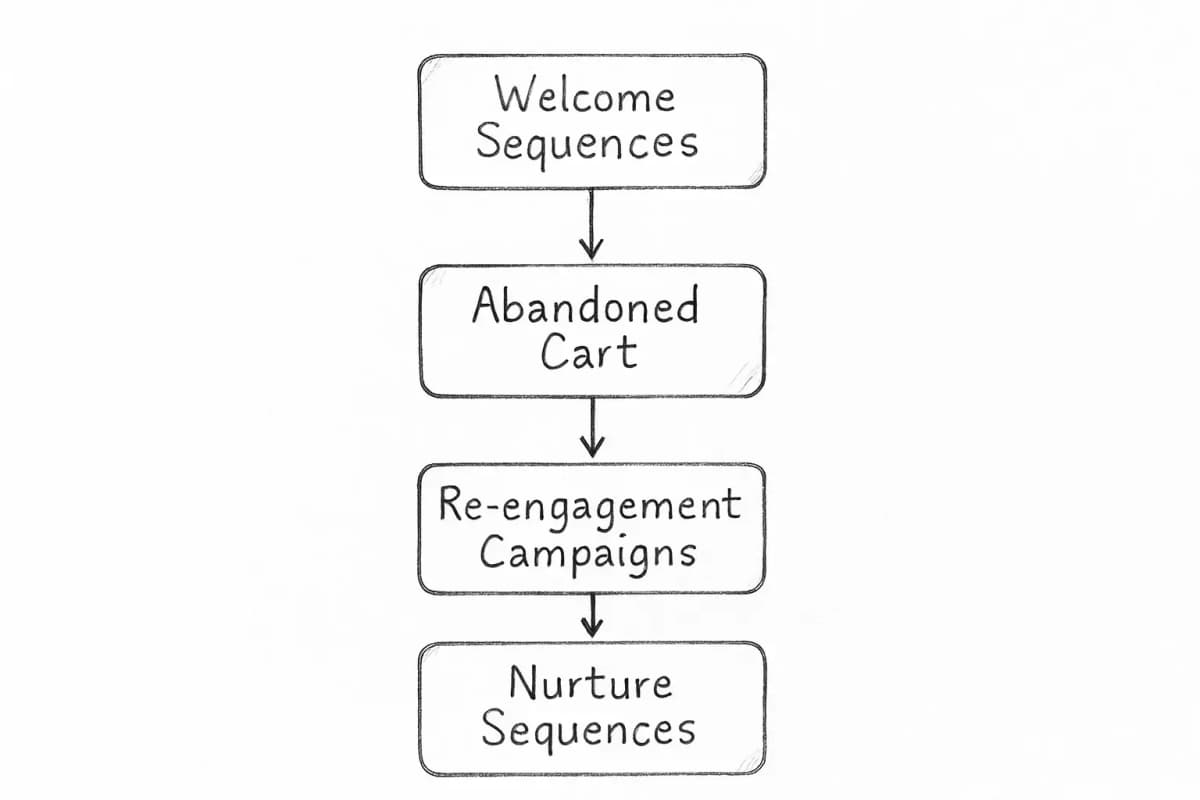
What Ties All Successful Email Marketing Campaign Examples Together
Looking across all these examples, the pattern is clear. Successful email marketing is not about one viral campaign. It is about systematically engaging the right customer, with the right message, at the right moment.
The brands that consistently achieve strong results do four things differently:
- They treat segmentation as a foundation, not an afterthought.
- They build automation flows that respond to behavior, not just the calendar.
- They personalize beyond the first-name token.
- They measure revenue impact, not just open rates.
87% of marketing leaders say email marketing is critical to the success of their company. The campaigns above show why, and they show exactly what that looks like in practice.
If you are still building the foundational infrastructure behind your campaigns, the Email Marketing Strategy Template for 2025 is a practical starting point to structure your approach before scaling.
Frequently Asked Questions
What makes an email marketing campaign successful?
Successful campaigns use data to create relevant experiences tailored to purchase history and browsing behavior, leverage automation to respond to customer actions in real time, and connect to broader business goals by tracking revenue impact rather than just open rates. Relevance and timing consistently matter more than volume.
What type of email campaign has the highest ROI?
Abandoned cart flows drive the highest average revenue per recipient ($3.65) and the highest average conversion rate (3.33%) of all automated email flows. Welcome sequences rank second. Both are automated, behavior-triggered, and require minimal ongoing effort once set up correctly.
How many emails should an abandoned cart sequence include?
Klaviyo's analysis shows three-email sequences produced $24.9 million compared to just $3.8 million from single emails, a 6.5x revenue difference. Most brands send the first email within one hour of abandonment, the second at 24 hours, and the third at 48 to 72 hours, optionally including an incentive in the third email.
How does personalization affect email campaign performance?
Marketers report a 760% increase in email revenue from emails with personalized subject lines. According to 65% of marketers, segmented emails perform better in terms of open rates, and emails with a personalized subject line are 22.2% more likely to be opened. Personalization that goes beyond the first name, using purchase history, browsing behavior, and location, compounds these results further.