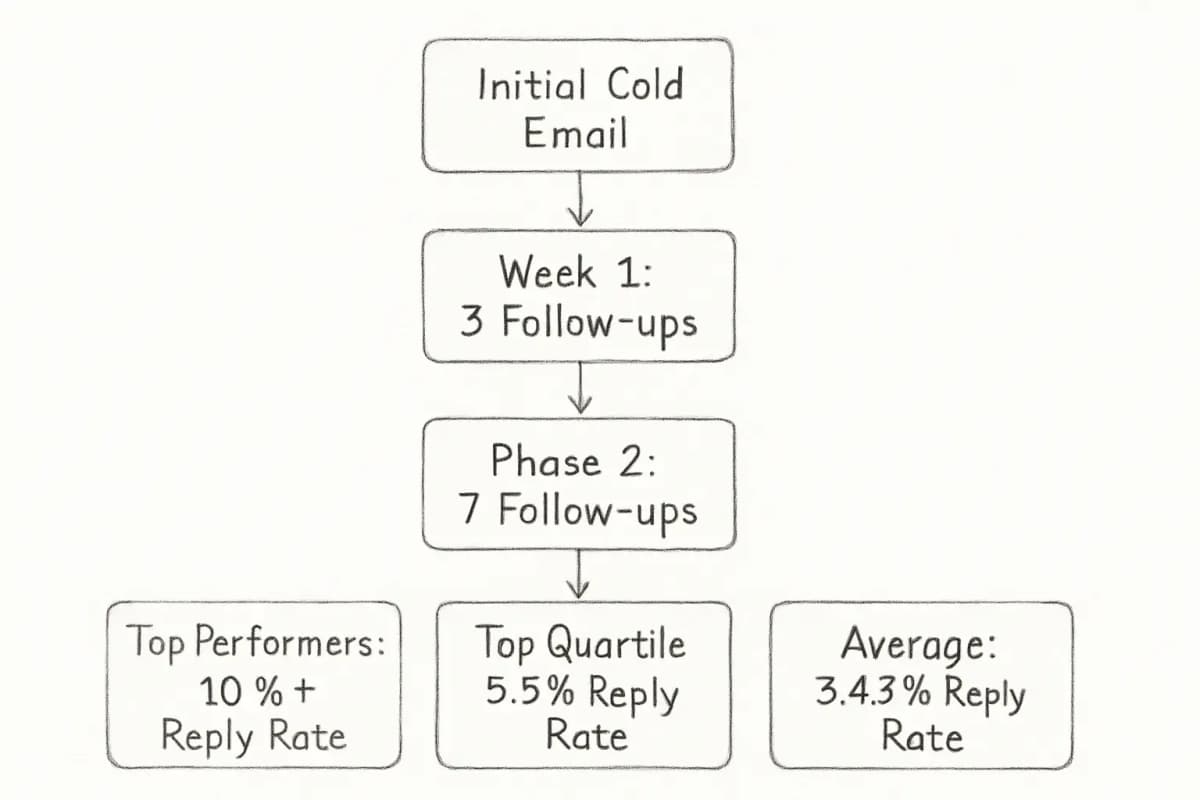
Cold email still works in 2025, but the gap between campaigns that generate pipeline and those that vanish into spam has never been wider. Average cold email response rates have declined to around 3.43%, driven by inbox saturation, sophisticated spam filters, and low-effort AI-generated outreach flooding inboxes. The good news: top-performing campaigns still exceed a 10% reply rate, while top-quartile senders achieve 5.5%. The difference is not volume. It is discipline, precision, and technical infrastructure.
This guide covers the 2025 best practices cold email marketing teams actually need to compete in a tighter inbox environment.
Key Takeaways
- Sending from a custom domain delivers a 108% higher reply rate than freemail (5.2% vs. 2.5%), and sequences with 21 to 50 recipients outperform sequences with 500+ recipients by 158%.
- The best-performing cold email campaigns have a word count of fewer than 80 words; it is enough to make your point without wasting the reader's time, with the key being concise, personalized, and single-ask messaging.
- Personalized email content increases average cold email response rates by 32.7%, and personalized subject lines increase open rates by 50%.
- The "3-7-7" cadence (follow-ups on Day 3, Day 10, and Day 17) captures approximately 93% of total replies by Day 17, and follow-ups account for 42% of all replies in cold email campaigns.
- Under the CAN-SPAM Act, penalties can reach up to $50,120 per offending email, while GDPR-related fines have totaled around €5.88 billion across 2,245 enforcement actions as of early 2025.
1. Build a Technical Foundation First
Every other best practice depends on whether your email lands in the inbox. If it does not, nothing else matters.
SPF, DKIM, and DMARC authentication must be in place, spam complaint rates must stay below 0.1%, and one-click unsubscribe must be supported. Gmail tightened enforcement again in November 2025, meaning non-compliant senders now face temporary or permanent rejection across the three largest inbox providers simultaneously.
Use a separate sending domain rather than your primary business domain. If something goes wrong, you do not want to tank the reputation of the domain your team uses daily. Set up a subdomain (like outreach.yourcompany.com) and properly authenticate it with SPF, DKIM, and DMARC records.
Domain warming is equally non-negotiable for new infrastructure. Start at 5 to 10 emails per day in weeks one and two, scale to 15 to 20 in weeks three and four, and cap at 50 emails per day per inbox at maximum capacity.
Emails with correct SPF and DKIM records reach inboxes 40% more often. That alone is reason to prioritize setup before copy.
One more technical note: tracking pixels are increasingly flagged by spam filters and affect deliverability. Most open tracking relies on invisible images embedded in emails, and today's spam filters are highly sensitive to this technique. Open rates are no longer a reliable or safe metric for cold outreach. Track replies and positive engagement instead.
2. Prioritize Smaller, Tighter Lists Over Volume
The instinct to scale list size is the most common mistake in cold email. The data tells a different story.
The best sequences targeted between 21 and 50 recipients, achieving a 6.2% reply rate. Contrast this to 2.4% for sequences with over 500 recipients, and you understand that relevance is harder to maintain at scale.
Only 2 to 3% of your potential buyers are actively in-market at any given time, making consistent but targeted outreach necessary to catch them when they are ready.
List hygiene is part of this equation. Verify your email list before each campaign. Double-verification reduces bounce rates and protects your sender reputation. Invalid addresses damage deliverability more than low engagement.
Keep your bounce rate under control. If your bounce rate exceeds 3% or complaints exceed 0.1%, pause and fix: remove the bad segment, re-verify, and cool down sending for 48 to 72 hours.
For a deep dive into segmenting contacts for maximum relevance, see our guide on email list segmentation strategies that boost ROI.
3. Personalize Beyond the First Name
Personalization is not a nice-to-have. It is the primary driver of reply rates in 2025.
Generic cold emails see around 9% response rates, whereas those with advanced personalization (tailored to the recipient's context) see about 18%, double the generic rate. Another study found highly personalized campaigns using multiple custom fields boosted replies by 142% compared to non-personalized blasts.
The bar for "personalization" has risen. Adding a first name no longer qualifies. The trick is finding ways to personalize meaningfully without spending hours on each email, going beyond just the first name and actually referencing something specific about the prospect's company, role, or recent activity.
Hook type matters just as much as depth of personalization. Timeline-based hooks significantly outperform traditional problem-statement approaches, achieving 10.01% reply rates compared to 4.39% for problem-based hooks, a 2.3x performance gap. A timeline hook frames your value around a compressed, specific achievement window rather than a generic pain statement.
Research shows that 71% of decision-makers cite lack of relevancy as their biggest problem with cold emails. Impersonality (43%) and lack of trust (36%) followed. Solve for relevancy first, then trust.
For more on applying personalization at scale, our article on email personalization techniques that boost conversions covers practical frameworks.
4. Write Shorter, Clearer Emails
Long cold emails are a conversion killer. The evidence is consistent across multiple datasets.
Research found the best-performing cold email campaigns have a word count of fewer than 80 words. It is enough to get your point across without wasting the reader's time. The key is to be concise, personalized, and focused on a single message or ask.
Emails of 50 to 125 words achieve the highest reply rates in 2025 to 2026 data, around 50% higher than longer formats.
Structure each email around a single call to action. Write shorter emails with personalized opening lines and clear CTAs to respect your prospect's time. Keep first-touch emails under 80 words with a single, focused ask such as "Worth a quick chat next week?" Remove filler phrases, redundant information, and unnecessary context that dilutes your message.
Avoid attachments in cold email entirely. Attachments are high-risk and unnecessary in cold emails. They can trigger filters or appear suspicious, and they slow down delivery and discourage opens.
5. Master Your Subject Lines
Subject lines matter more than we want to admit. 72% of people skim them in under 3 seconds.
The subject line determines whether your email gets opened. Several specific patterns consistently outperform in 2025.
A question in the subject line lifts open rates by approximately 21%, and subject lines of 36 to 50 characters achieve the best response rates.
Personalization in subject lines compounds open rate gains significantly. Personalized subject lines increase average cold email open rates by 50%.
Overused subject line patterns may underperform, likely due to recipient fatigue and spam filtering heuristics. Making your subject line look relevant is critical to getting your emails opened.
Rotate subject lines across your sequences. If you send the exact same subject line every time, filters may flag it. Use variables or slight tweaks to keep subject lines from being identical across all your emails.
For more depth on this topic, our guide on email subject line best practices that boost open rates covers what moves the needle.
6. Use a Disciplined Follow-Up Cadence
Most cold email replies do not come from the first message. The first email captures 58% of replies, with the remaining 42% coming from follow-ups. Stopping after one send means leaving nearly half your potential responses on the table.
The "3-7-7" cadence (follow-ups on Day 3, Day 10, and Day 17) captures approximately 93% of total replies by Day 17. A simple 2-email sequence already achieves a 6.9% response rate.
Each follow-up must add new value. A cold email sequence is not a persistent "did you read my last email?" nag. Each message should stand on its own merit and offer something useful, whether that is an insight, a relevant article, a case study, or a provocative question.
Know when to stop. A fourth follow-up correlates with a 1.6% spam rate and a 2% unsubscribe rate, which will damage your sender reputation over time. If there is no response after three touches, shift to LinkedIn or another channel rather than continuing email contact.
To mimic human behavior, your gaps between emails should increase with every step: wait 2 to 3 days between steps one and two (high urgency), 4 to 5 days between steps two and three (giving space), and 7 or more days for long-term nurturing after that.
7. Stay Compliant with CAN-SPAM and GDPR
Compliance is not optional in 2025. The enforcement environment has tightened, and AI-powered outreach has drawn additional regulatory scrutiny.
The FTC adjusts CAN-SPAM penalties annually for inflation. As of 2025, the maximum penalty is $51,744 per email. This applies to each individual message, not per campaign.
GDPR sets the gold standard for privacy. If you are contacting anyone in the EU or EEA, you must either get explicit, documented consent (such as a double opt-in) or prove a legitimate interest with a clear benefit to the recipient.
Regulators are now scrutinizing AI-enriched data, including how platforms enrich emails with job titles, intent signals, or LinkedIn information. If it is not public and you did not get consent, it could be non-compliant. Always have a clear legal basis and ensure AI tools used for personalization are not pulling private data.
Permission-based email campaigns outperform non-compliant ones, with 38% higher open rates and 68% higher click-through rates. Compliance does not just protect you legally; it also boosts your results.
Practical compliance checklist:
- Include a valid physical mailing address in every email
- Provide a one-click unsubscribe mechanism and honor it within 10 business days
- Never use misleading subject lines
- Document how you obtained each contact's email address
- Remove hard bounces and opt-outs immediately and maintain a suppression list
8. Measure What Actually Matters
Open rates have become increasingly unreliable as a primary metric. Open rate tracking has been inflated since 2022 by Apple's Mail Privacy Protection, which pre-loads tracking pixels for Apple Mail users. Reply rate is the more reliable engagement benchmark for cold outreach.
Focus your measurement on:
- Reply rate (the primary indicator of genuine engagement)
- Positive reply rate (replies showing actual interest, not just out-of-office messages)
- Bounce rate (keep this below 3%)
- Spam complaint rate (keep this below 0.1%)
- Meeting booking rate (the downstream conversion that drives revenue)
Teams that keep domain health stable and send consistently see 15 to 20% higher replies. Consistency in technical hygiene is as important as consistency in outreach.
If you want a complete framework for tracking campaign performance beyond just cold outreach, our email marketing analytics best practices guide covers the full measurement stack.
Frequently Asked Questions
What is a good cold email reply rate in 2025?
Top-performing cold email campaigns exceed a 10% reply rate, top-quartile senders achieve 5.5% reply rates, and the average reply rate across all senders is 3.43%. If your reply rate sits above 5%, you are ahead of most senders. Anything above 10% indicates strong targeting, strong copy, and solid deliverability working together.
How many follow-up emails should I send in a cold email sequence?
The "3-7-7" cadence, with follow-ups on Day 3, Day 10, and Day 17, is now considered the most effective standard sequence. Keep your first email under 80 words, per Instantly's 2026 Benchmark Report, which found short emails significantly outperform longer formats. A fourth follow-up typically harms deliverability more than it helps reply rates.
Do I need SPF, DKIM, and DMARC set up before sending cold emails?
Yes, without exception. SPF, DKIM, and DMARC are no longer optional. Since February 2024, Google and Yahoo have required all bulk senders to have these in place, and Microsoft followed in May 2025. Skipping this step means a meaningful percentage of your sends never reach the inbox, regardless of how good your copy is.
Is cold email legal under GDPR?
Cold email is legal in the US under CAN-SPAM, in the EU under GDPR with legitimate interest as the legal basis, and in Canada under CASL with the appropriate consent framework. In practice, B2B cold email to EU contacts is permissible when you can document legitimate interest and provide a clear, easy opt-out. B2C cold email to EU consumers almost always requires explicit prior consent. When in doubt, consult a legal professional familiar with the regulations in each target market.
How do I improve cold email deliverability quickly?
Start with three immediate fixes: companies that followed cold email deliverability best practices raised their inbox rate from 65% to 92% in about a month. The jump came after they fixed authentication, lowered daily sending, and removed old contacts from their lists. Authenticate your domain, clean your list before sending, and warm up any new sending infrastructure before scaling volume.