Cold email is still one of the highest-return outreach channels available to B2B teams, but the execution bar has never been higher. Email delivers up to $42 for every $1 spent when highly targeted, yet average response rates have declined sharply over the past seven years, from 8.5% in 2019 to around 3.43% in 2026, driven by inbox saturation, sophisticated spam filters, and low-effort AI-generated outreach.
The difference between campaigns that generate pipeline and campaigns that get ignored comes down to a small number of decisions: technical infrastructure, list quality, personalization depth, and message structure. This guide covers the 2025 best practices for cold email marketing that actually separate top-performing senders from the rest, backed by data from large-scale benchmark studies.
Key Takeaways
- Authentication is non-negotiable. SPF, DKIM, and DMARC are now required by Gmail, Yahoo, and Microsoft. Missing them means rejection, not just filtering.
- Reply rate, not open rate, is your primary metric. Open rate tracking is increasingly unreliable due to Apple Mail Privacy Protection (MPP).
- Advanced personalization doubles response rates. Campaigns with deep, contextual personalization see reply rates up to 18%, versus roughly 9% for generic outreach.
- Shorter emails consistently outperform longer ones. Top senders keep first-touch emails under 80 to 125 words with a single call-to-action (CTA).
- Follow-ups capture 42% of all replies. A structured sequence of 3 to 5 emails spaced 3 to 7 days apart is essential to maximizing campaign results.
1. Get Your Technical Foundation Right First
Before you write a single word of copy, your sending infrastructure needs to be solid. If your emails don't reach people, nothing else matters.
All three major inbox providers, Google, Yahoo, and Microsoft, now require SPF, DKIM, and DMARC authentication, spam complaint rates below 0.3%, and easy unsubscribe mechanisms for domains sending 5,000 or more emails per day. Fail any of these and your emails get rejected at the SMTP level, not filtered to spam, but bounced entirely.
The enforcement timeline matters. Google started enforcing guidelines for bulk senders from February 2024. From November 2025, Gmail tightened enforcement with non-compliant emails now facing temporary or even permanent rejections. Microsoft followed in May 2025.
Properly configuring SPF, DKIM, and DMARC records reduces spam flags by 50%. Emails with correct SPF and DKIM records reach inboxes 40% more often.
Your spam complaint rate also requires close attention. Keep spam rates reported in Google Postmaster Tools below 0.10% and avoid ever reaching a spam rate of 0.30% or higher. The 0.3% threshold is when enforcement begins, not a safe target.
Technical checklist before any campaign:
- Verify SPF, DKIM, and DMARC records are configured and passing
- Set up one-click unsubscribe and honor opt-outs within 48 hours
- Monitor your spam complaint rate weekly via Google Postmaster Tools
- Use a custom branded domain, never a free Gmail or Yahoo address for outbound
Using your own branded domain for cold outreach improves deliverability by 40%.
2. Warm Your Domain Before Scaling Volume
Domain warming is critical for new sending infrastructure. Jumping straight to high volume is the fastest way to destroy a domain's reputation before your campaign even starts.
Start slowly and gradually increase volume: send 5 to 10 emails per day in weeks one and two (a mix of warming and cold emails), increase to 15 to 20 per day in weeks three and four, scale to 30 to 40 per day in weeks five and six, and reach a maximum of 50 emails per day per inbox from week seven onward.
Companies that followed cold email deliverability best practices raised their inbox rate from 65% to 92% in about a month. The jump came after they fixed authentication, lowered daily sending, and removed old contacts from their lists.
Increase volume by 20 to 30% weekly once your domain is established and your engagement signals look healthy. If bounce rates or complaint rates spike, pull back rather than pushing through.
3. Build and Verify a Targeted List
List quality drives deliverability more than most senders realize. Bad leads mean bounced emails and reputation drops. If more than 2% of your emails bounce, you are already on thin ice.
Regularly verify your email list before each campaign. Double-verification reduces bounce rates and protects your sender reputation. Invalid addresses damage deliverability more than low engagement.
Beyond list hygiene, targeting precision directly shapes reply rates. Sequences with 21 to 50 recipients outperform by 158% compared to sequences with 500 or more recipients (6.2% versus 2.4% reply rate). This doesn't mean you can't scale beyond 50 recipients. It means you need to segment your audience and put in the effort to have a personalized offer for each subsegment.
Segmentation into smaller cohorts of 50 recipients achieves a 5.8% reply rate versus 2.1% for blasts of 1,000 or more contacts, a 2.76x lift, because targeted messaging addresses specific pain points, buyer journeys, and industry dynamics.
For practical tools to build and segment your prospecting lists, see our guide to email list segmentation strategies that boost ROI.
4. Personalize Beyond the First Name
Generic outreach is the single biggest reason cold email fails in 2025. Campaigns with advanced personalization, beyond first name, saw reply rates up to 18%, double the average of generic templates, yet only 5% of senders personalize every message.
HubSpot research shows personalized emails deliver 6x higher transaction rates compared to generic campaigns, and personalized subject lines alone lift open rates by 26%.
True personalization goes well past merge tags. Deep contextual personalization means referencing something specific: a recent post, a company announcement, a hiring trend, or a business challenge unique to their situation. Spend 3 to 5 minutes per prospect pulling signals from their LinkedIn activity, company news, funding rounds, or job postings before writing the opening line.
Hunter.io's analysis of 11 million emails confirms that personalization depth (not just merge tags) drives 52% higher reply rates and that smaller, highly targeted campaigns outperform broad blasts by 2.76x.
Research from The Digital Bloom found that the type of hook you lead with matters as much as personalization depth. Timeline-based hooks, structured around compressed achievement windows and specific metric progression, achieve 10.01% reply rates compared to 4.39% for problem-based hooks, a 2.3x performance gap.
For a deeper look at personalization applied across the full email program, see 7 email personalization techniques that boost conversions 47%.
5. Write Emails That Respect the Reader's Time
Research found the best-performing cold email campaigns have a word count of fewer than 80 words, indicating this is the sweet spot for performance. It's enough to get your point across without wasting the reader's time. The key is to be concise, personalized, and focused on a single message and ask.
Emails with 6 to 8 sentences get the best results, producing a 42.67% open rate and a 6.9% reply rate. Messages under 200 words perform better than anything longer.
Structure your first email around one clear idea and one low-friction CTA. Multiple CTAs dilute focus. Top performers use binary questions or simple requests that require minimal cognitive load: "Does this make sense?" or "Worth a quick call?"
Subject lines require equal attention. Campaigns without open tracking see a 68% higher reply rate (7.4% versus 4.4%), partly because disabling open-tracking pixels removes a signal that spam filters can act on. For subject line tactics that improve opens without inflating vanity metrics, see email subject line best practices that boost open rates by 27%. 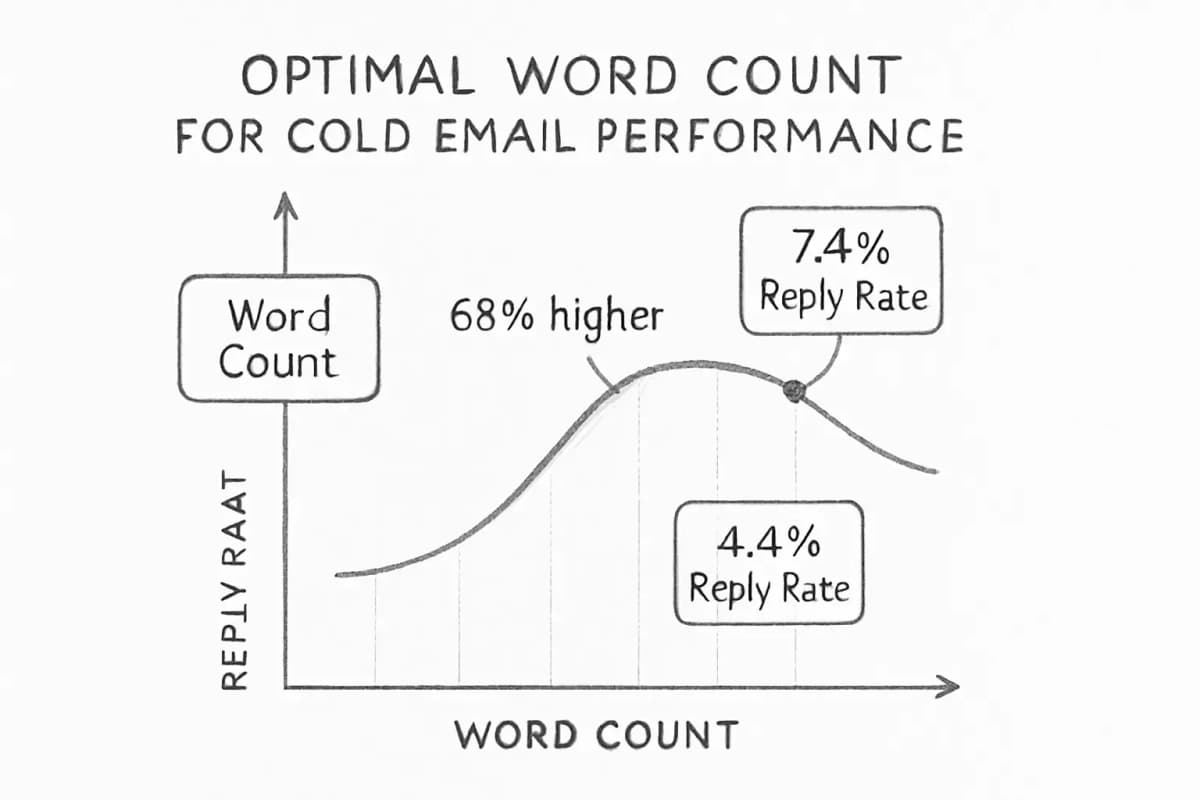
6. Build a Follow-Up Sequence That Adds Value
Most cold email programs underinvest in follow-ups. In large benchmark datasets, the first email captures 58% of the replies, with the remaining 42% captured by follow-ups. That means nearly half your potential replies walk out the door if you stop after one send.
The optimal cold email sequence is: Day 1 (initial email), Day 4 (first follow-up), Day 8 (second follow-up), Day 15 (final break-up email). This cadence consistently outperforms compressed timelines.
Build a 5 to 7 step sequence where each touch adds something new: a case study, a different pain point, social proof, or a relevant resource. Space follow-ups 3 to 7 days apart and avoid "just checking in" messages that add no value.
Break-up emails, a final message acknowledging you will not follow up again, generate a 33% response rate due to the fear of missing out (FOMO).
One timing note worth tracking: Tuesday through Thursday, 8 to 11 AM or 2 to 4 PM in the recipient's local timezone, consistently delivers the strongest engagement across 2025 to 2026 platform data.
7. Track the Right Metrics
Reply rate has displaced open rate as the primary KPI, thanks to Apple MPP. Open rate tracking relies on pixel fires, which are increasingly blocked by email clients, especially Apple Mail's Mail Privacy Protection. Reported open rates can be inflated by 10 to 20% in some tools.
Focus your measurement on metrics that reflect genuine engagement:
- Reply rate: Platform-wide average is 3.43%. Anything above 5% is solid; above 10% is excellent.
- Positive reply rate: Filter out "unsubscribe me" responses to see true interest.
- Bounce rate: Keep hard bounces below 2%. Fix deliverability first with SPF/DKIM/DMARC authentication, spam complaints under 0.3%, and bounces under 2%.
- Meeting booked rate: The revenue-relevant end point. A 3 to 5% positive reply rate on a list of 1,000 targeted prospects generates 30 to 50 conversations, enough to book 8 to 12 qualified meetings per month with proper follow-up sequencing.
A 50% open rate with a 0.5% reply rate means your subject lines are good, but your message or call-to-action needs work. Tracking these metrics lets you diagnose issues at the right layer of the funnel.
For a complete framework on measuring your program, see email marketing analytics best practices.
8. Use AI as a Research Tool, Not a Writing Shortcut
Sales reps using AI writing assistants for cold email spend 55% less time on email composition while maintaining or improving quality. 73% of B2B sales teams plan to increase their use of AI tools for personalization and email optimization in 2025.
The risk is using AI to generate outreach without human editing. The successful 5% of cold emails feel personal, crafted, and conversation-like, whereas the failing 95% often have the hallmarks of automation. In 2025, humanizing your emails is more important than ever to avoid being ignored.
Feed the model specific inputs such as recent funding, hiring signals, product launches, and role-level pain points, then edit every output for natural voice. AI handles research and scaffolding well. The human layer of context and editing pushes reply rates from average to above 4.4% and beyond.
AI works best in cold email as a research accelerator and draft scaffolding tool, not as a copy-paste content engine. The personalization signals it surfaces (funding rounds, LinkedIn activity, new hires) are where it adds real value. The editing and voice judgment remain human responsibilities.
Frequently Asked Questions
What is a good cold email reply rate in 2025?
The overall average cold email response rate is 3.43%. Good benchmarks start above 5%, and below 1% signals major issues. Top campaigns achieve 8 to 15% with strong targeting and personalization. If you are in B2B outbound, treat anything above 5% as solid performance and above 10% as excellent.
How many follow-up emails should I send in a cold sequence?
Campaigns with only one email achieve a 3.0% reply rate, while two-email sequences reach 4.8% (+60%), and three-email sequences plateau at 5.8%. Beyond three follow-ups, reply rates decline as spam complaints and unsubscribes increase. A three to five step sequence spaced 3 to 7 days apart is the practical sweet spot for most B2B cold outreach.
Do I need SPF, DKIM, and DMARC set up for cold email?
Yes, and this is no longer optional. Google and Yahoo announced their authentication requirements together in October 2023, with enforcement starting February 2024. Microsoft followed 16 months later, enforcing from May 2025. Without proper authentication, your emails face delivery rejection, not just spam folder placement.
How long should a cold email be?
50 to 125 words achieves the highest reply rates in 2025 to 2026 data, around 50% higher than longer formats. Lead with one relevant insight about the prospect, connect it to a specific outcome you can deliver, and close with a single low-effort question. Every sentence should earn its place.