
Most marketing agencies treat cold email as a volume play. They blast generic pitches to hundreds of prospects and wonder why the replies never come. The reality is that effective cold email templates for marketing agencies rely on precision, not scale, and the gap between average and top-performing campaigns is enormous.
According to Instantly's Cold Email Benchmark Report 2026, which analyzed billions of cold email interactions, elite campaigns exceed a 10% reply rate, top-quartile senders achieve 5.5%, and the platform-wide average sits at just 3.43%. If your agency is sending cold emails without a structured, research-backed approach, you are almost certainly leaving pipeline on the table.
This guide gives you the frameworks, templates, and technical foundations to build cold email outreach that actually books meetings.
Key Takeaways
- Average cold email response rates have declined from 8.5% in 2019 to around 3.43% entering 2026, driven by inbox saturation, sophisticated spam filters, and low-effort AI-generated outreach.
- Personalization can increase response rates by up to 142%, making it the single highest-leverage variable in any cold email campaign.
- The best-performing cold email campaigns keep word count under 80 words, which is enough to communicate value without wasting the reader's time.
- Timeline-based hooks achieve a 10.01% reply rate and a 2.34% meeting booking rate, outperforming problem-based hooks by 2.3x and 3.4x respectively.
- SPF, DKIM, and DMARC authentication are no longer optional. Since February 2024, Google and Yahoo have required all bulk senders to have these in place, with Microsoft following in May 2025.
Why Most Agency Cold Emails Fail
Research shows that 71% of decision-makers cite lack of relevancy as their biggest problem with cold emails. Impersonality (43%) and lack of trust (36%) follow closely behind.
For marketing agencies specifically, the challenge is compounded by the fact that every prospect has already received dozens of nearly identical pitches. If you're a marketing agency doing cold outreach, your prospects are already flooded with messages from "award-winning" firms. To stand out, you need to be sharper, faster, and more relevant than the competition.
The core failure modes are predictable:
- Pitching services before establishing why the prospect should care
- Using generic value propositions such as "we drive results" without proof
- Sending the same email to vastly different prospect types
- Skipping follow-ups after the first no-reply
- Ignoring deliverability fundamentals
Fix these five problems and your reply rate will improve before you change a single word of your template copy.
The 4-Part Framework Every Agency Template Needs
Every cold email template for marketing agencies, regardless of the service being offered, should follow the same structural logic: hook, relevance, value, and ask. Here is what each part does.
Hook: The opening line that proves you did your homework. This is not a compliment. It is a specific observation about the prospect's business, a recent trigger event, or a measurable outcome they are chasing.
Relevance: A single sentence connecting your agency's work to their situation. Not a list of services. One clear link between their problem and your capability.
Value: One concrete proof point. A case study result, a specific number, or a named client outcome. Offer case studies, insights, and relevant resources to establish credibility and build interest upfront.
Ask: A low-friction call to action. Avoid a direct request for a meeting in the first message. Instead, include links to valuable content, such as a smart link to a resource hub, building the case for a follow-up discussion.
This structure keeps your email focused and prevents the most common mistake: pitching before earning the right to pitch.
5 Cold Email Templates Marketing Agencies Can Use Right Now
These templates are frameworks, not copy-paste scripts. Replace the bracketed fields with real, researched details for each prospect. No sales rep should expect to simply paste a template into a blank email, swap in their prospect's name, hit send, and expect results. Buyers can tell when they're being hit with a template rather than a genuine, personalized email.
Template 1: The Trigger Event Template
Best for: Prospects who just raised funding, launched a product, or made a new hire.
Subject: [Company name] + growth stage timing
Hi [First name],
Noticed [Company name] just [specific trigger: raised a Series A / launched [product] / hired a new VP of Marketing]. That usually means [relevant challenge: building pipeline fast / scaling content / standing up paid channels].
We helped [similar company in same stage] generate [specific result, e.g., 40% more qualified leads] within 90 days of a similar inflection point.
Worth a 15-minute call to see if we can do the same for you?
[Your name]
Buying signals are observable events that indicate a prospect is actively considering a purchase, such as new hires, funding rounds, leadership changes, product launches, or visits to your pricing page. Timing your outreach to these signals is one of the highest-leverage moves available to any agency.
Template 2: The Audit Hook Template
Best for: Prospects whose online presence has clear, visible gaps you can diagnose before hitting send.
Subject: Quick note on [Company name]'s [channel]
Hi [First name],
Spent a few minutes looking at [Company name]'s [specific channel: paid search / organic content / email program]. A few things stood out: [one specific, honest observation, e.g., "Your top landing pages aren't capturing email from blog traffic"].
We fix this for [industry] companies regularly. Most see [specific improvement] within [timeframe].
Happy to share the full breakdown if it's useful. Would that be worth 20 minutes?
[Your name]
This template works because it provides a sample of the agency's thinking before asking for anything.
Template 3: The Social Proof Template
Best for: Outreach to decision-makers who are skeptical of agencies and need proof before they engage.
Subject: How [peer company] cut their [metric] by [X]%
Hi [First name],
[Peer company, ideally one your prospect will recognize] had the same challenge you're facing: [specific problem, e.g., high CPAs on paid social with limited creative resources].
We [specific thing you did], and they went from [before metric] to [after metric] in [timeframe].
If [Company name] is running into the same wall, I'd love to show you the approach. Worth a quick call?
[Your name]
Including social proof in cold emails can boost open rates by 15% and drive up to 80% more conversions.
Template 4: The Competitor Gap Template
Best for: Prospects in competitive markets where comparison is a natural motivator.
Subject: [Competitor name] vs [Company name] on [channel]
Hi [First name],
Ran a quick comparison between [Company name] and [top competitor] on [specific channel: organic search / email / LinkedIn ads]. [Competitor] is currently [specific advantage: outranking you on 12 high-intent keywords / sending 3x more nurture sequences].
We've helped [similar company] close that gap within [timeframe] using [brief approach description].
Open to a 15-minute call to walk through what we're seeing?
[Your name]
This template requires real research and only works when the gap you identify is specific and verifiable.
Template 5: The Direct Value Drop Template
Best for: Short, punchy outreach to time-constrained executives.
Subject: [Specific number] for [Company name]
Hi [First name],
We helped [similar company] achieve [specific metric] in [timeframe] by [one sentence on how].
Would a similar result be useful for [Company name] right now?
[Your name]
Research from Instantly found that the best performing cold email campaigns have a word count of fewer than 80 words. It is enough to get your point across without wasting the reader's time. The key is to be concise, personalized, and focused on a single message and ask.
Subject Lines That Actually Get Opened
Your subject line determines whether the rest of the email is ever read. The data on what works is consistent across large studies.
Subject lines of 36 to 50 characters achieve the best response rates, and using the company name in the subject line can boost opens by approximately 22%. Numbers in subject lines increase open rates by 113% on average, and a question in the subject line lifts open rates by roughly 21%.
Subject lines that look like they came from a colleague rather than a marketer increase open rates by 47%. Examples include "quick question," "re: [company name]," or just the prospect's first name.
What to avoid is just as clear. Avoid spammy words like "free," "act now," or "guaranteed," as these can send your email straight to the junk folder.
For a deeper breakdown of subject line mechanics, see our guide on email subject line best practices that boost open rates by 27%.
Follow-Up Sequences: When to Send and What to Say
Most agencies abandon outreach too early. 70% of sales reps give up after their first email goes unanswered, even though successful contact typically requires multiple follow-ups.
Instantly's benchmark data shows that 58% of replies arrive on step one, but the remaining steps contribute another 42% of replies, proving follow-up persistence improves campaign results. The sweet spot for sequence length is 4 to 7 touchpoints, as under four gives up too early and beyond seven diminishes returns unless each touch adds genuine new value.
For timing and cadence:
The 3-7-7 follow-up cadence (sending messages on Day 0, Day 3, Day 10, and Day 17) captures 93% of total replies by Day 10, after which additional follow-ups typically yield marginal or negative returns.
Each follow-up should add something new: a different angle, a new data point, a case study, or a relevant industry observation. Each follow-up should add new value, not just bump the email to the top of the inbox. 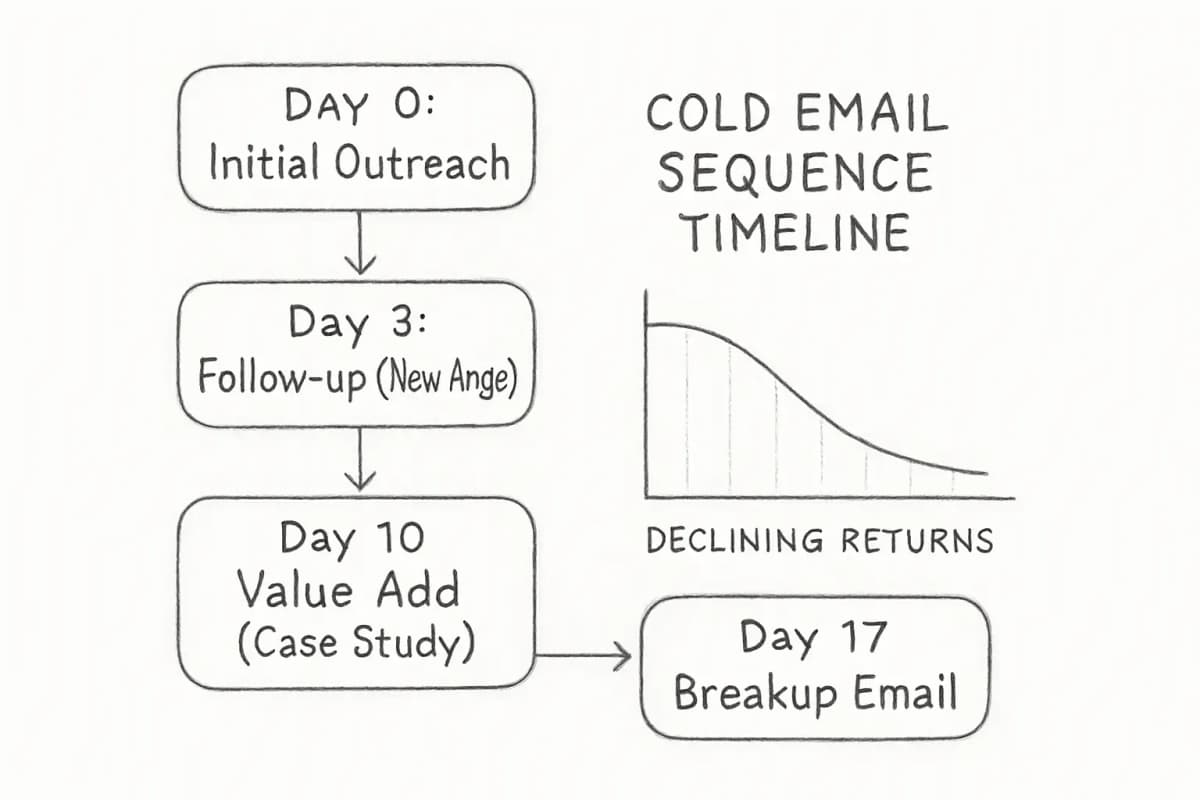
Personalization at Scale Without the Manual Grind
Personalization is not optional in 2025. Campaigns with advanced personalization beyond just a first name saw reply rates up to 18%, double the average of generic templates, yet only 5% of senders personalize every message.
The good news is that personalization does not have to mean writing every email from scratch. The practical approach is to segment your prospect list by a shared characteristic and write a modular opening line that references that segment's common situation.
Smart segmentation and building modular message templates are your best tools here. Start by segmenting your audience by job role, industry, or company size. Then build a flexible framework: an opening line that shows relevance, a clear value proposition, and a CTA that fits the individual's world.
For account-level personalization, one client increased response rates from 2% to 11% just by narrowing their ideal customer profile from "all SaaS companies" to "Series B SaaS companies using Salesforce with 50 to 200 employees."
Pairing tight ICP definition with specific opening lines is where most agencies will find the biggest reply rate gains. If you want to push this further with behavioral and contextual signals, our article on email personalization techniques that boost conversions 47% covers the full framework.
Deliverability: The Foundation Everything Else Depends On
No amount of great copy matters if your emails land in spam. With over 160 billion spam emails sent daily, filters now divert nearly 1 in 5 emails straight to spam folders.
About 17% of cold outreach emails never reach any inbox at all, vanishing due to bounces, spam filtering, or authentication failures.
The non-negotiable technical setup for any agency running cold outreach:
- SPF, DKIM, and DMARC on every sending domain
- A dedicated cold email sending domain, separate from your primary brand domain
- Bounce rate kept below 2% through verified contact data
- Spam complaint rate kept below 0.1%
- A gradual warm-up for new email accounts: do not go from zero to high volume overnight. Gradually increase sending volume and use email warming tools to build a positive reputation. Consistency matters; sporadic big blasts raise red flags.
For agency prospecting volume, send 30 to 50 cold emails per inbox daily to stay within safe deliverability limits. If you want to scale, set up multiple inboxes using tools like Smartlead or Instantly and gradually warm up each inbox to avoid triggering spam filters.
Understanding how your analytics connect to deliverability outcomes is critical. Our guide to email marketing analytics best practices covers the metrics that actually predict inbox placement.
Segmenting Your Outreach for Higher Relevance
Sending the same cold email template to a 5-person founder-led startup and a 500-person enterprise is one of the fastest ways to tank your reply rate. Different company stages have different pain points, different buying processes, and different risk tolerances.
Segment your outreach by at minimum:
- Company size (headcount and revenue stage)
- Industry vertical (the problem you solve looks different in SaaS vs. retail vs. professional services)
- Role and seniority (a CMO cares about different things than a marketing coordinator)
- Trigger event (fundraise, new hire, product launch, recent content they published)
Research from Hunter.io's analysis of 11 million emails confirms that personalization depth (not just merge tags) drives 52% higher reply rates, and smaller, highly-targeted campaigns outperform broad blasts by 2.76x.
For agencies working across multiple client verticals, tight segmentation also improves the quality of the conversations you book. You will get fewer generic exploratory calls and more conversations with prospects who already understand why they are talking to you.
See our framework on email list segmentation strategies that boost ROI by 760% for a systematic approach to building segmented outreach lists.
Frequently Asked Questions
How long should a cold email be for a marketing agency?
Around 50 to 125 words correlates with higher response rates in large datasets, according to Boomerang's analysis. Keep your email to the shortest length that communicates your relevance, one proof point, and one clear ask. If your email requires scrolling on mobile, it is too long.
What is a realistic cold email reply rate for an agency?
According to Instantly's 2026 benchmark data, the average reply rate is 3.43%, top-quartile campaigns achieve 5.5%, and elite campaigns exceed 10%. For most agencies, a well-structured campaign targeting a defined ICP should aim for 5% to 8% as a realistic initial benchmark, with improvements as you test subject lines, hooks, and CTAs.
How many follow-up emails should an agency send?
58% of replies arrive on the first email, but the remaining steps contribute another 42%, proving follow-up persistence improves results. The sweet spot for sequence length is 4 to 7 touchpoints; under four gives up too early and beyond seven diminishes returns unless each touch adds genuine new value.
Should I use HTML or plain text for agency cold emails?
Plain text consistently outperforms HTML for cold outreach. The top-performing cold emails feel like someone typed them up over coffee. That is the bar. Heavily designed emails signal mass marketing, which triggers both spam filters and prospect skepticism. Save branded HTML templates for nurture campaigns and newsletters, not first-touch cold outreach.