Restaurants running email campaigns without a clear strategy are leaving money on the table. Email marketing returns approximately $42 for every dollar spent in the restaurant industry, making it one of the most cost-efficient channels available to operators of any size. The channel also outperforms social media by a wide margin: email generates an impressive $36 return for every $1 spent, compared to around $2.70 for X ads and $8.40 for Instagram.
The challenge is not convincing yourself that email works. The challenge is knowing which email marketing campaign ideas for restaurants actually move the needle, and building them into a system that runs without demanding your attention every week.
This guide covers eight high-converting campaign types, how to segment your audience for each, and what metrics tell you whether your campaigns are performing.
Key Takeaways
- Restaurant email marketing delivers roughly $42 in return per $1 spent, far ahead of social media advertising.
- According to MailerLite's 2025 data, the restaurant industry average open rate is 43.6%, with an unsubscribe rate of just 0.17%.
- Birthday emails achieve a 47% redemption rate, far outperforming generic monthly newsletters.
- Automated emails generate 320% more revenue than non-automated emails, making a set-and-forget approach far more effective than manual blasts.
- Segmentation and personalization are the two variables with the highest impact on campaign performance across all restaurant email types.
Why Restaurants Underuse Email (And What to Do About It)
The TouchBistro 2024 Restaurant Industry Trends report reveals that the most commonly used methods of communication with guests are social media, email, and SMS, with social media taking the top spot as the primary channel for 37% of those surveyed, and email in second place at 26%.
That 26% represents a significant opportunity. Restaurants that commit to email build a communication channel they own outright, unlike a social media following that depends on algorithm access.
Successful restaurants use automated "set it and forget it" email marketing campaigns, while struggling ones rely on occasional handwritten emails. The difference is not budget or staff time. It is setup discipline. A well-configured automation stack runs birthday campaigns, welcome sequences, and win-back flows without manual intervention after the initial build.
The majority of restaurateurs have already automated their marketing efforts, with 30% aiming to catch up as soon as possible. That means 97% of those surveyed have adopted or plan to adopt automation.
If you have not built automated email sequences yet, you are already behind the majority of your competition.
1. The Welcome Email Sequence
The welcome email is the single highest-return automation you can build. The average business email open rate is 19.7%, while welcome emails have an open rate of 68.6%, achieving 4x higher open rates and 5x higher click-through rates than standard campaigns.
A guest's intent is at its highest the moment they subscribe. Do not waste that window with a generic confirmation.
A three-part welcome sequence for restaurants might look like:
- Email 1 (immediate): Thank them, deliver the incentive (a discount code or free item offer), and show your best-selling dishes with quality photos.
- Email 2 (day 3): Introduce your story, chef, or sourcing philosophy. This builds connection rather than just promoting.
- Email 3 (day 7): Social proof. Highlight popular dishes, customer reviews, or press mentions to reinforce the decision to sign up.
Welcome emails are an automated series introducing new subscribers to your restaurant and its offerings. They are also one of your best opportunities for converting a first-time visitor into a regularly returning guest.
For more detail on structuring high-performing welcome flows, see our guide on welcome email sequence best practices.
2. Birthday and Anniversary Campaigns
Birthday emails are the closest thing to a guaranteed conversion in restaurant email marketing. On average, birthday email open rates rise to and often exceed 45%. Guests anticipate birthday rewards, which grants you the opportunity to boost guest engagement and drive revenue.
The revenue math is straightforward. Twenty birthday reservations per month, with an average party of three at a $40 average, equals $2,400 in monthly email-attributed revenue from a tool that costs $0 to $29 per month.
What makes birthday campaigns work is the combination of relevance and timing. Set up an automated email seven days before each guest's birthday with a special offer, such as a complimentary dessert, free appetizer, or percentage off. Sending the offer a week in advance gives guests time to plan a visit.
Offer ideas that consistently perform:
- A free dessert or appetizer with any entree purchase
- Double loyalty points during the birthday month
- A fixed dollar amount off a minimum spend
- A complimentary experience if your concept supports it (cooking class, tasting menu, private table)
A 2024 report from Mailjet found that 61% of recipients opened emails with their names in the subject line. For birthday emails specifically, a subject line that includes the guest's first name and references their birthday outperforms generic subject lines by a meaningful margin.
3. Promotional and Limited-Time Offer Campaigns
Promotional emails work when they feel exclusive and time-bound. A generic weekly discount trains guests to wait for offers rather than visit at full price. If every email contains a discount, you train guests to never pay full price. Mix in chef stories, behind-the-scenes content, new menu announcements, and event invitations. Discounts should be strategic, used for slow nights, birthdays, and win-back offers, not the default.
For promotional campaigns that drive real results, focus on:
- Slow-night specials: Tuesday and Wednesday evening offers to fill off-peak capacity.
- Limited-time menu items: Seasonal dishes or collaborations with a clear end date.
- Flash offers: A shorter redemption window creates urgency without devaluing your brand long-term.
Limited-time coupons that create a sense of urgency, such as "today only" or "60-minute flash deals," perform significantly better than open-ended ones. This taps into the behavioral principle of loss aversion: people are more motivated to avoid missing out than to gain something new.
According to WifiTalents data, 55% of diners are influenced by quality promotional emails from restaurants. The quality threshold matters. High-resolution food photography, clear offer mechanics, and a single call to action are the baseline requirements for a promotional email that converts.
Delicious-looking food photos increase click-through rates and conversions, with 69% of casual diners choosing restaurants based on their food photos.
4. Loyalty Program Update Emails
Loyalty programs drive repeat visits when guests are aware of their progress. The problem is that most loyalty emails are ignored because they are too generic.
Data from the National Restaurant Association indicates that 77% of loyalty program members are more likely to return to a restaurant. That number assumes the program is communicated well. Guests who do not know they are close to a reward have no reason to rush back.
Generic loyalty updates often get ignored, but personalized progress updates drive action. The "anticipation effect" motivates guests to return to reach the next reward tier. Telling a member they are only 20 points away from a free pizza encourages that extra visit.
Loyalty email ideas that work:
- Progress update ("You are 15 points away from a free entree")
- Reward expiry reminder ("Your reward expires in 7 days")
- Tier upgrade notification when a guest moves to a new loyalty level
- Referral invitation for existing loyalty members, rewarding both the referrer and the new subscriber
According to a report from Paytronix and PYMNTS, 47% of diners are enrolled in at least one restaurant loyalty program, and reward incentives have become more important than ever. For restaurants without a formal program, even a simple points system with email-based updates produces measurable repeat visit behavior.
5. New Menu and Seasonal Launch Campaigns
Menu launches are a natural email moment. Guests who opted into your list are signaling interest in your food. A well-crafted menu launch email converts that interest into a visit.
Restaurants that update menus quarterly see 15 to 30% increases in customer excitement and return rate. Email is the most reliable way to announce those updates to people who have already indicated they care.
A seasonal launch email should include:
- A clear announcement of what is new
- Descriptions that explain why a dish is worth trying (ingredients, preparation method, limited availability)
- At least one high-quality photo of the new item
- A single CTA, either a reservation link or an online ordering button
Avoid listing your entire new menu in one email. Pick one or two hero items, build appetite around them, and drive to action. You can announce additional items in follow-up emails or your monthly newsletter.
A well-crafted email can remind a past guest to stop by again, encourage reservations for a new seasonal menu, or boost online orders with a limited-time discount.
6. Win-Back Campaigns for Lapsed Guests
Every restaurant has guests who visited once or twice and then stopped. Acquiring a new restaurant customer costs 5 to 25 times more than retaining an existing one, according to Harvard Business Review. A win-back campaign targeting guests who have not visited in 30 to 90 days is one of the highest-ROI uses of your email list.
Research shows that 45% of subscribers who receive a win-back email will open future emails from your brand. The first win-back email does not need to include a discount. A simple "We have not seen you in a while" with a reminder of what guests love about your restaurant is often enough to prompt a return.
A three-email win-back sequence structure:
- Day 30 (after last visit): Recognition. Warm, personal tone. Reference what they ordered or what makes your restaurant worth returning to.
- Day 45: Soft offer. A modest incentive such as a free appetizer or 10% off their next visit.
- Day 60: Urgency. Time-limited offer. If they do not respond, suppress them from future win-back flows to protect your deliverability.
Automated emails make up 2% of total sends but generate 30% of email-driven revenue. The lapsed purchase automation averages a 33% open rate, 1.96% click-to-send, and 0.52% conversion.
The key is behavior-based triggering. A guest who has not visited in 30 days should receive a different message from one who has been absent for 90 days. Segmenting by recency gives each email the right tone and offer.
For a deeper look at segmentation techniques that improve win-back performance, see our article on email list segmentation strategies that boost ROI.
7. Event and Reservation Campaigns
Special occasions and in-restaurant events are high-converting email topics because they give guests a concrete reason to visit on a specific date. An email promoting a new menu item or event can be supported by a social media post, an app notification, and a text reminder, increasing the chances guests will take action.
Event email ideas for restaurants:
- Holiday reservations: Mother's Day, Valentine's Day, and New Year's Eve all book significantly better when promoted 2 to 3 weeks in advance by email.
- Chef's table or tasting menu nights: Exclusive, limited-seat experiences justify a premium and create perceived scarcity.
- Happy hour reminders: Sent Tuesday through Thursday at lunchtime for that evening's offer.
- Community or charity events: These build brand affinity without relying on discounts.
According to Mailerlite data, the best days to send restaurant emails are Monday (51.90% open rate), Tuesday (51%), and Sunday (51.28%), with the best send window falling between 3 PM and 7 PM.
Timing matters for event emails. A Mother's Day reservation campaign sent three weeks out gives guests time to plan. The same email sent two days before the holiday mostly reaches people who already have plans.
8. Post-Visit Feedback and Review Request Emails
The guest experience does not end when someone leaves your restaurant. A follow-up email sent within 24 to 48 hours of a visit serves two functions: it collects actionable feedback and it creates a natural opportunity to ask for a public review.
Send an automated follow-up within 24 to 48 hours of the visit. Include a short survey or review link for easy responses. Thank guests for their time and share how their feedback helps improve.
Keep post-visit emails short. The call to action should be one click. If you are asking for a review, link directly to your Google Business profile or Yelp page rather than sending guests to a landing page first.
Restaurants that respond to reviews see a 35% higher customer return rate. Gathering feedback through email feeds the review ecosystem that drives discovery, making this campaign type both a retention tool and a top-of-funnel acquisition driver.
Segmentation and Personalization: The Multiplier
Each of the eight campaign types above performs better when it reaches the right guest at the right time with a relevant message. That requires segmentation.
People value personalized promotions, which email marketing is perfect for. 80% of customers are more likely to purchase from a brand that offers personalized promotions.
Personalized, carefully designed email campaigns work much better than mass mailings. The open rate for personalized messages is 26% higher, and the click-through rate for personalized emails reaches 41%.
Practical restaurant email segments worth building:
- Frequency-based: First-time visitors, regulars (3 or more visits), and lapsed (no visit in 30+ days)
- Occasion-based: Guests who have dined on holidays, booked private events, or celebrated birthdays
- Order behavior-based: Online order customers vs. in-person diners; cuisine preferences based on order history
- Loyalty tier: Members near reward thresholds vs. those who just joined
For more on building segments that drive measurable revenue, see our guide on email personalization techniques that boost conversions.
Measuring Campaign Performance
According to MailerLite's 2025 report, benchmark engagement rates for the restaurant industry are: open rate 43.6%, click-through rate 1.13%, click-to-open rate 2.93%, and unsubscribe rate 0.17%.
Use these as your baseline. If your open rates are consistently below 25%, start with subject line testing. If your click-through rate is below 1%, the issue is usually email content, offer clarity, or CTA placement.
The click-through rate shows how many subscribers clicked a link in your email, telling you if your content and offer are effective at driving action. Monitor your unsubscribe rate, as a high rate might indicate you are sending too many emails or the content is not relevant.
Track redemption rates for offer-based campaigns separately from engagement metrics. A 30% open rate on a promotional email means nothing if zero guests redeem the offer. 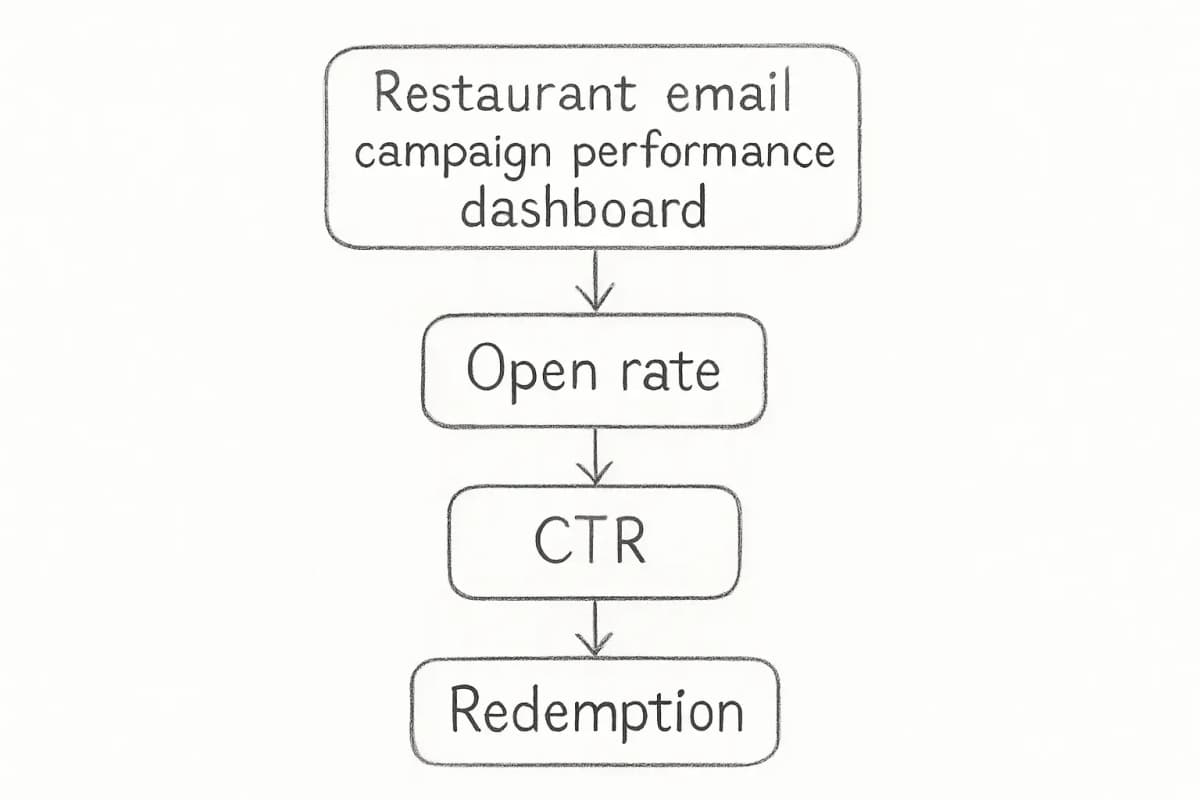
Sending Frequency: A Common Mistake
More email is not better email. Restaurants that send daily emails see high unsubscribe rates. Two to four emails per month is the right cadence for most restaurants. Save daily communication for social media. Email should be reserved for meaningful content: events, seasonal menus, and special occasions.
When guests feel that every email is a discount or a push to buy, they stop opening them. Vary your content: mix promotions with storytelling, feedback requests, and loyalty updates. Guests who trust your emails open them. Trust is built by delivering value, not just offers.
Frequently Asked Questions
How often should a restaurant send marketing emails?
Two to four emails per month is the right cadence for most restaurants. Save daily communication for social media. Email should be reserved for meaningful content such as events, seasonal menus, and special occasions. Sending more frequently risks increased unsubscribe rates and reduced engagement across your list.
What types of restaurant emails get the highest open rates?
Welcome emails have an open rate of 68.6%, demonstrating their potential to engage customers from the start. Birthday emails also perform well, with open rates that rise to and often exceed 45%. Both categories outperform standard promotional blasts by a significant margin because they are personally relevant to the recipient.
How do I grow my restaurant email list?
The most effective collection methods for restaurants include WiFi login requiring an email for access, reservation systems that capture email at booking, loyalty programs where email is the natural entry point, table tent cards with QR codes linking to a signup with an incentive, staff mentions at checkout, and website popups for visitors browsing your menu online.
What is a good conversion rate for restaurant email offers?
Digital and mobile coupons typically achieve redemption rates of 7%, significantly outperforming paper coupons. Birthday offers perform much higher. A well-crafted birthday offer with a compelling incentive should see 15 to 30% redemption. General promotional offers sent to a broad, unsegmented list will typically underperform both benchmarks.