Email marketing still delivers the highest ROI of any digital channel in 2025, and the gap between brands that use it well and those that treat it like a broadcast tool is widening fast. Email marketing ROI averages $36 to $42 for every $1 spent, and the number of email users worldwide in 2025 is estimated at approximately 4.6 billion. That reach, combined with direct inbox access to an owned audience, makes email the most cost-efficient channel in most marketing stacks.
But competing in a crowded inbox requires more than a monthly newsletter. These 10 email marketing tips for 2025 focus on what actually moves revenue: smarter segmentation, tighter deliverability, AI-assisted personalization, and automation that runs without constant intervention.
Key Takeaways
- Automated emails generate 320% more revenue than non-automated campaigns.
- Segmented email campaigns generate 30% more opens and 50% more click-throughs, and 78% of marketers say segmentation is their most effective tactic.
- Personalized emails see approximately 26% higher open rates.
- Google, Yahoo, Microsoft, and La Poste now require SPF, DKIM, and DMARC authentication for bulk email senders.
- AI implementation delivers measurable returns including 13% higher click-through rates and 41% revenue increases from personalization.
1. Segment Your List Beyond Basic Demographics
Batch-and-blast email is the fastest way to erode engagement and deliverability. Segmentation is the correction.
Segmenting email lists can lead to up to a 760% increase in email revenue. That figure reflects what happens when subscribers receive messages relevant to where they are in the buying journey, not just what industry they work in.
Effective segments in 2025 go beyond job title or company size. The highest-performing programs use:
- Behavioral data: pages visited, links clicked, products browsed
- Purchase history: what they bought, how often, and when
- Engagement recency: active subscribers vs. those who haven't opened in 90 days
- Lifecycle stage: new subscriber, repeat buyer, lapsed customer
Creating segments based on firmographics, behavioral data, and lifecycle stage helps avoid the performance drag of batch-and-blast sending.
For a detailed breakdown of how to structure these segments, see Email List Segmentation Strategies That Boost ROI by 760%.
2. Lock Down Email Authentication (SPF, DKIM, DMARC)
This is no longer optional. Following Google and Yahoo's 2024 rollout of bulk sender requirements, Microsoft introduced its own email authentication rules for high-volume senders targeting Outlook.com domains. From May 5, 2025, businesses sending more than 5,000 emails a day must comply, or risk having messages throttled, sent to spam, or blocked entirely.
The three protocols every sender needs:
- SPF (Sender Policy Framework): Lists authorized IP addresses permitted to send on behalf of your domain
- DKIM (DomainKeys Identified Mail): Adds a cryptographic signature that proves the message wasn't altered in transit
- DMARC (Domain-based Message Authentication, Reporting, and Conformance): Ties SPF and DKIM together and tells mailbox providers how to handle messages that fail authentication
Authenticating your email domain proves your emails are legitimate and keeps them out of the spam folder. Set up SPF to validate the sender's IP address, then add DKIM for a digital signature. Finally, configure DMARC to align your email domain with the sender's address, giving you control over unauthorized messages.
BIMI (Brand Indicators for Message Identification) is technically optional but recommended as an additional layer. It adds your logo to supporting inboxes and can boost open rates by up to 21%.
3. Write Subject Lines That Earn the Open
Your subject line determines whether the rest of your email gets read. 47% of recipients open emails based on the subject line alone.
The fundamentals have not changed, but the competition has intensified. What works in 2025:
- Length: Data consistently shows that subject lines between 41 and 50 characters, approximately 6 to 7 words, perform best, maximizing visibility across all devices without sacrificing clarity.
- Personalization: According to a study by Campaign Monitor, emails with personalized subject lines are 26% more likely to be opened.
- Urgency: There is a 22% higher open rate when subject lines convey urgency.
- Questions: Subject lines with a question mark see a 20% open rate versus 12% without.
One thing to avoid: misleading subject lines. 30.4% of recipients will unsubscribe when the subject line is misaligned with the content of the email.
For a comprehensive breakdown, read Email Subject Line Best Practices That Boost Open Rates by 27%.
4. Build Automated Email Flows Around Behavior
Manual sends have their place, but behavioral automation is where the revenue lives. Automated emails accounted for just 2% of email sends but drove 30% of revenue, earning 16 times more per send than scheduled campaigns.
The highest-priority flows to build or refine in 2025:
- Welcome series: Welcome emails generate 320% more revenue per email than promotional ones, and more than 8 out of 10 people will open a welcome email, generating four times as many opens and ten times as many clicks as other email types.
- Abandoned cart recovery: Sending three abandoned cart emails results in 69% more orders than a single email.
- Post-purchase sequences: These drive repeat purchases and referrals at near-zero marginal cost.
- Re-engagement campaigns: 40% of users report 50 or more unread marketing emails in their inbox, making re-engagement flows essential for list health.
For best practices on building your welcome flow, see Welcome Email Sequence Best Practices: 7 Proven Strategies.
5. Use Personalization Beyond First Name
True personalization in 2025 means dynamic content, not just merge tags. A report by Epsilon indicates that personalized emails deliver 6 times higher transaction rates compared to non-personalized emails.
What this looks like in practice:
- Product recommendations based on browsing and purchase history
- Location-aware content (local store events, regional promotions)
- Lifecycle-triggered messaging (onboarding, anniversary, win-back)
- Dynamic content blocks that change based on subscriber attributes
Using dynamic email content can boost revenue by up to 22%. From personalized product recommendations to location-based offers, dynamic elements make email marketing campaigns more relevant and more effective.
Personalization in email messages improves open rates by 29% and click-through rates by 41%.
6. Apply AI to the High-Leverage Variables
63% of marketers now use AI in email campaigns. These AI implementations deliver measurable results including 13% higher click-through rates and 41% revenue increases from personalization.
Where AI delivers the clearest lift in 2025:
Subject line optimization: AI-optimized subject lines produce 50% higher open rates than manually written ones, and the improvement is consistent across industries and audience sizes.
Send time optimization: Individual-level send-time optimization calculates each subscriber's personal open probability window based on click behavior, conversion timing, and reply patterns, delivering a 15 to 25% open rate improvement.
Predictive segmentation: Rather than relying on static rules, AI identifies which subscribers are most likely to convert, churn, or disengage before those signals are visible manually.
65% of marketers advocate using AI as an assistive tool but oppose fully hands-off deployment. The best approach is to use AI to draft emails, then refine them with a human voice check. 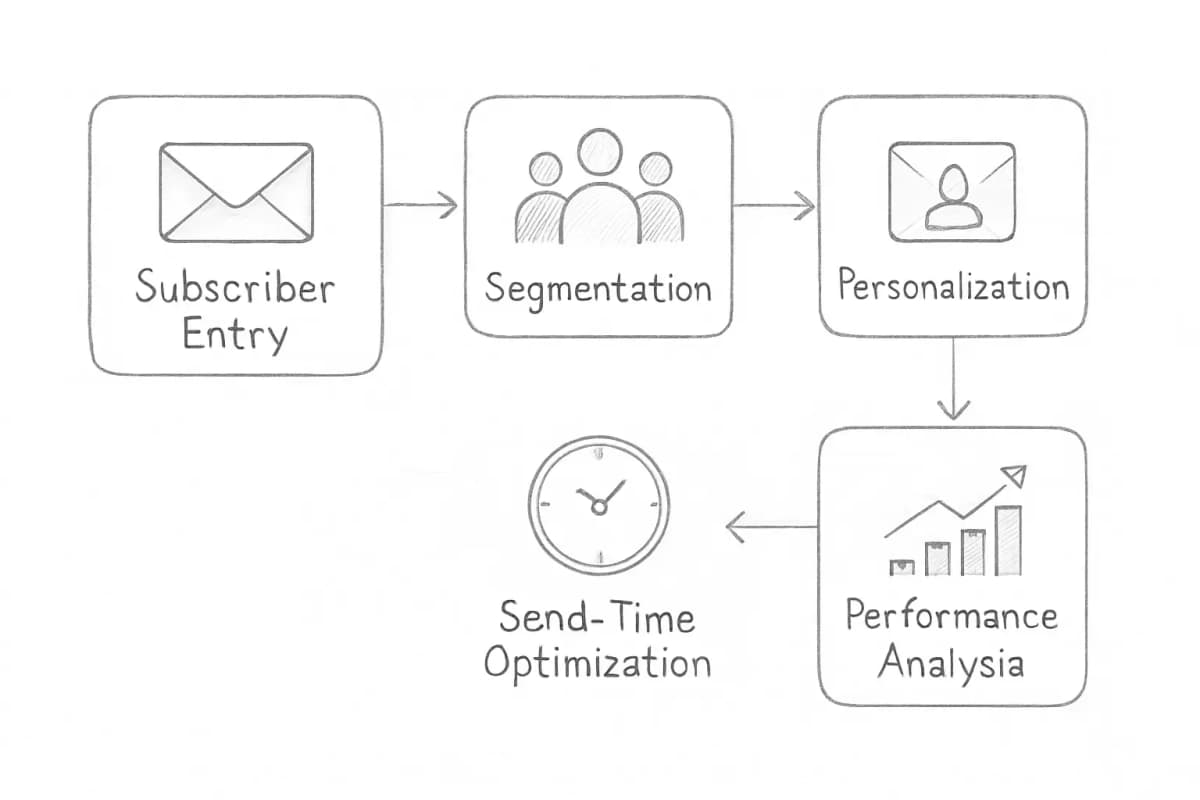
7. Prioritize List Hygiene and Sender Reputation
Your sender reputation is the infrastructure your entire program runs on. A degraded reputation means lower inbox placement regardless of how good your content is.
96% of recipients have unsubscribed because emails were sent too frequently. Sending more does not mean earning more.
Core list hygiene practices for 2025:
- Remove hard bounces immediately after every send
- Suppress contacts who haven't engaged in 90 to 180 days (or run a re-engagement flow first)
- Use double opt-in for new subscribers to confirm consent and intent
- Monitor spam complaint rates; staying below a 0.3% reported spam rate is now vital to deliverability.
Think of your email list as a garden. Without regular weeding, it becomes overgrown with inactive and invalid contacts that stifle growth. List hygiene is the practice of regularly cleaning your subscriber list, and it directly tells inbox providers that you are a responsible sender who respects recipient inboxes.
8. Optimize for Mobile First
Mobile email usage accounts for over 50% of all email opens in 2025. If your emails do not render correctly on a phone, a significant portion of your list will never engage with them.
Over 50% of users delete an email if it is not optimized for mobile.
Mobile optimization requirements in 2025:
- Single-column layouts that reflow cleanly on small screens
- Minimum 14px body text, 22px headlines
- Tap targets (buttons and links) of at least 44x44 pixels
- Compressed images that load fast on mobile data
- Preview text that extends the subject line rather than repeating it
In January 2025, 65% of web page views were via mobile devices. For email marketers, it is a clear signal to prioritize mobile-friendly content across all campaigns.
9. Test Continuously and Track the Right Metrics
Most teams run occasional A/B tests on subject lines and call it optimization. High-performing programs treat testing as an ongoing process across every campaign variable.
A/B testing generates $42 for every $1 spent, compared to $21 for marketers who do not do A/B testing.
What to test systematically:
- Subject lines and preview text
- Send time and day of week
- Call-to-action copy and button placement
- Email length and format (text-heavy vs. image-rich)
- From name (brand vs. individual)
On metrics: open rate is increasingly unreliable. Apple's iOS 15 privacy features allow Apple Mail users to block third parties from tracking email opens. Considering Apple owns more than 50% of email client market share, that means more than half of open rate metrics may not reflect how many people actually opened an email.
Shift your primary KPIs to click-through rate, revenue per email, and conversion rate, which all connect directly to business outcomes.
For a complete guide to measuring what matters, read Email Marketing Analytics Best Practices.
10. Align Email Frequency With Subscriber Preferences
Sending too often is one of the most common causes of list decay. 76% of unsubscribers cite frequency of emails as the reason they left.
The right cadence is not universal. It depends on your audience, your content quality, and what subscribers signed up expecting. Some practical guidance:
- Newsletters with a weekly cadence see a 48.31% open rate and a 5.71% click-through rate on average, making weekly the strongest frequency for newsletters specifically.
- The sweet spot for most businesses lies in sending one to two emails per week, which helps maximize engagement while keeping unsubscribes low.
- Use a preference center to let subscribers choose their own cadence.
The goal is to send every email with a clear purpose. If you cannot articulate why this message deserves inbox space today, it should wait or be cut.
Frequently Asked Questions
What is a good email open rate in 2025?
MailerLite's 2025 benchmarks study found that the average open rate across all industries was 42.35%. However, open rates vary significantly by industry, send type, and whether Apple Mail Privacy Protection is inflating the numbers. Focus on click-through rate and revenue per email for a more accurate read on true engagement.
How often should I send marketing emails?
Marketing emails perform best Tuesday through Thursday, while morning hours from 8 to 11 AM show peak engagement rates. The sweet spot for most businesses is one to two emails per week, which maximizes engagement while keeping unsubscribes low. Use your own data to validate these benchmarks against your specific audience.
Does email personalization actually improve results?
Yes, measurably. Personalized subject lines are 26% more likely to be opened. By delivering content more relevant to each individual, AI-powered personalization can lead to higher conversion rates, and personalized emails deliver 6 times higher transaction rates compared to non-personalized emails.
What technical setup do I need for good email deliverability in 2025?
Mailbox providers like Gmail and Yahoo now enforce stricter requirements for bulk senders, including authentication such as DMARC, one-click unsubscribe, and low spam complaint thresholds, while also using AI-driven filtering to evaluate engagement and sender behavior. At minimum, configure SPF, DKIM, and DMARC for every sending domain. Keep your spam complaint rate below 0.3% and remove inactive subscribers on a regular schedule.