
Email marketing consistently delivers the highest return of any digital marketing channel, but most teams only look at open rates and click-throughs and stop there. That leaves real revenue insight on the table. If you want to know how to measure ROI from email marketing with accuracy, you need a repeatable framework: a formula, the right metrics, a reliable attribution model, and a process for improving what you find.
This guide covers all of it, with the data to back every step.
Key Takeaways
- Email marketing campaigns average a 36:1 ROI, meaning businesses earn $36 for every $1 spent.
- The core ROI formula is: (Revenue from email - Cost of email) / Cost of email x 100 = ROI%
- Bot-driven phantom engagement has made open rates unreliable, pushing high-performing teams toward revenue per email, list churn, and lifetime value as the metrics that matter.
- Automated messages make up only 2% of email volume, yet generated 37% of all email-attributed sales in 2024.
- Segmented campaigns generate 760% more revenue than non-segmented ones.
Why Email ROI Measurement Matters More Than Ever
Twenty-five percent of marketers cite measuring ROI as a top challenge, and twenty-one percent of marketing leaders still don't measure email ROI at all, though that figure has improved from 36% in 2023. That gap matters because decisions made without revenue data are decisions made on guesswork.
Email marketing ROI measures how much revenue you generate for every dollar you spend. Expenses include platform costs, content creation, and list building. But tracking this ROI is not the same as tracking open or click rates. Those metrics show only engagement. Email marketing ROI shows whether that engagement is converting into actual revenue.
When you track ROI properly, you can show stakeholders which campaigns are profitable, justify budget requests with hard numbers, and make decisions about what to scale and what to cut.
The Email Marketing ROI Formula
The formula for calculating email marketing ROI is: Email ROI (%) = [(gross profit - cost of email campaign) / cost of email campaign] x 100. In this formula, gross profit is the total revenue generated from the email campaign minus any direct costs associated with the product or service sold. The cost of an email campaign includes all expenses tied to the campaign, including platform costs, design, copywriting, and any other associated costs.
What Counts as "Cost"
Most teams undercount their actual spend. To calculate true costs, you need to consider the cost of your email service provider, the salaries or hourly rates of team members working on email, and any support technology like email testing services and deliverability tools.
For example, if your email marketer spends 10 hours per week on email campaigns at $25 per hour, that is $250 weekly or approximately $13,000 annually in labor costs that must be factored into your ROI calculations.
A Practical Example
Imagine a company spends $1,000 on an email marketing campaign. From this campaign, they made 50 sales, resulting in total revenue of $5,000. The cost of products sold amounts to $2,000. Gross profit is $5,000 minus $2,000, which equals $3,000. Email ROI equals [($3,000 minus $1,000) / $1,000] x 100 = 200%.
That 200% return means the campaign more than doubled its investment in net profit terms.
The Metrics That Actually Predict Revenue
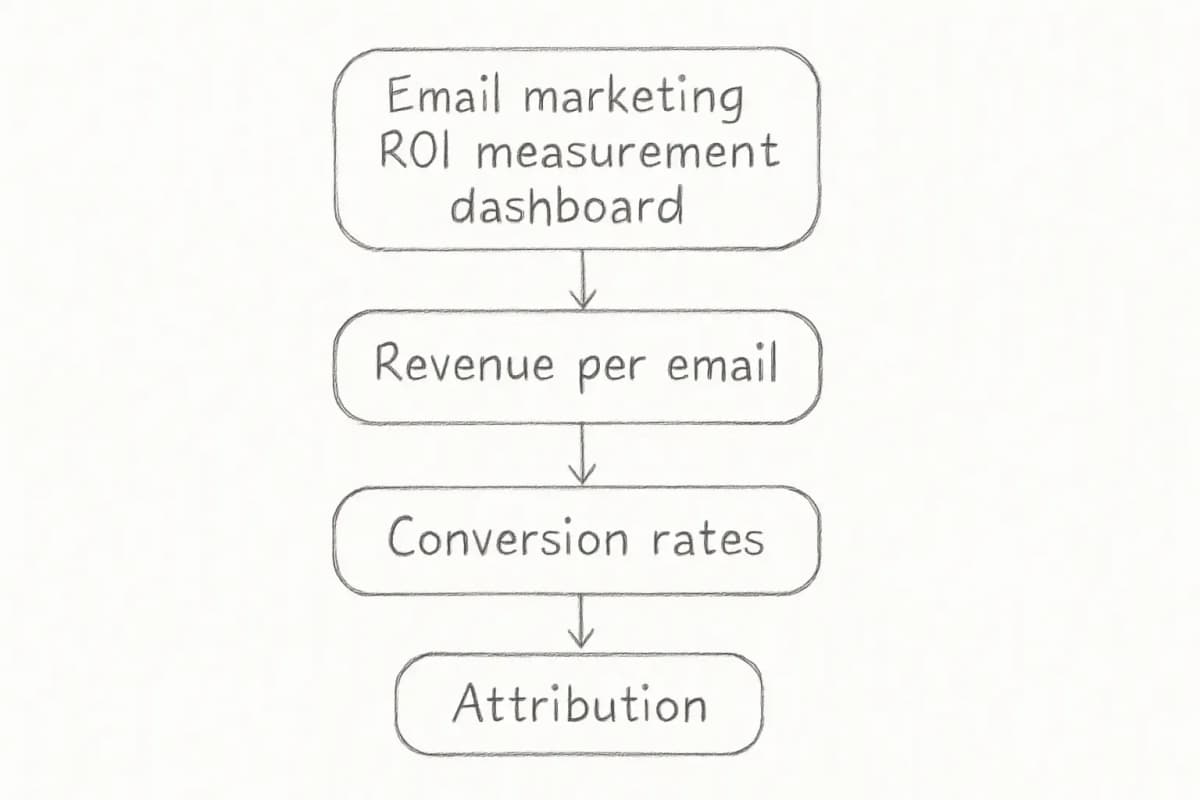
Engagement metrics are useful but incomplete. Revenue-focused metrics include total revenue generated from direct sales attributed to your email campaigns, revenue per email sent (which helps you understand the average value of each email), and customer lifetime value from email (which tracks long-term revenue rather than just immediate purchases).
Engagement metrics that predict revenue include click-through rate, open rate, and conversion rate. While open rates do not directly generate revenue, they are essential for campaign success, and low open rates can signal deliverability issues that hurt your overall ROI.
Cost-related metrics help you understand efficiency, including cost per acquisition (how much you spend to acquire each new customer through email), cost per click, and unsubscribe rate (which can indicate content misalignment and represent lost future revenue).
For a deeper look at building a measurement system around these metrics, see our guide to email marketing analytics best practices.
Revenue Per Email: The Metric Worth Watching
The average revenue per recipient for email campaigns is $0.11. However, the top 10% of email campaigns outperform the best SMS campaigns, with respective revenue-per-recipient figures of $0.95 and $0.77. Tracking this metric across campaigns makes it easy to identify your highest-performing sends and replicate what works.
Attribution: Connecting Emails to Revenue Accurately
Attribution is where most teams struggle. A customer might open three emails, click a paid ad, and then convert through organic search. Which channel gets credit?
B2B buyer journeys now involve 6 to 8 touchpoints on average before conversion. Single-touch models like last-click ignore every touchpoint except one, misattributing credit and distorting your entire channel mix.
Common multi-touch attribution (MTA) models include linear, time-decay, position/U-shaped, W-shaped, and custom. Here is how to choose:
- Last-touch: Simple to set up, but gives full credit to the final interaction and ignores every earlier email touchpoint.
- First-touch: Useful for understanding which campaigns create awareness and bring subscribers in.
- Linear: Distributes credit equally across every touchpoint in the journey.
- Time-decay: Gives more credit to touchpoints closest to conversion, which works well for short sales cycles.
- Position-based (U-shaped): Weights first and last touches heavily, with remaining credit spread across middle interactions.
Multi-channel attribution and marketing-qualified leads (MQLs) jumped 22% year-over-year as email campaign reporting moves away from engagement proxies toward revenue accountability.
For practical implementation, Google Analytics 4 switched to data-driven attribution as its default model in January 2024. For B2B teams, connecting your email platform to your CRM ensures you can attribute pipeline and closed-won revenue, not just lead volume.
How Automation Changes Your ROI Math
Automated flows are the single most powerful lever for improving email ROI, and they are systematically underreported in most measurement setups.
Email automations deliver 30 times more revenue per recipient than one-off promotional campaigns. The average return per recipient for campaigns sits at $0.11, while automated flows earn $1.94 per recipient.
If you are not tracking automated flows separately from broadcast campaigns, you are looking at blended numbers that underrepresent your best-performing sends and make it harder to allocate effort correctly.
Many brands forget that ROI covers more than regular campaign sends. Automated flows like welcome emails, cart recovery, and browse abandonment contribute significantly to returns. Tracking these separately from your campaigns gives you a much fuller picture.
Segmentation and Personalization: The ROI Multipliers
Two tactics consistently show up in high-ROI email programs: segmentation and personalization. The data on both is compelling enough to treat them as foundational, not optional.
Segmented campaigns generate 760% more revenue than broadcast sends. The reason is straightforward: relevance drives opens, clicks, and conversions.
Personalized email marketing generates a median ROI of 122%. That gap over standard campaigns reflects what happens when the message matches what the subscriber actually cares about.
Brands that regularly A/B test their emails achieve 83% higher ROI than those that never test. Companies that never test report average ROI of 2,300%, while those that regularly test achieve 4,200%.
For a full breakdown of segmentation strategy, read our article on email list segmentation strategies that boost ROI by 760%. And if you want to go deeper on personalization tactics, our guide on 7 email personalization techniques that boost conversions 47% covers the specific methods that move the needle.
Common Mistakes That Distort Your ROI Measurement
Even teams with solid tracking setups make measurement errors that inflate or deflate their numbers. The most common problems:
- Counting gross revenue instead of profit: Your formula should use gross profit (revenue minus product costs), not raw revenue. Counting top-line revenue overstates returns, especially for ecommerce.
- Ignoring labor costs: Factoring in only your email service provider cost will not give you a reliable result. You also need to calculate how much time each team member spends on email and convert that to an hourly rate.
- Using open rates as the primary success metric: Click rates matter more than open rates. Apple Mail Privacy Protection has made open rates unreliable. Focus on click-through rates, click-to-open rates, and conversion rates as your primary engagement metrics.
- Blending automation and broadcast data: Mixing these produces averages that obscure the real performance of each type.
- Skipping UTM tagging: Without UTM parameters on email links, your analytics platform cannot distinguish email-driven traffic from other sources, making revenue attribution impossible.
A Step-by-Step Process for Measuring Email ROI
- Define the campaign goal: Revenue, lead generation, or retention. The goal determines what counts as a conversion and what revenue figure you will use in your formula.
- Tag every link with UTMs: Use consistent naming conventions for source, medium, and campaign so your analytics data stays clean.
- Calculate your total cost: ESP fees plus team labor plus any design or copywriting costs.
- Pull revenue data: Use Google Analytics 4, your e-commerce platform, or your CRM to attribute revenue to email-originated sessions or leads.
- Choose an attribution model: Match the model to your sales cycle length and the complexity of your buyer journey.
- Apply the formula: (Revenue - Cost) / Cost x 100.
- Track separately by type: Measure automated flows, promotional campaigns, and newsletters independently so you can compare performance across each.
- Review on a consistent cadence: Monthly or quarterly reviews allow you to spot trends, cut underperformers, and double down on what drives returns.
For a complete campaign planning resource, the email marketing strategy template for 2025 provides a structured framework you can adapt to your measurement process.
Industry Benchmarks: What Good ROI Looks Like
Not every industry sees the same returns, so comparing your program against a relevant benchmark matters more than chasing a generic average.
For every $1 spent on email marketing, businesses see an average return of $36, representing a 3,600% ROI. But averages vary significantly by sector:
- Retail, ecommerce, and consumer goods achieve the highest email ROI of any sector, at 4,500%.
- The average email marketing ROI for large businesses is 44:1.
- The top 8% of email programs hit a 45:1 or higher ROI and most commonly send newsletters and onboarding emails, not promotions.
Companies achieving exceptional email returns invest more than 20% of their total marketing budget in the channel. Conversely, 75% of low-ROI companies spend less than 20% on email. Budget allocation correlates directly with returns.
Frequently Asked Questions
What is a good ROI for email marketing?
The average ROI for email marketing sits at $36 to $42 for every dollar spent, which translates to a 3,600% to 4,200% return. That said, benchmarks vary by industry, list quality, and program maturity. A program improving its own baseline quarter over quarter is more valuable than one chasing an industry average.
What costs should I include when calculating email marketing ROI?
Revenue includes conversions, assisted revenue, and retention-driven revenue. Cost includes software, team time, and production. Many teams undercount by excluding labor. Make sure you account for every hour your team spends on email strategy, copywriting, design, and analysis.
Why are open rates unreliable for measuring email ROI?
Bot-driven phantom engagement has made open rates unreliable. Apple Mail Privacy Protection pre-loads tracking pixels regardless of whether a subscriber actually reads the email, inflating open rate data. Conversion rate, revenue per email, and click-to-open rate are more reliable signals of genuine engagement and financial performance.
How do I attribute revenue to email marketing when a customer uses multiple channels before buying?
Multi-touch attribution (MTA) models give credit to every interaction along the buyer journey, helping marketers understand what is actually driving revenue, not just who closed the deal. For most teams, connecting your email platform to Google Analytics 4 with UTM tracking and choosing a model that fits your sales cycle (time-decay for short cycles, position-based for longer ones) will give you a workable and defensible attribution setup.