HVAC companies operate in a market where timing, trust, and repeat business determine who grows and who stalls. The US HVAC services market was worth $19.85 billion in 2024 and is expected to grow at a CAGR of 6.60% through 2029. More competition means you cannot rely on referrals alone. Email gives you a direct, low-cost channel to stay in front of customers year-round, and the numbers back it up: email generates $36 for every $1 spent, a 3600% ROI. The HVAC email marketing tips in this guide will show you how to put that return to work for your business.
Key Takeaways
- The industry standard open rate for HVAC emails averages about 23% with click-through rates of around 3%. Knowing your benchmark is the first step to beating it.
- Segmented email campaigns generate 30% more opens and 50% more click-throughs than non-segmented campaigns.
- Automated email campaigns generate a 320% higher ROI compared to manually executed campaigns.
- 71% of consumers expect personalized interactions from brands, and 76% get frustrated when their brand interactions are not personalized to their interests.
- With 66% of consumers researching small businesses using their smartphones, you must optimize your marketing efforts for mobile devices, and this includes email marketing.
1. Build a Clean, Targeted Email List From Day One
Every effective HVAC email campaign starts with list quality, not list size. A successful HVAC email marketing campaign starts with a clean, high-quality email list. Collecting the right contacts ensures your campaigns reach homeowners who are actually interested in your services.
One of the most important aspects of HVAC email marketing is maintaining a clean email list. A clean HVAC email list is up-to-date and free of bounced, invalid, and unengaged addresses.
Practical ways to grow your list:
- Add an opt-in form to your website's service and contact pages
- Collect email addresses at every service call and job completion
- Offer a seasonal maintenance checklist or energy-saving guide as an incentive to subscribe
- Never purchase email lists. Ever. Purchased lists damage deliverability and violate consent laws
The average deliverability rate sits at 85% in 2024, heavily influenced by authentication protocols like DMARC, SPF, and DKIM. Brands that implement proper authentication see deliverability rates above 90%, while those without proper setup struggle with inbox placement and may see their messages relegated to spam folders.
Set up SPF, DKIM, and DMARC records through your email service provider before you send your first campaign. Most platforms walk you through this in their onboarding.
2. Segment Your List Based on Service History and Behavior
Sending one email to your entire list is one of the fastest ways to lose subscribers. If you're planning to send out the same email to your whole list, don't. Unless you want to tank your engagement. The last thing your customers need is more irrelevant emails in their inboxes.
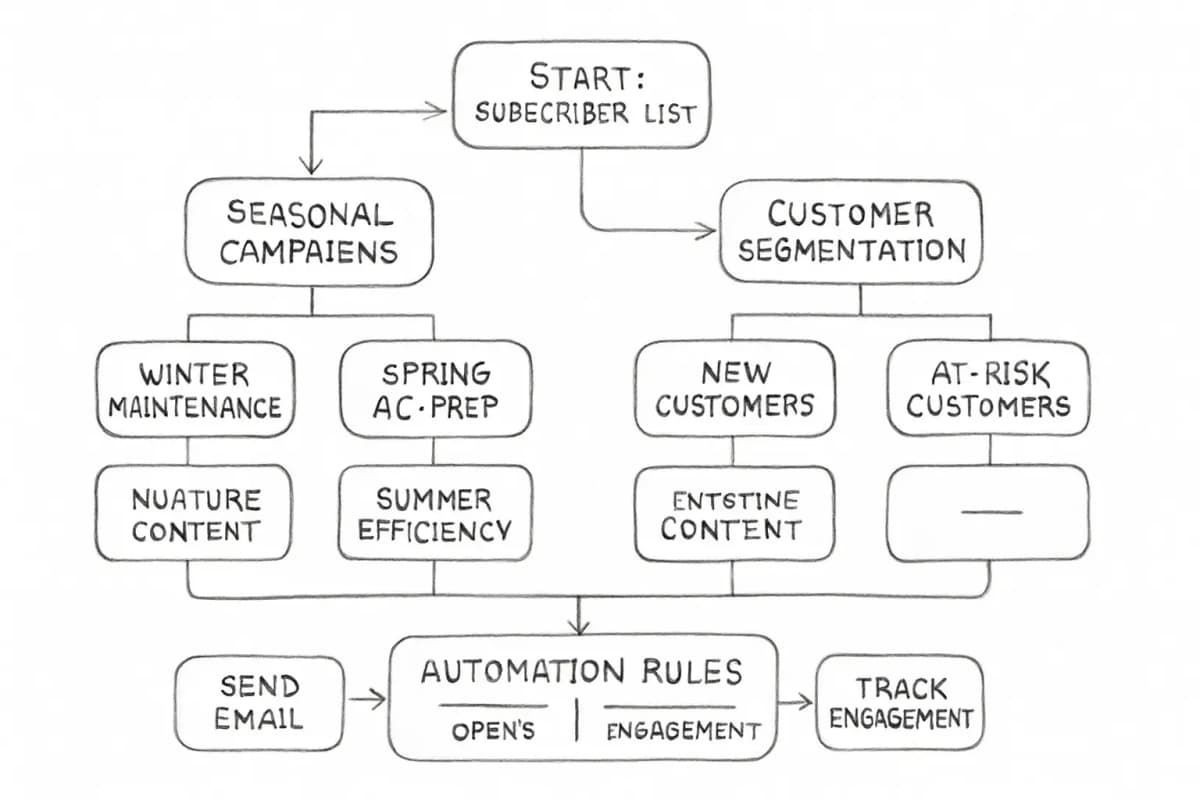
For HVAC businesses, the most effective segmentation factors include:
- Service type: AC customers vs. heating customers vs. full-system customers
- Service history: When they last booked, what was done, what equipment they own
- Engagement: Active openers vs. subscribers who have not engaged in 90 days
- Geography: Customers in different zip codes may have different needs and seasonal timing
- Customer status: New customers, repeat clients, lapsed customers
Segmenting your email list based on customer behavior, location, service history, and preferences ensures each campaign is set up to generate the best results.
The payoff from segmentation is significant. Using segmented email campaigns can lead to a remarkable 760% increase in revenue. Segmented campaigns significantly boost engagement, conversions, and overall revenue by addressing specific audience needs and preferences.
For a deeper look at segmentation strategy, see our guide on email list segmentation strategies that boost ROI by 760%.
3. Use Seasonal Campaigns to Fill Your Calendar Before Demand Peaks
HVAC demand is intensely seasonal. Most homeowners do not think about their heating or cooling system until something breaks or the temperature becomes extreme. Your job is to reach them before that happens.
Many homeowners forget to schedule regular HVAC maintenance until something breaks. Seasonal reminder emails timed for spring and fall encourage them to stay ahead of the weather and avoid costly emergency repairs. These reminders also position your company as proactive and customer-focused.
Pre-season timing matters. Send tune-up reminders before customers think about it. Early spring for AC, early fall for heating.
A practical seasonal email calendar for HVAC:
- February/March: AC tune-up promotion ahead of summer heat
- April/May: Spring maintenance package with early-bird discount
- August/September: Furnace and heating system check ahead of winter
- October/November: Year-end service deals and maintenance contract promotions
- December/January: Emergency service reminders and heating system care tips
Seasonal templates work well for aging-equipment email campaigns, which can be lucrative even if they yield only a handful of jobs. In boosting the close rate for aging equipment contracts, often $10,000 to $20,000 a pop, email marketing campaigns are uniquely effective at helping HVAC contractors grow their share of the most valuable segment of their market.
4. Automate Your Core Email Sequences
Manual email sending does not scale. Email marketing automation is a powerful tool that can help residential HVAC contractors save time, reduce costs, and build stronger client relationships. By staying connected with clients through automated service reminders, seasonal promotions, and personalized follow-ups, contractors can improve client retention and maximize sales opportunities.
The core automated sequences every HVAC business should have running:
Welcome sequence: When someone joins your list, your welcome email sets the tone. Use it to introduce your company, highlight your core services, and offer an exclusive discount for new customers. You can also link to helpful blog posts or videos that explain HVAC basics, showing you are a helpful resource right from the start. Our welcome email sequence best practices guide covers how to build this step by step.
Post-service follow-up: After a service has been completed, send a follow-up email thanking the customer and encouraging them to leave a review or schedule future maintenance.
Re-engagement sequence: If a customer has not opened your emails or booked a service in a while, send a re-engagement email with a special offer to encourage them to return.
Maintenance reminders: Send seasonal reminders triggered by date, reminding customers to schedule maintenance before peak season.
In 2023, automated emails accounted for 41% of all email orders from only 2% of email sends. That ratio is compelling: a small number of automated sends carry significant revenue weight.
5. Personalize Beyond the First Name
Using a subscriber's first name is a baseline, not a strategy. HVAC customers respond to messages that reflect their actual situation, what system they have, when they last had service, what season is approaching, and where they live.
Effective email marketing means not just blasting the same "winter is coming" message every autumn. Instead, it means having a smart strategy based on sending personalized, relevant emails to carefully segmented customers.
Personalization tactics that work specifically for HVAC:
- Reference the customer's last service date and the specific work done
- Include the system type in the email body (e.g., "your Carrier AC unit")
- Trigger offers based on equipment age, since systems 10+ years old are strong replacement candidates
- Use birthday or anniversary emails as personal touches that build loyalty, such as "Happy 1 year in your new home! Time for a system check?" or trigger lapsed customer re-engagement when a customer has not booked in 12 or more months.
Personalized emails with personalized subject lines can increase open rates by 26%. That alone can move an average HVAC open rate of 23% closer to 29%, which translates directly to more booked appointments.
For more techniques, see our post on 7 email personalization techniques that boost conversions 47%.
6. Write Subject Lines That Earn the Open
Your subject line is the single variable that determines whether everything else you wrote gets read. 47% of recipients open emails based solely on the subject line, while 69% report emails as spam for the same reason.
For HVAC emails, subject lines that perform well share a few consistent traits:
- Seasonal specificity: "Is your AC ready for summer?" outperforms "Schedule your maintenance today"
- Urgency without hype: "Book before Memorial Day weekend fills up" beats vague deadline pressure
- Personalization: Including the customer's name or a reference to their system drives opens
- Local relevance: Mentioning the city or neighborhood builds trust with homeowners
Seasonal and specific subject lines work best. Examples like "Is your AC ready for summer?" or "{{first_name}}, your furnace needs attention before winter" perform well.
Keep subject lines under 50 characters for mobile display. With 66% of consumers researching small businesses using their smartphones, failing to optimize your emails for mobile will cut your marketing efforts off at the knees.
For subject line formulas backed by data, see our guide on email subject line best practices that boost open rates by 27%.
7. Track the Right Metrics and Test Consistently
You cannot improve what you do not measure. Too many HVAC companies send emails and never look at the data. They have no idea if their campaigns are working or wasting time.
The metrics that matter most for HVAC email campaigns:
- Open rate: Benchmark against the HVAC industry average of 23%
- Click-through rate (CTR): Benchmark at approximately 3%
- Conversion rate: Booked appointments or quote requests per email sent
- Unsubscribe rate: A rising unsubscribe rate signals irrelevant content or poor list hygiene
- Revenue per email: The most direct measure of campaign ROI
The best email campaigns are data-driven, meaning marketers use data to inform every decision they make. That slowly improves the campaign over time because every change is supported by customer feedback.
A/B testing is the most reliable way to improve results over time. Test one variable at a time: subject line vs. subject line, send time vs. send time, CTA placement vs. CTA placement. Marketers who A/B test their emails often increase email ROI by 86% compared to those who never do.
Establishing a consistent delivery schedule means determining the weekly, monthly, and seasonal email content you plan to send throughout the year. A good starting point is one email per week, rotating between nurture and sales-oriented emails. HVAC companies should also send seasonal emails offering tips and best practices when the seasons change during the winter and summer months.
8. Balance Value Content With Promotional Emails
Not every email should ask for a booking. Customers who receive useful information between service calls are more likely to stay on your list and trust your recommendations when you do pitch a service.
Not all of your email marketing messages should focus on sales. Developing an effective nurturing campaign that offers helpful tips and best practices is equally important. Seasonal HVAC tips and advice could include content like "How Often Should I Change My Furnace Filter?" or "What Is The Best Way To Start Up My AC in the Summer?" These emails allow customers to engage with your content while keeping you top of mind for potential future HVAC issues.
Content that works well in HVAC nurture emails:
- Filter replacement reminders with frequency guidance based on home size
- Energy efficiency tips tied to the current season
- Explanation of what a seasonal tune-up actually includes (builds perceived value)
- Promotional campaigns for preventative maintenance packages that emphasize long-term benefits such as increased system efficiency and reduced repair costs
- Customer testimonials and reviews that reinforce trust
A good rule of thumb: for every two promotional emails, send at least one purely helpful email. This keeps your unsubscribe rate low and your sender reputation strong.
Frequently Asked Questions
How often should an HVAC company send marketing emails?
A good starting cadence is one email per week, rotating between nurture and sales-oriented content. For businesses just getting started, sending 5 to 8 emails per month shows the highest ROI of about $48 per $1 spent. Watch your unsubscribe rate as a signal that frequency is too high for your audience.
What types of emails work best for HVAC businesses?
Seasonal reminders, maintenance tips, and emergency preparedness content perform best. Welcome emails, post-service follow-ups, and re-engagement campaigns also deliver strong results when automated and personalized to each subscriber's service history.
How do I reduce unsubscribes from my HVAC email list?
The primary cause of unsubscribes is irrelevant content. Take time to segment your list into buckets. You might bucket customers by how much they spent during a certain time frame, when they were last serviced, or even their birthday. More relevant emails equal fewer unsubscribes. Also verify that your send frequency is not too high for your audience and that every email delivers clear value.
What is a good open rate for HVAC emails?
The industry standard open rate for HVAC emails averages about 23% with click-through rates of around 3%. If your open rate is consistently below 15%, focus on subject line testing and list hygiene. If your CTR is below 1%, the problem is likely in your email content or call to action placement.
Do HVAC businesses need email marketing software?
Yes. Manually sending campaigns through a personal inbox is not scalable, hurts deliverability, and provides no analytics. HVAC-specific needs include seasonal campaign scheduling, maintenance reminder automation, equipment lifecycle tracking, and integration with scheduling software. Platforms like Mailchimp, HubSpot, and Housecall Pro all offer HVAC-relevant automation features at various price points.