Most restaurants underutilize email. Only 26% of businesses regularly use email marketing for sales, even though the channel consistently outperforms social media and paid ads. For restaurants specifically, email marketing delivers approximately $42 for every dollar spent, making it one of the highest-ROI channels available to food and beverage operators.
The problem is rarely motivation. It is usually time. Writing a fresh campaign every week while managing staff, inventory, and service is not realistic. That is where a well-built restaurant email marketing template earns its place. The right template cuts production time, keeps your brand consistent, and gives your team a repeatable system for filling seats and driving repeat visits.
This guide covers the seven most important template types, what to put inside each one, and how to make every email land in the inbox and get opened.
Key Takeaways
- Restaurant emails average a 40% open rate, well above most industries.
- Email marketing ROI for restaurants runs around $42 per dollar spent.
- The most effective restaurant emails follow a predictable format: strong subject line, one clear CTA, and relevant offer.
- The most effective emails are segmented and personalized based on subscriber behaviors and preferences.
- Automated emails generate 320% more revenue than non-automated emails.
Why Restaurant Email Marketing Works
Email marketing generates $36 for every $1 spent, over 10x what social media typically delivers. For restaurants, that ratio can climb even higher because your subscriber list is made up of people who already know and like your food.
60% of a restaurant's revenue comes from repeat customers, who also spend 67% more than new customers. Email is your most direct, algorithm-free channel to reach those people. Unlike Instagram posts that disappear in a feed or paid ads that stop working the moment your budget runs out, your email list is an asset you own and can market to again and again.
In 2024, 64% of restaurateurs were sending personalized offers to their customers, up from 55% in 2023. The competitive gap between restaurants that email well and those that do not is growing. Building your template library now puts you ahead of operators still relying on social media alone.
For a deeper look at the broader strategy behind these templates, see our guide on Restaurant Email Marketing Examples That Drive Sales.
The 7 Restaurant Email Marketing Templates You Need
1. Welcome Email Template
The welcome email is the most important message you will ever send. The first email you send as part of any email marketing campaign, the welcome email is used to greet new customers into your restaurant's family of loyal customers.
Every welcome email serves two primary purposes: confirming to customers that they are now subscribers, and beginning to entice them to return to your restaurant as soon as possible.
What to include:
- A warm, on-brand greeting from a named person (chef, owner, or manager)
- A clear reason they subscribed and what to expect
- An immediate incentive: a discount code, free appetizer on next visit, or early access to specials
- Links to your menu, reservation system, and social channels
- One CTA button ("Reserve a Table" or "View Our Menu")
Subject line examples:
- "Welcome to [Restaurant Name], here's something just for you"
- "[First Name], your table is always ready here"
- "You're in! Here's 10% off your next visit"
A strong welcome email uses three clear blocks, each telling the customer exactly what to do, with a CTA that invites them to visit your website or make a booking.
For a detailed breakdown of how to structure the sequence after that first email, see Welcome Email Sequence Best Practices: 7 Proven Strategies.
2. Promotional Offer Template
Promotional emails fill tables during slow periods and move specific menu items. According to research from Gourmet Marketing, 70% of customers want restaurants to send them coupons and are prepared to use them.
These emails work best when the offer is specific and the deadline is real.
What to include:
- A bold, visual-first header with a photo of the featured item or setting
- The offer stated plainly in the first two sentences (no burying the lead)
- Clear expiry date or limited availability language
- A single CTA: "Claim Your Offer" or "Book Now"
- Your address, phone number, and hours
Subject line examples:
- "Tuesday only: 20% off your entire bill"
- "Happy hour starts now and ends at 7"
- "This weekend: buy one entrée, get one free"
Subject lines that create a sense of urgency and exclusivity can give a 22% higher open rate. Keep the copy short. State the offer, state the terms, give them one button to click.
3. Birthday and Anniversary Template
Birthday emails work because personal milestones drive emotional loyalty. Guests appreciate acknowledgment on their special day. When they come in for the birthday offer, they often bring others, which increases table size and average order volume.
This is one of the easiest campaigns to automate and one of the most consistently high-performing.
What to include:
- A personalized subject line with the guest's first name
- A celebratory visual that feels warm, not generic
- A clear, single offer: free dessert, complimentary drink, or percentage discount
- Specific expiry window (typically 7 to 14 days around the birthday)
- Reservation link
Subject line examples:
- "Happy birthday, [First Name]! Dessert is on us"
- "[First Name], your birthday gift is inside"
- "It's your day, [First Name]. Here's a treat from us"
For better conversion, schedule birthday offers to send 7 to 10 days before the birthday rather than on the day itself. This gives guests time to plan a visit.
4. New Menu or Seasonal Launch Template
A menu change is one of the best reasons to email your list. It is news, it is relevant, and it gives even lapsed customers a reason to come back.
A new menu item is a great opportunity to send follow-up emails promoting special events. Use new menu items to drum up interest and keep in touch with loyal customers. A new item email should have at least one image of the menu items, a call to reserve or visit again, and a description of the new dishes.
What to include:
- One or two high-quality food photos (shoot these in natural light, not under kitchen fluorescents)
- A brief description of the dish or seasonal concept, written in appetite-triggering language
- A "be among the first to try it" framing to create mild urgency
- Clear CTA: "Reserve Your Table" or "Order Online"
Subject line examples:
- "Something new just hit our menu"
- "Fall menu is here. You're going to want to see this"
- "Meet the dish we've been working on all summer"
5. Event Invitation Template
Use this template to announce grand openings, chef's table events, prix fixe menus, live entertainment, and other special events throughout the year.
Event emails have a natural built-in urgency: seats are limited. Use that.
What to include:
- Event name and date in the subject line and at the very top of the email
- A short description of what makes this event worth attending (special guest, unique menu, exclusive experience)
- Seat or table count to create real scarcity
- A prominent RSVP button
- Contact details for questions
Subject line examples:
- "8 spots left: Wine dinner this Friday"
- "You're invited: Chef's Table, March 14"
- "Live jazz + prix fixe this Saturday. Seats going fast"
Keep the text simple and include only the facts. For your next event, include the date, the name of the event, and any special guest. Images of past events or the venue can do the emotional heavy lifting.
6. Win-Back (Re-engagement) Template
Every list has subscribers who stopped opening emails. Before you delete them, try to win them back with a targeted, honest message.
Many inactive subscribers do not disengage intentionally. They drift. A light nudge brings a portion back. Win-back emails often generate high ROI because the audience already knows the brand.
Win-back is the campaign where segmentation pays the most. A win-back message landing with someone who ordered last week is wasted; the same message landing with someone who has not ordered in 75 days is one of the most valuable sends you can make.
What to include:
- Acknowledgment that it has been a while (honest and direct, not guilt-tripping)
- A meaningful incentive to return: 15% off, a free starter, or a new item they may not have tried
- A short, curiosity-driven subject line
- One clear CTA to make a reservation or place an order
Subject line examples:
- "We miss you. Here's 15% off your next visit"
- "It's been a while, [First Name]. Something new is waiting"
- "Still thinking about you (and we have proof)"
7. Post-Visit Feedback and Review Request Template
A post-visit email gives customers a structured way to share their experience while it is still fresh. For satisfied guests, it creates a natural opportunity to leave a review; for others, it opens a direct line of communication before a negative experience makes its way online.
Send this email within 24 hours of a visit, ideally triggered automatically through your POS or reservation system.
What to include:
- A personal thank-you that references the visit (date or party size if available)
- A simple one-click rating or survey link
- A soft request to leave a public review if they had a great experience
- Direct reply option so unhappy guests can reach you privately
- A small goodwill gesture: a discount on their next visit for completing the survey
Subject line examples:
- "How was your dinner with us last night?"
- "Thanks for visiting, [First Name]. A quick question"
- "We'd love to hear from you"
Template Design Principles That Improve Performance
A good structure matters as much as the copy. Here is what consistent high-performing restaurant templates share:
Mobile-first layout. Over 70% of people read their emails on a mobile app, making mobile optimization non-negotiable. Use single-column layouts and large, touch-friendly buttons where CTAs are at least 44 x 44 pixels.
Strong visual hierarchy. A clean, photo-rich email template that's easy to scan works well. Highlight one main promotion up top while placing secondary promotions in smaller blocks below to create clear visual hierarchy.
One primary CTA per email. Every restaurant email should have a clear, action-oriented CTA. Use action verbs like "Reserve Now," "Order Online," or "View Menu," and focus on one primary CTA since multiple CTAs compete for attention.
On-brand consistency. Use your restaurant's colors, fonts, and logo so subscribers know who the email is from without thinking about it for more than a second.
Responsive testing. Ensure template designs are responsive on desktop and mobile by sending a test email to yourself before scheduling any campaign. 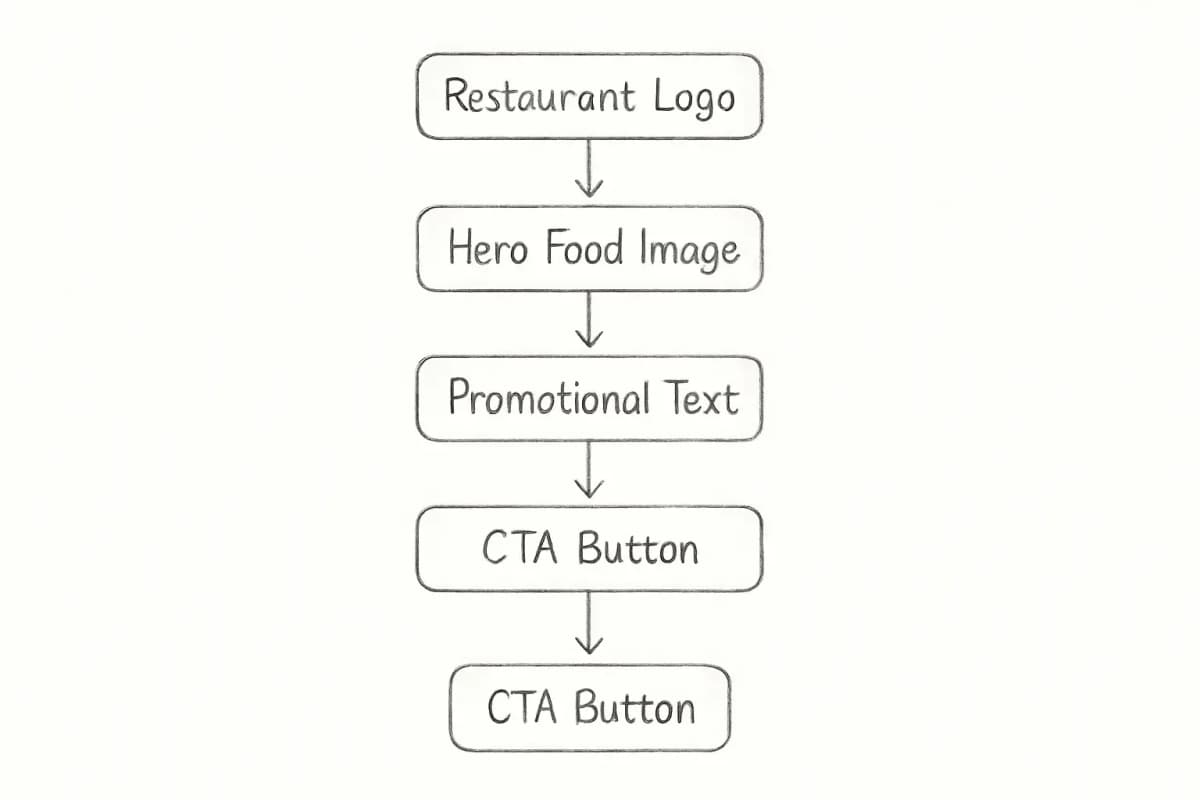
Subject Lines: The Make-or-Break Element
47% of recipients open emails based on the subject line alone. Getting this right is not optional.
Keep subject lines around 30 to 50 characters, which is the length most services display before cutting off. Use language that creates a sense of urgency and gives readers a reason to click.
Key tactics backed by data:
- Including a first name in the subject line can increase open rates by 14.68%.
- Adding one or more emojis in the subject line increases open rates by 13.65%.
- Subject lines that are questions receive a 10% higher open rate compared to average open rates.
- Subject lines with 6 to 10 words have the highest open rate of 21%. Subject lines with 21 or more words drop to just 9%.
Avoid spam-trigger words like "FREE!!!" in all caps, excessive exclamation marks, and anything that reads like a mass-blast. Email spam filters have become increasingly sophisticated at detecting promotional language and pressure tactics. Even all-caps subject lines or multiple exclamation marks can lower sender reputation over time.
For more guidance, our detailed guide on Email Subject Line Best Practices That Boost Open Rates by 27% covers testing frameworks and copywriting methods that apply directly to restaurant campaigns.
Segmentation: Send the Right Template to the Right Guest
A template is only as effective as the audience it reaches. Not all customers are the same, so why send them all the same emails? Personalization is one of the biggest benefits of restaurant email marketing, and list segmentation is a great way to simplify personalization. Segmentation helps you send more relevant messages, leading to higher engagement.
The most practical segments for restaurants:
- By visit frequency: loyal regulars vs. occasional guests vs. lapsed customers
- By order preference: vegetarians, wine enthusiasts, dessert buyers, family diners
- By location: critical for multi-location operators
- By lifecycle stage: new subscribers, active diners, win-back candidates
Adjust promotions based on past order history (pizza lovers get pizza-related offers; guests with a sweet tooth get dessert promotions). Send re-engagement campaigns to inactive past customers while rewarding loyal customers with special perks.
For a comprehensive breakdown of how segmentation scales ROI, see our guide on Email List Segmentation Strategies That Boost ROI by 760%.
How Often Should Restaurants Send Email?
Aim for 1 to 2 emails per week. That is the sweet spot for most restaurants. It keeps your brand top-of-mind without overwhelming your subscribers. Each email should serve a clear purpose: promoting a special, sharing an event, sending a reminder, or giving something helpful or personal.
Automation handles most of the heavy lifting. Automated campaigns run on triggers and on-demand campaigns are sent manually when you have something specific to promote. Automated campaigns handle the always-on retention work: welcome, win-back, birthday, and VIP. Set once, they run forever. On-demand campaigns handle moment-in-time promotions: a slow Tuesday, a new menu launch, a holiday weekend.
Frequently Asked Questions
What should a restaurant email marketing template include?
Every restaurant email template needs a clear subject line, on-brand design with at least one food or venue photo, a brief and specific body copy, and one primary call-to-action. No matter the purpose of the email, there are a few features that should virtually always be included to ensure your marketing performs well. Personalization is one of them: addressing customers more directly and including information about their dining preferences makes the email feel tailored to them.
How many emails should a restaurant send per week?
Most restaurants see good results sending one to two emails per week. The key is consistency and quality: make sure every email adds value. Automated campaigns (welcome, birthday, win-back) can run in the background and do not count against your manual send frequency.
What type of restaurant email gets the highest open rate?
Welcome series, birthday emails, event promotions, and loyalty updates are among the most successful. They build relationships and encourage repeat visits. Birthday emails tend to get the highest individual open rates because they are personally triggered and recipients know the email was sent specifically for them.
How do I build a restaurant email list?
Restaurants can build an email list by collecting addresses through their website, reservation channels, social media, in-store sign-ups, and online order placements. Always request permission to send marketing emails and offer incentives like discounts or exclusive content to encourage sign-ups. You can also collect emails through Wi-Fi sign-in landing pages, loyalty program enrollment, and post-visit feedback forms.