Wineries sit on one of the most loyalty-rich customer relationships in retail: people who have tasted your wine, walked your vineyard, and left with a memory attached to a bottle. The challenge is turning that one-time visit into a lasting direct-to-consumer relationship. Email marketing for wineries is the most cost-effective channel to do exactly that.
In 2025, the average ROI for wine sector email marketing is projected to reach between $36 and $42 for every dollar spent. Compare that to paid social or display advertising, and the case for email becomes clear fast.
This guide covers what works specifically for wineries: how to build a quality list, segment it correctly, write emails people open, and set up automations that sell while you sleep.
Key Takeaways
- When it comes to building direct relationships and delivering personalized messaging, email marketing is unmatched, generating an average ROI of $42 for every $1 spent according to the Data and Marketing Association.
- Wine marketing emails achieve an average open rate of 31.3%, indicating strong potential for attracting interest and converting casual buyers into club members.
- Wine email marketing campaigns that use segmentation can produce up to a 760% rise in revenue, demonstrating the impact of personalized communication.
- Welcome emails on winery DTC platforms achieve over 82% click-through rates, making them among the highest-converting emails a winery can send.
- According to WISE Academy's Triple Score data, only 18% of tasting room associates actively capture guest contact information, meaning 82% of potential customers leave without any follow-up.
Why Email Is the Right Channel for Wineries
Email marketing works well for wineries because it lets you stay close to your customers without fighting algorithms, without trying to go viral, and without posting every day just to be seen.
Social media reach is borrowed. Every ad you run, every social media post you make, it is rented attention. Platforms change. Algorithms shift. Costs go up. But your email list is yours.
While the vineyard visit and tasting room will always drive sales, the 2024 BMO Wine Market Report found that 61% of U.S. wine drinkers are Gen X, Gen Z, or millennial, all segments that make a significant majority of their purchases online. Email bridges the tasting room experience with ongoing online sales.
Email provides a unique opportunity for wineries to reach customers and prospects on a one-on-one basis without setting them off. That permission-based, personal channel is harder to replicate anywhere else.
How to Build a High-Quality Winery Email List
List size matters less than list quality. A list of 2,000 people who visited your tasting room and opted in willingly will outperform 20,000 cold contacts every time.
Capture emails at the tasting room
After touring your facilities and sampling your wine, customers who want to stay engaged with your winery should be able to add their email addresses right then and there. Having kiosks in your tasting room makes it easy for customers to sign up and serves as a fantastic way to maintain excitement. The kiosk automatically syncs data to your point-of-sale system and instantly sends a welcome message the next time they open their inbox.
Use a tablet or QR code, and highlight the benefits of joining your list, such as exclusive offers, updates, and wine club perks.
Build your website into a subscriber machine
Every page on your site is an opportunity to ask for an email address, and if you are not making it easy and enticing, you are leaving money and members on the table.
Instead of a generic newsletter prompt, offer something tangible: "Get 10% off your first order when you subscribe" or "Be the first to know about limited releases and events." Create dedicated landing pages for lead magnets, like a free wine pairing guide or access to an exclusive virtual tasting.
Keep sign-up forms simple
It is critical that you require as few fields as possible. First name and email address is best. There will be plenty of time later to collect details like birthday and zip code.
Never buy email lists. Avoid purchasing email lists. They are often poor-quality leads and are the marketing equivalent of serving boxed wine at a fine dinner.
Winery Email List Segmentation: The Foundation of Revenue
Sending the same email to your entire list is one of the most common and costly mistakes in wine email marketing. Your wine club members, one-time purchasers, and first-time subscribers all need different conversations.
Every winery should segment their email list into three main buckets aligned with where a customer is in their journey. The first is club members. Your wine club members are the most valuable people on your email list because they have given you their credit card information and permission to charge it on a regular basis.
The next segment is purchasers: people who have given you money in exchange for your wines or experiences but are not yet club members. Your goal with this group is to move them toward membership.
The third segment, sometimes called "lurkers," consists of people who have no evidence of having purchased from you. Maybe you have an email address and nothing else, an opt-in from the website with no account in your CRM. These subscribers need content that earns a first purchase before you pitch a club.
For a deeper dive into building and activating these segments, see our guide on email list segmentation strategies that boost ROI by 760%.
The Email Types Every Winery Needs
Variety is key for a successful winery email marketing strategy. Mix and match different email types for maximum impact. First impressions matter.
Welcome sequence
The most common automated email most wineries use is the welcome email. Many wineries deploy the standard, one-time welcome email that comes out of the box from their email service provider. Welcome emails are among the highest converting emails on WineDirect, with an over 82% click-through rate.
Elevate your welcome strategy by transforming it into a series. Craft a sequence that introduces your brand gradually, fostering a deeper connection with the subscriber. Our welcome email sequence best practices guide covers exactly how to structure this.
New release and product emails
Feature new releases or popular wines back in stock. Include tasting notes and food pairings, clear "Buy Now" links, and urgency cues such as "Limited Release" or "Only 50 Cases Left."
Seasonal campaigns
Wineries cluster emails around club shipment times in spring and fall harvest, and load more holiday emails into the fourth quarter. Lean into the natural rhythm of the wine calendar. Customers are more likely to open emails in Q1, Q2, and Q3 when there is less clutter in their inboxes.
Story-driven and relationship emails
Customers connect with stories, not just products. Highlight your vineyard's history, introduce the winemaking team, or share the inspiration behind a new release. Tying it to seasonal moments adds extra charm.
Relationship-building emails can cover what is happening in the vineyard, what the winemaker is up to, or seasonal recipes to pair with your wines, and should always invite readers to share their responses, ideas, and photos.
Birthday and anniversary emails
It is easy to set up a series of emails sent at key times of the year, such as on a wine club member's birthday. Birthdays are an ideal time to reach out with a quick note and perhaps suggest they celebrate with a wine from their last shipment. The goal of these emails is not to sell directly, but to solidify the relationship, and yes, that generates more sales down the line.
Subject Lines and Personalization That Drive Opens
You could write the perfect email, but if the subject line does not spark curiosity, it will not get opened.
Generic subject lines get ignored, but personalized or intriguing ones stand out. Instead of "September Wine Club Update," try "Emma, Your Exclusive Fall Release Awaits." Instead of "New Wines Available," try "Early Access Ends Tonight. Reserve Your Bottle."
Emails with just the winery name in the FROM field generally see lower open rates than emails that come from a person. However, just displaying a person's name is less effective than combining both. Use a format like "Sarah at Ridgeline Winery" for the sender name.
Email marketers now prioritize click-through rates, click-to-open rates, and conversion metrics over open rates when evaluating campaign performance, particularly since Apple's Mail Privacy Protection inflated open rate data. Track CTR and revenue per email as your real performance signals.
For a deeper look at crafting subject lines that move the needle, see our email subject line best practices guide.
Automation Flows That Generate Revenue While You Work the Cellar
Cart abandonment
According to the Baymard Institute, 69.99% of shoppers abandon their cart, often due to extra costs like shipping and fees. A series of 2 to 3 emails works best for recovery. Your first email should go out 4 hours after cart abandonment, with successive emails sent 1 day apart. Keep these emails simple and to the point.
Cart abandonment emails are prevalent in other ecommerce industries but are still new for many wineries that sell DTC. These emails follow up with a potential customer when they add an item to their cart, providing an easy way to return and complete the purchase.
Post-purchase and re-engagement flows
A welcome series turns new subscribers into first-time buyers. Post-purchase follow-ups drive reviews and reorders 10 to 21 days after delivery. Win-back campaigns re-engage customers who have not purchased in 90 to 120 days.
Birthday and anniversary emails set up to send to everyone you have dates for are a natural fit for automation. They feel personal, but they run in the background. 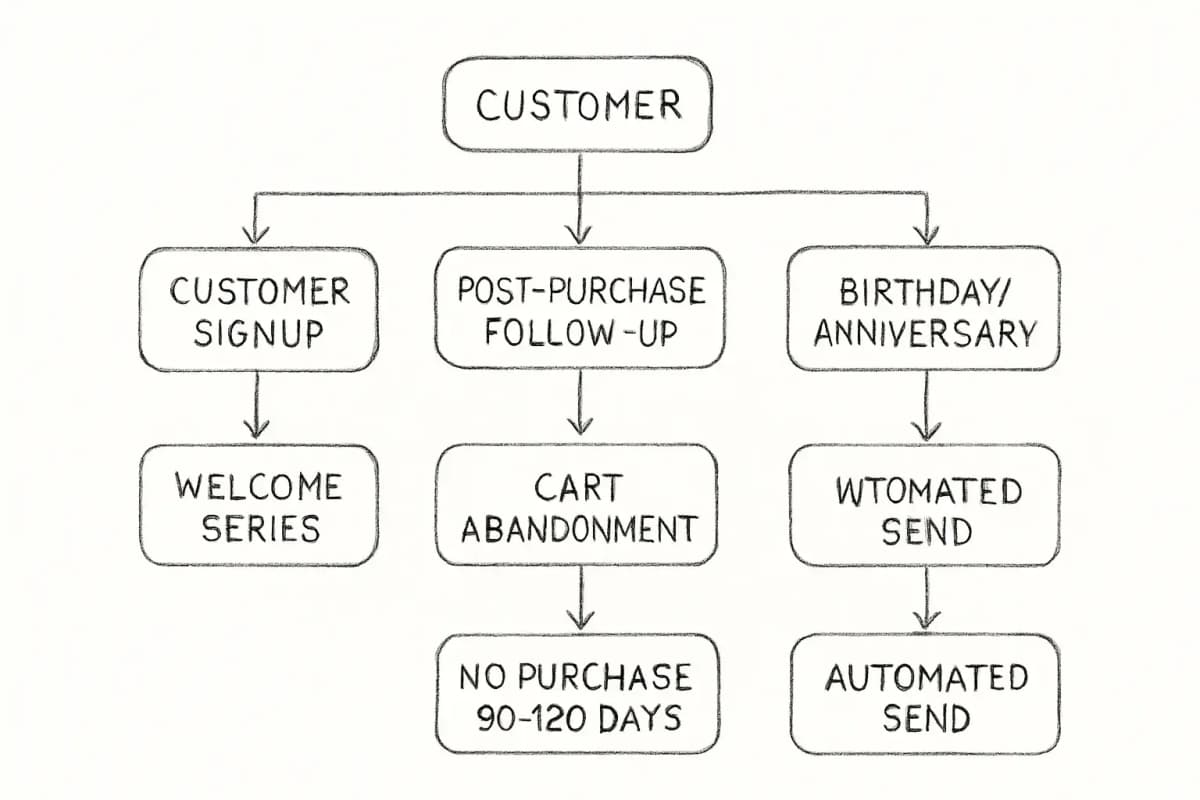
Metrics to Track for Winery Email Marketing
Email marketing is one of the most effective ways for wine industry professionals to reach their audience, nurture relationships, and drive sales, and it is a cost-effective solution for small wineries that allows them to connect with customers and boost revenue without breaking the bank.
The metrics that matter most for wineries:
- Open rate: If your open rate is below 20%, it is time to look at your subject lines and list health.
- Click-through rate: The truest signal of content relevance and call-to-action strength.
- Revenue per email: Calculate it by dividing total revenue generated by the number of emails sent. But the story does not stop at the numbers. Consider audience segmentation, subject line performance, and call-to-action clarity, as these influence how effectively emails convert.
- Wine club conversion rate: Track how many subscribers move from the purchaser segment to active club membership.
- Unsubscribe and spam rates: Keep your bounce rate under 2% to protect sender reputation, per Mailchimp's benchmarks.
If wineries are not looking at their visitors' paths and creating custom landing pages for each email, the most compelling email in wine country may not end in a sale. Match every email CTA to a dedicated landing page built for that specific campaign.
For a broader framework on tracking campaign performance, our email marketing analytics best practices guide covers the full measurement stack.
Deliverability: Getting Into the Inbox
All strategy is worthless if your emails land in spam. Deliverability metrics include open rate, click-through rate, click-to-open rate, read rate, and deleted-before-opening rate, among others. Inbox providers use all of them to decide where your email goes.
Improving your winery email marketing content will please your readers and please inbox providers through higher open and read rates. Higher open and read rates make your emails less likely to get blocked by spam filters. Emails can only get conversions if they make it to the inbox, leaving little wonder why the best winery email content strategies have a large focus on improving deliverability.
Practical deliverability steps for wineries:
- Set up SPF, DKIM, and DMARC records on your sending domain. Increase inbox deliverability with domain sender verification by generating SPF, DKIM, and DMARC records directly from your email platform.
- Regularly clean your list by removing inactive subscribers.
- Avoid large image-only emails, which trigger spam filters and render poorly on mobile.
- Over 53% of emails are now opened on mobile devices, with iPhone being the most popular device for subscribers. Design for small screens first.
Frequently Asked Questions
How often should a winery send marketing emails?
The average number of campaigns sent per winery reached 3.63 per month in 2020, meaning roughly one email per week. That said, frequency should match your content calendar and audience preferences. Quality and relevance matter more than volume. Sending more during low-noise periods like Q1 and Q2 and maintaining consistent quality during Q4 holiday peaks is a sound approach.
What is the best email platform for a small winery?
ActiveCampaign offers powerful automation tools, customizable templates, and in-depth analytics to help manage customer relationships effectively. Klaviyo boasts advanced segmentation and automation features specifically beneficial for small wineries managing an online store, and is ideal for maximizing the impact of direct-to-consumer strategies. Mailchimp is a practical starting point for smaller operations with straightforward needs. The right tool depends on whether you prioritize ease of use, DTC integrations, or advanced automation.
How should a winery use email to grow its wine club?
Use your email list to drive wine club memberships, the backbone of recurring revenue. Focus on quality over quantity since an engaged list is your most valuable asset. Start by sending non-members content that highlights the exclusive benefits club members receive, create urgency around limited shipment windows, and make the sign-up process a single click away from any email.
What type of winery email gets the highest engagement?
Automated emails achieve a 51.05% open rate compared to newsletters. The difference comes down to intent and personalization. Automated emails are triggered by specific actions, such as a customer subscription, making them highly relevant. Welcome sequences, birthday emails, and cart abandonment flows consistently outperform broadcast newsletters. Focus on getting your trigger-based automations running before optimizing broadcast campaigns.