
HomeBlogEmail Marketing Tools & SoftwareAI Email Marketing Tools: Top Picks for 2024
Email Marketing Tools & Software

AI Email Marketing Tools: Top Picks for 2024

Discover the best AI email marketing tools to automate campaigns, boost engagement, and improve ROI. Compare features, pricing, and find your ideal fit.

P

Priya Kapoor

July 15, 2026

13 min read
HomeBlogEmail Marketing Tools & SoftwareAI Email Marketing Tools: Top Picks for 2024
Email Marketing Tools & Software

AI Email Marketing Tools: Top Picks for 2024

Discover the best AI email marketing tools to automate campaigns, boost engagement, and improve ROI. Compare features, pricing, and find your ideal fit.

P

Priya Kapoor

July 15, 2026

13 min read
Share:
Share:
#AI Marketing#Email Automation#Marketing Technology#campaign management
Illustration for ai email marketing tool

Stay in the loop

Get the latest posts delivered straight to your inbox. No spam, unsubscribe anytime.

Nearly 63% of marketers now use AI tools in their email marketing efforts, and the gap between teams that use them and teams that don't is widening fast. Businesses using AI in email campaigns report an average ROI increase of 21%, while automated email sequences generate 320% more revenue than non-automated emails, according to Campaign Monitor. If you're still building campaigns manually, you're leaving measurable revenue on the table.

This guide covers the top AI email marketing tools available today, what each one actually does well, who it's built for, and how to choose the right one for your business.


Key Takeaways

  • Email marketing generates between $36 and $40 for every dollar spent, translating to a 3,600% to 4,000% ROI, outperforming most other marketing channels.
  • Automated emails generate dramatically higher returns despite representing just 2% of send volume, proving the business case for AI-powered workflow automation.
  • Nearly 72% of consumers prefer personalized emails with AI-driven recommendations over generic ones.
  • ActiveCampaign's Predictive Sending boosts customers' click-through rates by 17% on average by delivering emails at each contact's optimal open time.
  • Brands using AI-driven personalization report up to 42% higher revenue, with click-through rates exceeding 13%.

What an AI Email Marketing Tool Actually Does

AI email marketing tools use machine learning to automate decisions that marketers previously made manually: when to send, what to say, and who should receive each message. The software learns from how recipients interact with campaigns and adjusts its recommendations automatically, rather than requiring you to reconfigure rules after every send.

Traditional email platforms require you to set send times, write subject lines, and segment your list manually. AI tools monitor what works and what does not, then surface recommendations based on patterns in your engagement data. The practical difference becomes significant at scale: manual personalization breaks down quickly when you are running campaigns across thousands of contacts with different roles, industries, and buying stages.

The core capabilities to look for in any AI email marketing tool include:

Stay in the loop

Get the latest posts delivered straight to your inbox. No spam, unsubscribe anytime.

Nearly 63% of marketers now use AI tools in their email marketing efforts, and the gap between teams that use them and teams that don't is widening fast. Businesses using AI in email campaigns report an average ROI increase of 21%, while automated email sequences generate 320% more revenue than non-automated emails, according to Campaign Monitor. If you're still building campaigns manually, you're leaving measurable revenue on the table.

This guide covers the top AI email marketing tools available today, what each one actually does well, who it's built for, and how to choose the right one for your business.


Key Takeaways

  • Email marketing generates between $36 and $40 for every dollar spent, translating to a 3,600% to 4,000% ROI, outperforming most other marketing channels.
  • Automated emails generate dramatically higher returns despite representing just 2% of send volume, proving the business case for AI-powered workflow automation.
  • Nearly 72% of consumers prefer personalized emails with AI-driven recommendations over generic ones.
  • ActiveCampaign's Predictive Sending boosts customers' click-through rates by 17% on average by delivering emails at each contact's optimal open time.
  • Brands using AI-driven personalization report up to 42% higher revenue, with click-through rates exceeding 13%.

What an AI Email Marketing Tool Actually Does

AI email marketing tools use machine learning to automate decisions that marketers previously made manually: when to send, what to say, and who should receive each message. The software learns from how recipients interact with campaigns and adjusts its recommendations automatically, rather than requiring you to reconfigure rules after every send.

Traditional email platforms require you to set send times, write subject lines, and segment your list manually. AI tools monitor what works and what does not, then surface recommendations based on patterns in your engagement data. The practical difference becomes significant at scale: manual personalization breaks down quickly when you are running campaigns across thousands of contacts with different roles, industries, and buying stages.

The core capabilities to look for in any AI email marketing tool include:

  • Send-time optimization: Per-contact scheduling based on historical open behavior, not blanket assumptions
  • Content generation: Subject lines, body copy, and CTAs drafted from prompts
  • Predictive segmentation: Audience groups built from behavioral signals, not just list filters
  • AI-driven automation: Workflows that adapt based on engagement, not fixed drip sequences
  • Predictive analytics: Churn risk, customer lifetime value, and next purchase probability

More advanced tools now let you embed AI directly into your workflows, meaning emails can be personalized in real time, triggered by behavior, or even adjusted based on sentiment and engagement.


The Top AI Email Marketing Tools for 2024

1. ActiveCampaign: Best for B2B Automation and Mid-Market Teams

ActiveCampaign offers a suite of AI marketing automation features, including AI Campaign Builder, AI Brand Kit, Predictive Sending, AI-Suggested Segments, and the AI Actions Library. These tools automate campaign creation, personalize content, optimize send times, and continuously refine targeting based on real-time data. By handling routine tasks and providing actionable insights, these features help marketers achieve better results with less effort.

The platform's standout feature is Predictive Sending. By using AI to analyze engagement patterns, predictive sending helps you optimize send times for each person on your list, delivering better email performance, more audience reach, and more opportunities to build your brand. Predictive Sending analyzes when each contact is most likely to engage, then automatically sends at those optimal times, boosting customers' click-through rates by 17% on average.

AI-suggested segments in ActiveCampaign analyze your customer data to uncover high-value audiences you might not have identified on your own, such as likely repeat buyers or at-risk subscribers. The AI reveals patterns and predicts outcomes, providing ready-to-use segments that improve targeting and campaign performance.

Pricing: The Starter Plan begins at $15 per month for 1,000 contacts. The Plus Plan starts at $49 per month and adds CRM functionality, landing pages, SMS marketing, and lead scoring. The Professional Plan at $79 per month for 1,000 contacts includes predictive AI features for sending optimization, AI content generation, and win probability calculations.

Best for: B2B companies and service businesses on Plus or Professional plans. ActiveCampaign's AI is practical and well-integrated with automation workflows.


2. Klaviyo: Best for Ecommerce Brands

Klaviyo is the autonomous B2C CRM and AI marketing platform that unifies customer data and automates email, SMS, RCS, WhatsApp, and mobile push to drive personalized, revenue-generating campaigns. Built as both a system of record and system of action, Klaviyo combines a customer data platform, real-time signals, and AI agents to power automated insights and one-click execution.

  • Send-time optimization: Per-contact scheduling based on historical open behavior, not blanket assumptions
  • Content generation: Subject lines, body copy, and CTAs drafted from prompts
  • Predictive segmentation: Audience groups built from behavioral signals, not just list filters
  • AI-driven automation: Workflows that adapt based on engagement, not fixed drip sequences
  • Predictive analytics: Churn risk, customer lifetime value, and next purchase probability

More advanced tools now let you embed AI directly into your workflows, meaning emails can be personalized in real time, triggered by behavior, or even adjusted based on sentiment and engagement.


The Top AI Email Marketing Tools for 2024

1. ActiveCampaign: Best for B2B Automation and Mid-Market Teams

ActiveCampaign offers a suite of AI marketing automation features, including AI Campaign Builder, AI Brand Kit, Predictive Sending, AI-Suggested Segments, and the AI Actions Library. These tools automate campaign creation, personalize content, optimize send times, and continuously refine targeting based on real-time data. By handling routine tasks and providing actionable insights, these features help marketers achieve better results with less effort.

The platform's standout feature is Predictive Sending. By using AI to analyze engagement patterns, predictive sending helps you optimize send times for each person on your list, delivering better email performance, more audience reach, and more opportunities to build your brand. Predictive Sending analyzes when each contact is most likely to engage, then automatically sends at those optimal times, boosting customers' click-through rates by 17% on average.

AI-suggested segments in ActiveCampaign analyze your customer data to uncover high-value audiences you might not have identified on your own, such as likely repeat buyers or at-risk subscribers. The AI reveals patterns and predicts outcomes, providing ready-to-use segments that improve targeting and campaign performance.

Pricing: The Starter Plan begins at $15 per month for 1,000 contacts. The Plus Plan starts at $49 per month and adds CRM functionality, landing pages, SMS marketing, and lead scoring. The Professional Plan at $79 per month for 1,000 contacts includes predictive AI features for sending optimization, AI content generation, and win probability calculations.

Best for: B2B companies and service businesses on Plus or Professional plans. ActiveCampaign's AI is practical and well-integrated with automation workflows.


2. Klaviyo: Best for Ecommerce Brands

Klaviyo is the autonomous B2C CRM and AI marketing platform that unifies customer data and automates email, SMS, RCS, WhatsApp, and mobile push to drive personalized, revenue-generating campaigns. Built as both a system of record and system of action, Klaviyo combines a customer data platform, real-time signals, and AI agents to power automated insights and one-click execution.

Klaviyo earns its top position because of K:AI, its built-in AI agent system that goes well beyond standard automation. The Marketing Agent ingests your website data and generates fully designed, on-brand email campaigns in just a few clicks, with no prompts required. Klaviyo's AI spans over 40 features, from Segments AI that builds audience targeting from your full customer data set to personalized send time optimization that delivers messages when each individual subscriber is most likely to engage.

Klaviyo calculates customer lifetime value, churn probability, and next order dates using machine learning trained on ecommerce patterns. Abandoned cart flows have proven particularly effective: Klaviyo's Q4 2024 data shows abandoned cart flows achieve 35 to 40% open rates and 15 to 20% conversion rates.

Pricing: The free plan lets you import and sync contacts, customize templates, and use automations and segmentation. On this tier you are limited to 250 active profiles and 500 email sends per month. Paid plans start at $45 per month for 251 to 500 profiles and scale across 58+ tier thresholds.

Best for: Ecommerce brands that need data-driven automation. The segmentation depth, AI optimization, and native Shopify integration are a tier above what most competitors offer.

For a deeper look at how to build revenue-driving automated sequences, see our guide on email marketing automation tips.


3. HubSpot Marketing Hub: Best for Full-Funnel Teams with CRM Needs

HubSpot combines email with CRM and automation in a platform designed for teams that want a single system managing both marketing campaigns and contact records. Breeze AI is HubSpot's AI layer, powering AI-drafted emails with CRM personalization, the Breeze Copilot AI assistant, and Audience Segments for fit and intent targeting through Breeze Intelligence.

The smart send time feature analyzes when each individual contact typically opens emails and schedules delivery for those windows. Content optimization tools suggest stronger subject lines and flag copy patterns that tend to trigger spam filters. Segmentation works through list-building tools that filter by lifecycle stage, lead score, and behavioral signals like page views or form fills.

HubSpot's Breeze AI automatically tracks email revenue attribution, connecting every email interaction to closed deals and calculating true campaign ROI. It also powers send-time optimization, automatically determining the optimal delivery time for each subscriber.

Pricing: HubSpot offers a free tier with basic email tools. HubSpot Marketing Hub is the best choice for businesses that need a comprehensive marketing platform with CRM integration and powerful automation features. It's ideal for larger organizations that can justify the price.

Best for: AI-powered inbound marketing and email optimization. HubSpot's Content Assistant writes email copy that fits your inbound strategy, Smart Content changes based on who's reading, and Performance Predictions tell you if a campaign will work before you send it. The AI is designed specifically for inbound methodologies, supporting the entire buyer journey.


Klaviyo earns its top position because of K:AI, its built-in AI agent system that goes well beyond standard automation. The Marketing Agent ingests your website data and generates fully designed, on-brand email campaigns in just a few clicks, with no prompts required. Klaviyo's AI spans over 40 features, from Segments AI that builds audience targeting from your full customer data set to personalized send time optimization that delivers messages when each individual subscriber is most likely to engage.

Klaviyo calculates customer lifetime value, churn probability, and next order dates using machine learning trained on ecommerce patterns. Abandoned cart flows have proven particularly effective: Klaviyo's Q4 2024 data shows abandoned cart flows achieve 35 to 40% open rates and 15 to 20% conversion rates.

Pricing: The free plan lets you import and sync contacts, customize templates, and use automations and segmentation. On this tier you are limited to 250 active profiles and 500 email sends per month. Paid plans start at $45 per month for 251 to 500 profiles and scale across 58+ tier thresholds.

Best for: Ecommerce brands that need data-driven automation. The segmentation depth, AI optimization, and native Shopify integration are a tier above what most competitors offer.

For a deeper look at how to build revenue-driving automated sequences, see our guide on email marketing automation tips.


3. HubSpot Marketing Hub: Best for Full-Funnel Teams with CRM Needs

HubSpot combines email with CRM and automation in a platform designed for teams that want a single system managing both marketing campaigns and contact records. Breeze AI is HubSpot's AI layer, powering AI-drafted emails with CRM personalization, the Breeze Copilot AI assistant, and Audience Segments for fit and intent targeting through Breeze Intelligence.

The smart send time feature analyzes when each individual contact typically opens emails and schedules delivery for those windows. Content optimization tools suggest stronger subject lines and flag copy patterns that tend to trigger spam filters. Segmentation works through list-building tools that filter by lifecycle stage, lead score, and behavioral signals like page views or form fills.

HubSpot's Breeze AI automatically tracks email revenue attribution, connecting every email interaction to closed deals and calculating true campaign ROI. It also powers send-time optimization, automatically determining the optimal delivery time for each subscriber.

Pricing: HubSpot offers a free tier with basic email tools. HubSpot Marketing Hub is the best choice for businesses that need a comprehensive marketing platform with CRM integration and powerful automation features. It's ideal for larger organizations that can justify the price.

Best for: AI-powered inbound marketing and email optimization. HubSpot's Content Assistant writes email copy that fits your inbound strategy, Smart Content changes based on who's reading, and Performance Predictions tell you if a campaign will work before you send it. The AI is designed specifically for inbound methodologies, supporting the entire buyer journey.


4. Mailchimp: Best for Small Businesses and Beginners

Mailchimp provides email marketing with AI features including Content Optimizer, Creative Assistant, and predictive segmentation. Content Optimizer analyzes past campaigns to recommend subject lines and send times that match your audience's engagement patterns. Creative Assistant uses generative AI to suggest email layouts and image placements based on your brand assets.

Mailchimp's benchmarking AI is underappreciated. It compares your campaign metrics against similar businesses in your industry and tells you where you're above or below average. This context is valuable for beginners who don't know what "good" looks like for their industry and audience size.

Pricing: A free plan is available for up to 500 contacts with a limit of 1,000 sends per month. Paid plans start at $13 per month (Essentials) and scale based on features and audience size.

Best for: Small businesses and startups that need capable email automation without the complexity or cost of enterprise platforms.


5. Brevo (formerly Sendinblue): Best for Budget-Conscious Teams

Brevo offers the most generous free tier of any email marketing platform and keeps pricing low at scale. Its AI features are basic compared to HubSpot or Klaviyo, but for small businesses watching every dollar, the value proposition is hard to beat.

Brevo works well for small-to-medium businesses that need affordable email with basic automation, particularly for large contact lists with moderate sending frequency and for teams that want email, SMS, and WhatsApp in one platform.

Best for: Small businesses and startups on tight budgets that need reliable email marketing with SMS and WhatsApp integration, without paying $50+ per month for features they won't use.


6. Jasper AI: Best for Email Copywriting at Scale

Jasper is not an email platform; it's an AI writing tool that excels at generating email copy. If your bottleneck is writing compelling subject lines, body copy, and CTAs rather than automation or deliverability, Jasper fills that gap better than any ESP's built-in AI.

In testing, Jasper was used to generate 10 subject line variants and 5 body copy versions for a product launch email. The Brand Voice feature maintained consistent tone across all variants, and the template library provided frameworks for welcome sequences, re-engagement, and promotional campaigns. Quality was noticeably higher than what Mailchimp or ActiveCampaign's built-in AI produced.

Pricing: Pricing starts from $69 per month with a free 7-day trial available, though credit card details are required.

Best for: Marketing teams that produce high volumes of email content and need consistent brand voice across multiple campaigns. Jasper pairs well with any dedicated ESP for sending and automation.


How to Choose the Right AI Email Marketing Tool

The right tool depends on three factors: your business model, your team's technical depth, and where your biggest bottleneck is.

4. Mailchimp: Best for Small Businesses and Beginners

Mailchimp provides email marketing with AI features including Content Optimizer, Creative Assistant, and predictive segmentation. Content Optimizer analyzes past campaigns to recommend subject lines and send times that match your audience's engagement patterns. Creative Assistant uses generative AI to suggest email layouts and image placements based on your brand assets.

Mailchimp's benchmarking AI is underappreciated. It compares your campaign metrics against similar businesses in your industry and tells you where you're above or below average. This context is valuable for beginners who don't know what "good" looks like for their industry and audience size.

Pricing: A free plan is available for up to 500 contacts with a limit of 1,000 sends per month. Paid plans start at $13 per month (Essentials) and scale based on features and audience size.

Best for: Small businesses and startups that need capable email automation without the complexity or cost of enterprise platforms.


5. Brevo (formerly Sendinblue): Best for Budget-Conscious Teams

Brevo offers the most generous free tier of any email marketing platform and keeps pricing low at scale. Its AI features are basic compared to HubSpot or Klaviyo, but for small businesses watching every dollar, the value proposition is hard to beat.

Brevo works well for small-to-medium businesses that need affordable email with basic automation, particularly for large contact lists with moderate sending frequency and for teams that want email, SMS, and WhatsApp in one platform.

Best for: Small businesses and startups on tight budgets that need reliable email marketing with SMS and WhatsApp integration, without paying $50+ per month for features they won't use.


6. Jasper AI: Best for Email Copywriting at Scale

Jasper is not an email platform; it's an AI writing tool that excels at generating email copy. If your bottleneck is writing compelling subject lines, body copy, and CTAs rather than automation or deliverability, Jasper fills that gap better than any ESP's built-in AI.

In testing, Jasper was used to generate 10 subject line variants and 5 body copy versions for a product launch email. The Brand Voice feature maintained consistent tone across all variants, and the template library provided frameworks for welcome sequences, re-engagement, and promotional campaigns. Quality was noticeably higher than what Mailchimp or ActiveCampaign's built-in AI produced.

Pricing: Pricing starts from $69 per month with a free 7-day trial available, though credit card details are required.

Best for: Marketing teams that produce high volumes of email content and need consistent brand voice across multiple campaigns. Jasper pairs well with any dedicated ESP for sending and automation.


How to Choose the Right AI Email Marketing Tool

The right tool depends on three factors: your business model, your team's technical depth, and where your biggest bottleneck is.

Business TypeRecommended Tool
Ecommerce (Shopify, WooCommerce)Klaviyo
B2B / SaaS with CRM needsHubSpot or ActiveCampaign
Small business, limited budgetMailchimp or Brevo
High-volume content productionJasper (paired with any ESP)
Mid-market with complex automationActiveCampaign

AI copywriting tools like Jasper focus on generating text: subject lines, body copy, sequences. AI email marketing platforms like Klaviyo and ActiveCampaign go further with optimization features: send time prediction, churn scoring, segmentation, and performance analytics. Copywriting is one feature; full-stack AI tools use AI across the entire email lifecycle.

If you're not sure where to start, focus on the feature that solves your most pressing problem. Struggling with low open rates? Prioritize send-time optimization and subject line best practices. Leaving revenue on the table from undifferentiated campaigns? Email list segmentation powered by AI will move the needle faster than any other lever.


What AI Can and Cannot Do for Your Email Program

AI tools are most effective when your email program already has solid foundations: a clean list, clear segmentation logic, and a defined content strategy. They amplify what's working; they don't fix what's broken.

The tools that actually deliver on their AI promises help email marketers understand customer behavior, predict what will resonate, optimize content and lists in real time, and continuously improve performance. They give you back the time and mental bandwidth to focus on strategy and creativity instead of getting bogged down in tactical execution.

That said, AI-generated content still requires human editing for brand voice. Email body drafts from AI content generators are functional first drafts. The quality is comparable across leading platforms, but they're professional yet personality-free. They need brand voice editing before sending.

The strongest use cases for AI in email right now are:

  1. Per-contact send-time optimization: No human can calculate the best send window for 50,000 individual contacts. AI can.
  2. Behavioral segmentation: AI finds audience clusters you wouldn't have thought to create manually.
  3. Predictive analytics: Churn risk and CLV predictions let you intervene before a customer goes quiet.
  4. A/B testing at scale: AI can generate and test more subject line variants than any manual process.
Business TypeRecommended Tool
Ecommerce (Shopify, WooCommerce)Klaviyo
B2B / SaaS with CRM needsHubSpot or ActiveCampaign
Small business, limited budgetMailchimp or Brevo
High-volume content productionJasper (paired with any ESP)
Mid-market with complex automationActiveCampaign

AI copywriting tools like Jasper focus on generating text: subject lines, body copy, sequences. AI email marketing platforms like Klaviyo and ActiveCampaign go further with optimization features: send time prediction, churn scoring, segmentation, and performance analytics. Copywriting is one feature; full-stack AI tools use AI across the entire email lifecycle.

If you're not sure where to start, focus on the feature that solves your most pressing problem. Struggling with low open rates? Prioritize send-time optimization and subject line best practices. Leaving revenue on the table from undifferentiated campaigns? Email list segmentation powered by AI will move the needle faster than any other lever.


What AI Can and Cannot Do for Your Email Program

AI tools are most effective when your email program already has solid foundations: a clean list, clear segmentation logic, and a defined content strategy. They amplify what's working; they don't fix what's broken.

The tools that actually deliver on their AI promises help email marketers understand customer behavior, predict what will resonate, optimize content and lists in real time, and continuously improve performance. They give you back the time and mental bandwidth to focus on strategy and creativity instead of getting bogged down in tactical execution.

That said, AI-generated content still requires human editing for brand voice. Email body drafts from AI content generators are functional first drafts. The quality is comparable across leading platforms, but they're professional yet personality-free. They need brand voice editing before sending.

The strongest use cases for AI in email right now are:

  1. Per-contact send-time optimization: No human can calculate the best send window for 50,000 individual contacts. AI can.
  2. Behavioral segmentation: AI finds audience clusters you wouldn't have thought to create manually.
  3. Predictive analytics: Churn risk and CLV predictions let you intervene before a customer goes quiet.
  4. A/B testing at scale: AI can generate and test more subject line variants than any manual process.

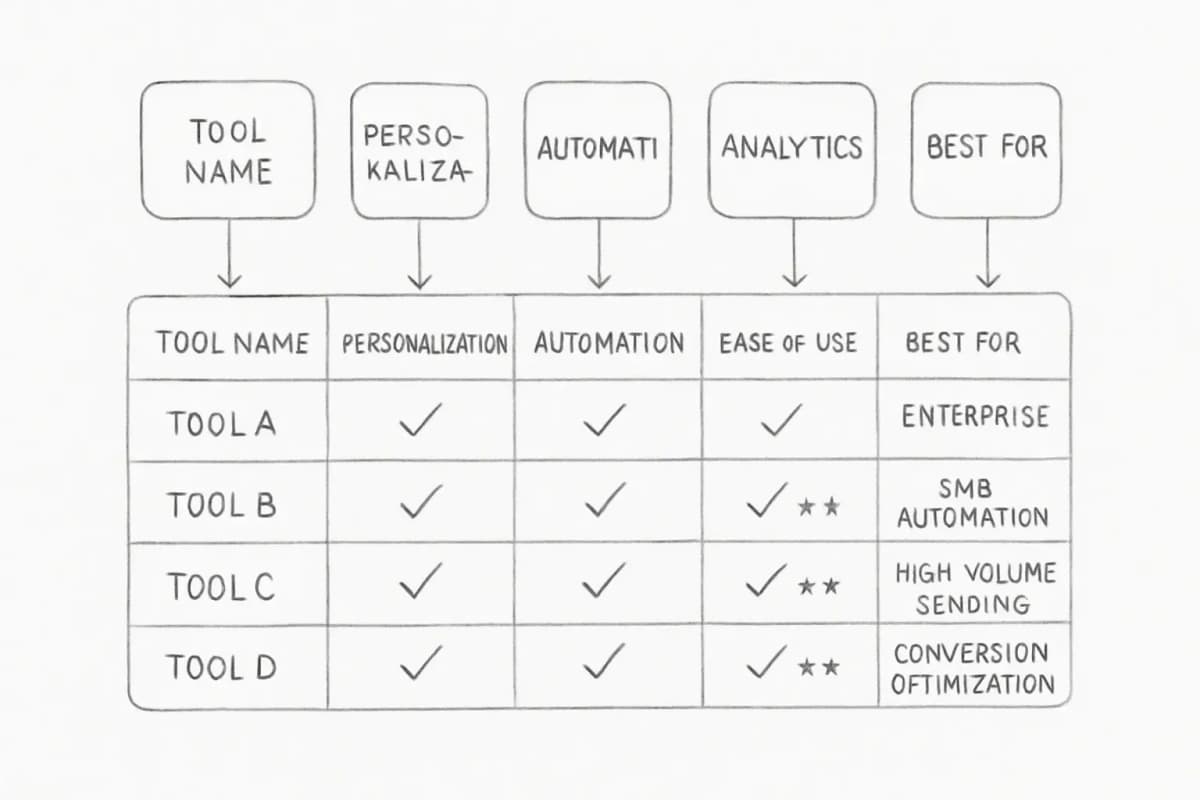
39% of email marketing professionals believe that AI-driven hyperpersonalization will have the biggest effect on email automation campaigns in the coming years, as this approach tailors content more precisely to individual user behaviors and preferences. Comparison chart displaying top AI email marketing tools in rows with columns for key features (personalization capabilities, automation workflows, analytics depth, ease of use, pricing tier) and best use cases (enterprise campaigns, SMB automation, high-volume sending, conversion optimization). Include 4-5 popular tools as examples with checkmarks, feature ratings, and use case tags to help readers quickly identify which tool matches their needs.

Measuring ROI from Your AI Email Marketing Tool

Before choosing a platform, define how you'll measure success. The metrics that matter most vary by tool and objective:

  • Open rate lift: Baseline against your pre-AI average for the same list segment
  • Click-through rate: AI-optimized send times and subject lines should move this within 30 to 60 days
  • Revenue per email: The definitive metric for ecommerce teams
  • Time saved in campaign production: Track hours from brief to send before and after

Track before-and-after metrics for each AI feature you enable. For send time optimization, compare open rates. For AI-generated content, compare time spent writing. For predictive analytics, track whether identified at-risk customers were successfully retained. Most platforms don't isolate AI-specific ROI, so you'll need to run your own comparisons over 2 to 3 months.

For a structured approach to tracking and acting on these metrics, see our post on email marketing analytics best practices.


Frequently Asked Questions

What is an AI email marketing tool?

An AI email marketing tool is software that uses machine learning to automate and improve email campaign decisions. AI email marketing is the use of artificial intelligence in email marketing tasks. For example, AI can predict the best time to send an email and which products to recommend to customers in your emails. It can also write emails and build automated workflows. As a result, you can spend less time on email marketing activities while getting better results, including higher open rates and increased revenue.

Which AI email marketing tool is best for ecommerce?

Klaviyo is the recommended choice for ecommerce store owners who need advanced features like predictive AI for marketing automation, dynamic content, and integrated SMS campaigns. Klaviyo's integration with virtually all ecommerce platforms makes it easy to develop personalized campaigns directly linked to customer behavior.

Can AI email tools improve deliverability?

AI can indirectly improve deliverability by helping you send more relevant content to engaged segments, which lowers spam complaints and improves sender reputation. Content optimization tools in platforms like HubSpot suggest stronger subject lines and flag copy patterns that tend to trigger spam filters. However, deliverability fundamentals like list hygiene, authentication setup, and sending volume discipline still require human oversight.

How much do AI email marketing tools cost?

39% of email marketing professionals believe that AI-driven hyperpersonalization will have the biggest effect on email automation campaigns in the coming years, as this approach tailors content more precisely to individual user behaviors and preferences. Comparison chart displaying top AI email marketing tools in rows with columns for key features (personalization capabilities, automation workflows, analytics depth, ease of use, pricing tier) and best use cases (enterprise campaigns, SMB automation, high-volume sending, conversion optimization). Include 4-5 popular tools as examples with checkmarks, feature ratings, and use case tags to help readers quickly identify which tool matches their needs.


Measuring ROI from Your AI Email Marketing Tool

Before choosing a platform, define how you'll measure success. The metrics that matter most vary by tool and objective:

  • Open rate lift: Baseline against your pre-AI average for the same list segment
  • Click-through rate: AI-optimized send times and subject lines should move this within 30 to 60 days
  • Revenue per email: The definitive metric for ecommerce teams
  • Time saved in campaign production: Track hours from brief to send before and after

Track before-and-after metrics for each AI feature you enable. For send time optimization, compare open rates. For AI-generated content, compare time spent writing. For predictive analytics, track whether identified at-risk customers were successfully retained. Most platforms don't isolate AI-specific ROI, so you'll need to run your own comparisons over 2 to 3 months.

For a structured approach to tracking and acting on these metrics, see our post on email marketing analytics best practices.


Frequently Asked Questions

What is an AI email marketing tool?

An AI email marketing tool is software that uses machine learning to automate and improve email campaign decisions. AI email marketing is the use of artificial intelligence in email marketing tasks. For example, AI can predict the best time to send an email and which products to recommend to customers in your emails. It can also write emails and build automated workflows. As a result, you can spend less time on email marketing activities while getting better results, including higher open rates and increased revenue.

Which AI email marketing tool is best for ecommerce?

Klaviyo is the recommended choice for ecommerce store owners who need advanced features like predictive AI for marketing automation, dynamic content, and integrated SMS campaigns. Klaviyo's integration with virtually all ecommerce platforms makes it easy to develop personalized campaigns directly linked to customer behavior.

Can AI email tools improve deliverability?

AI can indirectly improve deliverability by helping you send more relevant content to engaged segments, which lowers spam complaints and improves sender reputation. Content optimization tools in platforms like HubSpot suggest stronger subject lines and flag copy patterns that tend to trigger spam filters. However, deliverability fundamentals like list hygiene, authentication setup, and sending volume discipline still require human oversight.

How much do AI email marketing tools cost?

Costs vary widely by platform and list size. Entry-level plans start at $13 per month (Mailchimp), $15 per month (ActiveCampaign), and $20 per month (Klaviyo for up to 500 contacts). Dedicated AI copywriting tools like Jasper start from $69 per month. Enterprise platforms like HubSpot scale into hundreds of dollars per month as contact counts and feature requirements grow. Most platforms offer free trials or free tiers for small lists, which is the lowest-risk way to evaluate fit before committing.


No comments yet. Be the first!

Leave a comment

Comments are reviewed before publishing.

Costs vary widely by platform and list size. Entry-level plans start at $13 per month (Mailchimp), $15 per month (ActiveCampaign), and $20 per month (Klaviyo for up to 500 contacts). Dedicated AI copywriting tools like Jasper start from $69 per month. Enterprise platforms like HubSpot scale into hundreds of dollars per month as contact counts and feature requirements grow. Most platforms offer free trials or free tiers for small lists, which is the lowest-risk way to evaluate fit before committing.

No comments yet. Be the first!

Leave a comment

Comments are reviewed before publishing.

More from

Related posts

Illustration for email marketing tools with ai optimization 2025
Email Marketing Tools & SoftwareJul 17, 2026 15 min

Best Email Marketing Tools With AI Optimization 2025

Compare top email marketing tools with built-in AI features for 2025. Discover automation, personalization, and deliverability improvements.

More from

Related posts

Illustration for email marketing tools with ai optimization 2025
Email Marketing Tools & SoftwareJul 17, 2026 15 min

Best Email Marketing Tools With AI Optimization 2025

Compare top email marketing tools with built-in AI features for 2025. Discover automation, personalization, and deliverability improvements.

SSarah Mitchell
SSarah Mitchell
Illustration for ai-powered email marketing platforms
Email Marketing Tools & SoftwareJul 17, 2026 15 min

AI-Powered Email Marketing Platforms: 2024 Guide

Discover the best AI-powered email marketing platforms that automate campaigns, improve deliverability, and boost ROI. Compare features and find the right tool.

MMarcus Webb
Illustration for ai-powered email marketing platforms
Email Marketing Tools & SoftwareJul 17, 2026 15 min

AI-Powered Email Marketing Platforms: 2024 Guide

Discover the best AI-powered email marketing platforms that automate campaigns, improve deliverability, and boost ROI. Compare features and find the right tool.

MMarcus Webb
Illustration for best email marketing automation tools 2024
Email Marketing Tools & SoftwareJul 16, 2026 11 min

Best Email Marketing Automation Tools 2024

Compare top email marketing automation platforms for deliverability, segmentation, and ROI. Find the right tool for your business needs.

RRachel Torres
Illustration for best email marketing automation tools 2024
Email Marketing Tools & SoftwareJul 16, 2026 11 min

Best Email Marketing Automation Tools 2024

Compare top email marketing automation platforms for deliverability, segmentation, and ROI. Find the right tool for your business needs.

RRachel Torres