
HomeBlogEmail Marketing Tools & SoftwareAI-Powered Email Marketing Tools: Top 10 for 2024
Email Marketing Tools & Software

AI-Powered Email Marketing Tools: Top 10 for 2024

Discover the best AI-powered email marketing tools to boost open rates, personalize campaigns, and save time. Compare features and find the right fit.

M

Marcus Webb

July 13, 2026

HomeBlogEmail Marketing Tools & SoftwareAI-Powered Email Marketing Tools: Top 10 for 2024
Email Marketing Tools & Software

AI-Powered Email Marketing Tools: Top 10 for 2024

Discover the best AI-powered email marketing tools to boost open rates, personalize campaigns, and save time. Compare features and find the right fit.

M

Marcus Webb

July 13, 2026

15 min read
15 min read
Share:
Share:
#AI Marketing Automation#Email Personalization#Marketing Technology#Email Campaign Tools
Illustration for ai-powered email marketing tools

Stay in the loop

Get the latest posts delivered straight to your inbox. No spam, unsubscribe anytime.

Nearly two-thirds of marketers now use AI tools for email campaigns, with automated emails generating 320% more revenue than manual campaigns despite representing just 2% of total send volume. If you are still picking tools based on a drag-and-drop editor and a contact limit, you are selecting the wrong criteria. The variable that separates high-performing email programs from average ones in 2024 is how intelligently a platform uses your data.

This guide covers the top 10 ai-powered email marketing tools, what each one actually does well, who it fits, and what to watch out for before you commit.

Key Takeaways

  • Businesses using AI in email campaigns report an average ROI increase of 21%.
  • Marketers implementing AI-powered personalization see revenue increase by 41% and click-through rates rise 13.44% compared to non-personalized campaigns.
  • AI send-time optimization lifts open rates by 15-23% by delivering at each subscriber's personal optimal moment rather than batch-sending at a fixed time.
  • Research by McKinsey shows that organizations investing in AI experience a sales ROI uplift of 10 to 20 percent.
  • Not all "AI-powered" tools are equal. Many AI email tools claim to be AI-powered but rely on basic automation rather than deep personalization.

What Makes a Tool Genuinely AI-Powered

Before comparing platforms, it helps to understand what separates real AI from rebranded automation. AI email marketing tools use machine learning to automate decisions that marketers previously made manually: when to send, what to say, and who should receive each message. The software learns from how recipients interact with campaigns and adjusts its recommendations automatically, rather than requiring you to reconfigure rules after every send.

AI copywriting tools like Jasper and Copy.ai focus on generating text: subject lines, body copy, sequences. Full AI email marketing platforms go further, adding send time prediction, churn scoring, segmentation, and performance analytics. Copywriting is one feature; AI marketing tools use AI across the entire email lifecycle.

The practical test: does the tool learn from your specific audience's behavior, or does it apply generic rules across all users?


Top 10 AI-Powered Email Marketing Tools

Stay in the loop

Get the latest posts delivered straight to your inbox. No spam, unsubscribe anytime.

Nearly two-thirds of marketers now use AI tools for email campaigns, with automated emails generating 320% more revenue than manual campaigns despite representing just 2% of total send volume. If you are still picking tools based on a drag-and-drop editor and a contact limit, you are selecting the wrong criteria. The variable that separates high-performing email programs from average ones in 2024 is how intelligently a platform uses your data.

This guide covers the top 10 ai-powered email marketing tools, what each one actually does well, who it fits, and what to watch out for before you commit.

Key Takeaways

  • Businesses using AI in email campaigns report an average ROI increase of 21%.
  • Marketers implementing AI-powered personalization see revenue increase by 41% and click-through rates rise 13.44% compared to non-personalized campaigns.
  • AI send-time optimization lifts open rates by 15-23% by delivering at each subscriber's personal optimal moment rather than batch-sending at a fixed time.
  • Research by McKinsey shows that organizations investing in AI experience a sales ROI uplift of 10 to 20 percent.
  • Not all "AI-powered" tools are equal. Many AI email tools claim to be AI-powered but rely on basic automation rather than deep personalization.

What Makes a Tool Genuinely AI-Powered

Before comparing platforms, it helps to understand what separates real AI from rebranded automation. AI email marketing tools use machine learning to automate decisions that marketers previously made manually: when to send, what to say, and who should receive each message. The software learns from how recipients interact with campaigns and adjusts its recommendations automatically, rather than requiring you to reconfigure rules after every send.

AI copywriting tools like Jasper and Copy.ai focus on generating text: subject lines, body copy, sequences. Full AI email marketing platforms go further, adding send time prediction, churn scoring, segmentation, and performance analytics. Copywriting is one feature; AI marketing tools use AI across the entire email lifecycle.

The practical test: does the tool learn from your specific audience's behavior, or does it apply generic rules across all users?


Top 10 AI-Powered Email Marketing Tools

1. ActiveCampaign

Best for: Mid-market and B2B teams that need deep automation logic.

ActiveCampaign has the most granular automation builder of any email marketing platform. Its AI layer adds predictive sending, win probability scoring, and content recommendations on top of already-powerful if/then/else automation logic.

ActiveCampaign's AI analyzes each contact's historical engagement patterns, predicts the best send time per individual, and recommends subject line styles based on what has worked for similar contacts. The conditional logic allows for multiple paths based on engagement history, industry, and deal value.

If you are sending segmented campaigns, building multi-step workflows, scoring leads, or split-testing automations, ActiveCampaign is where the value equation tips heavily in its favor. It is the closest thing to a true AI-native email platform in its class.

Pricing: Starts at $15/month (Starter).


2. Klaviyo

Best for: Ecommerce brands on Shopify or WooCommerce.

Klaviyo is an autonomous B2C CRM and AI marketing platform that unifies customer data and automates email, SMS, RCS, WhatsApp, and mobile push to drive personalized, revenue-generating campaigns. Built as both a system of record and system of action, it combines a customer data platform, real-time signals, and AI agents to power automated insights and one-click execution.

Klaviyo uses AI and predictive analytics to forecast customer behavior, including expected next purchase date, predicted lifetime value, and churn probability. These predictions feed directly into segmentation, enabling automated targeting of high-value or at-risk customers without manual analysis. AI also powers subject line optimization, send-time personalization, and product recommendations within email templates.

Klaviyo crossed $1B revenue in 2024 with 167,000 customers and 34% YoY growth, with automated workflows generating 30x more revenue per recipient than standard campaigns.

Pricing: Free up to 250 contacts; paid plans start at $45/month for 251-500 profiles and scale across 58+ tier thresholds.

If you want to understand how personalization drives Klaviyo's results, see our guide on AI email marketing personalization techniques.


3. HubSpot Marketing Hub

Best for: Teams that need email tightly connected to a CRM.

1. ActiveCampaign

Best for: Mid-market and B2B teams that need deep automation logic.

ActiveCampaign has the most granular automation builder of any email marketing platform. Its AI layer adds predictive sending, win probability scoring, and content recommendations on top of already-powerful if/then/else automation logic.

ActiveCampaign's AI analyzes each contact's historical engagement patterns, predicts the best send time per individual, and recommends subject line styles based on what has worked for similar contacts. The conditional logic allows for multiple paths based on engagement history, industry, and deal value.

If you are sending segmented campaigns, building multi-step workflows, scoring leads, or split-testing automations, ActiveCampaign is where the value equation tips heavily in its favor. It is the closest thing to a true AI-native email platform in its class.

Pricing: Starts at $15/month (Starter).


2. Klaviyo

Best for: Ecommerce brands on Shopify or WooCommerce.

Klaviyo is an autonomous B2C CRM and AI marketing platform that unifies customer data and automates email, SMS, RCS, WhatsApp, and mobile push to drive personalized, revenue-generating campaigns. Built as both a system of record and system of action, it combines a customer data platform, real-time signals, and AI agents to power automated insights and one-click execution.

Klaviyo uses AI and predictive analytics to forecast customer behavior, including expected next purchase date, predicted lifetime value, and churn probability. These predictions feed directly into segmentation, enabling automated targeting of high-value or at-risk customers without manual analysis. AI also powers subject line optimization, send-time personalization, and product recommendations within email templates.

Klaviyo crossed $1B revenue in 2024 with 167,000 customers and 34% YoY growth, with automated workflows generating 30x more revenue per recipient than standard campaigns.

Pricing: Free up to 250 contacts; paid plans start at $45/month for 251-500 profiles and scale across 58+ tier thresholds.

If you want to understand how personalization drives Klaviyo's results, see our guide on AI email marketing personalization techniques.


3. HubSpot Marketing Hub

Best for: Teams that need email tightly connected to a CRM.

HubSpot combines email with CRM and automation in a platform designed for teams that want a single system managing both marketing campaigns and contact records. Breeze AI is HubSpot's AI layer, powering AI-drafted emails with CRM personalization, the Breeze Copilot AI assistant, and Audience Segments for fit and intent targeting through Breeze Intelligence.

The smart send time feature analyzes when each individual contact typically opens emails and schedules delivery for those windows. Content optimization tools suggest stronger subject lines and flag copy patterns that tend to trigger spam filters.

Unlike traditional analytics, which report on past performance, AI-powered analytics identify patterns, predict future outcomes, and provide actionable recommendations to enhance engagement and drive revenue growth.

Pricing: Free plan available; paid tiers start at $15/month per seat.


4. Mailchimp

Best for: Small businesses and teams new to email marketing automation.

Mailchimp provides email marketing with AI features including Content Optimizer, Creative Assistant, and predictive segmentation. Content Optimizer analyzes past campaigns to recommend subject lines and send times that match your audience's engagement patterns. Creative Assistant uses generative AI to suggest email layouts and image placements based on your brand assets.

Mailchimp's benchmarking AI is underappreciated. It compares your campaign metrics against similar businesses in your industry and tells you where you are above or below average. This context is valuable for beginners who do not know what "good" looks like for their industry and audience size.

The platform's AI features are more accessible than enterprise alternatives, though less sophisticated. Mailchimp is best suited for small businesses and startups that need capable email automation without the complexity or cost of enterprise platforms.

Pricing: Free up to 500 contacts; paid plans from $13/month.


5. Brevo (formerly Sendinblue)

Best for: Small to mid-size businesses that need email, SMS, and WhatsApp in one budget-friendly platform.

Brevo offers the most generous free tier of any email marketing platform and keeps pricing low at scale. Its AI features are basic compared to HubSpot or Klaviyo, but for small businesses watching every dollar, the value proposition is hard to beat.

Brevo's AI suggests subject lines based on past open rate patterns and optimizes send timing by timezone. The automation builder handles basic welcome sequences and cart abandonment flows. Nothing groundbreaking, but everything works reliably at a fraction of Mailchimp's cost.

Pricing: Free plan with up to 300 emails per day; paid plans start at $9 per month.


6. Klaviyo for B2C vs. Omnisend (Ecommerce Alternative)

Best for: Ecommerce brands looking for a simpler, more affordable Klaviyo alternative.

Omnisend is specifically built for ecommerce and offers a tighter feature set at a lower price point. Omnisend is the closest competitor to Klaviyo in the ecommerce email space, slightly cheaper with similar features. The trade-off: Klaviyo has deeper analytics and more sophisticated predictive features, while Omnisend has a simpler UI and faster time to value.

For brands under $2M in revenue that want AI-driven behavioral automation without the steep learning curve, Omnisend is worth serious consideration before defaulting to Klaviyo.

HubSpot combines email with CRM and automation in a platform designed for teams that want a single system managing both marketing campaigns and contact records. Breeze AI is HubSpot's AI layer, powering AI-drafted emails with CRM personalization, the Breeze Copilot AI assistant, and Audience Segments for fit and intent targeting through Breeze Intelligence.

The smart send time feature analyzes when each individual contact typically opens emails and schedules delivery for those windows. Content optimization tools suggest stronger subject lines and flag copy patterns that tend to trigger spam filters.

Unlike traditional analytics, which report on past performance, AI-powered analytics identify patterns, predict future outcomes, and provide actionable recommendations to enhance engagement and drive revenue growth.

Pricing: Free plan available; paid tiers start at $15/month per seat.


4. Mailchimp

Best for: Small businesses and teams new to email marketing automation.

Mailchimp provides email marketing with AI features including Content Optimizer, Creative Assistant, and predictive segmentation. Content Optimizer analyzes past campaigns to recommend subject lines and send times that match your audience's engagement patterns. Creative Assistant uses generative AI to suggest email layouts and image placements based on your brand assets.

Mailchimp's benchmarking AI is underappreciated. It compares your campaign metrics against similar businesses in your industry and tells you where you are above or below average. This context is valuable for beginners who do not know what "good" looks like for their industry and audience size.

The platform's AI features are more accessible than enterprise alternatives, though less sophisticated. Mailchimp is best suited for small businesses and startups that need capable email automation without the complexity or cost of enterprise platforms.

Pricing: Free up to 500 contacts; paid plans from $13/month.


5. Brevo (formerly Sendinblue)

Best for: Small to mid-size businesses that need email, SMS, and WhatsApp in one budget-friendly platform.

Brevo offers the most generous free tier of any email marketing platform and keeps pricing low at scale. Its AI features are basic compared to HubSpot or Klaviyo, but for small businesses watching every dollar, the value proposition is hard to beat.

Brevo's AI suggests subject lines based on past open rate patterns and optimizes send timing by timezone. The automation builder handles basic welcome sequences and cart abandonment flows. Nothing groundbreaking, but everything works reliably at a fraction of Mailchimp's cost.

Pricing: Free plan with up to 300 emails per day; paid plans start at $9 per month.


6. Klaviyo for B2C vs. Omnisend (Ecommerce Alternative)

Best for: Ecommerce brands looking for a simpler, more affordable Klaviyo alternative.

Omnisend is specifically built for ecommerce and offers a tighter feature set at a lower price point. Omnisend is the closest competitor to Klaviyo in the ecommerce email space, slightly cheaper with similar features. The trade-off: Klaviyo has deeper analytics and more sophisticated predictive features, while Omnisend has a simpler UI and faster time to value.

For brands under $2M in revenue that want AI-driven behavioral automation without the steep learning curve, Omnisend is worth serious consideration before defaulting to Klaviyo.

Pricing: Free plan available; paid plans from $16/month.


7. Jasper

Best for: Teams whose primary bottleneck is writing email copy at speed and scale.

Jasper is not an email platform; it is an AI writing tool that excels at generating email copy. If your bottleneck is writing compelling subject lines, body copy, and CTAs rather than automation or deliverability, Jasper fills that gap better than any ESP's built-in AI.

Testing across A/B copy generation showed Jasper's Brand Voice feature maintaining consistent tone across all variants, and the template library providing frameworks for welcome sequences, re-engagement, and promotional campaigns. Quality was noticeably higher than what Mailchimp or ActiveCampaign's built-in AI produced.

The key limitation: Jasper needs to be paired with a sending platform. It is a content layer, not an email marketing system.

Pricing: From $69/month; 7-day trial available (credit card required).


8. Persado

Best for: Enterprise brands focused on emotionally intelligent, conversion-driven copy.

Persado's Motivation AI is based on a decade's worth of messaging performance insights from Fortune 500 brands. Rather than generating generic copy, it identifies which emotional language patterns drive specific actions like purchases, applications, or renewals.

Dell used Persado for AI subject line optimization, testing emotional language variations. A 50% increase in open rates and over $40 million in incremental revenue was attributed to email campaigns with optimized subject lines.

Financial services companies already using Persado for always-on personalized batch and triggered campaigns have cut email operations time up to 75% and seen a 20% increase in conversions, on average.

Pricing: Enterprise pricing; contact Persado for a quote.


9. GetResponse

Best for: Teams that want an all-in-one platform combining email, landing pages, and webinars.

GetResponse is a strong contender for businesses that focus on webinars and sales funnels. Its AI-powered email generator and robust automation features make it a valuable tool for lead generation and sales.

GetResponse includes an AI email generator, conversion funnels, and a webinar tool natively, making it one of the few platforms where you can run an end-to-end campaign, from list building to nurture to webinar, without adding third-party tools.

Pricing: Free plan available; paid plans from $15/month.


10. Customer.io

Best for: SaaS and product teams that need behavior-triggered email tied to in-app events.

The tools that actually deliver on their AI promises help email marketers understand customer behavior, predict what will resonate, optimize content and lists in real time, and continuously improve performance. They give you back the time and mental bandwidth to focus on strategy and creativity instead of getting bogged down in tactical execution.

Pricing: Free plan available; paid plans from $16/month.


7. Jasper

Best for: Teams whose primary bottleneck is writing email copy at speed and scale.

Jasper is not an email platform; it is an AI writing tool that excels at generating email copy. If your bottleneck is writing compelling subject lines, body copy, and CTAs rather than automation or deliverability, Jasper fills that gap better than any ESP's built-in AI.

Testing across A/B copy generation showed Jasper's Brand Voice feature maintaining consistent tone across all variants, and the template library providing frameworks for welcome sequences, re-engagement, and promotional campaigns. Quality was noticeably higher than what Mailchimp or ActiveCampaign's built-in AI produced.

The key limitation: Jasper needs to be paired with a sending platform. It is a content layer, not an email marketing system.

Pricing: From $69/month; 7-day trial available (credit card required).


8. Persado

Best for: Enterprise brands focused on emotionally intelligent, conversion-driven copy.

Persado's Motivation AI is based on a decade's worth of messaging performance insights from Fortune 500 brands. Rather than generating generic copy, it identifies which emotional language patterns drive specific actions like purchases, applications, or renewals.

Dell used Persado for AI subject line optimization, testing emotional language variations. A 50% increase in open rates and over $40 million in incremental revenue was attributed to email campaigns with optimized subject lines.

Financial services companies already using Persado for always-on personalized batch and triggered campaigns have cut email operations time up to 75% and seen a 20% increase in conversions, on average.

Pricing: Enterprise pricing; contact Persado for a quote.


9. GetResponse

Best for: Teams that want an all-in-one platform combining email, landing pages, and webinars.

GetResponse is a strong contender for businesses that focus on webinars and sales funnels. Its AI-powered email generator and robust automation features make it a valuable tool for lead generation and sales.

GetResponse includes an AI email generator, conversion funnels, and a webinar tool natively, making it one of the few platforms where you can run an end-to-end campaign, from list building to nurture to webinar, without adding third-party tools.

Pricing: Free plan available; paid plans from $15/month.


10. Customer.io

Best for: SaaS and product teams that need behavior-triggered email tied to in-app events.

The tools that actually deliver on their AI promises help email marketers understand customer behavior, predict what will resonate, optimize content and lists in real time, and continuously improve performance. They give you back the time and mental bandwidth to focus on strategy and creativity instead of getting bogged down in tactical execution.

Customer.io lets you trigger emails based on granular product events, not just marketing list actions. For SaaS teams, this means emails based on what users do or do not do inside the product, such as reaching a trial limit, skipping a key feature, or hitting a usage milestone. If you are building a SaaS product, see our deeper guide on SaaS email marketing strategy.

Pricing: From $100/month (Basic); scales by message volume.


How to Choose the Right Tool for Your Team

The right platform depends on three factors: your business model, your team's technical capacity, and where your biggest performance gap sits.

Customer.io lets you trigger emails based on granular product events, not just marketing list actions. For SaaS teams, this means emails based on what users do or do not do inside the product, such as reaching a trial limit, skipping a key feature, or hitting a usage milestone. If you are building a SaaS product, see our deeper guide on SaaS email marketing strategy.

Pricing: From $100/month (Basic); scales by message volume.


How to Choose the Right Tool for Your Team

The right platform depends on three factors: your business model, your team's technical capacity, and where your biggest performance gap sits.

Business TypeRecommended ToolKey Reason
Ecommerce (Shopify/WooCommerce)KlaviyoPurchase-behavior segmentation and predictive CLV
B2B with CRMHubSpotNative CRM-to-email intelligence
Small business / budget-consciousBrevoReliable automation at the lowest cost
Advanced automation needsActiveCampaignDeepest if/then logic and AI learning
Enterprise content optimizationPersadoEmotionally-driven language with Fortune 500 data
SaaS onboarding/retentionCustomer.ioEvent-triggered emails from product behavior
Copy bottleneckJasperFaster, higher-quality copy across sequences
Business TypeRecommended ToolKey Reason
Ecommerce (Shopify/WooCommerce)KlaviyoPurchase-behavior segmentation and predictive CLV
B2B with CRMHubSpotNative CRM-to-email intelligence
Small business / budget-consciousBrevoReliable automation at the lowest cost
Advanced automation needsActiveCampaignDeepest if/then logic and AI learning
Enterprise content optimizationPersadoEmotionally-driven language with Fortune 500 data
SaaS onboarding/retentionCustomer.ioEvent-triggered emails from product behavior
Copy bottleneckJasperFaster, higher-quality copy across sequences

For a broader framework on building a system around these tools, see our email marketing automation tips guide.


What AI Cannot Replace

AI tools improve speed, personalization depth, and testing cadence. They do not replace the foundational work: knowing your audience, writing with genuine clarity, and sending emails that actually help the person reading them.

Some platforms are rebranding basic automations as "AI," while others are actually offering genuine intelligence that enhances your creativity and capabilities. The distinction matters when you are comparing pricing tiers. Always test a tool's AI against your actual list, not vendor demos. A subject line generator trained on generic retail data will underperform on a niche B2B list.

The results you get from AI tools also compound over time. AI's gains stem from its ability to analyze individual user behavior patterns and dynamically adjust content, timing, and offers to match each recipient's preferences and likelihood to engage. That learning loop only builds value if you are sending consistently and feeding the model real engagement data.
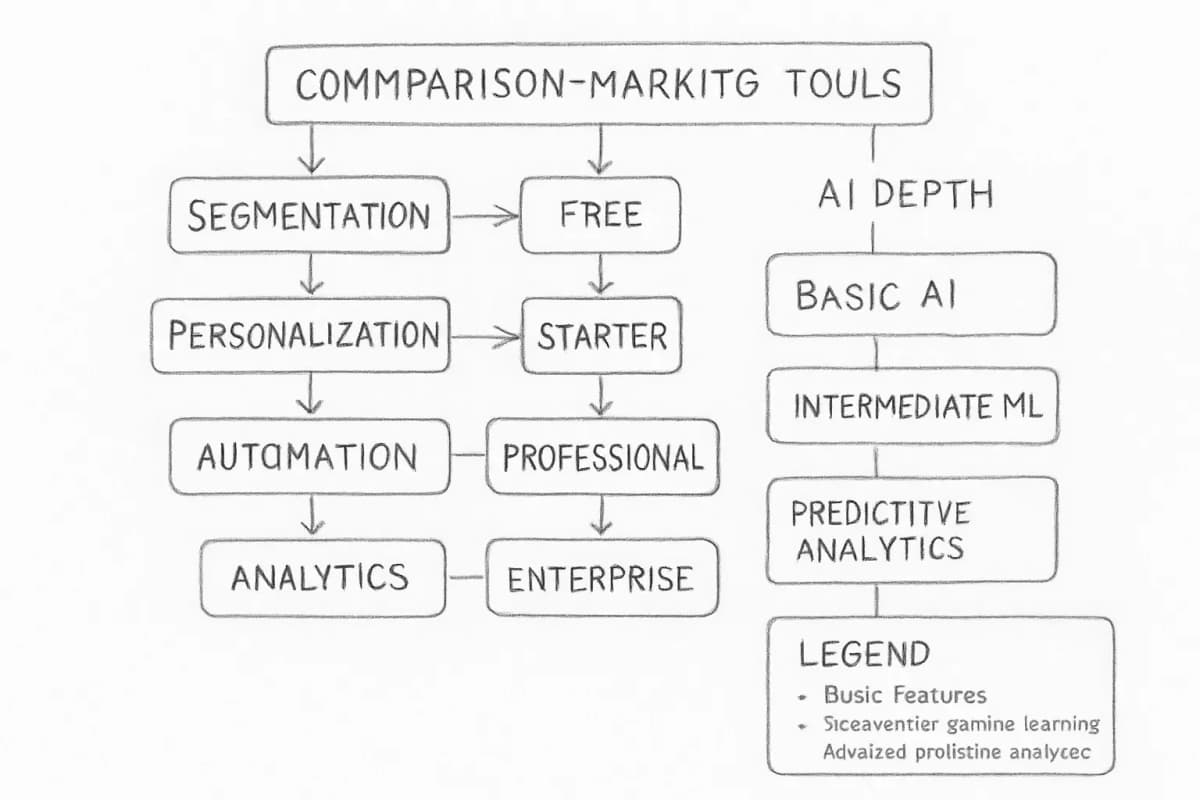

Comparison chart displaying top AI email marketing tools organized by three dimensions: use case categories (segmentation, personalization, automation, analytics), pricing tiers (free, starter, professional, enterprise), and AI depth levels (basic AI features, intermediate machine learning, advanced predictive analytics). Chart should show 8-10 tool names positioned across these axes with visual differentiation by color or icon to represent their strengths. Include a legend explaining pricing ranges and AI capability levels.


Frequently Asked Questions

What are ai-powered email marketing tools?

An AI email marketing tool is software that helps plan, write, and send emails automatically. The AI technology enables these tools to draw insights from data such as open rates, clicks, and customer behavior to tailor subject lines, send times, and even message tone.

How much can AI actually improve email open rates?

Brands using AI-powered subject line optimization see open rate improvements of 35-95% compared to untested subject lines. The range depends on the baseline: brands with already-optimized subject lines see 35% lifts, while brands sending generic subject lines see up to 95% improvement when AI testing is introduced.

Is Klaviyo or ActiveCampaign better for AI-powered email?

For a broader framework on building a system around these tools, see our email marketing automation tips guide.


What AI Cannot Replace

AI tools improve speed, personalization depth, and testing cadence. They do not replace the foundational work: knowing your audience, writing with genuine clarity, and sending emails that actually help the person reading them.

Some platforms are rebranding basic automations as "AI," while others are actually offering genuine intelligence that enhances your creativity and capabilities. The distinction matters when you are comparing pricing tiers. Always test a tool's AI against your actual list, not vendor demos. A subject line generator trained on generic retail data will underperform on a niche B2B list.

The results you get from AI tools also compound over time. AI's gains stem from its ability to analyze individual user behavior patterns and dynamically adjust content, timing, and offers to match each recipient's preferences and likelihood to engage. That learning loop only builds value if you are sending consistently and feeding the model real engagement data.


Comparison chart displaying top AI email marketing tools organized by three dimensions: use case categories (segmentation, personalization, automation, analytics), pricing tiers (free, starter, professional, enterprise), and AI depth levels (basic AI features, intermediate machine learning, advanced predictive analytics). Chart should show 8-10 tool names positioned across these axes with visual differentiation by color or icon to represent their strengths. Include a legend explaining pricing ranges and AI capability levels.


Frequently Asked Questions

What are ai-powered email marketing tools?

An AI email marketing tool is software that helps plan, write, and send emails automatically. The AI technology enables these tools to draw insights from data such as open rates, clicks, and customer behavior to tailor subject lines, send times, and even message tone.

How much can AI actually improve email open rates?

Brands using AI-powered subject line optimization see open rate improvements of 35-95% compared to untested subject lines. The range depends on the baseline: brands with already-optimized subject lines see 35% lifts, while brands sending generic subject lines see up to 95% improvement when AI testing is introduced.

Is Klaviyo or ActiveCampaign better for AI-powered email?

It depends on your business model. ActiveCampaign is best for marketing teams that need enterprise-grade automation logic at mid-market pricing, especially for complex, behavior-driven email sequences. Klaviyo is best for ecommerce brands on Shopify or WooCommerce that want AI-powered revenue attribution, predictive customer analytics, and behavior-triggered automation built specifically for online retail.

Do AI email tools work for small businesses with small lists?

Yes, though with limitations. Prediction accuracy is only as good as the training data, which means if your list is under about 5,000 subscribers, AI scoring tools are not reliable enough to trust blindly. For smaller lists, focus on AI for content generation and send-time optimization first, and lean into predictive segmentation once your list and engagement history grow.

What should I look for when evaluating an AI email tool?

Integration is the deciding factor: tools that require CSV exports or manual handoffs between systems kill adoption regardless of how capable their AI is. Prioritize platforms that sync bidirectionally with your CRM, offer behavioral segmentation, and surface data in a format your team will actually use.


No comments yet. Be the first!

Leave a comment

Comments are reviewed before publishing.

It depends on your business model. ActiveCampaign is best for marketing teams that need enterprise-grade automation logic at mid-market pricing, especially for complex, behavior-driven email sequences. Klaviyo is best for ecommerce brands on Shopify or WooCommerce that want AI-powered revenue attribution, predictive customer analytics, and behavior-triggered automation built specifically for online retail.

Do AI email tools work for small businesses with small lists?

Yes, though with limitations. Prediction accuracy is only as good as the training data, which means if your list is under about 5,000 subscribers, AI scoring tools are not reliable enough to trust blindly. For smaller lists, focus on AI for content generation and send-time optimization first, and lean into predictive segmentation once your list and engagement history grow.

What should I look for when evaluating an AI email tool?

Integration is the deciding factor: tools that require CSV exports or manual handoffs between systems kill adoption regardless of how capable their AI is. Prioritize platforms that sync bidirectionally with your CRM, offer behavioral segmentation, and surface data in a format your team will actually use.

No comments yet. Be the first!

Leave a comment

Comments are reviewed before publishing.

More from

Related posts

Illustration for best ai email marketing tools 2025
Email Marketing Tools & SoftwareJul 14, 2026 15 min

Best AI Email Marketing Tools 2025

Compare top AI email marketing platforms for 2025. Features, pricing, and ROI data to help you choose the right tool for your campaigns.

More from

Related posts

Illustration for best ai email marketing tools 2025
Email Marketing Tools & SoftwareJul 14, 2026 15 min

Best AI Email Marketing Tools 2025

Compare top AI email marketing platforms for 2025. Features, pricing, and ROI data to help you choose the right tool for your campaigns.

J
James Chen
J
James Chen