Most businesses treat email marketing as a broadcast channel, sending the same message to their whole list and wondering why results plateau. Automated branding email marketing fixes that. It combines behavior-triggered workflows with consistent brand identity to deliver the right message, in your brand's voice, at exactly the moment a subscriber is most likely to act.
The results are not marginal. Automated emails drove 37% of all ecommerce email revenue in 2024 despite representing just 2% of email volume. That efficiency gap is the core argument for building an automated branding email program rather than relying on manual campaign sends.
Key Takeaways
- Automated email workflows generate returns 30x higher than one-off email campaigns, and drive 37% of all email-generated sales despite accounting for just 2% of total email volume.
- Reports show up to a 33% increase in revenue when branding remains consistent across channels, making brand consistency a measurable financial lever, not just a design preference.
- Email is the channel that relies the most on marketing automation, with 58% of surveyed professionals choosing it over both content and social media management.
- Brands using AI-driven personalization report up to 42% higher revenue, with click-through rates exceeding 13%.
- Automation reduces brand guideline violations by 78%, making it the most reliable way to enforce visual and tonal consistency at scale.
What Automated Branding Email Marketing Actually Means
Automated branding email marketing is not simply scheduling emails in advance. It is a system of behavior-triggered workflows, built on locked brand templates, that sends personalized messages when a subscriber takes a specific action or reaches a defined lifecycle stage.
The distinction matters. Email branding is creating a consistent and recognizable brand identity in your company emails, including making sure that your emails align with your other branding methods across multiple platforms. Combine that with automation, and every triggered email, from a welcome sequence to a cart recovery reminder, carries the same visual identity and voice as your website, ads, and social channels.
Templates and approval workflows ensure visual and messaging consistency across all campaigns. This matters because every automated touchpoint either reinforces or dilutes your brand identity.
The practical implication: you cannot bolt branding onto automation after the fact. Brand standards need to be baked into your template library, tone guidelines, and workflow logic before you build your first sequence.
The Revenue Case: Why Automation Multiplies Brand Value
On average, email marketing delivers a return of between $36 and $42 for every $1 spent, the highest ROI of any digital marketing channel. Automation concentrates that return dramatically.
Compared to regular campaigns, automated messages see 52% better open rates and 332% higher clicks. Conversion rates for automated emails exceed campaigns by 2,361%. The mechanism is timing and relevance. A message triggered by real behavior arrives when intent is highest.
Brand consistency amplifies this further. A Forrester Research report analyzing 3,100 businesses found that 68.3% of companies with documented brand consistency frameworks reported 10 to 20% revenue growth year-over-year, compared to just 29.1% among businesses operating without formal brand guidelines.
82% of marketers use automation to create triggered emails, which result in 8 times more opens and greater earnings than typical bulk emails. The brands achieving the highest returns are not sending more email. They are sending better-timed, better-branded email to the right segments.
For more on building the analytical foundation to measure these returns, see our guide to email marketing analytics best practices.
The Core Automated Workflows Every Brand Needs
Research across thousands of ecommerce and B2B businesses consistently shows that five core email flows generate approximately 80% of total automated email revenue. These are not optional extras. They are the foundation of any effective email marketing strategy, each triggered by a specific subscriber action and delivering contextually relevant content at the exact moment it matters most.
1. Welcome Series
The welcome series is the highest-performing automated flow across virtually every industry. New subscribers are at peak engagement: they just opted in, which means your brand is top of mind. Welcome emails achieve an average open rate of 68.6% and generate 3x more revenue per email than any other automated flow. This sequence is your brand's first impression at scale. Every email in it must carry identical visual and tonal standards.
2. Abandoned Cart Recovery
According to Klaviyo benchmarks, the abandoned cart flow has the highest revenue per recipient of any automation, averaging $3.65. A three-email sequence typically begins with an immediate reminder within 1 to 2 hours, showcasing the specific abandoned products with compelling visuals and clear purchase links. The second email arrives after 24 hours, incorporating social proof through customer reviews, testimonials, or purchase notifications.
3. Post-Purchase Flow
A post-purchase email goes out automatically to confirm an order, communicate important information, or deliver a specific notification, and the goal is to enhance communication and build trust and confidence with customers, laying the groundwork for repeat purchases and re-engagement.
4. Browse Abandonment
Browse abandonment automation targets visitors who viewed products without adding to cart. Set triggers 2 to 4 hours after browsing with personalized product recommendations and social proof elements.
5. Re-Engagement
Every email list experiences natural decay. On average, 25 to 30% of subscribers become inactive within 12 months. A re-engagement sequence targets these dormant subscribers with a focused campaign to reactivate them or clean them from your list. Both outcomes improve your program: reactivated subscribers generate revenue, and removed addresses protect deliverability.
For a detailed breakdown of how to structure these sequences from the first email, see welcome email sequence best practices.
Building Brand Consistency Into Your Automation System
95% of companies have brand guidelines, but only 25 to 30% actively enforce them, creating advantages for disciplined brands. Automated branding email marketing closes that enforcement gap by making consistency structural, not aspirational.
Here is how to do it practically:
Create locked master templates. Email automation tools often allow you to create and save branded templates, ensuring every email sent follows your brand guidelines. They also help maintain consistency in timing, personalization, and messaging. Lock logos, color values, font stacks, and header/footer structures so individual campaign editors cannot deviate from them.
Document your brand voice in detail. In automation, brand voice becomes the consistent character your AI-powered systems project. This includes chatbots, email sequences, social media responses, and customer service platforms. Every automated touchpoint either reinforces or dilutes your brand identity. Vague directives like "be professional" are not enough. Move to concrete instructions: use active voice, avoid jargon unless defined, and maintain a tone of confident collaboration.
Audit templates quarterly. Review your email templates regularly, at least quarterly or whenever there is a brand update. This ensures that all emails remain aligned with current brand guidelines and any new marketing strategies.
Common mistakes to avoid. Common mistakes include using inconsistent logos or colors, varying fonts, changing tone of voice, sending emails from different sender names, and neglecting to update templates after brand changes. 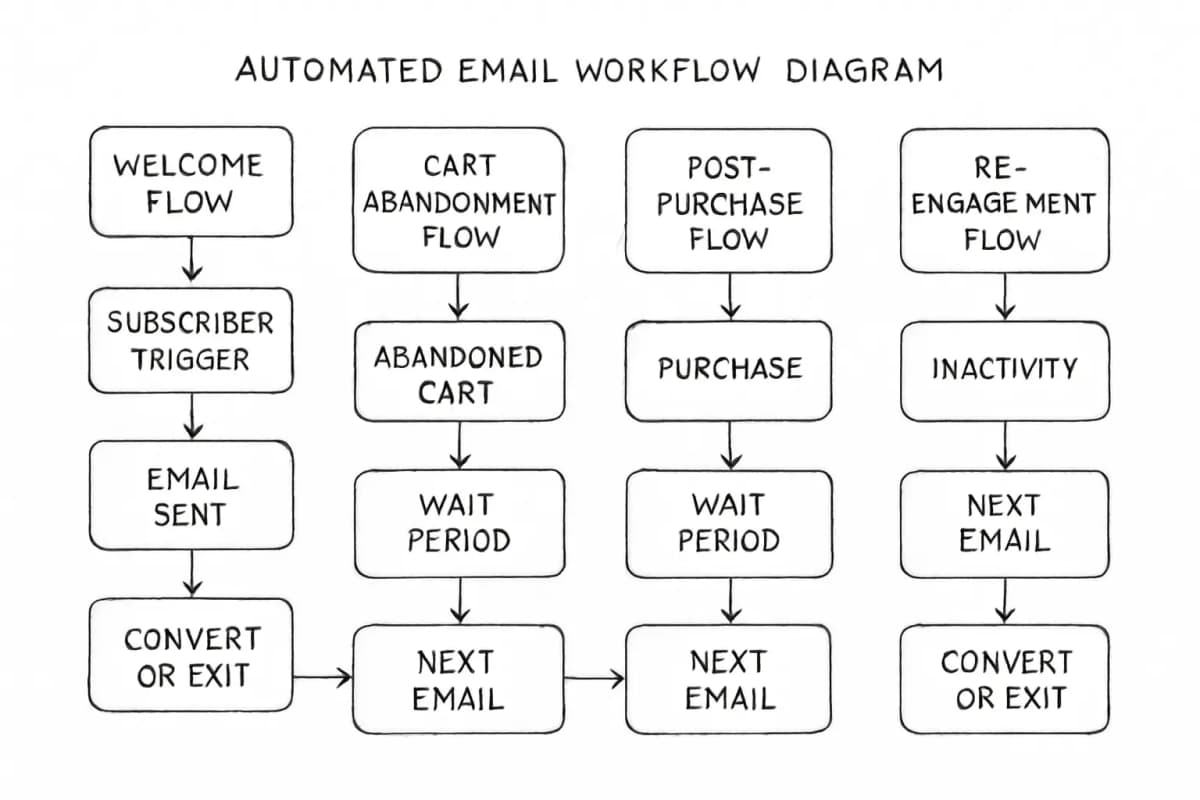
Personalization Within Brand Guardrails
Personalization and brand consistency are not in conflict. The goal is to personalize the content while keeping the identity fixed.
Segmented and personalized emails generate 58% of all email revenue, concentrating returns in the campaigns that treat subscribers as individuals. Personalized emails have a 29% higher open rate and a 41% higher click-through rate compared to non-personalized sends.
The practical framework is to separate what changes from what does not. Define core brand voice elements that never change, such as tone, values, and key messages, and variable elements that can adapt, like specific words, level of formality, and cultural references. Use AI tools to maintain consistency in the core elements while personalizing the variables.
Behavior-based personalization is the highest-leverage application. Behaviour-based personalization using purchase history data boosts click-through rate by up to 39%. That lift comes from relevance, not from template redesigns.
For a deep dive on this, read our guide to email list segmentation strategies that boost ROI by 760%.
Measuring Performance: What to Track and Why
Brands using email analytics tools see a 43% higher ROI than those that do not. Measurement remains the weakest point. Only 12.5% of companies believe they are measuring ROI accurately.
Track these metrics separately for automated flows versus broadcast campaigns:
- Revenue per recipient (RPR): The clearest indicator of automated flow performance. Abandoned cart flows alone generate an average $3.65 RPR, compared to $0.11 for standard email campaigns, according to Klaviyo benchmarks.
- Click-to-conversion rate: Email campaign click-to-conversion rates grew by 27.6% in 2024, making this a benchmark worth comparing your flows against.
- Flow-level open rates and CTR: Track these per sequence, not as a program average, so you can isolate which specific emails are underperforming.
- Deliverability signals: Roughly 7% of emails now land in spam, directly reducing ROI. Monitor spam complaint rates and keep them below 0.08% to stay within Google and Yahoo bulk sender thresholds.
Brands achieving 7,000% and higher returns are almost always running automated workflows, segmenting lists by behavior, and testing subject lines and offers consistently. Measurement is what makes that iteration possible.
For a complete framework on tracking these metrics, see email marketing analytics best practices.
Frequently Asked Questions
What is automated branding email marketing?
Automated branding email marketing is the practice of using behavior-triggered email workflows that consistently reflect a company's visual identity, tone of voice, and brand standards. Rather than sending manual campaigns, it uses automation rules to deliver the right branded message when a subscriber takes a specific action, such as signing up, abandoning a cart, or going inactive.
How much revenue can automated email flows generate compared to regular campaigns?
Compared to regular campaigns, automated messages see 52% better open rates and 332% higher clicks. Conversion rates for automated emails exceed campaigns by 2,361%. These improvements stem from better timing and relevance. Automated flows also account for a disproportionate share of total email revenue: in 2024, automated emails drove 37% of all email-generated sales.
How do I maintain brand consistency across automated emails?
Start by building locked master templates in your email platform that encode your colors, fonts, logo placement, and header/footer structure. Then document a detailed brand voice guide with concrete examples of approved and off-brand phrasing. Review your email templates at least quarterly or whenever there is a brand update, to ensure that all emails remain aligned with current brand guidelines and any new marketing strategies. Use platform approval workflows to prevent ad hoc edits from breaking consistency.
What is the ROI of email marketing automation for small and mid-size businesses?
On average, email marketing delivers a return of between $36 and $42 for every $1 spent, the highest ROI of any digital marketing channel. For context, paid search returns $2 per $1, social advertising $2.80, and display ads $1.35. Automation concentrates that return further. Marketing automation software users can benefit from a 451% increase in qualified leads, and businesses with mature automated programs routinely outperform the channel average. The entry cost is low: most email platforms include automation at their base tier, making it accessible regardless of team size.