
Email
Email

A modern blog built with Payload CMS, Next.js, and shadcn/ui.

RSS FeedSitemap

Explore

  • Blog
  • News
  • Statistics
  • Authors

Categories

  • CRM & Email Marketing Tools
  • Email Analytics & Reporting
  • Email Security & Compliance
  • Email Automation
  • Email List Building
  • Seasonal & Holiday Email Marketing
  • Email Marketing Benchmarks & Statistics
  • Email Design & Personalization

Latest articles

  • Agency Email Marketing Automation: Setup & ROIJul 20, 2026
  • AI Tools for Email Marketing VisibilityJul 20, 2026
  • Machine Learning in Email Marketing: Complete GuideJul 20, 2026
  • Email Marketing Automation: Definition and Core ConceptsJul 20, 2026

Popular topics

  • #deliverability and segmentation
  • #beauty brand email strategy
  • #skincare email marketing
  • #Marketing
  • #email engagement metrics
  • #Content Generation
  • #Sales Efficiency
  • #Cyber Monday Trends
  • #Email Campaign Benchmarks
  • #Holiday Marketing Statistics
  • #BFCM Email Strategy
  • #Enterprise Email
  • #credit card marketing
  • #Business Software
  • #CRM Software
  • #MarTech

Stay in the loop

Join 2,000+ readers. Unsubscribe anytime.

Subscribe
Email

© 2026 Email. All rights reserved.

SitemapRSS
HomeBlogEmail Marketing StrategyEmail Promotion and Internet Marketing Automation
Email Marketing Strategy

Email Promotion and Internet Marketing Automation

Master email promotion and internet marketing automation to drive sales and engagement. Learn strategies that increase ROI and save time.

S

Sarah Mitchell

July 19, 2026

10 min read
Share:
#Email Automation#marketing automation#email campaigns#Digital Marketing
Illustration for email promotion and internet marketing automation

Stay in the loop

Get the latest posts delivered straight to your inbox. No spam, unsubscribe anytime.

Email promotion and internet marketing automation are no longer optional extras for growth-minded businesses. They are the operational core of modern digital marketing. Email remains the most reliable high-ROI digital channel, and the biggest gains come from automation, personalization, deliverability discipline, and realistic attribution, not from sending more emails.

If you are still managing campaigns manually, sending the same message to your entire list, or relying on one-off broadcasts to drive revenue, this guide shows you exactly what to change and why.


Key Takeaways

  • Email marketing delivers a return of $36 to $42 for every $1 spent, outperforming paid search ($2), social advertising ($2.80), and display ads ($1.35).
  • In 2024, automated emails drove 37% of all email-generated sales despite accounting for just 2% of total email volume.
  • Automated emails result in a 320% increase in revenue compared to non-automated emails.
  • Brands using AI-driven personalization report up to 42% higher revenue, with click-through rates exceeding 13%, lifting overall ROI by nearly 20%.
  • Marketing automation boosts segmentation efficiency and targeting, with segmentation identified as the most common result achieved by teams using automation platforms, according to Liana's 2025 survey.

What Email Promotion and Internet Marketing Automation Actually Mean

These two terms get used interchangeably, but they describe different layers of the same strategy.

Email promotion refers to sending targeted messages to a subscriber list with the goal of driving a specific action: a purchase, a sign-up, a download, or a return visit.

Internet marketing automation is the broader infrastructure. It involves using software to handle and coordinate marketing processes across multiple channels from a single platform, going beyond simple email scheduling to include lead generation, segmentation, customer journey mapping, and multi-channel campaign management.

The practical distinction is this: email marketing involves direct communication with subscribers, while email marketing automation uses tools and software to handle dynamic content, send-time optimization, and automated sequences.

When the two are combined, the result is a system that scales personal communication without scaling headcount.


Why the Numbers Favor Automation Over Manual Campaigns

The performance gap between automated and manual email campaigns is substantial, not marginal.

Automated email flows, including abandoned cart and post-purchase messages, generate up to 30 times more revenue per recipient compared to standard campaigns. This efficiency comes from their targeted nature, addressing specific customer behaviors and encouraging conversions at critical points in the customer journey.

Companies can save up to 5 to 10 hours each week by automating only 15 to 20 emails. That time compounds quickly across a team.

Production speed has also improved dramatically due to AI: 76% of marketing teams now produce and send a marketing email within 3 days. In 2024, 62% of teams took two weeks or more for a single email.

The business case for automation goes beyond efficiency. In 2024, 50% of consumers said they purchased directly from an email, more than from social media posts or ads. That audience expects timely, relevant communication. Manual processes cannot keep pace with that expectation at scale.


The Core Automated Workflows Every Program Needs

Not all automation delivers equal results. These are the workflows that consistently drive the most revenue per recipient.

Welcome Sequences

Welcome email sequences serve as your brand's digital handshake, creating first impressions that determine long-term subscriber engagement. The trigger fires when someone subscribes to your newsletter, creates an account, or downloads gated content, and the first email should go out within minutes of form submission.

The optimal welcome series spans 3 to 5 strategically timed emails over 7 to 14 days, beginning with an immediate confirmation that sets clear expectations, then progressing through brand storytelling, valuable resource sharing, and gentle product introductions.

For a detailed breakdown of what makes these sequences convert, see our guide on welcome email sequence best practices.

Abandoned Cart Recovery

In 2025, 70.19% of ecommerce customers abandoned their shopping carts. That represents the single largest recoverable revenue opportunity in ecommerce email marketing.

Abandoned cart emails achieve an average open rate of 50.5%, a click rate of 6.25%, and a conversion rate of 3.33%, with top-performing brands reaching 7.69%.

Set the trigger to activate when a customer adds products to their cart and leaves within 30 minutes to one hour. The three-email sequence begins with an immediate reminder, showcases the specific abandoned products with clear purchase links, and follows 24 hours later with social proof through customer reviews to address objections.

Re-engagement Campaigns

When customers lapse and stop purchasing, re-engagement campaigns are proven ways to boost retention. The best automation tools reactivate past customers with communications based on personal site activity and purchase history, using triggered campaigns and customer data to bring dormant subscribers back.

AI decisioning adds significant value here, determining the offer, channel, timing, and creative most likely to bring each individual back based on their past behavior, rather than sending every lapsing user the same reactivation email.

Post-Purchase Flows

Post-purchase campaigns keep customers engaged after a transaction by sending thank-you emails, product care tips, or requests for reviews.

Order confirmation campaigns carry the highest open rate of all transactional emails, up to 70%. They should trigger immediately upon successful payment processing, arriving within minutes of the completed transaction. That open rate makes order confirmations one of the most underused upsell opportunities in ecommerce.


Segmentation: The Engine Behind Effective Automation

Automation without segmentation is just scheduled broadcasting. Segmentation is what makes automation genuinely personal.

Automated email segmentation organizes contacts into targeted groups automatically using dynamic rules and real-time data. Unlike static lists that require constant manual updates, automated segmentation continuously adjusts audience membership based on changing customer behaviors, preferences, and lifecycle stages.

Segmentation and personalization are closely related but serve different roles. Segmentation groups subscribers by shared characteristics, while personalization tailors the content for individuals within those groups. Used together, they produce more relevant and higher-converting campaigns.

The most productive segmentation types to start with:

  • Behavioral: Tracks what subscribers actually do, creating dynamic segments that update automatically based on actions like email opens, website visits, and purchase history.
  • Lifecycle stage: Different stages require different messaging. New subscribers need welcome content, while loyal customers respond to exclusive rewards.
  • Engagement-based: Newsletter readers can be segmented based on whether they open emails or click links, and this type of segmentation can also be used for list-cleaning purposes.

For a deeper look at how segmentation drives revenue, see our full guide on email list segmentation strategies.


Personalization Inside Automation: Where Revenue Actually Moves

Segmentation tells you who gets a message. Personalization determines what they see inside it.

Research shows that 76% of consumers are more inclined to purchase from brands that engage in personalized advertising or marketing.

Behavior-based personalization using purchase history data boosts click-through rates by up to 39%, and companies using AI-driven email strategies see up to 41% more revenue than those using traditional batch-and-blast sends.

Dynamic content is one of the most powerful personalization tactics available. It automatically updates content within an email that offers real-time information every time the email is opened, including countdown timers in special offer emails, live shipment locations, or the in-stock status of wishlist products.

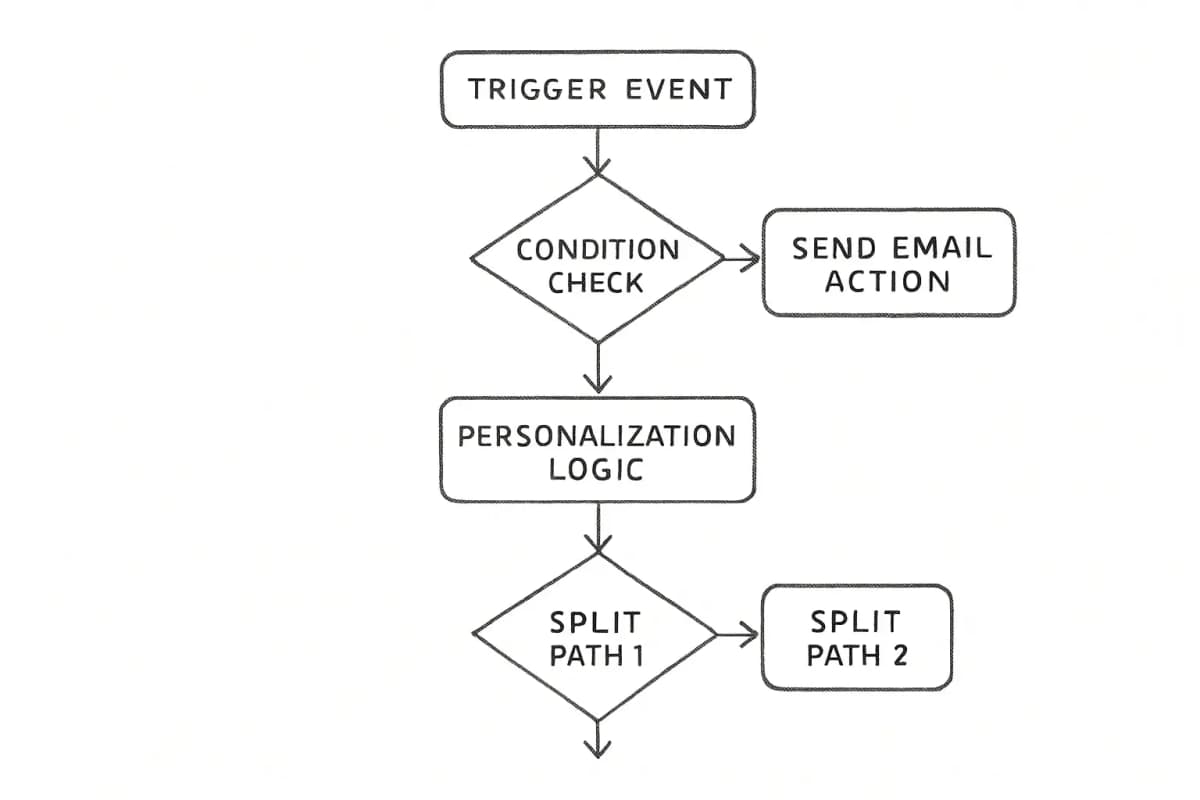
The key principle: personalization should reflect actual behavior, not just a first name in the subject line. In 2026, personalization needs to go beyond addressing subscribers by their first name. Email automation workflow flowchart showing the complete automation sequence: a trigger event (subscriber action) feeds into decision conditions (behavior-based rules), which branch into multiple action paths (send email, wait period, personalization rules, conditional splits). The diagram should show left-to-right flow with clear decision diamonds for conditional logic and rectangular action boxes. Include examples like 'trigger' leading to 'condition check' (opened email, clicked link, abandoned cart) branching into parallel 'action' nodes (send promotional email, apply discount, segment subscriber, pause sequence). Use arrows to show flow direction and connectors between stages.

Building the Right Automation Stack

Choosing an email automation tool that integrates with other platforms, including CRM systems, social media management tools, and ecommerce platforms, is critical because these integrations allow for efficient management of customer data and communication across multiple channels.

When evaluating platforms, prioritize these capabilities:

  • Advanced audience segmentation with dynamic list updates
  • Trigger-based workflow builders with conditional logic
  • CRM integration for unified customer data
  • AI-powered send-time optimization
  • Analytics that connect email activity to revenue, not just opens

By 2026, marketing experts predict up to 75% of email strategy operations will be fully AI-driven. Platforms that cannot support AI-assisted workflows will become a ceiling on what your program can achieve.

For a practical walkthrough of connecting your automation tools to your CRM, our email marketing automation CRM setup guide covers the process step by step.


Measuring What Actually Matters

Tracking open rates alone gives you an incomplete picture. Apple Mail Privacy Protection now affects roughly 50 to 60% of recorded email opens, automatically downloading tracking pixels before a recipient views the email. This inflates open rate data across the industry. Use open rates as a directional signal, not a precise measurement, and lean on click rate and email-attributed revenue as your primary performance benchmarks.

The metrics that connect most directly to business outcomes:

  • Click-to-conversion rate: Measures how many clicks result in a completed goal, whether a purchase, sign-up, or download
  • Revenue per email: Tracks average income generated per send across your list
  • Workflow conversion rate: Measures how each automated sequence moves subscribers through the funnel
  • List growth rate: Reflects net subscriber growth after unsubscribes and bounces
  • Deliverability rate: Roughly 7% of emails now land in spam, directly reducing ROI. Monitoring inbox placement is not optional

About 21% of marketing leaders still do not measure email ROI, which limits their ability to evaluate performance. If you are in that group, establishing basic revenue attribution for your automated flows is the highest-leverage action you can take right now.


Frequently Asked Questions

What is the difference between email promotion and email marketing automation?

Email promotion refers to sending targeted messages to a subscriber list to drive a specific action, such as a purchase or sign-up. Email marketing automation is the system behind it: software that sends those messages based on triggers, subscriber behavior, and predefined logic rather than manual scheduling. Automation is reactive, sending messages based on individual customer behavior and data signals and running continuously in the background. Most strong email programs use both: campaigns for broadcast moments and automation for always-on, behavior-based engagement.

How much revenue can automated email workflows generate compared to manual campaigns?

Automated emails result in a 320% increase in revenue compared to non-automated emails, according to Campaign Monitor data. At the flow level, automated emails drove 37% of all email-generated sales in 2024 despite accounting for just 2% of email volume. The disproportionate return comes from timing: automated messages reach subscribers at the exact moment their behavior signals intent.

What types of email automation workflows should I prioritize first?

Start with the four workflows that consistently deliver the highest return: welcome sequences, abandoned cart recovery, post-purchase follow-ups, and re-engagement campaigns. These cover the full customer lifecycle: automatically introducing new subscribers to your brand, keeping customers engaged after a purchase, reminding visitors to complete their checkout, and winning back inactive subscribers with targeted offers. Once these are in place, layer in behavioral workflows based on your specific product and audience.

How does segmentation improve email automation performance?

Combining segmentation and personalization leads to better audience engagement, which sends positive signals to internet service providers. Your positive sender reputation keeps you out of the spam folder, meaning more people see your messages. Beyond deliverability, with segmentation driving relevant content, email marketing ROI can reach $50 for every dollar spent. Companies that see the highest ROI from email (36:1 to 50:1) are most likely to have between 25% and 50% of their marketing team dedicated to email, and they are consistently segmenting all of their sends.


No comments yet. Be the first!

Leave a comment

Comments are reviewed before publishing.

More from

Related posts

Illustration for machine learning and email marketing
Email Marketing StrategyJul 20, 2026 15 min

Machine Learning in Email Marketing: Complete Guide

Learn how machine learning improves email marketing through personalization, send time optimization, and predictive analytics. Boost engagement and ROI today.

RRachel Torres
Illustration for enterprise marketing automation email
Email Marketing StrategyJul 19, 2026 12 min

Enterprise Marketing Automation Email: Strategy & Setup

Learn how to implement enterprise marketing automation email systems. Boost deliverability, personalization, and ROI with proven best practices and tools.

RRachel Torres
Illustration for marketing automation email campaigns
Email Marketing StrategyJul 19, 2026 12 min

Marketing Automation Email Campaigns: Setup Guide

Learn how to set up marketing automation email campaigns that nurture leads and boost conversions. Step-by-step strategies for busy marketers.

PPriya Kapoor
HomeBlogEmail Marketing StrategyEmail Promotion and Internet Marketing Automation
Email Marketing Strategy

Email Promotion and Internet Marketing Automation

Master email promotion and internet marketing automation to drive sales and engagement. Learn strategies that increase ROI and save time.

S

Sarah Mitchell

July 19, 2026

10 min read
Share:
#Email Automation#marketing automation#email campaigns#Digital Marketing
Illustration for email promotion and internet marketing automation

Stay in the loop

Get the latest posts delivered straight to your inbox. No spam, unsubscribe anytime.

Email promotion and internet marketing automation are no longer optional extras for growth-minded businesses. They are the operational core of modern digital marketing. Email remains the most reliable high-ROI digital channel, and the biggest gains come from automation, personalization, deliverability discipline, and realistic attribution, not from sending more emails.

If you are still managing campaigns manually, sending the same message to your entire list, or relying on one-off broadcasts to drive revenue, this guide shows you exactly what to change and why.


Key Takeaways

  • Email marketing delivers a return of $36 to $42 for every $1 spent, outperforming paid search ($2), social advertising ($2.80), and display ads ($1.35).
  • In 2024, automated emails drove 37% of all email-generated sales despite accounting for just 2% of total email volume.
  • Automated emails result in a 320% increase in revenue compared to non-automated emails.
  • Brands using AI-driven personalization report up to 42% higher revenue, with click-through rates exceeding 13%, lifting overall ROI by nearly 20%.
  • Marketing automation boosts segmentation efficiency and targeting, with segmentation identified as the most common result achieved by teams using automation platforms, according to Liana's 2025 survey.

What Email Promotion and Internet Marketing Automation Actually Mean

These two terms get used interchangeably, but they describe different layers of the same strategy.

Email promotion refers to sending targeted messages to a subscriber list with the goal of driving a specific action: a purchase, a sign-up, a download, or a return visit.

Internet marketing automation is the broader infrastructure. It involves using software to handle and coordinate marketing processes across multiple channels from a single platform, going beyond simple email scheduling to include lead generation, segmentation, customer journey mapping, and multi-channel campaign management.

The practical distinction is this: email marketing involves direct communication with subscribers, while email marketing automation uses tools and software to handle dynamic content, send-time optimization, and automated sequences.

When the two are combined, the result is a system that scales personal communication without scaling headcount.


Why the Numbers Favor Automation Over Manual Campaigns

The performance gap between automated and manual email campaigns is substantial, not marginal.

Automated email flows, including abandoned cart and post-purchase messages, generate up to 30 times more revenue per recipient compared to standard campaigns. This efficiency comes from their targeted nature, addressing specific customer behaviors and encouraging conversions at critical points in the customer journey.

Companies can save up to 5 to 10 hours each week by automating only 15 to 20 emails. That time compounds quickly across a team.

Production speed has also improved dramatically due to AI: 76% of marketing teams now produce and send a marketing email within 3 days. In 2024, 62% of teams took two weeks or more for a single email.

The business case for automation goes beyond efficiency. In 2024, 50% of consumers said they purchased directly from an email, more than from social media posts or ads. That audience expects timely, relevant communication. Manual processes cannot keep pace with that expectation at scale.


The Core Automated Workflows Every Program Needs

Not all automation delivers equal results. These are the workflows that consistently drive the most revenue per recipient.

Welcome Sequences

Welcome email sequences serve as your brand's digital handshake, creating first impressions that determine long-term subscriber engagement. The trigger fires when someone subscribes to your newsletter, creates an account, or downloads gated content, and the first email should go out within minutes of form submission.

The optimal welcome series spans 3 to 5 strategically timed emails over 7 to 14 days, beginning with an immediate confirmation that sets clear expectations, then progressing through brand storytelling, valuable resource sharing, and gentle product introductions.

For a detailed breakdown of what makes these sequences convert, see our guide on welcome email sequence best practices.

Abandoned Cart Recovery

In 2025, 70.19% of ecommerce customers abandoned their shopping carts. That represents the single largest recoverable revenue opportunity in ecommerce email marketing.

Abandoned cart emails achieve an average open rate of 50.5%, a click rate of 6.25%, and a conversion rate of 3.33%, with top-performing brands reaching 7.69%.

Set the trigger to activate when a customer adds products to their cart and leaves within 30 minutes to one hour. The three-email sequence begins with an immediate reminder, showcases the specific abandoned products with clear purchase links, and follows 24 hours later with social proof through customer reviews to address objections.

Re-engagement Campaigns

When customers lapse and stop purchasing, re-engagement campaigns are proven ways to boost retention. The best automation tools reactivate past customers with communications based on personal site activity and purchase history, using triggered campaigns and customer data to bring dormant subscribers back.

AI decisioning adds significant value here, determining the offer, channel, timing, and creative most likely to bring each individual back based on their past behavior, rather than sending every lapsing user the same reactivation email.

Post-Purchase Flows

Post-purchase campaigns keep customers engaged after a transaction by sending thank-you emails, product care tips, or requests for reviews.

Order confirmation campaigns carry the highest open rate of all transactional emails, up to 70%. They should trigger immediately upon successful payment processing, arriving within minutes of the completed transaction. That open rate makes order confirmations one of the most underused upsell opportunities in ecommerce.


Segmentation: The Engine Behind Effective Automation

Automation without segmentation is just scheduled broadcasting. Segmentation is what makes automation genuinely personal.

Automated email segmentation organizes contacts into targeted groups automatically using dynamic rules and real-time data. Unlike static lists that require constant manual updates, automated segmentation continuously adjusts audience membership based on changing customer behaviors, preferences, and lifecycle stages.

Segmentation and personalization are closely related but serve different roles. Segmentation groups subscribers by shared characteristics, while personalization tailors the content for individuals within those groups. Used together, they produce more relevant and higher-converting campaigns.

The most productive segmentation types to start with:

  • Behavioral: Tracks what subscribers actually do, creating dynamic segments that update automatically based on actions like email opens, website visits, and purchase history.
  • Lifecycle stage: Different stages require different messaging. New subscribers need welcome content, while loyal customers respond to exclusive rewards.
  • Engagement-based: Newsletter readers can be segmented based on whether they open emails or click links, and this type of segmentation can also be used for list-cleaning purposes.

For a deeper look at how segmentation drives revenue, see our full guide on email list segmentation strategies.


Personalization Inside Automation: Where Revenue Actually Moves

Segmentation tells you who gets a message. Personalization determines what they see inside it.

Research shows that 76% of consumers are more inclined to purchase from brands that engage in personalized advertising or marketing.

Behavior-based personalization using purchase history data boosts click-through rates by up to 39%, and companies using AI-driven email strategies see up to 41% more revenue than those using traditional batch-and-blast sends.

Dynamic content is one of the most powerful personalization tactics available. It automatically updates content within an email that offers real-time information every time the email is opened, including countdown timers in special offer emails, live shipment locations, or the in-stock status of wishlist products.

The key principle: personalization should reflect actual behavior, not just a first name in the subject line. In 2026, personalization needs to go beyond addressing subscribers by their first name. Email automation workflow flowchart showing the complete automation sequence: a trigger event (subscriber action) feeds into decision conditions (behavior-based rules), which branch into multiple action paths (send email, wait period, personalization rules, conditional splits). The diagram should show left-to-right flow with clear decision diamonds for conditional logic and rectangular action boxes. Include examples like 'trigger' leading to 'condition check' (opened email, clicked link, abandoned cart) branching into parallel 'action' nodes (send promotional email, apply discount, segment subscriber, pause sequence). Use arrows to show flow direction and connectors between stages.


Building the Right Automation Stack

Choosing an email automation tool that integrates with other platforms, including CRM systems, social media management tools, and ecommerce platforms, is critical because these integrations allow for efficient management of customer data and communication across multiple channels.

When evaluating platforms, prioritize these capabilities:

  • Advanced audience segmentation with dynamic list updates
  • Trigger-based workflow builders with conditional logic
  • CRM integration for unified customer data
  • AI-powered send-time optimization
  • Analytics that connect email activity to revenue, not just opens

By 2026, marketing experts predict up to 75% of email strategy operations will be fully AI-driven. Platforms that cannot support AI-assisted workflows will become a ceiling on what your program can achieve.

For a practical walkthrough of connecting your automation tools to your CRM, our email marketing automation CRM setup guide covers the process step by step.


Measuring What Actually Matters

Tracking open rates alone gives you an incomplete picture. Apple Mail Privacy Protection now affects roughly 50 to 60% of recorded email opens, automatically downloading tracking pixels before a recipient views the email. This inflates open rate data across the industry. Use open rates as a directional signal, not a precise measurement, and lean on click rate and email-attributed revenue as your primary performance benchmarks.

The metrics that connect most directly to business outcomes:

  • Click-to-conversion rate: Measures how many clicks result in a completed goal, whether a purchase, sign-up, or download
  • Revenue per email: Tracks average income generated per send across your list
  • Workflow conversion rate: Measures how each automated sequence moves subscribers through the funnel
  • List growth rate: Reflects net subscriber growth after unsubscribes and bounces
  • Deliverability rate: Roughly 7% of emails now land in spam, directly reducing ROI. Monitoring inbox placement is not optional

About 21% of marketing leaders still do not measure email ROI, which limits their ability to evaluate performance. If you are in that group, establishing basic revenue attribution for your automated flows is the highest-leverage action you can take right now.


Frequently Asked Questions

What is the difference between email promotion and email marketing automation?

Email promotion refers to sending targeted messages to a subscriber list to drive a specific action, such as a purchase or sign-up. Email marketing automation is the system behind it: software that sends those messages based on triggers, subscriber behavior, and predefined logic rather than manual scheduling. Automation is reactive, sending messages based on individual customer behavior and data signals and running continuously in the background. Most strong email programs use both: campaigns for broadcast moments and automation for always-on, behavior-based engagement.

How much revenue can automated email workflows generate compared to manual campaigns?

Automated emails result in a 320% increase in revenue compared to non-automated emails, according to Campaign Monitor data. At the flow level, automated emails drove 37% of all email-generated sales in 2024 despite accounting for just 2% of email volume. The disproportionate return comes from timing: automated messages reach subscribers at the exact moment their behavior signals intent.

What types of email automation workflows should I prioritize first?

Start with the four workflows that consistently deliver the highest return: welcome sequences, abandoned cart recovery, post-purchase follow-ups, and re-engagement campaigns. These cover the full customer lifecycle: automatically introducing new subscribers to your brand, keeping customers engaged after a purchase, reminding visitors to complete their checkout, and winning back inactive subscribers with targeted offers. Once these are in place, layer in behavioral workflows based on your specific product and audience.

How does segmentation improve email automation performance?

Combining segmentation and personalization leads to better audience engagement, which sends positive signals to internet service providers. Your positive sender reputation keeps you out of the spam folder, meaning more people see your messages. Beyond deliverability, with segmentation driving relevant content, email marketing ROI can reach $50 for every dollar spent. Companies that see the highest ROI from email (36:1 to 50:1) are most likely to have between 25% and 50% of their marketing team dedicated to email, and they are consistently segmenting all of their sends.
No comments yet. Be the first!

Leave a comment

Comments are reviewed before publishing.

More from

Related posts

Illustration for machine learning and email marketing
Email Marketing StrategyJul 20, 2026 15 min

Machine Learning in Email Marketing: Complete Guide

Learn how machine learning improves email marketing through personalization, send time optimization, and predictive analytics. Boost engagement and ROI today.

RRachel Torres
Illustration for enterprise marketing automation email
Email Marketing StrategyJul 19, 2026 12 min

Enterprise Marketing Automation Email: Strategy & Setup

Learn how to implement enterprise marketing automation email systems. Boost deliverability, personalization, and ROI with proven best practices and tools.

RRachel Torres
Illustration for marketing automation email campaigns
Email Marketing StrategyJul 19, 2026 12 min

Marketing Automation Email Campaigns: Setup Guide

Learn how to set up marketing automation email campaigns that nurture leads and boost conversions. Step-by-step strategies for busy marketers.

PPriya Kapoor