
HomeBlogEmail Marketing Tools & PlatformsBest AI Email Marketing Automation Tools 2025
Email Marketing Tools & Platforms

Best AI Email Marketing Automation Tools 2025

Compare top AI email marketing automation tools for 2025. Find the best platform for your business with our detailed feature breakdown and pricing guide.

M

Marcus Webb

July 15, 2026

HomeBlogEmail Marketing Tools & PlatformsBest AI Email Marketing Automation Tools 2025
Email Marketing Tools & Platforms

Best AI Email Marketing Automation Tools 2025

Compare top AI email marketing automation tools for 2025. Find the best platform for your business with our detailed feature breakdown and pricing guide.

M

Marcus Webb

July 15, 2026

13 min read
13 min read
Share:
Share:
#AI Email Marketing#marketing automation#Email Tools#2025 Software Reviews
Illustration for best ai email marketing automation tools 2025

Stay in the loop

Get the latest posts delivered straight to your inbox. No spam, unsubscribe anytime.

AI email marketing automation is no longer an advanced capability reserved for enterprise teams. Nearly 63% of marketers now use AI tools in their email marketing efforts, and approximately 47% use AI specifically to generate their email campaigns. If your team is still building campaigns manually, you are already working at a disadvantage.

The business case is clear. The average email marketing ROI is $36 for every $1 spent, which is a 3,500% return. Add AI to that equation, and the results compound further. Research by McKinsey shows that organizations investing in AI are experiencing a sales ROI uplift of 10 to 20 percent. Meanwhile, automated emails generate 320% more revenue than non-automated emails.

The challenge is choosing the right tool. The market now includes platforms that handle everything from predictive send-time optimization to fully autonomous campaign creation. This guide covers the best AI email marketing automation tools in 2025, matched to the use cases where they actually deliver results.


Key Takeaways

  • 63% of marketers now employ AI tools for their email marketing efforts, signaling mainstream acceptance of AI-native platforms.
  • Automated emails generate 320% more revenue than non-automated emails, making automation the single highest-leverage change most teams can make.
  • AI can save marketers up to 30% of their time by automating email design, content creation, and scheduling.
  • The best AI email marketing tool depends on your use case. Klaviyo leads for ecommerce, ActiveCampaign for B2B automation, and HubSpot for teams already invested in a CRM-first stack.
  • By 2026, 89% of marketing experts expect up to 75% of email strategy operations to be fully AI-driven.

What AI Actually Does in Email Marketing

Before comparing platforms, it helps to understand what AI features move the needle versus what is mostly marketing copy.

AI technology enables email marketing tools to draw insights from data such as open rates, clicks, and customer behavior to tailor subject lines, send times, and message tone. In practice, meaningful AI falls into four categories:

  • Predictive send-time optimization: AI analyzes each contact's historical engagement patterns and delivers emails at the individual level when that person is most likely to open.

Stay in the loop

Get the latest posts delivered straight to your inbox. No spam, unsubscribe anytime.

AI email marketing automation is no longer an advanced capability reserved for enterprise teams. Nearly 63% of marketers now use AI tools in their email marketing efforts, and approximately 47% use AI specifically to generate their email campaigns. If your team is still building campaigns manually, you are already working at a disadvantage.

The business case is clear. The average email marketing ROI is $36 for every $1 spent, which is a 3,500% return. Add AI to that equation, and the results compound further. Research by McKinsey shows that organizations investing in AI are experiencing a sales ROI uplift of 10 to 20 percent. Meanwhile, automated emails generate 320% more revenue than non-automated emails.

The challenge is choosing the right tool. The market now includes platforms that handle everything from predictive send-time optimization to fully autonomous campaign creation. This guide covers the best AI email marketing automation tools in 2025, matched to the use cases where they actually deliver results.


Key Takeaways

  • 63% of marketers now employ AI tools for their email marketing efforts, signaling mainstream acceptance of AI-native platforms.
  • Automated emails generate 320% more revenue than non-automated emails, making automation the single highest-leverage change most teams can make.
  • AI can save marketers up to 30% of their time by automating email design, content creation, and scheduling.
  • The best AI email marketing tool depends on your use case. Klaviyo leads for ecommerce, ActiveCampaign for B2B automation, and HubSpot for teams already invested in a CRM-first stack.
  • By 2026, 89% of marketing experts expect up to 75% of email strategy operations to be fully AI-driven.

What AI Actually Does in Email Marketing

Before comparing platforms, it helps to understand what AI features move the needle versus what is mostly marketing copy.

AI technology enables email marketing tools to draw insights from data such as open rates, clicks, and customer behavior to tailor subject lines, send times, and message tone. In practice, meaningful AI falls into four categories:

  • Predictive send-time optimization: AI analyzes each contact's historical engagement patterns and delivers emails at the individual level when that person is most likely to open.
  • Behavioral segmentation: AI-suggested segments analyze customer data to uncover high-value audiences such as likely repeat buyers or at-risk subscribers that teams might not have identified manually.
  • Content generation and subject line optimization: Using AI for subject line optimization can boost open rates by up to 10%.
  • Autonomous campaign execution: The newest generation of tools can receive a goal in plain language and build the entire campaign, including audience, sequence, copy, and timing.
  • In practice, many AI email tools claim to be AI-powered but rely on basic automation rather than deep personalization. The tools below have been selected because their AI capabilities are substantive and verifiable.


    ActiveCampaign: Best for AI-Powered Marketing Automation

    ActiveCampaign is the strongest mid-market option for teams that want deep behavioral automation combined with real AI features, not surface-level extras.

    ActiveCampaign offers seven core AI features: AI Campaign Builder for generating personalized email campaigns, AI Automation Builder using natural language prompts, AI Brand Kits for brand consistency, AI-Suggested Segments for intelligent customer segmentation, Predictive Sending for optimal timing, Campaign Reporting Co-pilot for performance insights, and AI Content Generator for email text creation.

    Predictive Sending is the standout. Predictive Sending analyzes when each contact is most likely to engage, then automatically sends at those optimal times, boosting customers' click-through rates by 17% on average. Instead of sending bulk emails at once, the system uses contact-level data to determine optimal timing in their time zone, and recalculates weekly based on evolving behavior.

    ActiveCampaign offers true autonomous marketing with AI agents that not only automate tasks but also strategize, execute, and optimize campaigns. Unlike tools that bolt on basic AI features, ActiveCampaign's AI is deeply integrated, learning from billions of interactions to deliver real-time recommendations, hyper-personalization, and continuous improvement.

    Best for: B2B companies, SaaS teams, and service businesses that need integrated CRM and complex behavioral automation. If you are building a SaaS email marketing strategy, ActiveCampaign's behavioral triggers and predictive scoring make it a natural fit.

    Pricing: The Starter Plan begins at $15/month for 1,000 contacts. The Plus Plan starts at $49/month and adds CRM functionality, landing pages, SMS, and lead scoring. The Professional Plan at $79/month includes predictive AI features for sending optimization, AI content generation, and win probability calculations.


    Klaviyo: Best for Ecommerce Email Marketing

    Klaviyo is the autonomous B2C CRM and AI marketing platform that unifies customer data and automates email, SMS, RCS, WhatsApp, and mobile push. Built as both a system of record and system of action, Klaviyo combines a customer data platform, real-time signals, and AI agents to power automated insights and one-click execution.

  • Behavioral segmentation: AI-suggested segments analyze customer data to uncover high-value audiences such as likely repeat buyers or at-risk subscribers that teams might not have identified manually.
  • Content generation and subject line optimization: Using AI for subject line optimization can boost open rates by up to 10%.
  • Autonomous campaign execution: The newest generation of tools can receive a goal in plain language and build the entire campaign, including audience, sequence, copy, and timing.
  • In practice, many AI email tools claim to be AI-powered but rely on basic automation rather than deep personalization. The tools below have been selected because their AI capabilities are substantive and verifiable.


    ActiveCampaign: Best for AI-Powered Marketing Automation

    ActiveCampaign is the strongest mid-market option for teams that want deep behavioral automation combined with real AI features, not surface-level extras.

    ActiveCampaign offers seven core AI features: AI Campaign Builder for generating personalized email campaigns, AI Automation Builder using natural language prompts, AI Brand Kits for brand consistency, AI-Suggested Segments for intelligent customer segmentation, Predictive Sending for optimal timing, Campaign Reporting Co-pilot for performance insights, and AI Content Generator for email text creation.

    Predictive Sending is the standout. Predictive Sending analyzes when each contact is most likely to engage, then automatically sends at those optimal times, boosting customers' click-through rates by 17% on average. Instead of sending bulk emails at once, the system uses contact-level data to determine optimal timing in their time zone, and recalculates weekly based on evolving behavior.

    ActiveCampaign offers true autonomous marketing with AI agents that not only automate tasks but also strategize, execute, and optimize campaigns. Unlike tools that bolt on basic AI features, ActiveCampaign's AI is deeply integrated, learning from billions of interactions to deliver real-time recommendations, hyper-personalization, and continuous improvement.

    Best for: B2B companies, SaaS teams, and service businesses that need integrated CRM and complex behavioral automation. If you are building a SaaS email marketing strategy, ActiveCampaign's behavioral triggers and predictive scoring make it a natural fit.

    Pricing: The Starter Plan begins at $15/month for 1,000 contacts. The Plus Plan starts at $49/month and adds CRM functionality, landing pages, SMS, and lead scoring. The Professional Plan at $79/month includes predictive AI features for sending optimization, AI content generation, and win probability calculations.


    Klaviyo: Best for Ecommerce Email Marketing

    Klaviyo is the autonomous B2C CRM and AI marketing platform that unifies customer data and automates email, SMS, RCS, WhatsApp, and mobile push. Built as both a system of record and system of action, Klaviyo combines a customer data platform, real-time signals, and AI agents to power automated insights and one-click execution.

    Klaviyo's AI suite, called K:AI, is built around the product catalog and purchase data that ecommerce brands live on. Klaviyo uses AI and predictive analytics to forecast customer behavior, including expected next purchase date, predicted lifetime value, and churn probability. These predictions feed directly into segmentation, enabling automated targeting of high-value or at-risk customers without manual analysis.

    Klaviyo AI analyzes each subscriber's browsing and purchase history to insert personalized product blocks into emails. Instead of a static "Featured Products" section showing the same items to everyone, each subscriber sees products selected for them individually, while you build just one template.

    According to Klaviyo's 2025 State of Email report, brands using Klaviyo AI-driven segments see revenue per recipient increases of 18 to 45% compared to traditional demographic segmentation.

    The new Composer agent takes automation further. A marketer describes a goal, such as "launch a summer re-engagement campaign for customers who haven't purchased in 90 days," and Composer identifies the right audience, drafts email and SMS content, sequences the timing, and queues everything for review, in minutes.

    Best for: Ecommerce brands on Shopify, WooCommerce, or BigCommerce. Klaviyo integrates natively with all three and its data model is built specifically around retail purchase behavior.

    Pricing: The free tier caps at 250 active profiles and 500 email sends per month. Pricing scales steeply, with paid plans reaching $150/month at 10,000 contacts and $720/month at 50,000 contacts for email alone.


    HubSpot Marketing Hub: Best for CRM-First Teams

    HubSpot's AI capabilities are unified under Breeze, a platform that spans marketing, sales, and customer service within a single CRM. For teams already in HubSpot, this tight integration is a meaningful advantage.

    The Breeze AI ecosystem consists of three core components: Breeze Copilot, a conversational AI assistant available throughout the HubSpot interface; Breeze Agents, specialized AI workers that handle entire workflows autonomously; and Breeze Intelligence, the data layer that enriches your CRM with buyer intent signals and contact data from external sources.

    AI-Powered Email uses your CRM data to create deeply personal messages for individual contacts for higher conversion. This means the email AI does not just generate generic content. It pulls from deal stage, recent conversations, content downloads, and website behavior to write contextually relevant messages for each recipient.

    HubSpot pushed out more than 200 AI updates in 2025 alone, and the practical results are significant. Customers using Breeze have seen results including 70% of customer conversations resolved automatically and 4x more leads created on average.

    Best for: Teams that need marketing, sales, and service on one platform, and businesses that rely heavily on CRM data to personalize outreach. The pricing reflects the breadth. Comparable AI features on HubSpot require the Professional plan at $800+/month, while ActiveCampaign offers similar capabilities starting at $49/month.


    Brevo: Best Budget-Friendly AI Platform

    Brevo stands out because it makes AI accessible without requiring an expensive tier upgrade. Brevo takes the lead in accessibility: its AI email builder is available even on the free plan. You can generate email content in seconds, refine your copy, adjust styles, and optimize send times for each subscriber to boost engagement.

    Klaviyo's AI suite, called K:AI, is built around the product catalog and purchase data that ecommerce brands live on. Klaviyo uses AI and predictive analytics to forecast customer behavior, including expected next purchase date, predicted lifetime value, and churn probability. These predictions feed directly into segmentation, enabling automated targeting of high-value or at-risk customers without manual analysis.

    Klaviyo AI analyzes each subscriber's browsing and purchase history to insert personalized product blocks into emails. Instead of a static "Featured Products" section showing the same items to everyone, each subscriber sees products selected for them individually, while you build just one template.

    According to Klaviyo's 2025 State of Email report, brands using Klaviyo AI-driven segments see revenue per recipient increases of 18 to 45% compared to traditional demographic segmentation.

    The new Composer agent takes automation further. A marketer describes a goal, such as "launch a summer re-engagement campaign for customers who haven't purchased in 90 days," and Composer identifies the right audience, drafts email and SMS content, sequences the timing, and queues everything for review, in minutes.

    Best for: Ecommerce brands on Shopify, WooCommerce, or BigCommerce. Klaviyo integrates natively with all three and its data model is built specifically around retail purchase behavior.

    Pricing: The free tier caps at 250 active profiles and 500 email sends per month. Pricing scales steeply, with paid plans reaching $150/month at 10,000 contacts and $720/month at 50,000 contacts for email alone.


    HubSpot Marketing Hub: Best for CRM-First Teams

    HubSpot's AI capabilities are unified under Breeze, a platform that spans marketing, sales, and customer service within a single CRM. For teams already in HubSpot, this tight integration is a meaningful advantage.

    The Breeze AI ecosystem consists of three core components: Breeze Copilot, a conversational AI assistant available throughout the HubSpot interface; Breeze Agents, specialized AI workers that handle entire workflows autonomously; and Breeze Intelligence, the data layer that enriches your CRM with buyer intent signals and contact data from external sources.

    AI-Powered Email uses your CRM data to create deeply personal messages for individual contacts for higher conversion. This means the email AI does not just generate generic content. It pulls from deal stage, recent conversations, content downloads, and website behavior to write contextually relevant messages for each recipient.

    HubSpot pushed out more than 200 AI updates in 2025 alone, and the practical results are significant. Customers using Breeze have seen results including 70% of customer conversations resolved automatically and 4x more leads created on average.

    Best for: Teams that need marketing, sales, and service on one platform, and businesses that rely heavily on CRM data to personalize outreach. The pricing reflects the breadth. Comparable AI features on HubSpot require the Professional plan at $800+/month, while ActiveCampaign offers similar capabilities starting at $49/month.


    Brevo: Best Budget-Friendly AI Platform

    Brevo stands out because it makes AI accessible without requiring an expensive tier upgrade. Brevo takes the lead in accessibility: its AI email builder is available even on the free plan. You can generate email content in seconds, refine your copy, adjust styles, and optimize send times for each subscriber to boost engagement.

    Higher tiers unlock marketing automation for unlimited multi-step workflows, A/B testing, advanced reporting, and AI send time optimization that automatically sends emails when each contact is most likely to engage. The Business tier adds AI segmentation through Brevo's Aura AI and an AI Data Analyst that lets teams ask plain-language questions about campaign performance.

    Brevo also prices differently from most competitors. Brevo's Marketing Platform plans are priced based on the number of emails sent per month, not the number of contacts. This makes it significantly cheaper for businesses with large lists that send at moderate frequency.

    Best for: Small to mid-sized businesses, nonprofits, and budget-conscious teams that want substantive AI features without committing to a $50+ monthly floor. It is also worth considering for teams that need email, SMS, and WhatsApp in one platform.

    Pricing: Free plan includes 9,000 emails/month, up to 100,000 contacts, 40+ email templates, personalization, automation, and basic reporting. The Starter plan begins at $9/month for 5,000 emails.


    Mailchimp: Best for Beginners and Broad Integrations

    Mailchimp remains the most widely recognized email marketing platform, and its AI features have matured under the Intuit Assist brand. Mailchimp's mature ecosystem includes best-in-class mobile apps, predictive insights covering customer lifetime value and purchase likelihood, send time optimization, and deep marketplace integrations.

    Mailchimp offers advanced email marketing tools including A/B testing, prebuilt and custom list segmentation options, and send time optimization. The AI content generator helps draft subject lines and email copy, though its send-time optimization is less precise than Brevo's: instead of optimizing for individual recipients, it calculates a general best time for the entire list.

    Best for: Teams new to email marketing who need a gentle learning curve, extensive integrations, and polished templates. Mailchimp supports over 500 integrations, making it practical for teams with complex martech stacks.

    Where it falls short: Mailchimp's cheapest paid plan starts at $13/month for just 500 contacts, and costs escalate quickly, making it one of the pricier options at scale.


    How to Choose the Right Tool for Your Team

    The best AI email marketing automation tools in 2025 are not interchangeable. Each platform has a primary strength:

    Higher tiers unlock marketing automation for unlimited multi-step workflows, A/B testing, advanced reporting, and AI send time optimization that automatically sends emails when each contact is most likely to engage. The Business tier adds AI segmentation through Brevo's Aura AI and an AI Data Analyst that lets teams ask plain-language questions about campaign performance.

    Brevo also prices differently from most competitors. Brevo's Marketing Platform plans are priced based on the number of emails sent per month, not the number of contacts. This makes it significantly cheaper for businesses with large lists that send at moderate frequency.

    Best for: Small to mid-sized businesses, nonprofits, and budget-conscious teams that want substantive AI features without committing to a $50+ monthly floor. It is also worth considering for teams that need email, SMS, and WhatsApp in one platform.

    Pricing: Free plan includes 9,000 emails/month, up to 100,000 contacts, 40+ email templates, personalization, automation, and basic reporting. The Starter plan begins at $9/month for 5,000 emails.


    Mailchimp: Best for Beginners and Broad Integrations

    Mailchimp remains the most widely recognized email marketing platform, and its AI features have matured under the Intuit Assist brand. Mailchimp's mature ecosystem includes best-in-class mobile apps, predictive insights covering customer lifetime value and purchase likelihood, send time optimization, and deep marketplace integrations.

    Mailchimp offers advanced email marketing tools including A/B testing, prebuilt and custom list segmentation options, and send time optimization. The AI content generator helps draft subject lines and email copy, though its send-time optimization is less precise than Brevo's: instead of optimizing for individual recipients, it calculates a general best time for the entire list.

    Best for: Teams new to email marketing who need a gentle learning curve, extensive integrations, and polished templates. Mailchimp supports over 500 integrations, making it practical for teams with complex martech stacks.

    Where it falls short: Mailchimp's cheapest paid plan starts at $13/month for just 500 contacts, and costs escalate quickly, making it one of the pricier options at scale.


    How to Choose the Right Tool for Your Team

    The best AI email marketing automation tools in 2025 are not interchangeable. Each platform has a primary strength:

    ToolBest Use CaseStarting Price
    ActiveCampaignB2B automation, behavioral workflows$15/month
    KlaviyoEcommerce, product-based personalizationFree tier available
    HubSpotCRM-integrated teams, enterprise marketingFree tier; Pro at $800+/month
    BrevoBudget teams, multi-channel campaignsFree tier; $9/month
    MailchimpBeginners, broad integrationsFree tier; $13/month

    Before selecting a platform, clarify two things: your primary use case (lifecycle marketing vs. cold outreach vs. ecommerce) and your AI maturity. If your team has never used behavioral automation, starting with a more prescriptive tool like Brevo or Mailchimp and then migrating makes more practical sense than onboarding a complex platform like Klaviyo or HubSpot.

    If you are still building your foundational strategy, the Email Marketing Automation CRM Setup Guide covers how to configure your platform from scratch before layering AI on top.

    ToolBest Use CaseStarting Price
    ActiveCampaignB2B automation, behavioral workflows$15/month
    KlaviyoEcommerce, product-based personalizationFree tier available
    HubSpotCRM-integrated teams, enterprise marketingFree tier; Pro at $800+/month
    BrevoBudget teams, multi-channel campaignsFree tier; $9/month
    MailchimpBeginners, broad integrationsFree tier; $13/month

    Before selecting a platform, clarify two things: your primary use case (lifecycle marketing vs. cold outreach vs. ecommerce) and your AI maturity. If your team has never used behavioral automation, starting with a more prescriptive tool like Brevo or Mailchimp and then migrating makes more practical sense than onboarding a complex platform like Klaviyo or HubSpot.

    If you are still building your foundational strategy, the Email Marketing Automation CRM Setup Guide covers how to configure your platform from scratch before layering AI on top.

    For teams focused on improving conversion rates across every stage, pair your platform choice with proven tactics from AI Email Marketing Personalization Techniques. AI-driven hyper-personalization can boost revenue by 41% and click-through rates by 13.44%, but only when the underlying segmentation logic is sound. Comparison chart showing 4-5 AI email marketing tools (such as Mailchimp, HubSpot, Klaviyo, Braze, ActiveCampaign) arranged in columns with rows displaying key criteria: core features (segmentation, automation, personalization), pricing tiers (entry-level through enterprise), deliverability ratings, and best use cases (SMB vs enterprise vs e-commerce). Use a clean grid layout with color-coded rows for easy scanning. Include pricing ranges (e.g., $20-500/month) and star ratings (3-5 stars) for deliverability infrastructure. The chart should emphasize that feature lists alone are insufficient, highlighting which tools excel at segmentation logic and spam folder avoidance.
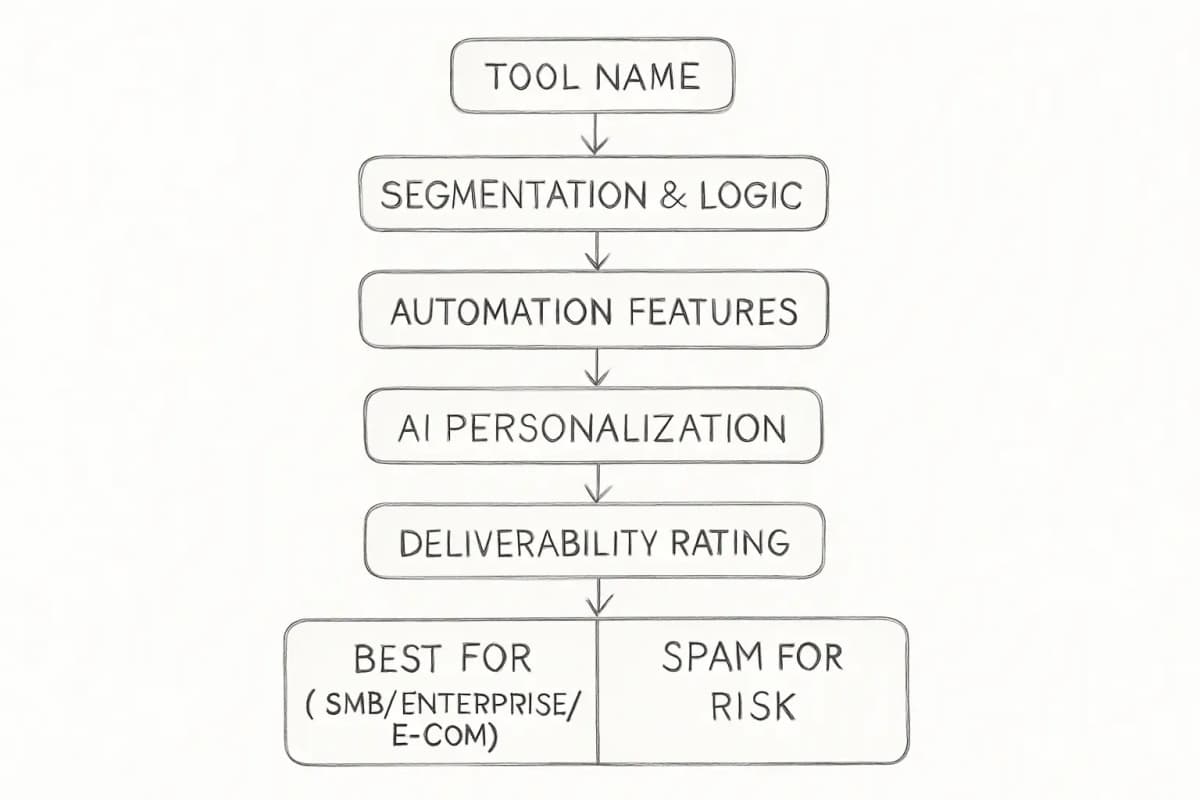
    For teams focused on improving conversion rates across every stage, pair your platform choice with proven tactics from AI Email Marketing Personalization Techniques. AI-driven hyper-personalization can boost revenue by 41% and click-through rates by 13.44%, but only when the underlying segmentation logic is sound. Comparison chart showing 4-5 AI email marketing tools (such as Mailchimp, HubSpot, Klaviyo, Braze, ActiveCampaign) arranged in columns with rows displaying key criteria: core features (segmentation, automation, personalization), pricing tiers (entry-level through enterprise), deliverability ratings, and best use cases (SMB vs enterprise vs e-commerce). Use a clean grid layout with color-coded rows for easy scanning. Include pricing ranges (e.g., $20-500/month) and star ratings (3-5 stars) for deliverability infrastructure. The chart should emphasize that feature lists alone are insufficient, highlighting which tools excel at segmentation logic and spam folder avoidance.


    What to Look for Beyond Feature Lists

    Most platform comparisons stop at features. These three factors separate strong results from disappointment.

    Deliverability infrastructure. Around 17% of marketing emails end up in spam folders. A tool's AI features are irrelevant if your campaigns do not reach inboxes. Look for platforms that offer domain authentication support, bounce suppression, and sender reputation monitoring.

    Data depth. AI quality is bounded by data quality. A platform analyzing 50 contacts will produce less accurate predictions than one analyzing 50,000. Klaviyo's AI helps teams discover opportunities grounded in your actual customer data, flow history, and 14 years of marketing intelligence across 193,000 brands. That training depth matters for prediction accuracy.

    Human oversight controls. 65% of marketers advocate using AI as an assistive tool but oppose fully hands-off deployment. The best platforms allow you to review and approve AI-generated content before sending, rather than fully automating output.

    You can also deepen results by combining your AI platform with proven campaign structures. The Email List Segmentation Strategies That Boost ROI by 760% guide covers how to build the audience logic that makes AI personalization actually work at scale.


    Frequently Asked Questions

    What is the best AI email marketing automation tool in 2025?

    There is no single best tool, because the right choice depends on your use case. ActiveCampaign is the strongest option for B2B automation and behavioral workflows. Klaviyo leads for ecommerce. HubSpot is best for teams that want CRM and marketing tightly integrated. Brevo offers the most accessible AI features for budget-conscious teams. Each platform is reviewed in detail above with pricing and limitations.

    How much does AI actually improve email marketing performance?

    Businesses using AI in email campaigns report an average ROI increase of 21%. More specifically, ActiveCampaign's Predictive Sending feature boosts customer click-through rates by 17% on average, and Klaviyo AI-driven segments produce revenue per recipient increases of 18 to 45% compared to traditional demographic segmentation. Results vary by platform, list quality, and how thoroughly AI features are implemented.

    Do I need a large email list to benefit from AI email marketing tools?

    Not necessarily. AI-powered content generation and subject line optimization add value from day one, regardless of list size. Predictive send-time optimization and behavioral segmentation require more historical data to work accurately. Companies typically see 5 to 15% improvement in open rates after AI learns subscriber patterns, usually after 2 to 3 months of use. Start with AI content tools, then activate predictive features once you have sufficient send history.

    What is the difference between AI automation and traditional email automation?


    What to Look for Beyond Feature Lists

    Most platform comparisons stop at features. These three factors separate strong results from disappointment.

    Deliverability infrastructure. Around 17% of marketing emails end up in spam folders. A tool's AI features are irrelevant if your campaigns do not reach inboxes. Look for platforms that offer domain authentication support, bounce suppression, and sender reputation monitoring.

    Data depth. AI quality is bounded by data quality. A platform analyzing 50 contacts will produce less accurate predictions than one analyzing 50,000. Klaviyo's AI helps teams discover opportunities grounded in your actual customer data, flow history, and 14 years of marketing intelligence across 193,000 brands. That training depth matters for prediction accuracy.

    Human oversight controls. 65% of marketers advocate using AI as an assistive tool but oppose fully hands-off deployment. The best platforms allow you to review and approve AI-generated content before sending, rather than fully automating output.

    You can also deepen results by combining your AI platform with proven campaign structures. The Email List Segmentation Strategies That Boost ROI by 760% guide covers how to build the audience logic that makes AI personalization actually work at scale.


    Frequently Asked Questions

    What is the best AI email marketing automation tool in 2025?

    There is no single best tool, because the right choice depends on your use case. ActiveCampaign is the strongest option for B2B automation and behavioral workflows. Klaviyo leads for ecommerce. HubSpot is best for teams that want CRM and marketing tightly integrated. Brevo offers the most accessible AI features for budget-conscious teams. Each platform is reviewed in detail above with pricing and limitations.

    How much does AI actually improve email marketing performance?

    Businesses using AI in email campaigns report an average ROI increase of 21%. More specifically, ActiveCampaign's Predictive Sending feature boosts customer click-through rates by 17% on average, and Klaviyo AI-driven segments produce revenue per recipient increases of 18 to 45% compared to traditional demographic segmentation. Results vary by platform, list quality, and how thoroughly AI features are implemented.

    Do I need a large email list to benefit from AI email marketing tools?

    Not necessarily. AI-powered content generation and subject line optimization add value from day one, regardless of list size. Predictive send-time optimization and behavioral segmentation require more historical data to work accurately. Companies typically see 5 to 15% improvement in open rates after AI learns subscriber patterns, usually after 2 to 3 months of use. Start with AI content tools, then activate predictive features once you have sufficient send history.

    What is the difference between AI automation and traditional email automation?

    Traditional marketing automation follows pre-set rules, while autonomous marketing uses AI to make strategic decisions, optimize campaigns in real time, and surface the next best action to take. In practical terms, traditional automation sends the same pre-written email to everyone who triggers a condition. AI automation adjusts content, timing, and sequencing dynamically based on each contact's behavior, purchase history, and predicted intent. The gap in performance between the two approaches is significant and growing.

    Is AI email marketing suitable for small businesses?

    Yes. More than 60% of small businesses say email is their most profitable marketing channel. Brevo and MailerLite both offer AI features on free or low-cost plans. The key is to start with automation for high-impact flows like welcome sequences and cart abandonment before expanding into more complex behavioral campaigns. For more on getting started with limited resources, see Email Marketing Tips for Small Business Owners.


    No comments yet. Be the first!

    Leave a comment

    Comments are reviewed before publishing.

    Traditional marketing automation follows pre-set rules, while autonomous marketing uses AI to make strategic decisions, optimize campaigns in real time, and surface the next best action to take. In practical terms, traditional automation sends the same pre-written email to everyone who triggers a condition. AI automation adjusts content, timing, and sequencing dynamically based on each contact's behavior, purchase history, and predicted intent. The gap in performance between the two approaches is significant and growing.

    Is AI email marketing suitable for small businesses?

    Yes. More than 60% of small businesses say email is their most profitable marketing channel. Brevo and MailerLite both offer AI features on free or low-cost plans. The key is to start with automation for high-impact flows like welcome sequences and cart abandonment before expanding into more complex behavioral campaigns. For more on getting started with limited resources, see Email Marketing Tips for Small Business Owners.

    No comments yet. Be the first!

    Leave a comment

    Comments are reviewed before publishing.

    More from

    Related posts

    Illustration for compare email marketing automation pricing plans
    Email Marketing Tools & PlatformsJul 17, 2026 11 min

    Compare Email Marketing Automation Pricing Plans 2024

    Compare top email marketing automation platforms side-by-side. See pricing, features, and ROI for Klaviyo, HubSpot, Mailchimp, and more. Find the right fit.

    More from

    Related posts

    Illustration for compare email marketing automation pricing plans
    Email Marketing Tools & PlatformsJul 17, 2026 11 min

    Compare Email Marketing Automation Pricing Plans 2024

    Compare top email marketing automation platforms side-by-side. See pricing, features, and ROI for Klaviyo, HubSpot, Mailchimp, and more. Find the right fit.

    MMarcus Webb
    MMarcus Webb
    Illustration for ai email marketing services
    Email Marketing Tools & PlatformsJul 16, 2026 11 min

    AI Email Marketing Services: Tools That Drive Real Results

    Discover how AI email marketing services automate campaigns, boost deliverability, and increase ROI. Compare top platforms and find the right fit for your business.

    MMarcus Webb
    Illustration for ai email marketing services
    Email Marketing Tools & PlatformsJul 16, 2026 11 min

    AI Email Marketing Services: Tools That Drive Real Results

    Discover how AI email marketing services automate campaigns, boost deliverability, and increase ROI. Compare top platforms and find the right fit for your business.

    MMarcus Webb
    Illustration for best email marketing automation platforms 2026
    Email Marketing Tools & PlatformsJul 16, 2026 14 min

    Best Email Marketing Automation Platforms 2026

    Compare top email automation tools for 2026. Find the platform that fits your budget, features, and business needs with our detailed guide.

    SSarah Mitchell
    Illustration for best email marketing automation platforms 2026
    Email Marketing Tools & PlatformsJul 16, 2026 14 min

    Best Email Marketing Automation Platforms 2026

    Compare top email automation tools for 2026. Find the platform that fits your budget, features, and business needs with our detailed guide.

    SSarah Mitchell