
HomeBlogEmail Marketing Tools & SoftwareBest AI Tools for Email Marketing 2025
Email Marketing Tools & Software

Best AI Tools for Email Marketing 2025

Discover top AI email marketing tools that boost open rates, personalization, and ROI. Compare features and find the right platform for your business.

R

Rachel Torres

July 14, 2026

15 min read
HomeBlogEmail Marketing Tools & SoftwareBest AI Tools for Email Marketing 2025
Email Marketing Tools & Software

Best AI Tools for Email Marketing 2025

Discover top AI email marketing tools that boost open rates, personalization, and ROI. Compare features and find the right platform for your business.

R

Rachel Torres

July 14, 2026

15 min read
Share:
Share:
#AI Tools#Email Marketing#marketing automation#2025 Guide
Illustration for best ai tools for email marketing 2025

Stay in the loop

Get the latest posts delivered straight to your inbox. No spam, unsubscribe anytime.

AI now touches every stage of an email marketing campaign, from the first word of the subject line to when it lands in someone's inbox. AI adoption has surged to 63% of marketers, with 87% of AI adopters specifically applying it to email marketing. That's not hype. That's a structural shift in how competitive email marketing works today.

The question is no longer whether you should use AI for email marketing. It's which tools are worth your time and budget. This guide covers the best AI tools for email marketing in 2025, what each one actually does well, and who each is built for.

Key Takeaways

  • The average email marketing ROI is $36 for every $1 spent, a 3,500% return. AI pushes that further.
  • Automated emails generate 320% more revenue than non-automated emails.
  • AI-driven email marketing results in a 13% boost in click-through rates, and AI subject line optimization can boost open rates by up to 10%.
  • Marketers using AI for email content creation save up to 30% of their time, with some reporting 90% reductions in newsletter production.
  • The best AI tools for email marketing fall into two categories: full-platform tools with embedded AI and specialist AI tools that handle one job exceptionally well.

What AI Actually Does in Email Marketing

Before comparing tools, it helps to understand the specific jobs AI handles in an email workflow. Across tools, teams use AI in email marketing for a few core jobs: speeding up execution, improving targeting, and automating decisions that don't need manual oversight.

More specifically, AI handles subject line and preview testing at scale, send-time optimization to hit inboxes when each contact is most likely to engage, behavior-based segmentation grouping users by actions like visits, trials, and purchases, and lifecycle flow optimization covering who enters, when to nudge, when to stop, and when to escalate.

More advanced tools let you embed AI directly into your workflows, meaning emails can be personalized in real time, triggered by behavior, or even adjusted based on sentiment and engagement.

Understanding these use cases helps you evaluate whether a tool's AI is genuinely useful or just a marketing label on a chatbot-powered text box.

Stay in the loop

Get the latest posts delivered straight to your inbox. No spam, unsubscribe anytime.

AI now touches every stage of an email marketing campaign, from the first word of the subject line to when it lands in someone's inbox. AI adoption has surged to 63% of marketers, with 87% of AI adopters specifically applying it to email marketing. That's not hype. That's a structural shift in how competitive email marketing works today.

The question is no longer whether you should use AI for email marketing. It's which tools are worth your time and budget. This guide covers the best AI tools for email marketing in 2025, what each one actually does well, and who each is built for.

Key Takeaways

  • The average email marketing ROI is $36 for every $1 spent, a 3,500% return. AI pushes that further.
  • Automated emails generate 320% more revenue than non-automated emails.
  • AI-driven email marketing results in a 13% boost in click-through rates, and AI subject line optimization can boost open rates by up to 10%.
  • Marketers using AI for email content creation save up to 30% of their time, with some reporting 90% reductions in newsletter production.
  • The best AI tools for email marketing fall into two categories: full-platform tools with embedded AI and specialist AI tools that handle one job exceptionally well.

What AI Actually Does in Email Marketing

Before comparing tools, it helps to understand the specific jobs AI handles in an email workflow. Across tools, teams use AI in email marketing for a few core jobs: speeding up execution, improving targeting, and automating decisions that don't need manual oversight.

More specifically, AI handles subject line and preview testing at scale, send-time optimization to hit inboxes when each contact is most likely to engage, behavior-based segmentation grouping users by actions like visits, trials, and purchases, and lifecycle flow optimization covering who enters, when to nudge, when to stop, and when to escalate.

More advanced tools let you embed AI directly into your workflows, meaning emails can be personalized in real time, triggered by behavior, or even adjusted based on sentiment and engagement.

Understanding these use cases helps you evaluate whether a tool's AI is genuinely useful or just a marketing label on a chatbot-powered text box.


1. ActiveCampaign: Best for Autonomous Email Marketing Automation

Best for: Mid-market businesses, B2B teams, and SaaS companies wanting deep automation with AI at the core.

ActiveCampaign approaches AI email marketing as a full-cycle system rather than a set of disconnected features. Where most platforms add AI to individual steps, ActiveCampaign connects AI across the entire campaign lifecycle, from creation through segmentation, sending, and reporting.

In May 2025, the platform launched its flagship AI engine. Active Intelligence is not just another AI feature, but a complete reimagining of how marketing automation works, evolving it into autonomous marketing. It is a system-wide intelligence engine powered by billions of data points and dozens of specialized AI agents working together.

Key AI capabilities include:

  • AI Campaign Builder, which generates complete campaigns from a single natural language prompt including subject lines, body copy, CTAs, and automation flows. Teams create campaigns 3x faster than building manually.
  • Predictive sending, which uses AI to find the best time to send your campaigns based on your contacts' preferences and behaviors.
  • A Segments Agent that eliminates technical barriers to audience building entirely. Rather than building segments from scratch, you can describe your audience in natural language and the agent builds complex conditions instantly.
  • An MCP Server released in June 2025 that lets AI tools like Claude, ChatGPT, and Cursor connect directly to your ActiveCampaign account, managing contacts, triggering automations, and pulling campaign data from within AI-powered tooling.

Independent review site EmailTooltester named ActiveCampaign the Best Email Marketing Tool of 2025, praising its simple yet powerful platform and highlighting deliverability, AI features, and responsive support.

Pricing starts at $15/month for 1,000 contacts on contact-based plans. Note that as of November 2025, new accounts are charged for every contact in the account, including unsubscribed, bounced, and unconfirmed contacts.

Ideal for: SaaS email marketing and B2B teams that want AI running across the full campaign lifecycle, not just content generation.


2. Klaviyo: Best for AI-Powered Ecommerce Email

Best for: Ecommerce brands on Shopify or WooCommerce wanting deep behavioral personalization and predictive analytics.

Klaviyo is the autonomous B2C CRM and AI marketing platform that unifies customer data and automates email, SMS, RCS, WhatsApp, and mobile push to drive personalized, revenue-generating campaigns. Built as both a system of record and system of action, Klaviyo combines a customer data platform, real-time signals, and AI agents to power automated insights and one-click execution.

Klaviyo AI is powered by your customer profiles, which capture every purchase, click, and interaction. This allows AI to create more relevant content, like smarter product recommendations.

Key AI features include:


1. ActiveCampaign: Best for Autonomous Email Marketing Automation

Best for: Mid-market businesses, B2B teams, and SaaS companies wanting deep automation with AI at the core.

ActiveCampaign approaches AI email marketing as a full-cycle system rather than a set of disconnected features. Where most platforms add AI to individual steps, ActiveCampaign connects AI across the entire campaign lifecycle, from creation through segmentation, sending, and reporting.

In May 2025, the platform launched its flagship AI engine. Active Intelligence is not just another AI feature, but a complete reimagining of how marketing automation works, evolving it into autonomous marketing. It is a system-wide intelligence engine powered by billions of data points and dozens of specialized AI agents working together.

Key AI capabilities include:

  • AI Campaign Builder, which generates complete campaigns from a single natural language prompt including subject lines, body copy, CTAs, and automation flows. Teams create campaigns 3x faster than building manually.
  • Predictive sending, which uses AI to find the best time to send your campaigns based on your contacts' preferences and behaviors.
  • A Segments Agent that eliminates technical barriers to audience building entirely. Rather than building segments from scratch, you can describe your audience in natural language and the agent builds complex conditions instantly.
  • An MCP Server released in June 2025 that lets AI tools like Claude, ChatGPT, and Cursor connect directly to your ActiveCampaign account, managing contacts, triggering automations, and pulling campaign data from within AI-powered tooling.

Independent review site EmailTooltester named ActiveCampaign the Best Email Marketing Tool of 2025, praising its simple yet powerful platform and highlighting deliverability, AI features, and responsive support.

Pricing starts at $15/month for 1,000 contacts on contact-based plans. Note that as of November 2025, new accounts are charged for every contact in the account, including unsubscribed, bounced, and unconfirmed contacts.

Ideal for: SaaS email marketing and B2B teams that want AI running across the full campaign lifecycle, not just content generation.


2. Klaviyo: Best for AI-Powered Ecommerce Email

Best for: Ecommerce brands on Shopify or WooCommerce wanting deep behavioral personalization and predictive analytics.

Klaviyo is the autonomous B2C CRM and AI marketing platform that unifies customer data and automates email, SMS, RCS, WhatsApp, and mobile push to drive personalized, revenue-generating campaigns. Built as both a system of record and system of action, Klaviyo combines a customer data platform, real-time signals, and AI agents to power automated insights and one-click execution.

Klaviyo AI is powered by your customer profiles, which capture every purchase, click, and interaction. This allows AI to create more relevant content, like smarter product recommendations.

Key AI features include:

  • Subject Line AI, which helps marketers craft on-brand subject lines in seconds informed by historical campaign performance, and can suggest multiple high-performing variations for A/B testing while optimizing for open rates without resorting to clickbait.
  • Personalized Send Time, which uses reinforcement learning to deliver each campaign at the moment each individual subscriber is most likely to open, click, and buy. You set a delivery window and Klaviyo AI queues each subscriber for their optimal time. Top campaigns using this feature see a 35% lift in click rate.
  • Segments AI, which lets you describe the audience you want in plain English and Klaviyo builds the segment automatically. The three highest-impact starting segments for ecommerce are win-back candidates, a dynamic VIP tier by predicted customer lifetime value, and a suppression segment for recent purchasers and open support tickets.
  • Predictive analytics that calculate predicted customer lifetime value, churn risk, next order date, spending potential, and time between orders.

According to Klaviyo's 2025 State of Email report, brands using Klaviyo AI-driven segments see revenue per recipient increases of 18 to 45% compared to traditional demographic segmentation.

AI tools including subject line generation, send time optimization, and predictive analytics are included in all paid plans, not gated behind extra fees. The email plan starts at $20/month for 251 to 500 active profiles.

Worth noting: Klaviyo gets expensive quickly as your list grows. A 25,000-profile list costs roughly $400/month for email only.


3. Brevo: Best Budget-Friendly AI Email Platform

Best for: Small to mid-size teams wanting AI-assisted campaigns without enterprise pricing.

Brevo's AI agent, Aura, launched in May 2025 as the first major result of a €50 million investment in AI innovation. Aura is accessible from any page within the Brevo dashboard via a simple icon that opens a chat-style interface. From there, you can ask it to draft subject lines, generate high-quality email copy, and adjust the tone to match your brand's voice.

Brevo takes the lead in accessibility: its AI email builder is available even on the free plan. With Brevo, you can generate email content in seconds, refine your copy, adjust styles, and even optimize send times for each subscriber to boost engagement.

Brevo's AI capabilities go far beyond content creation. Aura can add dynamic product recommendations, fine-tune audience segmentation, and optimize send times.

The free forever plan allows up to 100,000 contacts and includes automation, 40+ email templates, signup forms, and up to 9,000 emails per month.


4. HubSpot: Best for CRM-Native Email Marketing with AI

Best for: Teams already using HubSpot CRM that want marketing, sales, and email data unified in one place.

HubSpot is a multi-hub revenue platform that combines Marketing, Sales, Service, Operations, and Commerce in one shared CRM. When a lead fills out a form, gets nurtured via email, books a demo, and becomes a customer, HubSpot tracks every step on one contact record. That full-funnel visibility is the core of its value.

HubSpot Email Marketing is included in Marketing Hub plans, with a free tier available. Starter is $9 per seat/month, Professional $800/month, and Enterprise is $3,600/month. Paid plans offer automation, advanced segmentation, collaboration tools, and AI-powered features.

  • Subject Line AI, which helps marketers craft on-brand subject lines in seconds informed by historical campaign performance, and can suggest multiple high-performing variations for A/B testing while optimizing for open rates without resorting to clickbait.
  • Personalized Send Time, which uses reinforcement learning to deliver each campaign at the moment each individual subscriber is most likely to open, click, and buy. You set a delivery window and Klaviyo AI queues each subscriber for their optimal time. Top campaigns using this feature see a 35% lift in click rate.
  • Segments AI, which lets you describe the audience you want in plain English and Klaviyo builds the segment automatically. The three highest-impact starting segments for ecommerce are win-back candidates, a dynamic VIP tier by predicted customer lifetime value, and a suppression segment for recent purchasers and open support tickets.
  • Predictive analytics that calculate predicted customer lifetime value, churn risk, next order date, spending potential, and time between orders.

According to Klaviyo's 2025 State of Email report, brands using Klaviyo AI-driven segments see revenue per recipient increases of 18 to 45% compared to traditional demographic segmentation.

AI tools including subject line generation, send time optimization, and predictive analytics are included in all paid plans, not gated behind extra fees. The email plan starts at $20/month for 251 to 500 active profiles.

Worth noting: Klaviyo gets expensive quickly as your list grows. A 25,000-profile list costs roughly $400/month for email only.


3. Brevo: Best Budget-Friendly AI Email Platform

Best for: Small to mid-size teams wanting AI-assisted campaigns without enterprise pricing.

Brevo's AI agent, Aura, launched in May 2025 as the first major result of a €50 million investment in AI innovation. Aura is accessible from any page within the Brevo dashboard via a simple icon that opens a chat-style interface. From there, you can ask it to draft subject lines, generate high-quality email copy, and adjust the tone to match your brand's voice.

Brevo takes the lead in accessibility: its AI email builder is available even on the free plan. With Brevo, you can generate email content in seconds, refine your copy, adjust styles, and even optimize send times for each subscriber to boost engagement.

Brevo's AI capabilities go far beyond content creation. Aura can add dynamic product recommendations, fine-tune audience segmentation, and optimize send times.

The free forever plan allows up to 100,000 contacts and includes automation, 40+ email templates, signup forms, and up to 9,000 emails per month.


4. HubSpot: Best for CRM-Native Email Marketing with AI

Best for: Teams already using HubSpot CRM that want marketing, sales, and email data unified in one place.

HubSpot is a multi-hub revenue platform that combines Marketing, Sales, Service, Operations, and Commerce in one shared CRM. When a lead fills out a form, gets nurtured via email, books a demo, and becomes a customer, HubSpot tracks every step on one contact record. That full-funnel visibility is the core of its value.

HubSpot Email Marketing is included in Marketing Hub plans, with a free tier available. Starter is $9 per seat/month, Professional $800/month, and Enterprise is $3,600/month. Paid plans offer automation, advanced segmentation, collaboration tools, and AI-powered features.

HubSpot is the right fit when email strategy needs to tie directly into CRM pipeline data, lead scoring, and sales handoffs. It is not the most cost-effective option if email is the only channel you need.


5. Mailchimp: Best for Beginners Wanting AI Assistance

Best for: Small businesses and solo marketers who want straightforward campaign management with AI-powered suggestions.

Mailchimp now includes AI features powered by Intuit Assist, including AI-generated content, smart send-time optimization, and fully pre-built and auto-scheduled abandoned cart emails.

Mailchimp's Intuit Assist helps with content generation, tone adjustments, and brand-based template customization. However, its send-time optimization isn't as precise: instead of optimizing for individual recipients, it calculates a general best time for the entire list.

Mailchimp users find it best for straightforward and intuitive email campaign management, appreciating its user-friendly drag-and-drop editor, customizable templates, and detailed analytics. Reviewers value its simple contact and list management, mobile optimization, and integrations with platforms like WordPress, Shopify, Gmail, and Google Analytics.

For email marketing for small business owners who are just starting out, Mailchimp's familiar interface removes the learning curve while still giving access to AI-assisted tools.


6. Jasper AI: Best for Brand-Consistent Email Copy at Scale

Best for: Marketing teams and agencies that need high-volume, on-brand email copy across multiple campaigns and channels.

Jasper is not an email platform. It is a dedicated AI content tool that fits into your email workflow at the copy stage.

Jasper is not an email platform; it's an AI writing tool that excels at generating email copy. If your bottleneck is writing compelling subject lines, body copy, and CTAs rather than automation or deliverability, Jasper fills that gap better than any ESP's built-in AI.

Jasper IQ embeds your brand voice, style guides, audience profiles, and product knowledge into every output across your entire team, automatically. Jasper also includes marketing-specific agents, team-scale content pipelines, and enterprise governance controls.

Emails and ads come out polished and only need light editing according to hands-on testing. Jasper offers over 100 purpose-built marketing apps for specific, short-form writing tasks, including ad copy, email subject lines, product descriptions, and social media posts.

The Pro plan starts at $69 per month for one user, or $59 per month if paid annually. There is no permanent free plan, only a 7-day trial.

Key limitation: Jasper generates content but does not send, segment, or automate. You still need an ESP to handle campaign delivery.


7. Lavender: Best for Improving Sales Email Reply Rates

Best for: Sales development reps and outbound teams who want real-time coaching to improve individual email quality.

Lavender is a tool that helps you improve emails before you send them. It does not write emails for you. It reviews what you write and shows where changes can help you get more replies.

HubSpot is the right fit when email strategy needs to tie directly into CRM pipeline data, lead scoring, and sales handoffs. It is not the most cost-effective option if email is the only channel you need.


5. Mailchimp: Best for Beginners Wanting AI Assistance

Best for: Small businesses and solo marketers who want straightforward campaign management with AI-powered suggestions.

Mailchimp now includes AI features powered by Intuit Assist, including AI-generated content, smart send-time optimization, and fully pre-built and auto-scheduled abandoned cart emails.

Mailchimp's Intuit Assist helps with content generation, tone adjustments, and brand-based template customization. However, its send-time optimization isn't as precise: instead of optimizing for individual recipients, it calculates a general best time for the entire list.

Mailchimp users find it best for straightforward and intuitive email campaign management, appreciating its user-friendly drag-and-drop editor, customizable templates, and detailed analytics. Reviewers value its simple contact and list management, mobile optimization, and integrations with platforms like WordPress, Shopify, Gmail, and Google Analytics.

For email marketing for small business owners who are just starting out, Mailchimp's familiar interface removes the learning curve while still giving access to AI-assisted tools.


6. Jasper AI: Best for Brand-Consistent Email Copy at Scale

Best for: Marketing teams and agencies that need high-volume, on-brand email copy across multiple campaigns and channels.

Jasper is not an email platform. It is a dedicated AI content tool that fits into your email workflow at the copy stage.

Jasper is not an email platform; it's an AI writing tool that excels at generating email copy. If your bottleneck is writing compelling subject lines, body copy, and CTAs rather than automation or deliverability, Jasper fills that gap better than any ESP's built-in AI.

Jasper IQ embeds your brand voice, style guides, audience profiles, and product knowledge into every output across your entire team, automatically. Jasper also includes marketing-specific agents, team-scale content pipelines, and enterprise governance controls.

Emails and ads come out polished and only need light editing according to hands-on testing. Jasper offers over 100 purpose-built marketing apps for specific, short-form writing tasks, including ad copy, email subject lines, product descriptions, and social media posts.

The Pro plan starts at $69 per month for one user, or $59 per month if paid annually. There is no permanent free plan, only a 7-day trial.

Key limitation: Jasper generates content but does not send, segment, or automate. You still need an ESP to handle campaign delivery.


7. Lavender: Best for Improving Sales Email Reply Rates

Best for: Sales development reps and outbound teams who want real-time coaching to improve individual email quality.

Lavender is a tool that helps you improve emails before you send them. It does not write emails for you. It reviews what you write and shows where changes can help you get more replies.

Through Lavender, users can get AI-driven real-time coaching for their emails, confirm that their email is valid, check if their email ends up in spam, and see what it looks like on a mobile device. Lavender integrates with Gmail, Outlook Web, Outreach, and Salesloft.

Lavender works best when you want to improve reply rates and writing habits, not create emails from scratch.


How to Choose the Right AI Email Tool

The tools available represent a spectrum from full AI autonomy to AI-assisted human writing. Traditional email marketing sends one campaign to a segment. AI email marketing researches each recipient individually and adapts content, timing, and channel accordingly.

Use this framework to narrow your options:

Through Lavender, users can get AI-driven real-time coaching for their emails, confirm that their email is valid, check if their email ends up in spam, and see what it looks like on a mobile device. Lavender integrates with Gmail, Outlook Web, Outreach, and Salesloft.

Lavender works best when you want to improve reply rates and writing habits, not create emails from scratch.


How to Choose the Right AI Email Tool

The tools available represent a spectrum from full AI autonomy to AI-assisted human writing. Traditional email marketing sends one campaign to a segment. AI email marketing researches each recipient individually and adapts content, timing, and channel accordingly.

Use this framework to narrow your options:

  • Ecommerce brand on Shopify: Klaviyo. The depth of purchase data integration and predictive analytics justifies the price.
  • B2B or SaaS team with complex automation needs: ActiveCampaign. Its AI runs across the full campaign lifecycle.
  • Budget-conscious team needing AI features now: Brevo. The free plan includes Aura AI.
  • CRM-first organization: HubSpot. If your team lives in HubSpot, the email AI connects to pipeline data your other tools can't see.
  • Small business, simple campaigns: Mailchimp. The easiest to learn, with useful AI assistance for copy and timing.
  • Content team producing high volumes of email copy: Jasper. Best-in-class for maintaining brand voice at scale.
  • Outbound sales team wanting better reply rates: Lavender. Real-time coaching inside your inbox.
  • Ecommerce brand on Shopify: Klaviyo. The depth of purchase data integration and predictive analytics justifies the price.
  • B2B or SaaS team with complex automation needs: ActiveCampaign. Its AI runs across the full campaign lifecycle.
  • Budget-conscious team needing AI features now: Brevo. The free plan includes Aura AI.
  • CRM-first organization: HubSpot. If your team lives in HubSpot, the email AI connects to pipeline data your other tools can't see.
  • Small business, simple campaigns: Mailchimp. The easiest to learn, with useful AI assistance for copy and timing.
  • Content team producing high volumes of email copy: Jasper. Best-in-class for maintaining brand voice at scale.
  • Outbound sales team wanting better reply rates: Lavender. Real-time coaching inside your inbox.

For deeper guidance on using these tools in practice, see our guides on AI email marketing personalization techniques and how to leverage AI in your email marketing.


What to Expect From AI Email Marketing in 2025

The numbers support investment in AI-powered email tools. By 2026, 89% of marketing experts expect up to 75% of email strategy operations to be fully AI-driven, according to Litmus.

Marketers using AI are 46% more likely to exceed their goals compared to those who are not, highlighting a clear competitive advantage for early adopters.

That said, 65% of marketers advocate using AI as an assistive tool but oppose fully hands-off deployment, according to HubSpot's AI Trends for Marketers Report (2025). The strongest results still come from human judgment applied to AI-generated outputs, not raw AI content sent without review.

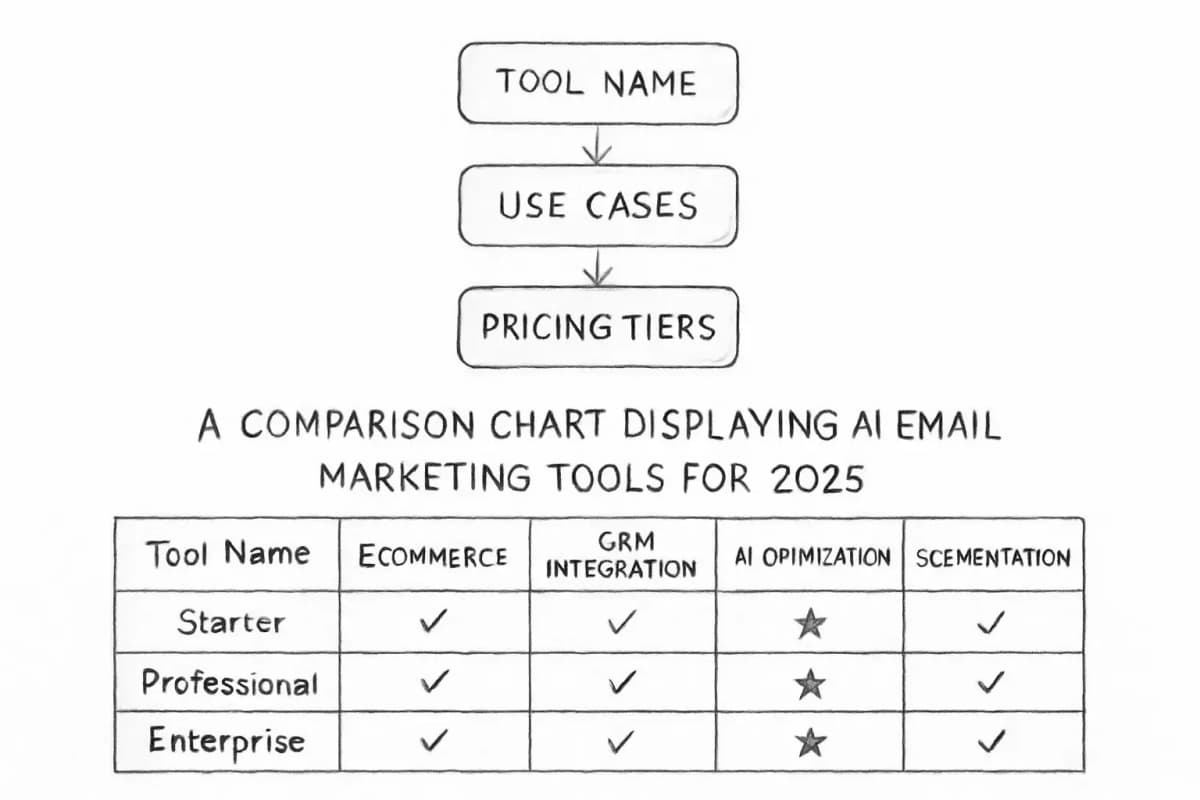
Pair AI tools with solid strategy fundamentals: strong email list segmentation strategies, tested email subject line best practices, and consistent measurement using email marketing analytics best practices. AI amplifies what works. It cannot fix a broken strategy. A comparison chart displaying AI email marketing tools for 2025. The chart should show multiple tools (such as Klaviyo, Omnisend, and others mentioned in email marketing context) arranged in columns with rows comparing: use cases (ecommerce, CRM integration, automation, etc.), pricing tiers (starter, professional, enterprise), and key features (AI subject line generation, send time optimization, segmentation, personalization). Use a clean table or grid layout with color coding to differentiate tool capabilities. Include visual indicators (checkmarks, stars, or highlighting) to show feature availability across pricing tiers.

Frequently Asked Questions

What is the best AI tool for email marketing in 2025?

There is no single best tool. It depends on your use case. The right choice depends on your use case: if you run an ecommerce store, Klaviyo or Omnisend will serve you best; if you need CRM-integrated marketing automation, HubSpot is the standard. ActiveCampaign is the strongest overall option for businesses that need AI across the full campaign lifecycle, from segmentation to send-time optimization.

How much does AI email marketing software cost?

For deeper guidance on using these tools in practice, see our guides on AI email marketing personalization techniques and how to leverage AI in your email marketing.


What to Expect From AI Email Marketing in 2025

The numbers support investment in AI-powered email tools. By 2026, 89% of marketing experts expect up to 75% of email strategy operations to be fully AI-driven, according to Litmus.

Marketers using AI are 46% more likely to exceed their goals compared to those who are not, highlighting a clear competitive advantage for early adopters.

That said, 65% of marketers advocate using AI as an assistive tool but oppose fully hands-off deployment, according to HubSpot's AI Trends for Marketers Report (2025). The strongest results still come from human judgment applied to AI-generated outputs, not raw AI content sent without review.

Pair AI tools with solid strategy fundamentals: strong email list segmentation strategies, tested email subject line best practices, and consistent measurement using email marketing analytics best practices. AI amplifies what works. It cannot fix a broken strategy. A comparison chart displaying AI email marketing tools for 2025. The chart should show multiple tools (such as Klaviyo, Omnisend, and others mentioned in email marketing context) arranged in columns with rows comparing: use cases (ecommerce, CRM integration, automation, etc.), pricing tiers (starter, professional, enterprise), and key features (AI subject line generation, send time optimization, segmentation, personalization). Use a clean table or grid layout with color coding to differentiate tool capabilities. Include visual indicators (checkmarks, stars, or highlighting) to show feature availability across pricing tiers.


Frequently Asked Questions

What is the best AI tool for email marketing in 2025?

There is no single best tool. It depends on your use case. The right choice depends on your use case: if you run an ecommerce store, Klaviyo or Omnisend will serve you best; if you need CRM-integrated marketing automation, HubSpot is the standard. ActiveCampaign is the strongest overall option for businesses that need AI across the full campaign lifecycle, from segmentation to send-time optimization.

How much does AI email marketing software cost?

Pricing varies widely. ActiveCampaign starts at $15/month for 1,000 contacts. Klaviyo's email plan starts at $20/month for 251 to 500 active profiles. Brevo offers a free plan with AI features included. Jasper Pro starts at $59/month billed annually. Most platforms offer free trials so you can test before committing.

Can AI replace a human email marketer?

Not yet. The strongest results still come from the combination of human creativity and machine intelligence. AI is a tool used by skilled marketers, not a substitute for them. AI handles execution, optimization, and scale. Human judgment remains essential for strategy, brand voice, and interpreting results accurately.

What AI features should I look for in an email marketing platform?

Look for AI-powered automation and personalization that lets you embed AI directly into your workflows, meaning emails can be personalized in real time and triggered by behavior. Also look for campaign planning and optimization features where AI can suggest campaign ideas, generate audience segments, and provide recommendations to improve performance before you send. Predictive send-time optimization and behavior-based segmentation round out the most impactful AI features available today.


No comments yet. Be the first!

Leave a comment

Comments are reviewed before publishing.

Pricing varies widely. ActiveCampaign starts at $15/month for 1,000 contacts. Klaviyo's email plan starts at $20/month for 251 to 500 active profiles. Brevo offers a free plan with AI features included. Jasper Pro starts at $59/month billed annually. Most platforms offer free trials so you can test before committing.

Can AI replace a human email marketer?

Not yet. The strongest results still come from the combination of human creativity and machine intelligence. AI is a tool used by skilled marketers, not a substitute for them. AI handles execution, optimization, and scale. Human judgment remains essential for strategy, brand voice, and interpreting results accurately.

What AI features should I look for in an email marketing platform?

Look for AI-powered automation and personalization that lets you embed AI directly into your workflows, meaning emails can be personalized in real time and triggered by behavior. Also look for campaign planning and optimization features where AI can suggest campaign ideas, generate audience segments, and provide recommendations to improve performance before you send. Predictive send-time optimization and behavior-based segmentation round out the most impactful AI features available today.

No comments yet. Be the first!

Leave a comment

Comments are reviewed before publishing.

More from

Related posts

Illustration for email marketing tools with ai optimization 2025
Email Marketing Tools & SoftwareJul 17, 2026 15 min

Best Email Marketing Tools With AI Optimization 2025

Compare top email marketing tools with built-in AI features for 2025. Discover automation, personalization, and deliverability improvements.

More from

Related posts

Illustration for email marketing tools with ai optimization 2025
Email Marketing Tools & SoftwareJul 17, 2026 15 min

Best Email Marketing Tools With AI Optimization 2025

Compare top email marketing tools with built-in AI features for 2025. Discover automation, personalization, and deliverability improvements.

SSarah Mitchell
SSarah Mitchell
Illustration for ai-powered email marketing platforms
Email Marketing Tools & SoftwareJul 17, 2026 15 min

AI-Powered Email Marketing Platforms: 2024 Guide

Discover the best AI-powered email marketing platforms that automate campaigns, improve deliverability, and boost ROI. Compare features and find the right tool.

MMarcus Webb
Illustration for ai-powered email marketing platforms
Email Marketing Tools & SoftwareJul 17, 2026 15 min

AI-Powered Email Marketing Platforms: 2024 Guide

Discover the best AI-powered email marketing platforms that automate campaigns, improve deliverability, and boost ROI. Compare features and find the right tool.

MMarcus Webb
Illustration for best email marketing automation tools 2024
Email Marketing Tools & SoftwareJul 16, 2026 11 min

Best Email Marketing Automation Tools 2024

Compare top email marketing automation platforms for deliverability, segmentation, and ROI. Find the right tool for your business needs.

RRachel Torres
Illustration for best email marketing automation tools 2024
Email Marketing Tools & SoftwareJul 16, 2026 11 min

Best Email Marketing Automation Tools 2024

Compare top email marketing automation platforms for deliverability, segmentation, and ROI. Find the right tool for your business needs.

RRachel Torres