
HomeBlogEmail Marketing ToolsBest Automation Email Marketing Tools for 2024
Email Marketing Tools

Best Automation Email Marketing Tools for 2024

Find the top email automation platforms that boost ROI and save time. Compare features, pricing, and deliverability to pick the right tool for your business.

P

Priya Kapoor

July 16, 2026

16 min read
HomeBlogEmail Marketing ToolsBest Automation Email Marketing Tools for 2024
Email Marketing Tools

Best Automation Email Marketing Tools for 2024

Find the top email automation platforms that boost ROI and save time. Compare features, pricing, and deliverability to pick the right tool for your business.

P

Priya Kapoor

July 16, 2026

16 min read
Share:
Share:
#Email Automation#marketing automation#Email Tools#campaign management
Illustration for best automation email marketing

Stay in the loop

Get the latest posts delivered straight to your inbox. No spam, unsubscribe anytime.

Choosing the right tool for best automation email marketing is one of the highest-leverage decisions you can make for your business. Email automations deliver 30 times more revenue per recipient than one-off promotional campaigns, with the average return per recipient for automated flows reaching $1.94 compared to just $0.11 for standard campaigns. Yet most teams spend weeks comparing feature lists without a clear framework for what actually matters.

This guide cuts through the noise. It covers the top tools, how to evaluate them, and which platform fits which use case, so you can stop debating and start sending.


Key Takeaways

  • Automated messages represent only 2% of email volume but generated 37% of all email-attributed sales in 2024, making automation the foundation of any profitable email program.
  • Automated emails average a 70.5% higher open rate and 152% higher click-through rate than standard marketing messages.
  • Email is the channel that relies most on marketing automation, with 58% of surveyed professionals choosing it over content and social media management.
  • The right tool depends on your business model: ActiveCampaign leads for workflow depth, Klaviyo for ecommerce, HubSpot for B2B and SaaS teams, Brevo for budget-conscious senders, and Mailchimp for beginners.
  • Pricing models vary significantly across platforms. Contact-based, send-volume-based, and profile-based billing all carry different cost implications as your list grows.

Why Email Automation Drives Disproportionate Returns

Email marketing delivers an average return of between $36 and $42 for every $1 spent, the highest ROI of any digital marketing channel. For context, paid search returns $2 per $1, social advertising $2.80, and display ads $1.35.

Automation is the multiplier behind those numbers. 69% of marketers adopted marketing automation because it reduces manual work and improves campaign execution speed. Rather than manually sending one-off blasts, automation lets you build sequences that respond to subscriber behavior around the clock.

Automated emails drove 37% of all ecommerce email revenue in 2024 despite representing just 2% of email volume. Welcome emails achieve an 83.6% open rate in ecommerce, the highest of any automated email type.

Stay in the loop

Get the latest posts delivered straight to your inbox. No spam, unsubscribe anytime.

Choosing the right tool for best automation email marketing is one of the highest-leverage decisions you can make for your business. Email automations deliver 30 times more revenue per recipient than one-off promotional campaigns, with the average return per recipient for automated flows reaching $1.94 compared to just $0.11 for standard campaigns. Yet most teams spend weeks comparing feature lists without a clear framework for what actually matters.

This guide cuts through the noise. It covers the top tools, how to evaluate them, and which platform fits which use case, so you can stop debating and start sending.


Key Takeaways

  • Automated messages represent only 2% of email volume but generated 37% of all email-attributed sales in 2024, making automation the foundation of any profitable email program.
  • Automated emails average a 70.5% higher open rate and 152% higher click-through rate than standard marketing messages.
  • Email is the channel that relies most on marketing automation, with 58% of surveyed professionals choosing it over content and social media management.
  • The right tool depends on your business model: ActiveCampaign leads for workflow depth, Klaviyo for ecommerce, HubSpot for B2B and SaaS teams, Brevo for budget-conscious senders, and Mailchimp for beginners.
  • Pricing models vary significantly across platforms. Contact-based, send-volume-based, and profile-based billing all carry different cost implications as your list grows.

Why Email Automation Drives Disproportionate Returns

Email marketing delivers an average return of between $36 and $42 for every $1 spent, the highest ROI of any digital marketing channel. For context, paid search returns $2 per $1, social advertising $2.80, and display ads $1.35.

Automation is the multiplier behind those numbers. 69% of marketers adopted marketing automation because it reduces manual work and improves campaign execution speed. Rather than manually sending one-off blasts, automation lets you build sequences that respond to subscriber behavior around the clock.

Automated emails drove 37% of all ecommerce email revenue in 2024 despite representing just 2% of email volume. Welcome emails achieve an 83.6% open rate in ecommerce, the highest of any automated email type.

The implication is clear: moving from broadcast sends to behavior-triggered automation is not a marginal improvement. It is a structural shift in how your email program generates revenue.


What to Look For in Best Automation Email Marketing Software

Before comparing platforms, align on the features that actually determine whether a tool will serve you in six months, not just week one.

A drag-and-drop email editor is essential for making attractive email designs quickly; the first thing to judge any email marketing software on is how user-friendly the email builder is. Beyond that, look for:

The implication is clear: moving from broadcast sends to behavior-triggered automation is not a marginal improvement. It is a structural shift in how your email program generates revenue.


What to Look For in Best Automation Email Marketing Software

Before comparing platforms, align on the features that actually determine whether a tool will serve you in six months, not just week one.

A drag-and-drop email editor is essential for making attractive email designs quickly; the first thing to judge any email marketing software on is how user-friendly the email builder is. Beyond that, look for:

  • Visual workflow builder: Look for tools with visual workflow builders that are intuitive to use and allow for detailed automation configurations.
  • Behavioral triggers: Behavioral triggers track user actions like abandoned carts or visited product pages and automatically send tailored messages that re-engage users.
  • Segmentation: Advanced segmentation capabilities are a must-have in any modern email marketing tool, allowing you to craft messages that resonate by dividing your audience into groups based on demographics, purchase history, location, or browsing behavior.
  • AI features: Over half (51%) of marketers are already using AI or experimenting with it in email, and most platforms have transitioned to AI-powered solutions, with some adding agentic AI to help automate campaigns.
  • Analytics and reporting: A robust tool should provide comprehensive analytics covering open rates, click-through rates, conversions, and bounce rates, with advanced tools also offering heatmaps and predictive analytics to forecast campaign performance.
  • CRM and ecommerce integrations: Seamless integration with CRMs, social media, or ecommerce systems ensures your marketing is cohesive and consistent across all channels.
  • Scalable pricing: The best platforms can grow alongside your business; even if you don't need advanced features right now, it's smart to pick a tool that offers upgrades, higher list limits, and additional functionality as your audience and goals expand.
  • Visual workflow builder: Look for tools with visual workflow builders that are intuitive to use and allow for detailed automation configurations.
  • Behavioral triggers: Behavioral triggers track user actions like abandoned carts or visited product pages and automatically send tailored messages that re-engage users.
  • Segmentation: Advanced segmentation capabilities are a must-have in any modern email marketing tool, allowing you to craft messages that resonate by dividing your audience into groups based on demographics, purchase history, location, or browsing behavior.
  • AI features: Over half (51%) of marketers are already using AI or experimenting with it in email, and most platforms have transitioned to AI-powered solutions, with some adding agentic AI to help automate campaigns.
  • Analytics and reporting: A robust tool should provide comprehensive analytics covering open rates, click-through rates, conversions, and bounce rates, with advanced tools also offering heatmaps and predictive analytics to forecast campaign performance.
  • CRM and ecommerce integrations: Seamless integration with CRMs, social media, or ecommerce systems ensures your marketing is cohesive and consistent across all channels.
  • Scalable pricing: The best platforms can grow alongside your business; even if you don't need advanced features right now, it's smart to pick a tool that offers upgrades, higher list limits, and additional functionality as your audience and goals expand.

For deeper strategies on how to apply automation effectively, the Email Marketing Automation CRM Setup Guide walks through connecting your tools from scratch.


The Top Email Marketing Automation Tools for 2024

1. ActiveCampaign: Best for Advanced Automation Workflows

ActiveCampaign takes the top spot for automation depth and holds a 4.5 out of 5 G2 rating across 14,000+ reviews.

ActiveCampaign was designed as an autonomous marketing platform from day one. It helps businesses build sophisticated, fully automated customer journeys using deep conditional logic and triggers tied to real behavior, including site activity, purchases, and custom events.

ActiveCampaign's automation builder is powered by AI, and a library of over 1,000 pre-built automation recipes is available, categorized by industry so you can find relevant starting points fast.

Pricing: The Plus plan starts at $49/month for 1,000 contacts (annual billing) and scales to $189/month at 10,000 contacts. The Plus plan adds CRM, lead scoring, and landing pages, features most B2B teams consider essential.

Best for: Growing businesses that need multi-step behavioral automation, CRM coordination, and advanced segmentation without enterprise-level pricing.

Watch out for: ActiveCampaign's 2024 pricing restructure pushed existing users up 30 to 40% and damaged trust with some long-term customers.


2. Klaviyo: Best for Ecommerce Brands

Klaviyo is a data-driven email and SMS platform built primarily for ecommerce brands. Its software is deeply integrated into the Shopify ecosystem and treats every contact interaction as a potential data point for smarter targeting.

Klaviyo organizes its features around ecommerce data models, including ecommerce-first segmentation built on purchase behavior, browse history, and predicted customer lifetime value, as well as strong pre-built lifecycle flows for cart recovery, browse abandonment, post-purchase follow-up, and winback campaigns.

Pricing: Email-only pricing starts at $45/month for 1,000 profiles and rises to $150/month at 10,000 and $720/month at 50,000.

Best for: Shopify and WooCommerce stores that want deep revenue attribution, predictive analytics, and behavior-based email and SMS flows in one platform.

Watch out for: As of early 2025, Klaviyo bills on all active profiles rather than just contacts emailed in a given month, which increased costs for brands with large unengaged lists.


3. HubSpot Marketing Hub: Best for B2B and SaaS Teams

For deeper strategies on how to apply automation effectively, the Email Marketing Automation CRM Setup Guide walks through connecting your tools from scratch.


The Top Email Marketing Automation Tools for 2024

1. ActiveCampaign: Best for Advanced Automation Workflows

ActiveCampaign takes the top spot for automation depth and holds a 4.5 out of 5 G2 rating across 14,000+ reviews.

ActiveCampaign was designed as an autonomous marketing platform from day one. It helps businesses build sophisticated, fully automated customer journeys using deep conditional logic and triggers tied to real behavior, including site activity, purchases, and custom events.

ActiveCampaign's automation builder is powered by AI, and a library of over 1,000 pre-built automation recipes is available, categorized by industry so you can find relevant starting points fast.

Pricing: The Plus plan starts at $49/month for 1,000 contacts (annual billing) and scales to $189/month at 10,000 contacts. The Plus plan adds CRM, lead scoring, and landing pages, features most B2B teams consider essential.

Best for: Growing businesses that need multi-step behavioral automation, CRM coordination, and advanced segmentation without enterprise-level pricing.

Watch out for: ActiveCampaign's 2024 pricing restructure pushed existing users up 30 to 40% and damaged trust with some long-term customers.


2. Klaviyo: Best for Ecommerce Brands

Klaviyo is a data-driven email and SMS platform built primarily for ecommerce brands. Its software is deeply integrated into the Shopify ecosystem and treats every contact interaction as a potential data point for smarter targeting.

Klaviyo organizes its features around ecommerce data models, including ecommerce-first segmentation built on purchase behavior, browse history, and predicted customer lifetime value, as well as strong pre-built lifecycle flows for cart recovery, browse abandonment, post-purchase follow-up, and winback campaigns.

Pricing: Email-only pricing starts at $45/month for 1,000 profiles and rises to $150/month at 10,000 and $720/month at 50,000.

Best for: Shopify and WooCommerce stores that want deep revenue attribution, predictive analytics, and behavior-based email and SMS flows in one platform.

Watch out for: As of early 2025, Klaviyo bills on all active profiles rather than just contacts emailed in a given month, which increased costs for brands with large unengaged lists.


3. HubSpot Marketing Hub: Best for B2B and SaaS Teams

HubSpot covers all digital marketing areas and caters to sales-oriented businesses like SaaS. It offers a unified platform that combines CRM capabilities with email marketing, automation, and sales tools.

The native connection between Marketing Hub and Sales Hub means the sales handoff is part of the same workflow rather than a separate integration to maintain. The Breeze AI suite adds prospecting, content generation, and customer support automation on top of that, all within the same platform.

Pricing: The Professional plan at $890/month is where real automation begins, including 2,000 contacts, workflow automation, A/B testing, and smart content, but it requires a mandatory $3,000 onboarding fee and an annual commitment.

Best for: Scaling B2B and SaaS teams that need the automation depth, native CRM, AI tools, and a usable free tier, making it the lowest-risk starting point for teams that expect to grow into more sophisticated programs.

Watch out for: The price jump from Starter to Professional is steep, and the mandatory onboarding fee adds significant upfront cost.


4. Brevo: Best for Budget-Conscious Senders with Large Lists

Brevo flips the usual pricing model. You pay for emails sent per month, so a large list you mail occasionally costs less than on contact-based platforms.

Brevo's marketing automation tools are impressive. It supports website tracking so you can trigger automated sequences from website visits, and it has 12 pre-built workflow templates covering lead nurturing, abandoned carts, and personalized follow-ups.

Brevo also lets you send multi-channel campaigns including SMS and WhatsApp messages, and businesses can manage transactional emails like receipts and order confirmations alongside promotional emails.

Pricing: Brevo offers up to 100,000 contacts on the free plan, and paid plans are priced based on email volume rather than contact tiers, meaning your costs scale with how much you actually send.

Best for: Businesses with large contact lists that send with moderate frequency, or those that need multichannel (email, SMS, WhatsApp) under one roof at a predictable cost.


5. Mailchimp: Best for Beginners and Simple Campaigns

Mailchimp is a strong starting point with quick setup, approachable tools, and a good fit when your program is mostly newsletters and straightforward campaigns.

More than 11 million users trust Mailchimp's data-driven tools to help them learn what works, improve future campaigns, and turn insights into action.

Pricing: Mailchimp paid plans start at $26.50/month for 1,000 contacts, and pricing scales significantly based on list size.

Best for: Solopreneurs, small teams, and marketers starting out who need a clean interface and basic automation without a steep learning curve.

Watch out for: Mailchimp counts contacts across all lists; the same person in multiple audiences counts multiple times toward your limit, a policy that can inflate costs and frustrate growing teams.


6. MailerLite: Best Free Plan for Automation

HubSpot covers all digital marketing areas and caters to sales-oriented businesses like SaaS. It offers a unified platform that combines CRM capabilities with email marketing, automation, and sales tools.

The native connection between Marketing Hub and Sales Hub means the sales handoff is part of the same workflow rather than a separate integration to maintain. The Breeze AI suite adds prospecting, content generation, and customer support automation on top of that, all within the same platform.

Pricing: The Professional plan at $890/month is where real automation begins, including 2,000 contacts, workflow automation, A/B testing, and smart content, but it requires a mandatory $3,000 onboarding fee and an annual commitment.

Best for: Scaling B2B and SaaS teams that need the automation depth, native CRM, AI tools, and a usable free tier, making it the lowest-risk starting point for teams that expect to grow into more sophisticated programs.

Watch out for: The price jump from Starter to Professional is steep, and the mandatory onboarding fee adds significant upfront cost.


4. Brevo: Best for Budget-Conscious Senders with Large Lists

Brevo flips the usual pricing model. You pay for emails sent per month, so a large list you mail occasionally costs less than on contact-based platforms.

Brevo's marketing automation tools are impressive. It supports website tracking so you can trigger automated sequences from website visits, and it has 12 pre-built workflow templates covering lead nurturing, abandoned carts, and personalized follow-ups.

Brevo also lets you send multi-channel campaigns including SMS and WhatsApp messages, and businesses can manage transactional emails like receipts and order confirmations alongside promotional emails.

Pricing: Brevo offers up to 100,000 contacts on the free plan, and paid plans are priced based on email volume rather than contact tiers, meaning your costs scale with how much you actually send.

Best for: Businesses with large contact lists that send with moderate frequency, or those that need multichannel (email, SMS, WhatsApp) under one roof at a predictable cost.


5. Mailchimp: Best for Beginners and Simple Campaigns

Mailchimp is a strong starting point with quick setup, approachable tools, and a good fit when your program is mostly newsletters and straightforward campaigns.

More than 11 million users trust Mailchimp's data-driven tools to help them learn what works, improve future campaigns, and turn insights into action.

Pricing: Mailchimp paid plans start at $26.50/month for 1,000 contacts, and pricing scales significantly based on list size.

Best for: Solopreneurs, small teams, and marketers starting out who need a clean interface and basic automation without a steep learning curve.

Watch out for: Mailchimp counts contacts across all lists; the same person in multiple audiences counts multiple times toward your limit, a policy that can inflate costs and frustrate growing teams.


6. MailerLite: Best Free Plan for Automation

For its price, MailerLite's automation tools stand out as a major strength. Welcome emails, abandoned cart emails, and audience segmentation are all included, and you can build relatively advanced workflows with multiple triggers and actions, with an automation editor that is simple to use even for beginners.

The free plan includes 1,000 subscribers and 12,000 emails per month.

Best for: Small to midsize businesses that want solid automation at low or no cost, without needing enterprise-grade complexity.


7. GetResponse: Best All-in-One Solution

GetResponse is a fully-featured marketing automation tool notable for its powerful automations in list management. Like ActiveCampaign, it offers triggered campaigns, segmentation, tagging, and data updates. On its Pro plan, you get access to a CRM, plus landing pages and the ability to run webinars.

Best for: Budget-conscious businesses that want to run sophisticated automated campaigns, particularly online store owners, with integrations and automations specific to ecommerce.
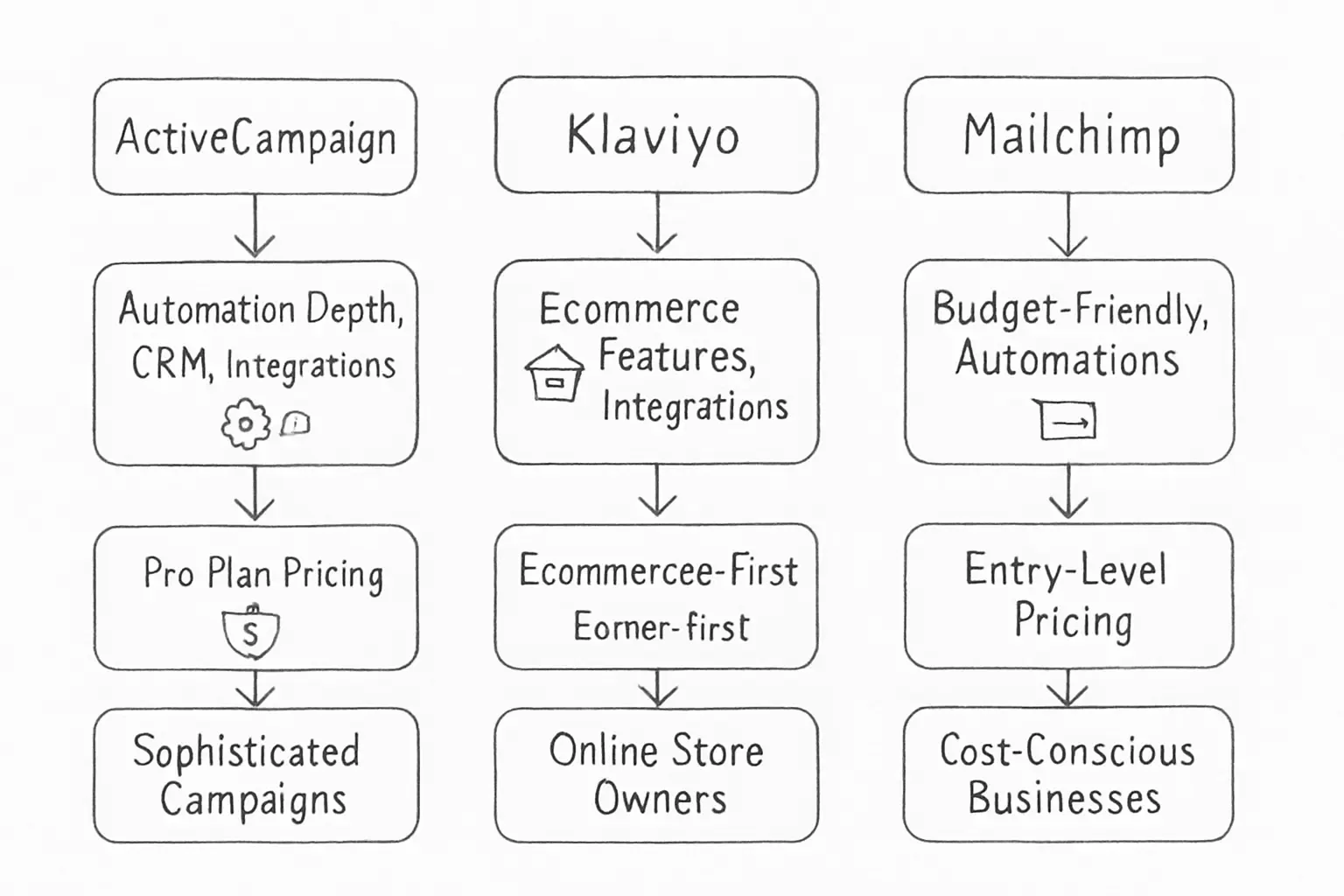

A comparison chart showing three email marketing automation tools (ActiveCampaign, Klaviyo, and Mailchimp) arranged in columns. Each column displays key information: tool name at top, core features listed below (CRM capabilities, ecommerce integrations, automation depth, landing pages, webinar functionality), pricing tier badges, and use case descriptions at bottom. Use a clean table or card-based layout with color coding to differentiate platforms. Include icons or visual indicators for key features like automation, CRM, ecommerce, and pricing tiers.


How to Match the Right Tool to Your Business

Picking the right platform comes down to three variables: your business model, your technical sophistication, and your budget ceiling.

ActiveCampaign wins on raw email automation depth. Klaviyo wins for ecommerce without question. Mailchimp and Brevo are both reasonable entry points for simpler programs: Mailchimp if ease of use is the priority, Brevo if send volume pricing works better for your list size.

For ecommerce teams, strong ecommerce email marketing strategies paired with a platform like Klaviyo or Omnisend will drive the highest lift. For SaaS businesses, aligning your platform choice with your product lifecycle and onboarding flow matters more than feature counts. See the SaaS Email Marketing Strategy guide for a deeper breakdown.

When budget is the primary constraint:

  • Brevo offers genuinely free marketing automation for accounts with fewer than 2,000 contacts. Kit is free up to 10,000 subscribers, though its automation is deliberately basic. Omnisend has a free plan for testing its automation and pre-built workflows.
  • ActiveCampaign has no free plan, only a 14-day trial, but it is where most businesses land once they outgrow the free tiers.

Key Features That Separate Good from Great

Beyond the basics, these capabilities separate tools that scale from tools that create bottlenecks:

For its price, MailerLite's automation tools stand out as a major strength. Welcome emails, abandoned cart emails, and audience segmentation are all included, and you can build relatively advanced workflows with multiple triggers and actions, with an automation editor that is simple to use even for beginners.

The free plan includes 1,000 subscribers and 12,000 emails per month.

Best for: Small to midsize businesses that want solid automation at low or no cost, without needing enterprise-grade complexity.


7. GetResponse: Best All-in-One Solution

GetResponse is a fully-featured marketing automation tool notable for its powerful automations in list management. Like ActiveCampaign, it offers triggered campaigns, segmentation, tagging, and data updates. On its Pro plan, you get access to a CRM, plus landing pages and the ability to run webinars.

Best for: Budget-conscious businesses that want to run sophisticated automated campaigns, particularly online store owners, with integrations and automations specific to ecommerce.


A comparison chart showing three email marketing automation tools (ActiveCampaign, Klaviyo, and Mailchimp) arranged in columns. Each column displays key information: tool name at top, core features listed below (CRM capabilities, ecommerce integrations, automation depth, landing pages, webinar functionality), pricing tier badges, and use case descriptions at bottom. Use a clean table or card-based layout with color coding to differentiate platforms. Include icons or visual indicators for key features like automation, CRM, ecommerce, and pricing tiers.


How to Match the Right Tool to Your Business

Picking the right platform comes down to three variables: your business model, your technical sophistication, and your budget ceiling.

ActiveCampaign wins on raw email automation depth. Klaviyo wins for ecommerce without question. Mailchimp and Brevo are both reasonable entry points for simpler programs: Mailchimp if ease of use is the priority, Brevo if send volume pricing works better for your list size.

For ecommerce teams, strong ecommerce email marketing strategies paired with a platform like Klaviyo or Omnisend will drive the highest lift. For SaaS businesses, aligning your platform choice with your product lifecycle and onboarding flow matters more than feature counts. See the SaaS Email Marketing Strategy guide for a deeper breakdown.

When budget is the primary constraint:

  • Brevo offers genuinely free marketing automation for accounts with fewer than 2,000 contacts. Kit is free up to 10,000 subscribers, though its automation is deliberately basic. Omnisend has a free plan for testing its automation and pre-built workflows.
  • ActiveCampaign has no free plan, only a 14-day trial, but it is where most businesses land once they outgrow the free tiers.

Key Features That Separate Good from Great

Beyond the basics, these capabilities separate tools that scale from tools that create bottlenecks:

Personalization depth: Brands using AI-driven personalization report up to 42% higher revenue, with click-through rates exceeding 13%, and this alone can lift ROI by nearly 20%.

Deliverability infrastructure: The best platforms for email marketing have their own SMTP servers and offer high deliverability, meaning your emails land in the inbox and not in spam.

A/B testing: A/B testing allows you to test different elements of your emails, such as subject lines, CTA buttons, images, and send times. Look for software that provides built-in A/B testing capabilities along with automated recommendations based on performance data.

CRM-to-email data flow: Modern automation solutions close data gaps by unifying information into a single, usable view. Real-time connections pull in cross-channel signals like purchases, page views, and add-to-cart events, so you always have the most current picture of each customer.

To get more out of the data your automation collects, the Email Marketing Analytics Best Practices guide covers what to measure and how to act on it.


Common Mistakes When Choosing an Automation Platform

Buying for today instead of 12 months from now: Evaluate the scalability and integration capabilities of the software. It might be cheaper to start with a less evolved platform now, but that decision may come back to haunt you in a year when you're trying to advance your strategies and have to migrate to a more robust platform.

Ignoring how contacts are counted: Mailchimp's contact counting methodology, such as charging for duplicates across audiences, creates unexpected cost increases that other platforms avoid. Always check whether a platform bills by contacts sent, total contacts stored, or active profiles.

Conflating automation with complexity: A tool with 1,000 automation templates is only useful if your team will actually build and maintain those workflows. Match complexity to your team's capacity.

Overlooking deliverability: Inbox placement is harder than it used to be. Roughly 7% of emails now land in spam, directly reducing ROI. Choose a platform with a strong sender reputation and built-in deliverability monitoring.


Frequently Asked Questions

What is the best automation email marketing tool for small businesses?

MailerLite offers the best free plan, including automation, landing pages, and a website builder for up to 500 subscribers. Moosend offers full automation at $9/month with unlimited emails. Brevo is another strong option with unlimited contacts on paid plans. For small businesses that anticipate growth, ActiveCampaign's Starter plan at $15/month gives access to multi-step automation right away.

How does email marketing automation actually improve ROI?

Marketers see a 3.0x ROI lift when they orchestrate across channels with marketing automation, while 30% of spend waste falls away thanks to better targeting and personalization. Automation also removes manual effort from repetitive tasks, freeing your team to focus on strategy and content rather than execution.

Is Klaviyo or ActiveCampaign better for ecommerce?

Personalization depth: Brands using AI-driven personalization report up to 42% higher revenue, with click-through rates exceeding 13%, and this alone can lift ROI by nearly 20%.

Deliverability infrastructure: The best platforms for email marketing have their own SMTP servers and offer high deliverability, meaning your emails land in the inbox and not in spam.

A/B testing: A/B testing allows you to test different elements of your emails, such as subject lines, CTA buttons, images, and send times. Look for software that provides built-in A/B testing capabilities along with automated recommendations based on performance data.

CRM-to-email data flow: Modern automation solutions close data gaps by unifying information into a single, usable view. Real-time connections pull in cross-channel signals like purchases, page views, and add-to-cart events, so you always have the most current picture of each customer.

To get more out of the data your automation collects, the Email Marketing Analytics Best Practices guide covers what to measure and how to act on it.


Common Mistakes When Choosing an Automation Platform

Buying for today instead of 12 months from now: Evaluate the scalability and integration capabilities of the software. It might be cheaper to start with a less evolved platform now, but that decision may come back to haunt you in a year when you're trying to advance your strategies and have to migrate to a more robust platform.

Ignoring how contacts are counted: Mailchimp's contact counting methodology, such as charging for duplicates across audiences, creates unexpected cost increases that other platforms avoid. Always check whether a platform bills by contacts sent, total contacts stored, or active profiles.

Conflating automation with complexity: A tool with 1,000 automation templates is only useful if your team will actually build and maintain those workflows. Match complexity to your team's capacity.

Overlooking deliverability: Inbox placement is harder than it used to be. Roughly 7% of emails now land in spam, directly reducing ROI. Choose a platform with a strong sender reputation and built-in deliverability monitoring.


Frequently Asked Questions

What is the best automation email marketing tool for small businesses?

MailerLite offers the best free plan, including automation, landing pages, and a website builder for up to 500 subscribers. Moosend offers full automation at $9/month with unlimited emails. Brevo is another strong option with unlimited contacts on paid plans. For small businesses that anticipate growth, ActiveCampaign's Starter plan at $15/month gives access to multi-step automation right away.

How does email marketing automation actually improve ROI?

Marketers see a 3.0x ROI lift when they orchestrate across channels with marketing automation, while 30% of spend waste falls away thanks to better targeting and personalization. Automation also removes manual effort from repetitive tasks, freeing your team to focus on strategy and content rather than execution.

Is Klaviyo or ActiveCampaign better for ecommerce?

The main difference between ActiveCampaign and Klaviyo is that ActiveCampaign provides more powerful automation, segmentation, reporting, and integration capabilities overall. However, Klaviyo is a strong option if you want to operate a sophisticated ecommerce email marketing operation while keeping to a smaller budget. For Shopify-native stores with revenue tracking as a priority, Klaviyo is the cleaner fit. For multi-channel B2B or mixed-model businesses, ActiveCampaign offers more flexibility.

What features should I prioritize when evaluating email automation software?

Start with automation depth (can it handle multi-step behavioral triggers?), deliverability infrastructure, segmentation capabilities, CRM integrations, and pricing transparency. The best tools offer meaningful functionality at every pricing level; look for email marketing automation platforms where even lower-tier plans deliver real utility rather than just a limited preview, and where upgrading feels like unlocking potential. After selecting a tool, pairing it with strong email list segmentation strategies will dramatically accelerate results.


No comments yet. Be the first!

Leave a comment

Comments are reviewed before publishing.

The main difference between ActiveCampaign and Klaviyo is that ActiveCampaign provides more powerful automation, segmentation, reporting, and integration capabilities overall. However, Klaviyo is a strong option if you want to operate a sophisticated ecommerce email marketing operation while keeping to a smaller budget. For Shopify-native stores with revenue tracking as a priority, Klaviyo is the cleaner fit. For multi-channel B2B or mixed-model businesses, ActiveCampaign offers more flexibility.

What features should I prioritize when evaluating email automation software?

Start with automation depth (can it handle multi-step behavioral triggers?), deliverability infrastructure, segmentation capabilities, CRM integrations, and pricing transparency. The best tools offer meaningful functionality at every pricing level; look for email marketing automation platforms where even lower-tier plans deliver real utility rather than just a limited preview, and where upgrading feels like unlocking potential. After selecting a tool, pairing it with strong email list segmentation strategies will dramatically accelerate results.

No comments yet. Be the first!

Leave a comment

Comments are reviewed before publishing.

More from

Related posts

Illustration for open source email marketing automation
Email Marketing ToolsJul 17, 2026 15 min

Open Source Email Marketing Automation Tools

Find the best open source email marketing automation platforms. Compare features, setup costs, and deployment options for your business.

More from

Related posts

Illustration for open source email marketing automation
Email Marketing ToolsJul 17, 2026 15 min

Open Source Email Marketing Automation Tools

Find the best open source email marketing automation platforms. Compare features, setup costs, and deployment options for your business.

J
James Chen
J
James Chen
Illustration for best platforms for automated email marketing
Email Marketing ToolsJul 17, 2026 16 min

Best Platforms for Automated Email Marketing

Compare top email automation platforms that save time and boost ROI. Find the right solution for your business needs and budget.

JJames Chen
Illustration for best platforms for automated email marketing
Email Marketing ToolsJul 17, 2026 16 min

Best Platforms for Automated Email Marketing

Compare top email automation platforms that save time and boost ROI. Find the right solution for your business needs and budget.

JJames Chen
Illustration for best ai email marketing platforms
Email Marketing ToolsJul 16, 2026 1 min

Best AI Email Marketing Platforms in 2024

Compare top AI email marketing platforms that boost open rates and ROI. Find the right tool for your business with our expert review.

JJames Chen
Illustration for best ai email marketing platforms
Email Marketing ToolsJul 16, 2026 1 min

Best AI Email Marketing Platforms in 2024

Compare top AI email marketing platforms that boost open rates and ROI. Find the right tool for your business with our expert review.

JJames Chen