
Email
Email

A modern blog built with Payload CMS, Next.js, and shadcn/ui.

RSS FeedSitemap

Explore

  • Blog
  • News
  • Statistics
  • Authors

Categories

  • Email Analytics & Reporting
  • Email Security and Compliance
  • Email Marketing Tools and Strategy
  • Email Automation Strategies
  • Email Database & List Building
  • Email Marketing Tools & Resources
  • Seasonal Email Marketing
  • Email Marketing Benchmarks

Latest articles

  • Email Promotion and Internet Marketing AutomationJul 19, 2026
  • Enterprise Marketing Automation Email: Strategy & SetupJul 19, 2026
  • AI and Machine Learning in Email MarketingJul 19, 2026
  • Best CRM with Email Marketing Automation 2025Jul 19, 2026

Popular topics

  • #Email Generation
  • #agency benchmarks
  • #email marketing content strategy
  • #Marketing Compliance
  • #AI Security
  • #Productivity Tools
  • #atlanta business
  • #Data-Driven Strategy
  • #Marketing Outsourcing
  • #Outsourced Email Marketing
  • #Sales Workflows
  • #automation software
  • #Back-to-School
  • #Email Software Comparison
  • #Email Branding
  • #Email Marketing Metrics

Stay in the loop

Join 2,000+ readers. Unsubscribe anytime.

Subscribe
Email

© 2026 Email. All rights reserved.

SitemapRSS
HomeBlogEmail Marketing ToolsBest Companies for Email Marketing Automation
Email Marketing Tools

Best Companies for Email Marketing Automation

Compare top email marketing automation platforms. See features, pricing, and ROI for HubSpot, Klaviyo, ActiveCampaign, and more. Find the right fit for your business.

S

Sarah Mitchell

July 18, 2026

13 min read
Share:
#Email Automation#Small Business Email#Email Software Comparison
Illustration for best companies for email marketing automation

Stay in the loop

Get the latest posts delivered straight to your inbox. No spam, unsubscribe anytime.

Choosing the right platform from the best companies for email marketing automation directly impacts how many leads you convert, how much time your team saves, and how much revenue each send generates. With automated messages making up just 2% of sends yet driving 37% of sales, the case for investing in a serious automation platform is clear. The question is which company fits your specific situation.

This guide cuts through the noise. Below you will find a breakdown of the strongest platforms available in 2025 and 2026, who each one serves best, and what to watch for before you commit.

Key Takeaways

  • Automated email flows, including abandoned cart and post-purchase messages, generate up to 30 times more revenue per recipient compared to standard email campaigns.
  • HubSpot holds over 29% market share in the marketing automation software category.
  • The top 10% of email workflows generate $16.96 in revenue per recipient, while average email flows generate $1.94.
  • The marketing automation market is projected to grow from USD 47.02 billion in 2025 to USD 81.01 billion by 2030, at a CAGR of 11.5%.
  • The best platform depends on your business model: B2B teams and SaaS companies need different automation logic than ecommerce brands or high-volume senders.

Why Email Marketing Automation Matters in 2025

Email automation lets businesses reach the right people at the right time with personalized messages, boosting efficiency, improving customer experiences, and increasing email marketing ROI. But not all automation is equal.

79% of marketers automate their customer journey, broken down into fully automated (10%), mostly automated (25%), and part automated (44%), while 21% don't automate their customer journey at all. That gap represents a real competitive advantage for teams that have built reliable, behavior-driven workflows.

On average, email marketing delivers a return of between $36 and $42 for every $1 spent, the highest ROI of any digital marketing channel.

The platforms below are the companies driving that performance for thousands of businesses. To get the most from any of them, pair your automation with a strong email list segmentation strategy and a well-crafted welcome email sequence.


The Best Companies for Email Marketing Automation

1. HubSpot: Best for CRM-First Teams and B2B Growth

HubSpot has evolved from a marketing automation pioneer into a comprehensive business platform. Its email marketing, built on a foundation of CRM data, offers sophisticated capabilities for companies wanting unified marketing, sales, and service operations.

HubSpot's automation is CRM-native, meaning every workflow, trigger, and personalization token is powered by a unified data source. That means no syncing required. For B2B companies managing long sales cycles, this is a meaningful advantage.

Pricing: The free plan gives you basic email marketing, forms, and landing pages capped at 2,000 sends per month with HubSpot branding. Starter is $15 per month and removes branding with 1,000 marketing contacts. Professional is $890 per month with full automation workflows. Enterprise is $3,600 per month with advanced reporting and controls.

Watch out for: HubSpot costs more than the headline because it bills for marketing contacts, extra seats, and onboarding on top of the base plan. At Starter, a 25,000-contact list can reach $1,215 per month even though the tier is advertised at $15.

Best for: B2B companies, enterprises, and teams that need marketing, sales, and service data in one place.


2. ActiveCampaign: Best for Deep Automation Logic

ActiveCampaign is a powerhouse for businesses that need sophisticated automation workflows and built-in sales CRM functionality. It combines email marketing, marketing automation, and customer relationship management into one platform, making it a strong choice for B2B companies, agencies, and teams with complex customer journeys.

The platform's 900+ automation recipes let you deploy proven workflows including welcome sequences, abandoned carts, and re-engagement series with just a few clicks. This automation is far more advanced than platforms like Mailchimp or Brevo, but easier and more marketing-focused than HubSpot's enterprise-level workflows.

Marketing teams using ActiveCampaign save an average of 10 hours weekly across tasks like campaign building, content creation, and lead follow-up.

Pricing: Starts at $15/month for up to 1,000 contacts and up to 10,000 emails/month. No free plan is available.

Best for: B2B and SaaS teams needing deep automation logic, behavioral branching, lead scoring, and lifecycle workflows.


3. Klaviyo: Best for Ecommerce Businesses

Klaviyo provides sophisticated segmentation features, allowing users to create highly specific audience groups based on behavior, purchase history, and engagement. It also uses AI to offer predictive analytics, providing insights into metrics like customer lifetime value, churn risk, and expected next order date.

Klaviyo's data model is built around ecommerce events such as purchase history, predictive lifetime value, churn risk, and next-purchase date, in ways that ActiveCampaign does not natively replicate without additional data connectors.

Pricing: Emails and SMS to 10,000 contacts a month costs $185. For large contact lists, the price can become prohibitively high.

Best for: Klaviyo is the market leader for Shopify email marketing. Its native integration pulls product, order, and browse data, enabling highly personalized automation.

Not ideal for: Non-ecommerce businesses or teams with tight budgets and large contact lists.


4. Brevo: Best for High-Volume Senders and Multichannel Campaigns

Brevo (formerly Sendinblue) is a multi-channel platform focused on making SMS and email marketing accessible and affordable, especially for small and mid-sized businesses. Its send-based pricing model is a genuine differentiator for businesses with large contact lists but moderate sending frequency.

Brevo allows unlimited contacts on most plans and instead charges based on monthly email volume. This structure benefits businesses with large databases who send infrequently or segment heavily.

Brevo stands out with its multichannel marketing capabilities, combining email, SMS marketing, and even live chat in a single interface. This makes it ideal for businesses that need to connect with customers across different platforms without using other tools.

Pricing: The free plan includes 300 emails/day with unlimited contacts. You can build a large list and pay nothing until you need to send more than 300 emails daily. Starter plans begin at $9/month for 5,000 emails.

Best for: High-volume senders, retail businesses, and teams that want email, SMS, and a CRM without paying per contact.


5. Mailchimp: Best for Small Teams Getting Started

Mailchimp remains one of the most recognized tools for small to mid-size teams. It offers strong templates, ecommerce-focused journeys, and beginner-friendly automation features.

With its wide brand recognition and hundreds of integrations, Mailchimp has built a reputation as the go-to email marketing platform for teams running their first automation workflows.

Pricing: Starts at $20/month for up to 500 contacts and up to 6,000 emails per month. A free plan is available.

Watch out for: Mailchimp is no longer the best on most measures. Its free plan has been significantly reduced, pricing scales steeply, and automation is paywalled.

Best for: Small businesses, beginners, and teams that need a familiar, low-barrier entry point.


6. MailerLite: Best for Simplicity and Budget-Conscious Teams

MailerLite's automation tools stand out as a major strength for its price. Welcome emails, abandoned cart emails, and audience segmentation are all included. You can build relatively advanced workflows with multiple triggers and actions, and the automation editor is simple to use even for beginners.

The free plan includes 1,000 subscribers and 12,000 emails per month.

Best for: Businesses at the beginning of their email marketing strategy. MailerLite is user-friendly and reliable, offering a smooth on-ramp to automation without high upfront costs.


7. GetResponse: Best for Teams That Also Need Webinar and Funnel Tools

GetResponse is an all-in-one platform that offers email marketing automation, landing page creation, webinar hosting, and more. It is designed for businesses looking for an advanced marketing solution.

GetResponse is best for teams that also need webinar and conversion funnel tools alongside email automation. It offers competitive pricing on mid-size lists. Marketing automation is solid but less granular than ActiveCampaign.

Best for: Course creators, coaches, and businesses that run events or webinars alongside their email campaigns.


How to Choose the Right Platform

Email marketing automation platforms help businesses send targeted, personalized emails at scale by automating workflows, segmenting audiences, and integrating with CRM and ecommerce tools. Today's marketing teams need platforms that offer predictive analytics, journey-based targeting, drag-and-drop journey builders, behavioral triggers, unified customer data, AI-powered content and optimization features, strong deliverability, and transparent pricing.

Here is a practical decision framework:

  • You run a B2B company with a long sales cycle: ActiveCampaign or HubSpot
  • You sell products on Shopify or WooCommerce: Klaviyo (large stores) or Omnisend (budget-conscious)
  • You have a large list but send infrequently: Brevo
  • You are just starting out and want simplicity: MailerLite or Mailchimp
  • You need webinars, landing pages, and email in one tool: GetResponse
  • You need full CRM plus sales and service tools: HubSpot

55% of marketers say easy integration with their existing tool stack, including CRM, is the most important feature in a marketing automation platform. Before committing, verify that your chosen platform connects cleanly with your CRM, ecommerce system, and lead capture tools.

For a deeper look at how to set up these integrations properly, see our email marketing automation CRM setup guide.


What Strong Automation Actually Looks Like

The gap between average and top-performing automation programs is significant. The top 10% of email workflows generate $16.96 in revenue per recipient, while average email flows generate $1.94.

The difference usually comes down to three factors:

  1. Behavioral triggers that fire based on what a contact actually does, not just when they joined your list
  2. Segmentation depth that lets you serve different messages to different audience groups
  3. Personalization that goes beyond a first name merge tag

Marketing teams using AI-powered email personalization generated 41% more revenue per recipient compared to rule-based segmentation, according to McKinsey's 2024 State of AI report.

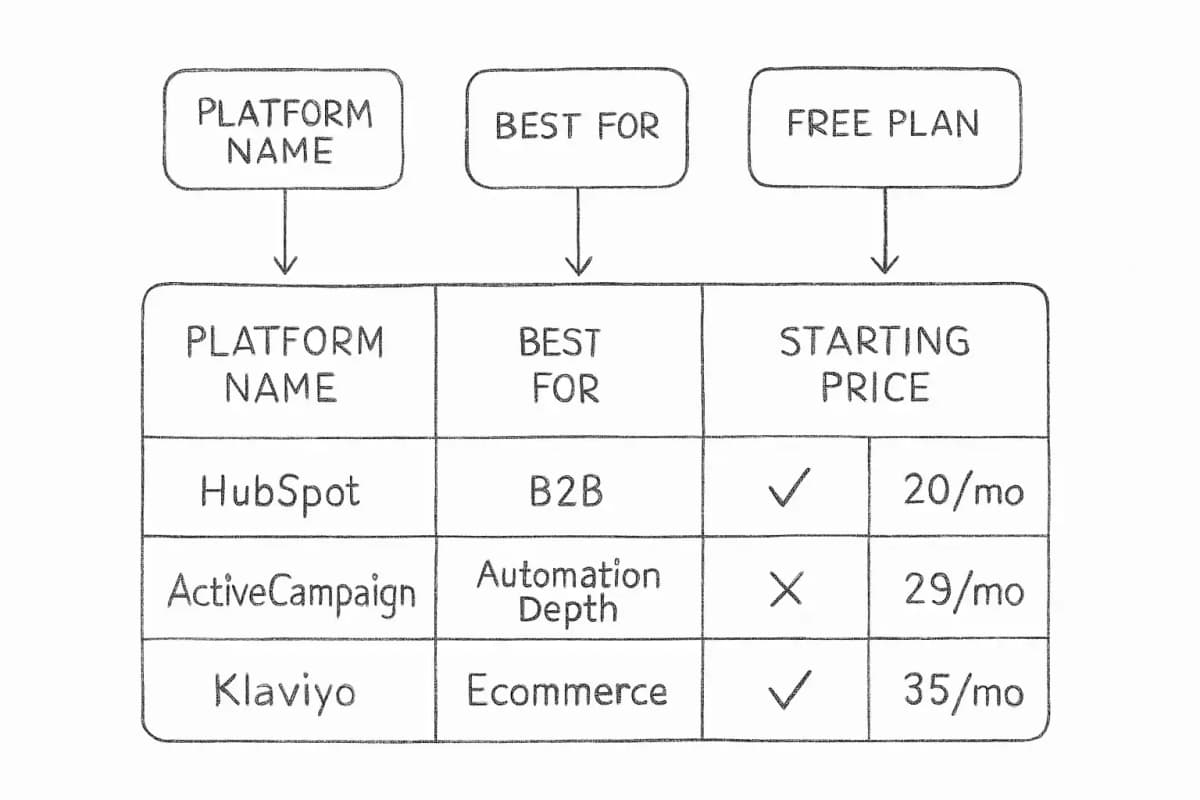
To understand how AI is changing what these platforms can do, see our guide on AI tools for email campaign templates. A comparison table visualization showing email marketing automation platforms (HubSpot, ActiveCampaign, Klaviyo, and others) organized by columns for platform name, best use case, free plan availability, and starting price. The table should use a clean, professional design with alternating row colors for readability. Include visual indicators (checkmarks, X marks, or colored badges) to highlight free plan options and pricing tiers. The table structure should emphasize the key decision factors mentioned in the article: B2B vs ecommerce positioning, automation depth, and cost.

Platform Comparison at a Glance

PlatformBest ForFree PlanStarting Price
HubSpotB2B, CRM-first teamsYes (limited)$15/month
ActiveCampaignDeep automation, B2B/SaaSNo (14-day trial)$15/month
KlaviyoEcommerce, ShopifyYes (250 contacts)$20/month
BrevoHigh-volume, multichannelYes (300/day)$9/month
MailchimpBeginners, small teamsYes (500 contacts)$20/month
MailerLiteBudget-conscious, simplicityYes (1,000 contacts)~$10/month
GetResponseWebinars + emailYes (500 contacts)$19/month

Frequently Asked Questions

What is the best company for email marketing automation overall?

There is no single best platform for every business. The pattern across expert comparisons is consistent: ActiveCampaign wins on automation depth and CRM integration, Klaviyo wins on ecommerce intelligence, Omnisend wins on multichannel value, Brevo wins on price, and MailerLite wins on simplicity. Match the platform to your actual use case rather than reputation.

How much does email marketing automation software cost?

For a list of around 10,000 contacts, expect $73 to $239 per month depending on the tool and plan tier. MailerLite is cheapest at roughly $73 per month, ActiveCampaign Plus runs $239 per month, and Klaviyo lands around $150 to $175 per month. Brevo is the outlier, charging by email volume rather than contacts, so costs depend on send frequency rather than list size.

Is HubSpot worth the cost for email marketing automation?

HubSpot is the most expensive and the most feature-heavy against email-focused platforms. If you need a connected CRM and sales tooling, that breadth justifies the price. If you mostly send campaigns and automations, leaner tools deliver the same email outcomes for a fraction of the spend.

What features should I prioritize when choosing an email automation platform?

Strong automation and segmentation are essential. Effective email automation saves time, while smart segmentation drives results. Choose a platform that supports behavior-based triggers and allows precise audience targeting. Beyond that, prioritize deliverability track record, pricing transparency at your expected contact volume, and integration with the tools you already use.


No comments yet. Be the first!

Leave a comment

Comments are reviewed before publishing.

More from

Related posts

Illustration for best ai email generator for marketing teams 2025
Email Marketing ToolsJul 19, 2026 12 min

Best AI Email Generator for Marketing Teams 2025

Compare top AI email generators for marketing teams. Save time, boost open rates, and scale campaigns. Find the right tool for your strategy.

MMarcus Webb
Illustration for best ai email marketing platforms 2025
Email Marketing ToolsJul 18, 2026 12 min

Best AI Email Marketing Platforms 2025

Compare top AI email marketing platforms for 2025. See automation features, pricing, and ROI benchmarks to pick the right tool for your business.

JJames Chen
Illustration for best platform for email marketing automation
Email Marketing ToolsJul 18, 2026 13 min

Best Platform for Email Marketing Automation

Compare top email marketing automation platforms by features, pricing, and deliverability. Find the right tool for your business needs and ROI goals.

SSarah Mitchell
HomeBlogEmail Marketing ToolsBest Companies for Email Marketing Automation
Email Marketing Tools

Best Companies for Email Marketing Automation

Compare top email marketing automation platforms. See features, pricing, and ROI for HubSpot, Klaviyo, ActiveCampaign, and more. Find the right fit for your business.

S

Sarah Mitchell

July 18, 2026

13 min read
Share:
#Email Automation#Small Business Email#Email Software Comparison
Illustration for best companies for email marketing automation

Stay in the loop

Get the latest posts delivered straight to your inbox. No spam, unsubscribe anytime.

Choosing the right platform from the best companies for email marketing automation directly impacts how many leads you convert, how much time your team saves, and how much revenue each send generates. With automated messages making up just 2% of sends yet driving 37% of sales, the case for investing in a serious automation platform is clear. The question is which company fits your specific situation.

This guide cuts through the noise. Below you will find a breakdown of the strongest platforms available in 2025 and 2026, who each one serves best, and what to watch for before you commit.

Key Takeaways

  • Automated email flows, including abandoned cart and post-purchase messages, generate up to 30 times more revenue per recipient compared to standard email campaigns.
  • HubSpot holds over 29% market share in the marketing automation software category.
  • The top 10% of email workflows generate $16.96 in revenue per recipient, while average email flows generate $1.94.
  • The marketing automation market is projected to grow from USD 47.02 billion in 2025 to USD 81.01 billion by 2030, at a CAGR of 11.5%.
  • The best platform depends on your business model: B2B teams and SaaS companies need different automation logic than ecommerce brands or high-volume senders.

Why Email Marketing Automation Matters in 2025

Email automation lets businesses reach the right people at the right time with personalized messages, boosting efficiency, improving customer experiences, and increasing email marketing ROI. But not all automation is equal.

79% of marketers automate their customer journey, broken down into fully automated (10%), mostly automated (25%), and part automated (44%), while 21% don't automate their customer journey at all. That gap represents a real competitive advantage for teams that have built reliable, behavior-driven workflows.

On average, email marketing delivers a return of between $36 and $42 for every $1 spent, the highest ROI of any digital marketing channel.

The platforms below are the companies driving that performance for thousands of businesses. To get the most from any of them, pair your automation with a strong email list segmentation strategy and a well-crafted welcome email sequence.


The Best Companies for Email Marketing Automation

1. HubSpot: Best for CRM-First Teams and B2B Growth

HubSpot has evolved from a marketing automation pioneer into a comprehensive business platform. Its email marketing, built on a foundation of CRM data, offers sophisticated capabilities for companies wanting unified marketing, sales, and service operations.

HubSpot's automation is CRM-native, meaning every workflow, trigger, and personalization token is powered by a unified data source. That means no syncing required. For B2B companies managing long sales cycles, this is a meaningful advantage.

Pricing: The free plan gives you basic email marketing, forms, and landing pages capped at 2,000 sends per month with HubSpot branding. Starter is $15 per month and removes branding with 1,000 marketing contacts. Professional is $890 per month with full automation workflows. Enterprise is $3,600 per month with advanced reporting and controls.

Watch out for: HubSpot costs more than the headline because it bills for marketing contacts, extra seats, and onboarding on top of the base plan. At Starter, a 25,000-contact list can reach $1,215 per month even though the tier is advertised at $15.

Best for: B2B companies, enterprises, and teams that need marketing, sales, and service data in one place.


2. ActiveCampaign: Best for Deep Automation Logic

ActiveCampaign is a powerhouse for businesses that need sophisticated automation workflows and built-in sales CRM functionality. It combines email marketing, marketing automation, and customer relationship management into one platform, making it a strong choice for B2B companies, agencies, and teams with complex customer journeys.

The platform's 900+ automation recipes let you deploy proven workflows including welcome sequences, abandoned carts, and re-engagement series with just a few clicks. This automation is far more advanced than platforms like Mailchimp or Brevo, but easier and more marketing-focused than HubSpot's enterprise-level workflows.

Marketing teams using ActiveCampaign save an average of 10 hours weekly across tasks like campaign building, content creation, and lead follow-up.

Pricing: Starts at $15/month for up to 1,000 contacts and up to 10,000 emails/month. No free plan is available.

Best for: B2B and SaaS teams needing deep automation logic, behavioral branching, lead scoring, and lifecycle workflows.


3. Klaviyo: Best for Ecommerce Businesses

Klaviyo provides sophisticated segmentation features, allowing users to create highly specific audience groups based on behavior, purchase history, and engagement. It also uses AI to offer predictive analytics, providing insights into metrics like customer lifetime value, churn risk, and expected next order date.

Klaviyo's data model is built around ecommerce events such as purchase history, predictive lifetime value, churn risk, and next-purchase date, in ways that ActiveCampaign does not natively replicate without additional data connectors.

Pricing: Emails and SMS to 10,000 contacts a month costs $185. For large contact lists, the price can become prohibitively high.

Best for: Klaviyo is the market leader for Shopify email marketing. Its native integration pulls product, order, and browse data, enabling highly personalized automation.

Not ideal for: Non-ecommerce businesses or teams with tight budgets and large contact lists.


4. Brevo: Best for High-Volume Senders and Multichannel Campaigns

Brevo (formerly Sendinblue) is a multi-channel platform focused on making SMS and email marketing accessible and affordable, especially for small and mid-sized businesses. Its send-based pricing model is a genuine differentiator for businesses with large contact lists but moderate sending frequency.

Brevo allows unlimited contacts on most plans and instead charges based on monthly email volume. This structure benefits businesses with large databases who send infrequently or segment heavily.

Brevo stands out with its multichannel marketing capabilities, combining email, SMS marketing, and even live chat in a single interface. This makes it ideal for businesses that need to connect with customers across different platforms without using other tools.

Pricing: The free plan includes 300 emails/day with unlimited contacts. You can build a large list and pay nothing until you need to send more than 300 emails daily. Starter plans begin at $9/month for 5,000 emails.

Best for: High-volume senders, retail businesses, and teams that want email, SMS, and a CRM without paying per contact.


5. Mailchimp: Best for Small Teams Getting Started

Mailchimp remains one of the most recognized tools for small to mid-size teams. It offers strong templates, ecommerce-focused journeys, and beginner-friendly automation features.

With its wide brand recognition and hundreds of integrations, Mailchimp has built a reputation as the go-to email marketing platform for teams running their first automation workflows.

Pricing: Starts at $20/month for up to 500 contacts and up to 6,000 emails per month. A free plan is available.

Watch out for: Mailchimp is no longer the best on most measures. Its free plan has been significantly reduced, pricing scales steeply, and automation is paywalled.

Best for: Small businesses, beginners, and teams that need a familiar, low-barrier entry point.


6. MailerLite: Best for Simplicity and Budget-Conscious Teams

MailerLite's automation tools stand out as a major strength for its price. Welcome emails, abandoned cart emails, and audience segmentation are all included. You can build relatively advanced workflows with multiple triggers and actions, and the automation editor is simple to use even for beginners.

The free plan includes 1,000 subscribers and 12,000 emails per month.

Best for: Businesses at the beginning of their email marketing strategy. MailerLite is user-friendly and reliable, offering a smooth on-ramp to automation without high upfront costs.


7. GetResponse: Best for Teams That Also Need Webinar and Funnel Tools

GetResponse is an all-in-one platform that offers email marketing automation, landing page creation, webinar hosting, and more. It is designed for businesses looking for an advanced marketing solution.

GetResponse is best for teams that also need webinar and conversion funnel tools alongside email automation. It offers competitive pricing on mid-size lists. Marketing automation is solid but less granular than ActiveCampaign.

Best for: Course creators, coaches, and businesses that run events or webinars alongside their email campaigns.


How to Choose the Right Platform

Email marketing automation platforms help businesses send targeted, personalized emails at scale by automating workflows, segmenting audiences, and integrating with CRM and ecommerce tools. Today's marketing teams need platforms that offer predictive analytics, journey-based targeting, drag-and-drop journey builders, behavioral triggers, unified customer data, AI-powered content and optimization features, strong deliverability, and transparent pricing.

Here is a practical decision framework:

  • You run a B2B company with a long sales cycle: ActiveCampaign or HubSpot
  • You sell products on Shopify or WooCommerce: Klaviyo (large stores) or Omnisend (budget-conscious)
  • You have a large list but send infrequently: Brevo
  • You are just starting out and want simplicity: MailerLite or Mailchimp
  • You need webinars, landing pages, and email in one tool: GetResponse
  • You need full CRM plus sales and service tools: HubSpot

55% of marketers say easy integration with their existing tool stack, including CRM, is the most important feature in a marketing automation platform. Before committing, verify that your chosen platform connects cleanly with your CRM, ecommerce system, and lead capture tools.

For a deeper look at how to set up these integrations properly, see our email marketing automation CRM setup guide.


What Strong Automation Actually Looks Like

The gap between average and top-performing automation programs is significant. The top 10% of email workflows generate $16.96 in revenue per recipient, while average email flows generate $1.94.

The difference usually comes down to three factors:

  1. Behavioral triggers that fire based on what a contact actually does, not just when they joined your list
  2. Segmentation depth that lets you serve different messages to different audience groups
  3. Personalization that goes beyond a first name merge tag

Marketing teams using AI-powered email personalization generated 41% more revenue per recipient compared to rule-based segmentation, according to McKinsey's 2024 State of AI report.

To understand how AI is changing what these platforms can do, see our guide on AI tools for email campaign templates. A comparison table visualization showing email marketing automation platforms (HubSpot, ActiveCampaign, Klaviyo, and others) organized by columns for platform name, best use case, free plan availability, and starting price. The table should use a clean, professional design with alternating row colors for readability. Include visual indicators (checkmarks, X marks, or colored badges) to highlight free plan options and pricing tiers. The table structure should emphasize the key decision factors mentioned in the article: B2B vs ecommerce positioning, automation depth, and cost.


Platform Comparison at a Glance

PlatformBest ForFree PlanStarting Price
HubSpotB2B, CRM-first teamsYes (limited)$15/month
ActiveCampaignDeep automation, B2B/SaaSNo (14-day trial)$15/month
KlaviyoEcommerce, ShopifyYes (250 contacts)$20/month
BrevoHigh-volume, multichannelYes (300/day)$9/month
MailchimpBeginners, small teamsYes (500 contacts)$20/month
MailerLiteBudget-conscious, simplicityYes (1,000 contacts)~$10/month
GetResponseWebinars + emailYes (500 contacts)$19/month

Frequently Asked Questions

What is the best company for email marketing automation overall?

There is no single best platform for every business. The pattern across expert comparisons is consistent: ActiveCampaign wins on automation depth and CRM integration, Klaviyo wins on ecommerce intelligence, Omnisend wins on multichannel value, Brevo wins on price, and MailerLite wins on simplicity. Match the platform to your actual use case rather than reputation.

How much does email marketing automation software cost?

For a list of around 10,000 contacts, expect $73 to $239 per month depending on the tool and plan tier. MailerLite is cheapest at roughly $73 per month, ActiveCampaign Plus runs $239 per month, and Klaviyo lands around $150 to $175 per month. Brevo is the outlier, charging by email volume rather than contacts, so costs depend on send frequency rather than list size.

Is HubSpot worth the cost for email marketing automation?

HubSpot is the most expensive and the most feature-heavy against email-focused platforms. If you need a connected CRM and sales tooling, that breadth justifies the price. If you mostly send campaigns and automations, leaner tools deliver the same email outcomes for a fraction of the spend.

What features should I prioritize when choosing an email automation platform?

Strong automation and segmentation are essential. Effective email automation saves time, while smart segmentation drives results. Choose a platform that supports behavior-based triggers and allows precise audience targeting. Beyond that, prioritize deliverability track record, pricing transparency at your expected contact volume, and integration with the tools you already use.

No comments yet. Be the first!

Leave a comment

Comments are reviewed before publishing.

More from

Related posts

Illustration for best ai email generator for marketing teams 2025
Email Marketing ToolsJul 19, 2026 12 min

Best AI Email Generator for Marketing Teams 2025

Compare top AI email generators for marketing teams. Save time, boost open rates, and scale campaigns. Find the right tool for your strategy.

MMarcus Webb
Illustration for best ai email marketing platforms 2025
Email Marketing ToolsJul 18, 2026 12 min

Best AI Email Marketing Platforms 2025

Compare top AI email marketing platforms for 2025. See automation features, pricing, and ROI benchmarks to pick the right tool for your business.

JJames Chen
Illustration for best platform for email marketing automation
Email Marketing ToolsJul 18, 2026 13 min

Best Platform for Email Marketing Automation

Compare top email marketing automation platforms by features, pricing, and deliverability. Find the right tool for your business needs and ROI goals.

SSarah Mitchell