
HomeBlogEmail Marketing ToolsBest Email Marketing Automation Software 2025
Email Marketing Tools

Best Email Marketing Automation Software 2025

Compare top email automation platforms for 2025. Find the right tool for your business based on features, pricing, and ease of use.

R

Rachel Torres

July 16, 2026

12 min read
HomeBlogEmail Marketing ToolsBest Email Marketing Automation Software 2025
Email Marketing Tools

Best Email Marketing Automation Software 2025

Compare top email automation platforms for 2025. Find the right tool for your business based on features, pricing, and ease of use.

R

Rachel Torres

July 16, 2026

12 min read
Share:
Share:
#Email Automation#marketing software#email platforms#2025 Tools
Illustration for best email marketing automation software 2025

Stay in the loop

Get the latest posts delivered straight to your inbox. No spam, unsubscribe anytime.

Choosing the right email marketing automation software can directly determine whether your campaigns generate real revenue or just sit in subscriber inboxes. Email marketing delivers a return of between $36 and $42 for every $1 spent, making it the highest ROI of any digital marketing channel. The software you use to build, trigger, and track those campaigns matters more than most teams realize.

The global email marketing software market was valued at $1.7 billion in 2025 and is projected to grow to $4.27 billion by 2034, at a CAGR of 10.6%. That growth reflects a simple reality: more businesses are treating email automation as infrastructure, not a side project.

This guide cuts through the noise and compares the best email marketing automation software in 2025 based on automation depth, deliverability, pricing model, and the use cases each platform actually serves well.

Key Takeaways

  • Automated emails generate 320% more revenue than non-automated emails, making platform choice a direct revenue decision, not just a tooling preference.
  • The email marketing segment dominated the U.S. marketing automation software market in 2025, accounting for 36.9% market share, driven by personalized campaigns and lead nurturing strategies.
  • No single platform is best for every team. The right choice depends on your use case: ecommerce, B2B, creators, or enterprise all have different requirements.
  • Today's marketing teams need platforms that offer predictive analytics, journey-based targeting, behavioral triggers, unified customer data, AI-powered optimization, and strong deliverability safeguards.
  • Pricing models vary significantly. Some charge by contact count, others by email volume. Matching the pricing model to your sending behavior can reduce costs significantly.

Why Email Marketing Automation Software Matters in 2025

Email automation lets businesses reach the right people at the right time with personalized messages, boosting efficiency, improving customer experiences, and increasing email marketing ROI. The difference between a basic email broadcast tool and a proper automation platform is the difference between sending emails and running a revenue engine.

Email marketing automation is praised as the key to maintaining relevance, and it works. Businesses using automation software generate twice as many leads as those without it.

Stay in the loop

Get the latest posts delivered straight to your inbox. No spam, unsubscribe anytime.

Choosing the right email marketing automation software can directly determine whether your campaigns generate real revenue or just sit in subscriber inboxes. Email marketing delivers a return of between $36 and $42 for every $1 spent, making it the highest ROI of any digital marketing channel. The software you use to build, trigger, and track those campaigns matters more than most teams realize.

The global email marketing software market was valued at $1.7 billion in 2025 and is projected to grow to $4.27 billion by 2034, at a CAGR of 10.6%. That growth reflects a simple reality: more businesses are treating email automation as infrastructure, not a side project.

This guide cuts through the noise and compares the best email marketing automation software in 2025 based on automation depth, deliverability, pricing model, and the use cases each platform actually serves well.

Key Takeaways

  • Automated emails generate 320% more revenue than non-automated emails, making platform choice a direct revenue decision, not just a tooling preference.
  • The email marketing segment dominated the U.S. marketing automation software market in 2025, accounting for 36.9% market share, driven by personalized campaigns and lead nurturing strategies.
  • No single platform is best for every team. The right choice depends on your use case: ecommerce, B2B, creators, or enterprise all have different requirements.
  • Today's marketing teams need platforms that offer predictive analytics, journey-based targeting, behavioral triggers, unified customer data, AI-powered optimization, and strong deliverability safeguards.
  • Pricing models vary significantly. Some charge by contact count, others by email volume. Matching the pricing model to your sending behavior can reduce costs significantly.

Why Email Marketing Automation Software Matters in 2025

Email automation lets businesses reach the right people at the right time with personalized messages, boosting efficiency, improving customer experiences, and increasing email marketing ROI. The difference between a basic email broadcast tool and a proper automation platform is the difference between sending emails and running a revenue engine.

Email marketing automation is praised as the key to maintaining relevance, and it works. Businesses using automation software generate twice as many leads as those without it.

Automated emails drove 37% of all ecommerce email revenue in 2024 despite representing just 2% of email volume. That ratio alone explains why investing in the right platform pays off quickly.

The best platforms in 2025 go well beyond scheduling emails. They combine behavioral triggers, segmentation, AI-assisted content, CRM integration, and multi-channel messaging into unified workflows. To get the most from any of them, your email marketing automation strategy needs to be set up properly from the start.


How to Choose the Right Platform

Before reviewing individual tools, you need to match platform capabilities to your actual business model. The wrong choice means paying for features you never use or missing the ones you need most.

Key factors to evaluate:

  • Automation depth: Can the platform handle complex, multi-step behavioral workflows, or just basic autoresponders?
  • Pricing model: Contact-based pricing scales up quickly for large lists. Volume-based pricing suits infrequent senders. Know which fits your sending pattern.
  • Deliverability infrastructure: Look for platforms that offer email warm-up, domain reputation monitoring, and compliance with GDPR and CAN-SPAM.
  • Integrations: The tool should easily integrate with your existing software landscape.
  • Scalability: The email marketing platform needs to be scalable to grow with your business. As your marketing strategies and business grow, the tool should be able to handle more significant demands.

The Best Email Marketing Automation Software in 2025

1. ActiveCampaign: Best for Advanced Automation

ActiveCampaign remains the top choice for teams that need serious automation depth without moving to enterprise pricing. With 900+ workflow templates, it is hard to think of a sales or marketing process you cannot automate. Triggers and conditions are fully customizable, giving you complete control over what workflows include and how they function.

ActiveCampaign includes segmentation, dynamic content, site tracking, and lead scoring. It even has a built-in CRM, allowing you to link up your sales and marketing data and set up automations for sales follow-ups.

ActiveCampaign orchestrates email, SMS, WhatsApp, and site messaging from a single workflow. Unified reporting ties marketing activity to revenue, so you can see what drives results across every channel.

Marketing teams using ActiveCampaign save an average of 10 hours weekly across tasks like campaign building, content creation, and lead follow-up.

Automated emails drove 37% of all ecommerce email revenue in 2024 despite representing just 2% of email volume. That ratio alone explains why investing in the right platform pays off quickly.

The best platforms in 2025 go well beyond scheduling emails. They combine behavioral triggers, segmentation, AI-assisted content, CRM integration, and multi-channel messaging into unified workflows. To get the most from any of them, your email marketing automation strategy needs to be set up properly from the start.


How to Choose the Right Platform

Before reviewing individual tools, you need to match platform capabilities to your actual business model. The wrong choice means paying for features you never use or missing the ones you need most.

Key factors to evaluate:

  • Automation depth: Can the platform handle complex, multi-step behavioral workflows, or just basic autoresponders?
  • Pricing model: Contact-based pricing scales up quickly for large lists. Volume-based pricing suits infrequent senders. Know which fits your sending pattern.
  • Deliverability infrastructure: Look for platforms that offer email warm-up, domain reputation monitoring, and compliance with GDPR and CAN-SPAM.
  • Integrations: The tool should easily integrate with your existing software landscape.
  • Scalability: The email marketing platform needs to be scalable to grow with your business. As your marketing strategies and business grow, the tool should be able to handle more significant demands.

The Best Email Marketing Automation Software in 2025

1. ActiveCampaign: Best for Advanced Automation

ActiveCampaign remains the top choice for teams that need serious automation depth without moving to enterprise pricing. With 900+ workflow templates, it is hard to think of a sales or marketing process you cannot automate. Triggers and conditions are fully customizable, giving you complete control over what workflows include and how they function.

ActiveCampaign includes segmentation, dynamic content, site tracking, and lead scoring. It even has a built-in CRM, allowing you to link up your sales and marketing data and set up automations for sales follow-ups.

ActiveCampaign orchestrates email, SMS, WhatsApp, and site messaging from a single workflow. Unified reporting ties marketing activity to revenue, so you can see what drives results across every channel.

Marketing teams using ActiveCampaign save an average of 10 hours weekly across tasks like campaign building, content creation, and lead follow-up.

Pricing: ActiveCampaign's Starter plan costs $15 per month for 1,000 contacts and 10,000 emails. There is a 14-day free trial that lets you send 100 emails to 100 contacts.

Best for: SMBs and growth teams with complex multi-step workflows, lead scoring needs, or B2B lifecycle marketing.


2. Klaviyo: Best for Ecommerce

Klaviyo is the autonomous B2C CRM and AI marketing platform that unifies customer data and automates email, SMS, RCS, WhatsApp, and mobile push to drive personalized, revenue-generating campaigns.

Klaviyo's ecommerce segmentation engine processes over 350 behavioral attributes per contact, including purchase history, product category affinity, RFM score, and predicted next order date. That depth makes it the strongest platform for Shopify and WooCommerce stores that want revenue-driven automation.

Klaviyo uses AI to offer predictive analytics, providing insights into metrics like customer lifetime value, churn risk, and expected next order date.

The tradeoff is cost. Klaviyo's pricing structure can be steep, particularly for businesses with large contact lists. Emails and SMS to 10,000 contacts a month will cost $185.

Pricing: Free plan available for up to 250 contacts. Paid plans scale based on active user profiles.

Best for: Ecommerce brands with Shopify or WooCommerce stores that want deep purchase-behavior automation and revenue attribution.

If you want to see how ecommerce-specific automation works in practice, the ecommerce email marketing tips guide covers the specific sequences that drive the highest returns.


3. HubSpot Marketing Hub: Best for B2B Teams and CRM Integration

HubSpot has evolved from a marketing automation pioneer into a comprehensive business platform. Its email marketing, built on a foundation of CRM data, offers sophisticated capabilities for companies wanting unified marketing, sales, and service operations.

HubSpot's automation is CRM-native, meaning every workflow, trigger, and personalization token is powered by a unified data source. That means no syncing required. It is also one of the fastest tools to adopt for teams that need to scale quickly without a complex setup.

HubSpot Email Marketing suits mid to larger enterprise-level companies with big budgets that need an all-in-one platform. It is best suited for companies with complex sales cycles or those who value a unified view of every customer interaction across marketing, sales, and service.

Pricing: The free plan gives basic email marketing, forms, and landing pages capped at 2,000 sends per month with HubSpot branding. Starter is $15 per month and removes branding. Professional is $890 per month and includes full automation workflows. Enterprise is $3,600 per month with advanced reporting and controls.

Best for: B2B teams, SaaS companies, and organizations that need marketing, sales, and service data unified in one place. Read more in our SaaS email marketing strategy guide.


4. Brevo: Best for High-Volume Senders and Budget-Conscious Teams

Pricing: ActiveCampaign's Starter plan costs $15 per month for 1,000 contacts and 10,000 emails. There is a 14-day free trial that lets you send 100 emails to 100 contacts.

Best for: SMBs and growth teams with complex multi-step workflows, lead scoring needs, or B2B lifecycle marketing.


2. Klaviyo: Best for Ecommerce

Klaviyo is the autonomous B2C CRM and AI marketing platform that unifies customer data and automates email, SMS, RCS, WhatsApp, and mobile push to drive personalized, revenue-generating campaigns.

Klaviyo's ecommerce segmentation engine processes over 350 behavioral attributes per contact, including purchase history, product category affinity, RFM score, and predicted next order date. That depth makes it the strongest platform for Shopify and WooCommerce stores that want revenue-driven automation.

Klaviyo uses AI to offer predictive analytics, providing insights into metrics like customer lifetime value, churn risk, and expected next order date.

The tradeoff is cost. Klaviyo's pricing structure can be steep, particularly for businesses with large contact lists. Emails and SMS to 10,000 contacts a month will cost $185.

Pricing: Free plan available for up to 250 contacts. Paid plans scale based on active user profiles.

Best for: Ecommerce brands with Shopify or WooCommerce stores that want deep purchase-behavior automation and revenue attribution.

If you want to see how ecommerce-specific automation works in practice, the ecommerce email marketing tips guide covers the specific sequences that drive the highest returns.


3. HubSpot Marketing Hub: Best for B2B Teams and CRM Integration

HubSpot has evolved from a marketing automation pioneer into a comprehensive business platform. Its email marketing, built on a foundation of CRM data, offers sophisticated capabilities for companies wanting unified marketing, sales, and service operations.

HubSpot's automation is CRM-native, meaning every workflow, trigger, and personalization token is powered by a unified data source. That means no syncing required. It is also one of the fastest tools to adopt for teams that need to scale quickly without a complex setup.

HubSpot Email Marketing suits mid to larger enterprise-level companies with big budgets that need an all-in-one platform. It is best suited for companies with complex sales cycles or those who value a unified view of every customer interaction across marketing, sales, and service.

Pricing: The free plan gives basic email marketing, forms, and landing pages capped at 2,000 sends per month with HubSpot branding. Starter is $15 per month and removes branding. Professional is $890 per month and includes full automation workflows. Enterprise is $3,600 per month with advanced reporting and controls.

Best for: B2B teams, SaaS companies, and organizations that need marketing, sales, and service data unified in one place. Read more in our SaaS email marketing strategy guide.


4. Brevo: Best for High-Volume Senders and Budget-Conscious Teams

Brevo, formerly Sendinblue, is a multi-channel platform focused on making SMS and email marketing accessible and affordable, especially for small and mid-sized businesses. Its send-based pricing model is a genuine differentiator for businesses with large contact lists but moderate sending frequency.

Brevo allows unlimited contacts on most plans and instead charges based on monthly email volume. This structure benefits businesses with large databases who send infrequently or segment heavily.

Brevo is an email marketing automation platform that caters to businesses of all sizes. Email marketing beginners can launch their first campaign in minutes using ready workflows and email templates. More experienced marketers can quickly create landing pages and run cross-promotions with Facebook ads, push notifications, WhatsApp, and SMS all in one dashboard.

Pricing: Brevo's free plan offers a flexible way to test-drive the platform by sending up to 300 emails a day. Paid plans start at approximately $25/month and scale by email volume.

Best for: Businesses with large contact lists who send selectively, teams that need transactional and marketing email in one platform, and SMBs looking for an affordable all-in-one.


5. Mailchimp: Best for Beginners and Brand Familiarity

Mailchimp remains one of the most recognized tools for small to mid-size teams. It offers strong templates, ecommerce-focused journeys, and beginner-friendly automation features.

Mailchimp's Customer Journey Builder has an intuitive interface that makes it easy to use for both beginners and advanced users. You can set up automated welcome emails, abandoned cart reminders, thank you messages, and more. Mailchimp also offers 100+ pre-built journeys that can help you set up a complete marketing strategy.

The main limitations are pricing at scale and automation complexity. ActiveCampaign's automation is far more advanced than Mailchimp's, so teams that outgrow basic journeys often migrate to purpose-built automation platforms.

Pricing: Free plan for up to 500 contacts and 1,000 emails/month. Paid plans begin at roughly $13/month for 500 contacts.

Best for: Small businesses, solopreneurs, and teams new to email marketing who want a well-supported platform with simple onboarding.


6. MailerLite: Best Value for Small Businesses

MailerLite is perfect for small to medium-sized businesses, bloggers, ecommerce shops, and freelancers who seek a straightforward yet powerful platform without unnecessary complexity. The software shines with its intuitive interface, making it accessible even for those new to email marketing.

One of MailerLite's standout features is its drag-and-drop editor, which lets users create beautiful, responsive emails without any coding knowledge. Additionally, it offers customizable templates, automation workflows, and detailed analytics to help optimize campaigns.

Users often praise its excellent customer support and affordable pricing, which starts with a free plan for up to 1,000 subscribers. Paid plans begin at around $10 per month, scaling based on the number of subscribers.

Best for: Budget-conscious small businesses and creators who need solid automation and deliverability without enterprise complexity.


7. GetResponse: Best for Marketers Who Need an All-in-One Suite

Brevo, formerly Sendinblue, is a multi-channel platform focused on making SMS and email marketing accessible and affordable, especially for small and mid-sized businesses. Its send-based pricing model is a genuine differentiator for businesses with large contact lists but moderate sending frequency.

Brevo allows unlimited contacts on most plans and instead charges based on monthly email volume. This structure benefits businesses with large databases who send infrequently or segment heavily.

Brevo is an email marketing automation platform that caters to businesses of all sizes. Email marketing beginners can launch their first campaign in minutes using ready workflows and email templates. More experienced marketers can quickly create landing pages and run cross-promotions with Facebook ads, push notifications, WhatsApp, and SMS all in one dashboard.

Pricing: Brevo's free plan offers a flexible way to test-drive the platform by sending up to 300 emails a day. Paid plans start at approximately $25/month and scale by email volume.

Best for: Businesses with large contact lists who send selectively, teams that need transactional and marketing email in one platform, and SMBs looking for an affordable all-in-one.


5. Mailchimp: Best for Beginners and Brand Familiarity

Mailchimp remains one of the most recognized tools for small to mid-size teams. It offers strong templates, ecommerce-focused journeys, and beginner-friendly automation features.

Mailchimp's Customer Journey Builder has an intuitive interface that makes it easy to use for both beginners and advanced users. You can set up automated welcome emails, abandoned cart reminders, thank you messages, and more. Mailchimp also offers 100+ pre-built journeys that can help you set up a complete marketing strategy.

The main limitations are pricing at scale and automation complexity. ActiveCampaign's automation is far more advanced than Mailchimp's, so teams that outgrow basic journeys often migrate to purpose-built automation platforms.

Pricing: Free plan for up to 500 contacts and 1,000 emails/month. Paid plans begin at roughly $13/month for 500 contacts.

Best for: Small businesses, solopreneurs, and teams new to email marketing who want a well-supported platform with simple onboarding.


6. MailerLite: Best Value for Small Businesses

MailerLite is perfect for small to medium-sized businesses, bloggers, ecommerce shops, and freelancers who seek a straightforward yet powerful platform without unnecessary complexity. The software shines with its intuitive interface, making it accessible even for those new to email marketing.

One of MailerLite's standout features is its drag-and-drop editor, which lets users create beautiful, responsive emails without any coding knowledge. Additionally, it offers customizable templates, automation workflows, and detailed analytics to help optimize campaigns.

Users often praise its excellent customer support and affordable pricing, which starts with a free plan for up to 1,000 subscribers. Paid plans begin at around $10 per month, scaling based on the number of subscribers.

Best for: Budget-conscious small businesses and creators who need solid automation and deliverability without enterprise complexity.


7. GetResponse: Best for Marketers Who Need an All-in-One Suite

GetResponse is a full-featured marketing automation suite with a few neat features that set it apart from more specialized email automation software, including a webinar hosting tool, live chat, and an AI-powered website generator.

GetResponse's powerhouse lies in its marketing automation capabilities. Inside one single tool you will find everything you need to automate your marketing campaigns, including webinars, dynamic segments, automated tagging, Facebook and Instagram ads, Google Search Ads, and email drip campaigns.

Pricing: GetResponse's Starter plan starts at $16/month with basic segmentation. From $54/month, the Marketer plan comes with advanced email marketing features and event-based automation.

Best for: Digital marketers, course creators, and businesses that want email, webinars, landing pages, and conversion funnels in one tool.
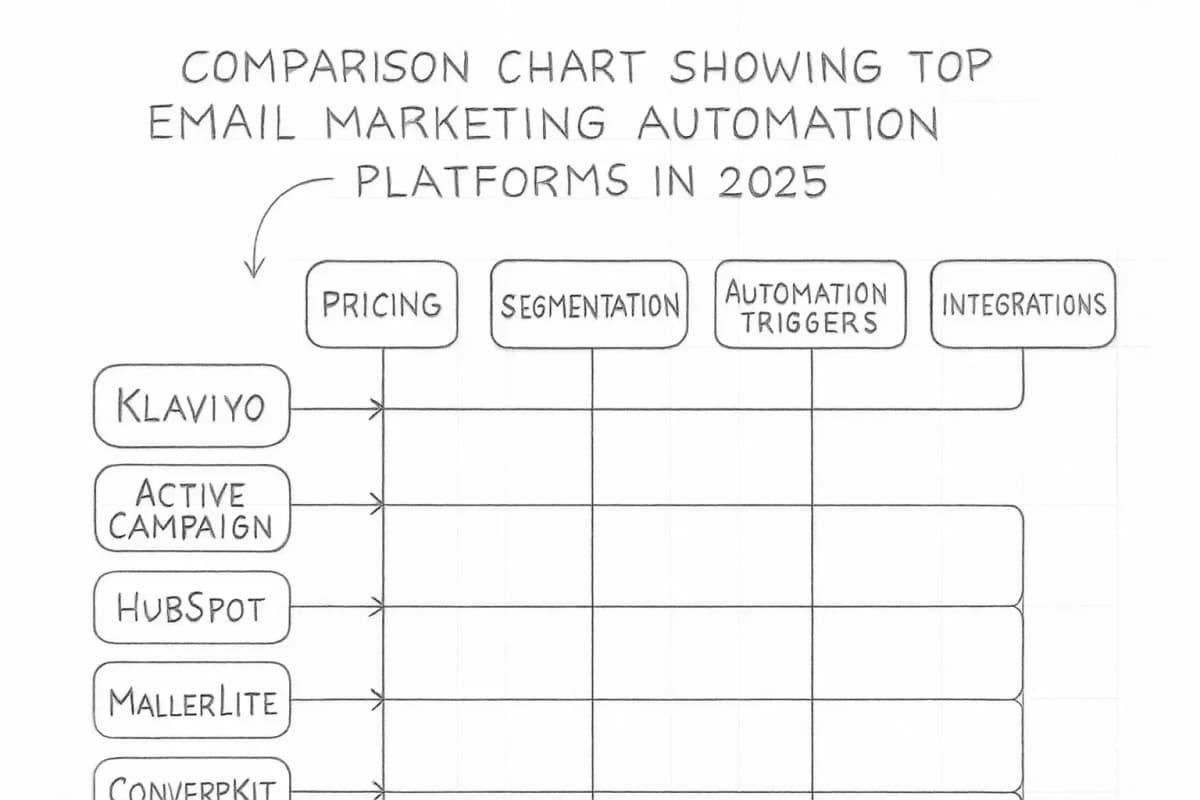

Comparison chart showing top email marketing automation platforms in 2025. Create a table or grid layout with platform names in rows and key features in columns. Include platforms like Klaviyo, ActiveCampaign, HubSpot, MailerLite, ConvertKit, and Drip. Feature columns should highlight: pricing tiers (starting prices), segmentation capabilities (basic to advanced), automation triggers (behavior-based, time-based, event-based), integrations, and best-for use cases (digital marketers, course creators, SMBs, enterprises). Use visual indicators like checkmarks, star ratings, or color coding to show feature availability and strength across platforms. Include price ranges ($16/month to $500+/month spectrum) to help readers compare cost against capability.


Features That Separate Good Platforms from Great Ones

Behavioral Triggers and Segmentation

The most impactful automations are behavior-driven, not time-based. All email marketing automation software works by sending emails based on triggers, which are pre-defined steps your prospects take in their customer journey. Unlike regular marketing emails sent on a fixed schedule, automated emails are sent when customer behavior matches conditions defined in an automated workflow.

Strong email list segmentation is what separates a generic drip sequence from a revenue-generating customer journey. Platforms like ActiveCampaign and Klaviyo lead here.

AI and Predictive Analytics

AI integration is transforming email marketing platforms, offering smarter segmentation, personalized content, and improved campaign performance.

Of marketers who use generative AI, 43% say that it is most helpful for creating email copy. Look for platforms that offer AI subject line generation, send-time optimization, and predictive segmentation, not just content templates. For a deeper look at what AI can do for your campaigns, see our guide on AI email marketing personalization techniques.

GetResponse is a full-featured marketing automation suite with a few neat features that set it apart from more specialized email automation software, including a webinar hosting tool, live chat, and an AI-powered website generator.

GetResponse's powerhouse lies in its marketing automation capabilities. Inside one single tool you will find everything you need to automate your marketing campaigns, including webinars, dynamic segments, automated tagging, Facebook and Instagram ads, Google Search Ads, and email drip campaigns.

Pricing: GetResponse's Starter plan starts at $16/month with basic segmentation. From $54/month, the Marketer plan comes with advanced email marketing features and event-based automation.

Best for: Digital marketers, course creators, and businesses that want email, webinars, landing pages, and conversion funnels in one tool.


Comparison chart showing top email marketing automation platforms in 2025. Create a table or grid layout with platform names in rows and key features in columns. Include platforms like Klaviyo, ActiveCampaign, HubSpot, MailerLite, ConvertKit, and Drip. Feature columns should highlight: pricing tiers (starting prices), segmentation capabilities (basic to advanced), automation triggers (behavior-based, time-based, event-based), integrations, and best-for use cases (digital marketers, course creators, SMBs, enterprises). Use visual indicators like checkmarks, star ratings, or color coding to show feature availability and strength across platforms. Include price ranges ($16/month to $500+/month spectrum) to help readers compare cost against capability.


Features That Separate Good Platforms from Great Ones

Behavioral Triggers and Segmentation

The most impactful automations are behavior-driven, not time-based. All email marketing automation software works by sending emails based on triggers, which are pre-defined steps your prospects take in their customer journey. Unlike regular marketing emails sent on a fixed schedule, automated emails are sent when customer behavior matches conditions defined in an automated workflow.

Strong email list segmentation is what separates a generic drip sequence from a revenue-generating customer journey. Platforms like ActiveCampaign and Klaviyo lead here.

AI and Predictive Analytics

AI integration is transforming email marketing platforms, offering smarter segmentation, personalized content, and improved campaign performance.

Of marketers who use generative AI, 43% say that it is most helpful for creating email copy. Look for platforms that offer AI subject line generation, send-time optimization, and predictive segmentation, not just content templates. For a deeper look at what AI can do for your campaigns, see our guide on AI email marketing personalization techniques.

Deliverability Tools

A platform is only valuable if your emails actually reach the inbox. Email marketing automation platforms help businesses send targeted, personalized emails at scale by automating workflows, segmenting audiences, and integrating with CRM and ecommerce tools. Today's marketing teams also need platforms with strong deliverability and compliance safeguards.


Platform Comparison at a Glance

Deliverability Tools

A platform is only valuable if your emails actually reach the inbox. Email marketing automation platforms help businesses send targeted, personalized emails at scale by automating workflows, segmenting audiences, and integrating with CRM and ecommerce tools. Today's marketing teams also need platforms with strong deliverability and compliance safeguards.


Platform Comparison at a Glance

PlatformBest ForStarting PriceFree Plan
ActiveCampaignAdvanced automation, B2B$15/month14-day trial
KlaviyoEcommerce, ShopifyContact-basedYes (250 contacts)
HubSpotB2B, CRM integration$15/monthYes (limited)
BrevoHigh-volume senders$25/monthYes (300 emails/day)
MailchimpBeginners, SMBs$13/monthYes (500 contacts)
MailerLiteSmall business value$10/monthYes (1,000 contacts)
GetResponseAll-in-one marketers$16/monthYes (500 contacts)
PlatformBest ForStarting PriceFree Plan
ActiveCampaignAdvanced automation, B2B$15/month14-day trial
KlaviyoEcommerce, ShopifyContact-basedYes (250 contacts)
HubSpotB2B, CRM integration$15/monthYes (limited)
BrevoHigh-volume senders$25/monthYes (300 emails/day)
MailchimpBeginners, SMBs$13/monthYes (500 contacts)
MailerLiteSmall business value$10/monthYes (1,000 contacts)
GetResponseAll-in-one marketers$16/monthYes (500 contacts)

Frequently Asked Questions

What is the best email marketing automation software for small businesses in 2025?

MailerLite and Brevo are the strongest options for small businesses in 2025. Users frequently commend MailerLite's affordability and intuitive drag-and-drop interface, which make crafting campaigns straightforward. Unlike some competitors, MailerLite offers comprehensive email automation and effective contact segmentation without breaking the bank. Brevo suits small businesses with large contact lists who send selectively, since its volume-based pricing keeps costs low.

How does email marketing automation software improve ROI?

Email automation lets businesses reach the right people at the right time with personalized messages, boosting efficiency, improving customer experiences, and increasing email marketing ROI. By automating your campaigns, you can nurture leads, maximize conversions, and save valuable time. Automated emails generate 320% more revenue than non-automated emails.

Should I choose a contact-based or volume-based pricing model?

That depends on how you send. ActiveCampaign bases its price on the number of contacts in your account. Brevo bases its price on the number of emails you send. These are two very different pricing models, so keep this in mind as you review your options. If you have a large list but segment heavily and only email a portion of it each month, volume-based pricing (like Brevo's) can save you significantly. If you send frequently to your full list, contact-based pricing at a lower tier often works out cheaper.

What features should I prioritize when choosing email automation software?

Prioritize automation depth, deliverability tools, native integrations with your existing stack, and clear reporting. Identify your specific needs and goals, look for an intuitive user interface, and choose a tool that offers AI-powered insights, email templates, A/B testing, auto-responders, and detailed analytics. If you use an ecommerce platform like Shopify, native integration should be non-negotiable. For B2B teams, CRM alignment matters more than product-specific segmentation. Also consider pairing your platform with strong email marketing analytics practices to track what actually drives revenue.


No comments yet. Be the first!

Leave a comment

Comments are reviewed before publishing.


Frequently Asked Questions

What is the best email marketing automation software for small businesses in 2025?

MailerLite and Brevo are the strongest options for small businesses in 2025. Users frequently commend MailerLite's affordability and intuitive drag-and-drop interface, which make crafting campaigns straightforward. Unlike some competitors, MailerLite offers comprehensive email automation and effective contact segmentation without breaking the bank. Brevo suits small businesses with large contact lists who send selectively, since its volume-based pricing keeps costs low.

How does email marketing automation software improve ROI?

Email automation lets businesses reach the right people at the right time with personalized messages, boosting efficiency, improving customer experiences, and increasing email marketing ROI. By automating your campaigns, you can nurture leads, maximize conversions, and save valuable time. Automated emails generate 320% more revenue than non-automated emails.

Should I choose a contact-based or volume-based pricing model?

That depends on how you send. ActiveCampaign bases its price on the number of contacts in your account. Brevo bases its price on the number of emails you send. These are two very different pricing models, so keep this in mind as you review your options. If you have a large list but segment heavily and only email a portion of it each month, volume-based pricing (like Brevo's) can save you significantly. If you send frequently to your full list, contact-based pricing at a lower tier often works out cheaper.

What features should I prioritize when choosing email automation software?

Prioritize automation depth, deliverability tools, native integrations with your existing stack, and clear reporting. Identify your specific needs and goals, look for an intuitive user interface, and choose a tool that offers AI-powered insights, email templates, A/B testing, auto-responders, and detailed analytics. If you use an ecommerce platform like Shopify, native integration should be non-negotiable. For B2B teams, CRM alignment matters more than product-specific segmentation. Also consider pairing your platform with strong email marketing analytics practices to track what actually drives revenue.

No comments yet. Be the first!

Leave a comment

Comments are reviewed before publishing.

More from

Related posts

Illustration for open source email marketing automation
Email Marketing ToolsJul 17, 2026 15 min

Open Source Email Marketing Automation Tools

Find the best open source email marketing automation platforms. Compare features, setup costs, and deployment options for your business.

More from

Related posts

Illustration for open source email marketing automation
Email Marketing ToolsJul 17, 2026 15 min

Open Source Email Marketing Automation Tools

Find the best open source email marketing automation platforms. Compare features, setup costs, and deployment options for your business.

J
James Chen
J
James Chen
Illustration for best platforms for automated email marketing
Email Marketing ToolsJul 17, 2026 16 min

Best Platforms for Automated Email Marketing

Compare top email automation platforms that save time and boost ROI. Find the right solution for your business needs and budget.

JJames Chen
Illustration for best platforms for automated email marketing
Email Marketing ToolsJul 17, 2026 16 min

Best Platforms for Automated Email Marketing

Compare top email automation platforms that save time and boost ROI. Find the right solution for your business needs and budget.

JJames Chen
Illustration for best ai email marketing platforms
Email Marketing ToolsJul 16, 2026 1 min

Best AI Email Marketing Platforms in 2024

Compare top AI email marketing platforms that boost open rates and ROI. Find the right tool for your business with our expert review.

JJames Chen
Illustration for best ai email marketing platforms
Email Marketing ToolsJul 16, 2026 1 min

Best AI Email Marketing Platforms in 2024

Compare top AI email marketing platforms that boost open rates and ROI. Find the right tool for your business with our expert review.

JJames Chen