
HomeBlogEmail Marketing Tools & SoftwareTop Email Marketing Automation Tools for 2024
Email Marketing Tools & Software

Top Email Marketing Automation Tools for 2024

Compare the best email marketing automation tools to boost ROI and save time. See features, pricing, and which platform fits your business.

R

Rachel Torres

July 16, 2026

15 min read
HomeBlogEmail Marketing Tools & SoftwareTop Email Marketing Automation Tools for 2024
Email Marketing Tools & Software

Top Email Marketing Automation Tools for 2024

Compare the best email marketing automation tools to boost ROI and save time. See features, pricing, and which platform fits your business.

R

Rachel Torres

July 16, 2026

15 min read
Share:
Share:
#Email Automation#Marketing Tools#email platforms#Email Strategy
Illustration for top email marketing automation tools

Stay in the loop

Get the latest posts delivered straight to your inbox. No spam, unsubscribe anytime.

Choosing the wrong email marketing automation tool does not just waste your budget. It costs you deliverability, delays your campaigns, and erodes your ability to personalize at scale. The right platform, by contrast, becomes a revenue engine. Email marketing delivers an average return of between $36 and $42 for every $1 spent, the highest ROI of any digital marketing channel. Automation is the multiplier inside that number: email automations deliver 30 times more revenue per recipient than one-off promotional campaigns, with the average return per recipient for automated flows reaching $1.94 compared to $0.11 for standard campaigns.

This guide covers the top email marketing automation tools available today, who each one fits, what they cost, and which platform you should actually choose based on your business model and goals.

Key Takeaways

  • Automated emails generate 320% more revenue than non-automated emails.
  • Despite representing only 2% of email volume, automated messages generated 37% of all email-attributed sales in 2024.
  • Email was the channel that relied the most on marketing automation, with 58% of surveyed professionals choosing it over both content and social media management as of early 2024.
  • No single tool wins for every business. The best fit depends on your use case (ecommerce, B2B, creator, or enterprise), list size, and the depth of automation you need.
  • Pricing models vary significantly. Some tools charge by contacts, others by email volume. Choosing the wrong model leads to expensive surprises as you scale.

Why Email Marketing Automation Matters Now

69% of marketers adopted marketing automation because it reduces manual work and improves campaign execution speed. That shift is not about replacing strategy with software. It is about running more sophisticated campaigns without growing your team proportionally.

Automated emails average a 70.5% higher open rate and 152% higher click-through rate than standard marketing messages. For any business sending more than a basic newsletter, those numbers make a compelling case for a dedicated automation platform.

If you are still manually sending follow-ups or batch-blasting your entire list with the same message, see our email marketing automation tips to understand where your biggest gains are hiding before you pick a tool.

Stay in the loop

Get the latest posts delivered straight to your inbox. No spam, unsubscribe anytime.

Choosing the wrong email marketing automation tool does not just waste your budget. It costs you deliverability, delays your campaigns, and erodes your ability to personalize at scale. The right platform, by contrast, becomes a revenue engine. Email marketing delivers an average return of between $36 and $42 for every $1 spent, the highest ROI of any digital marketing channel. Automation is the multiplier inside that number: email automations deliver 30 times more revenue per recipient than one-off promotional campaigns, with the average return per recipient for automated flows reaching $1.94 compared to $0.11 for standard campaigns.

This guide covers the top email marketing automation tools available today, who each one fits, what they cost, and which platform you should actually choose based on your business model and goals.

Key Takeaways

  • Automated emails generate 320% more revenue than non-automated emails.
  • Despite representing only 2% of email volume, automated messages generated 37% of all email-attributed sales in 2024.
  • Email was the channel that relied the most on marketing automation, with 58% of surveyed professionals choosing it over both content and social media management as of early 2024.
  • No single tool wins for every business. The best fit depends on your use case (ecommerce, B2B, creator, or enterprise), list size, and the depth of automation you need.
  • Pricing models vary significantly. Some tools charge by contacts, others by email volume. Choosing the wrong model leads to expensive surprises as you scale.

Why Email Marketing Automation Matters Now

69% of marketers adopted marketing automation because it reduces manual work and improves campaign execution speed. That shift is not about replacing strategy with software. It is about running more sophisticated campaigns without growing your team proportionally.

Automated emails average a 70.5% higher open rate and 152% higher click-through rate than standard marketing messages. For any business sending more than a basic newsletter, those numbers make a compelling case for a dedicated automation platform.

If you are still manually sending follow-ups or batch-blasting your entire list with the same message, see our email marketing automation tips to understand where your biggest gains are hiding before you pick a tool.


What to Look for Before You Buy

Today's marketing teams need platforms that offer predictive analytics, journey-based targeting, drag-and-drop journey builders and behavioral triggers, unified customer data for accurate segmentation, AI-powered content and optimization features, strong deliverability and compliance safeguards, and transparent pricing and easy migration support.

Beyond the feature checklist, pay close attention to:

  • Pricing model: Contact-based vs. email volume-based pricing affects your bill as you scale. Platforms become expensive as lists scale, and choosing based solely on starting price often leads to costly migrations later.
  • Automation depth at your tier: Some platforms lock complex workflows behind premium plans. Make sure the features you actually need are available at the tier you can afford.
  • Deliverability: The best platforms have their own SMTP servers and offer high deliverability, meaning your emails land in the inbox and not in spam.
  • Fit with your use case: A tool with every feature under the sun will not help if it is too complex to get off the ground. Choose something that matches your team's size and skills, not just your wishlist.

The Top Email Marketing Automation Tools in 2024

1. ActiveCampaign: Best for Advanced Automation Workflows

ActiveCampaign takes the top spot for automation depth and holds a 4.5 out of 5 G2 rating across 14,000+ reviews. It is the most capable option for growing businesses that need multi-step, behavior-driven workflows without moving to enterprise software.

The all-in-one platform combines email, SMS, WhatsApp, landing pages, CRM, and behavioral automation with over 1,000 integrations. Its AI feature, Active Intelligence, builds campaigns from plain-language goals using AI trained on billions of data points, delivering campaigns in 5 clicks.

Pricing: ActiveCampaign starts at $15 per month for 1,000 contacts on the Starter plan, which includes basic automation and email marketing features. However, the Starter plan has real limitations. Automations are capped at just 5 actions each with no branching or conditional logic, meaning complex workflows are off the table entirely at this tier. For full automation capability, you need the Plus plan.

Best for: Businesses that need advanced automation, CRM integration, and multi-channel marketing without jumping to enterprise-level tools. It is especially valuable for agencies, SaaS companies, and mid-sized businesses looking to scale personalization and track ROI.

Watch out for: As contact lists grow, pricing can increase quickly, making it harder to justify long-term costs.


2. Klaviyo: Best for Ecommerce Brands

Klaviyo is the leading email and SMS marketing platform built specifically for ecommerce, offering automated flows, purchase-behavior segmentation, and predictive analytics that typically generate 20-30% of total ecommerce revenue.


What to Look for Before You Buy

Today's marketing teams need platforms that offer predictive analytics, journey-based targeting, drag-and-drop journey builders and behavioral triggers, unified customer data for accurate segmentation, AI-powered content and optimization features, strong deliverability and compliance safeguards, and transparent pricing and easy migration support.

Beyond the feature checklist, pay close attention to:

  • Pricing model: Contact-based vs. email volume-based pricing affects your bill as you scale. Platforms become expensive as lists scale, and choosing based solely on starting price often leads to costly migrations later.
  • Automation depth at your tier: Some platforms lock complex workflows behind premium plans. Make sure the features you actually need are available at the tier you can afford.
  • Deliverability: The best platforms have their own SMTP servers and offer high deliverability, meaning your emails land in the inbox and not in spam.
  • Fit with your use case: A tool with every feature under the sun will not help if it is too complex to get off the ground. Choose something that matches your team's size and skills, not just your wishlist.

The Top Email Marketing Automation Tools in 2024

1. ActiveCampaign: Best for Advanced Automation Workflows

ActiveCampaign takes the top spot for automation depth and holds a 4.5 out of 5 G2 rating across 14,000+ reviews. It is the most capable option for growing businesses that need multi-step, behavior-driven workflows without moving to enterprise software.

The all-in-one platform combines email, SMS, WhatsApp, landing pages, CRM, and behavioral automation with over 1,000 integrations. Its AI feature, Active Intelligence, builds campaigns from plain-language goals using AI trained on billions of data points, delivering campaigns in 5 clicks.

Pricing: ActiveCampaign starts at $15 per month for 1,000 contacts on the Starter plan, which includes basic automation and email marketing features. However, the Starter plan has real limitations. Automations are capped at just 5 actions each with no branching or conditional logic, meaning complex workflows are off the table entirely at this tier. For full automation capability, you need the Plus plan.

Best for: Businesses that need advanced automation, CRM integration, and multi-channel marketing without jumping to enterprise-level tools. It is especially valuable for agencies, SaaS companies, and mid-sized businesses looking to scale personalization and track ROI.

Watch out for: As contact lists grow, pricing can increase quickly, making it harder to justify long-term costs.


2. Klaviyo: Best for Ecommerce Brands

Klaviyo is the leading email and SMS marketing platform built specifically for ecommerce, offering automated flows, purchase-behavior segmentation, and predictive analytics that typically generate 20-30% of total ecommerce revenue.

Klaviyo's 167,000 customer base generated over $1 billion in platform revenue during 2024, with automated email flows delivering 30x more revenue per recipient than one-off campaigns. The platform's AI tooling includes predictive CLV modeling, churn probability scoring, and a K:AI Marketing Agent that generates campaigns from product catalogs and brand guidelines, learning from every send.

Pricing: Klaviyo offers a free plan for businesses with up to 250 active profiles, allowing for 500 email sends and 150 SMS/MMS credits per month. The Email plan starts at $20/month for 251-500 active profiles and includes 5,000 monthly email sends. Costs scale steeply at larger list sizes: at 10,000 contacts, Klaviyo costs $150/month for email alone, and at 50,000 contacts, it reaches $720/month before adding SMS or other add-ons.

Best for: Ecommerce businesses doing $500K+ in revenue. It is not the cheapest option and not the simplest, but it is the one that most directly connects email marketing to revenue.

Watch out for: Klaviyo can be challenging to learn, particularly when setting up complex customer segments and advanced automation tasks.


3. HubSpot: Best for B2B Teams with CRM-First Strategies

HubSpot has evolved from a marketing automation pioneer into a comprehensive business platform. Its email marketing, built on a foundation of CRM data, offers sophisticated capabilities for companies wanting unified marketing, sales, and service operations.

HubSpot offers a unified platform that combines CRM capabilities with email marketing, automation, and sales tools, and the data flow makes it easier to coordinate marketing and sales efforts. That CRM foundation is the key differentiator: it enables rich segmentation that pure email service providers cannot match, and this is HubSpot's defining strength.

Pricing: The free plan gives basic email marketing capped at 2,000 sends per month with HubSpot branding. Starter at $15/month removes branding and includes 1,000 marketing contacts. Professional at $890/month includes three seats, 2,000 marketing contacts, and full automation workflows. Enterprise starts at $3,600/month.

Best for: Teams already invested in the HubSpot ecosystem, or companies that want email, CRM, and sales tools in one platform and have the budget for Professional.

Watch out for: If you only need email marketing, HubSpot's pricing does not compete with dedicated email platforms. The value is in the integrated platform. Real automation power starts at the Professional tier, which is a significant jump in cost.


4. Brevo: Best Volume-Based Option for Growing Lists

Brevo flips the usual pricing model. You pay for emails sent per month, so a large list you mail occasionally costs less than on contact-based platforms. This makes it one of the most cost-efficient tools for businesses with large lists but moderate send frequency.

It is the only platform in its class that combines marketing emails, transactional emails, SMS, and WhatsApp in one place. If you need order confirmations and marketing campaigns from the same tool, Brevo saves you from stitching together multiple services.

Pricing: The free plan sends 300 emails per day with no expiration date. The Starter plan begins at $9/month.

Klaviyo's 167,000 customer base generated over $1 billion in platform revenue during 2024, with automated email flows delivering 30x more revenue per recipient than one-off campaigns. The platform's AI tooling includes predictive CLV modeling, churn probability scoring, and a K:AI Marketing Agent that generates campaigns from product catalogs and brand guidelines, learning from every send.

Pricing: Klaviyo offers a free plan for businesses with up to 250 active profiles, allowing for 500 email sends and 150 SMS/MMS credits per month. The Email plan starts at $20/month for 251-500 active profiles and includes 5,000 monthly email sends. Costs scale steeply at larger list sizes: at 10,000 contacts, Klaviyo costs $150/month for email alone, and at 50,000 contacts, it reaches $720/month before adding SMS or other add-ons.

Best for: Ecommerce businesses doing $500K+ in revenue. It is not the cheapest option and not the simplest, but it is the one that most directly connects email marketing to revenue.

Watch out for: Klaviyo can be challenging to learn, particularly when setting up complex customer segments and advanced automation tasks.


3. HubSpot: Best for B2B Teams with CRM-First Strategies

HubSpot has evolved from a marketing automation pioneer into a comprehensive business platform. Its email marketing, built on a foundation of CRM data, offers sophisticated capabilities for companies wanting unified marketing, sales, and service operations.

HubSpot offers a unified platform that combines CRM capabilities with email marketing, automation, and sales tools, and the data flow makes it easier to coordinate marketing and sales efforts. That CRM foundation is the key differentiator: it enables rich segmentation that pure email service providers cannot match, and this is HubSpot's defining strength.

Pricing: The free plan gives basic email marketing capped at 2,000 sends per month with HubSpot branding. Starter at $15/month removes branding and includes 1,000 marketing contacts. Professional at $890/month includes three seats, 2,000 marketing contacts, and full automation workflows. Enterprise starts at $3,600/month.

Best for: Teams already invested in the HubSpot ecosystem, or companies that want email, CRM, and sales tools in one platform and have the budget for Professional.

Watch out for: If you only need email marketing, HubSpot's pricing does not compete with dedicated email platforms. The value is in the integrated platform. Real automation power starts at the Professional tier, which is a significant jump in cost.


4. Brevo: Best Volume-Based Option for Growing Lists

Brevo flips the usual pricing model. You pay for emails sent per month, so a large list you mail occasionally costs less than on contact-based platforms. This makes it one of the most cost-efficient tools for businesses with large lists but moderate send frequency.

It is the only platform in its class that combines marketing emails, transactional emails, SMS, and WhatsApp in one place. If you need order confirmations and marketing campaigns from the same tool, Brevo saves you from stitching together multiple services.

Pricing: The free plan sends 300 emails per day with no expiration date. The Starter plan begins at $9/month.

Best for: Ecommerce businesses that need transactional and marketing emails in one platform, and companies with large contact databases they email infrequently.


5. MailerLite: Best Value for Small Businesses

MailerLite is the quiet overachiever on this list. The free plan includes 1,000 subscribers, 12,000 emails per month, a drag-and-drop editor, landing pages, popups, and basic automations.

For its price, MailerLite's automation tools stand out as a major strength: welcome emails, abandoned cart emails, audience segmentation, and more. You can build relatively advanced workflows with multiple triggers and actions, and the automation editor is simple to use, even for beginners.

Pricing: MailerLite's paid plans for email marketing start at just $9 per month, which includes unlimited emails and three account users.

Best for: Small businesses and solopreneurs who want maximum features for minimum spend and do not need enterprise-grade automation.


6. Moosend: Best Budget-Friendly Automation Depth

Moosend offers automation capabilities that rival tools twice its price, making it an excellent choice for budget-conscious teams that do not want to sacrifice functionality. Critically, it provides a full automation builder with triggers, conditions, and actions at the $9/month price point, while most competitors lock automation behind higher tiers.

Best for: Teams with tight budgets who need real workflow logic, not just basic autoresponders.


7. GetResponse: Best All-in-One with Webinar and Funnel Features

GetResponse is a fully-featured marketing automation tool most notable for its powerful automations in list management. Like ActiveCampaign, it offers advanced automations such as triggered campaigns, segmentation, tagging, and data updates. Its Pro plan includes a CRM, and it lets you create landing pages and run webinars.

Pricing: Paid plans start at $19/month with unlimited emails and 1,000 contacts. GetResponse has a free plan that includes 2,500 emails and 500 contacts, but no automation.

Best for: Businesses looking to grow revenue streams through conversion funnels, including those selling subscriptions, tickets, or digital products.
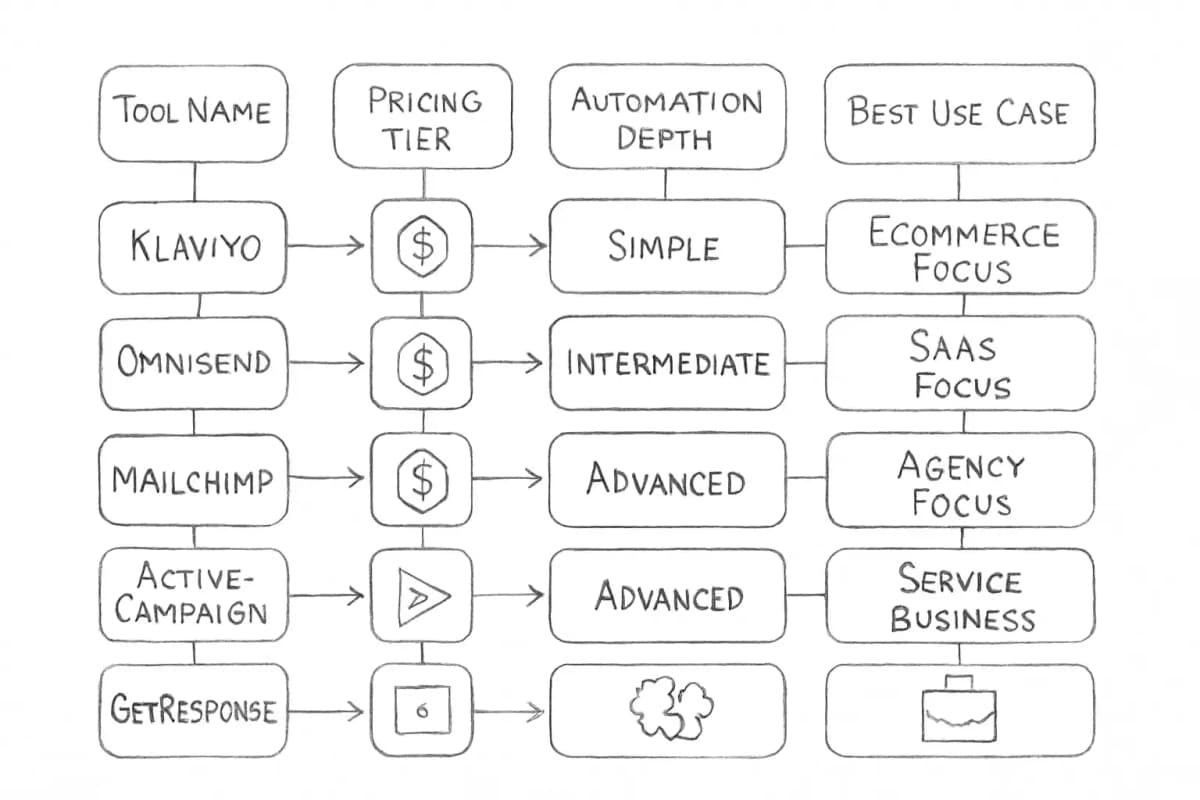

A comparison table displayed as a side-by-side matrix showing email marketing automation tools (rows: Klaviyo, Omnisend, Mailchimp, ActiveCampaign, GetResponse) with columns for pricing tier, automation depth level, and primary use case recommendation. Include visual indicators like pricing badges, automation complexity ratings (simple to advanced), and use case icons for ecommerce, SaaS, agencies, and service businesses. Use a clean grid layout with alternating row colors for readability.


How to Match the Tool to Your Business

The clearest way to narrow your choice is to match the tool to your primary use case:

Best for: Ecommerce businesses that need transactional and marketing emails in one platform, and companies with large contact databases they email infrequently.


5. MailerLite: Best Value for Small Businesses

MailerLite is the quiet overachiever on this list. The free plan includes 1,000 subscribers, 12,000 emails per month, a drag-and-drop editor, landing pages, popups, and basic automations.

For its price, MailerLite's automation tools stand out as a major strength: welcome emails, abandoned cart emails, audience segmentation, and more. You can build relatively advanced workflows with multiple triggers and actions, and the automation editor is simple to use, even for beginners.

Pricing: MailerLite's paid plans for email marketing start at just $9 per month, which includes unlimited emails and three account users.

Best for: Small businesses and solopreneurs who want maximum features for minimum spend and do not need enterprise-grade automation.


6. Moosend: Best Budget-Friendly Automation Depth

Moosend offers automation capabilities that rival tools twice its price, making it an excellent choice for budget-conscious teams that do not want to sacrifice functionality. Critically, it provides a full automation builder with triggers, conditions, and actions at the $9/month price point, while most competitors lock automation behind higher tiers.

Best for: Teams with tight budgets who need real workflow logic, not just basic autoresponders.


7. GetResponse: Best All-in-One with Webinar and Funnel Features

GetResponse is a fully-featured marketing automation tool most notable for its powerful automations in list management. Like ActiveCampaign, it offers advanced automations such as triggered campaigns, segmentation, tagging, and data updates. Its Pro plan includes a CRM, and it lets you create landing pages and run webinars.

Pricing: Paid plans start at $19/month with unlimited emails and 1,000 contacts. GetResponse has a free plan that includes 2,500 emails and 500 contacts, but no automation.

Best for: Businesses looking to grow revenue streams through conversion funnels, including those selling subscriptions, tickets, or digital products.


A comparison table displayed as a side-by-side matrix showing email marketing automation tools (rows: Klaviyo, Omnisend, Mailchimp, ActiveCampaign, GetResponse) with columns for pricing tier, automation depth level, and primary use case recommendation. Include visual indicators like pricing badges, automation complexity ratings (simple to advanced), and use case icons for ecommerce, SaaS, agencies, and service businesses. Use a clean grid layout with alternating row colors for readability.


How to Match the Tool to Your Business

The clearest way to narrow your choice is to match the tool to your primary use case:

  • Ecommerce (DTC, Shopify, WooCommerce): Klaviyo or Omnisend. Both connect natively to your store and turn purchase behavior into automated revenue. See our ecommerce email marketing tips for setup guidance.
  • B2B/SaaS: ActiveCampaign or HubSpot. You need lead scoring, CRM integration, and behavioral triggers based on product usage and sales activity.
  • Small business or solo operator: MailerLite or Brevo. Both give you a strong free tier and clean automation without complexity.
  • Newsletter and creator economy: Kit (formerly ConvertKit). Kit rebranded from ConvertKit in late 2024, and the product philosophy has not changed: it is built for creators, writers, and solo operators. The visual automation builder is where it shines, letting you map out entire subscriber journeys, purchase triggers, and tag-based sequences in a way that makes sense visually.

Regardless of the platform you choose, your results will depend heavily on how well you segment your audience and personalize your messages. See our guide on email list segmentation strategies to build the audience structure that makes any automation tool more effective.


A Word on AI Features in 2024

Brands using AI-driven personalization report up to 42% higher revenue, with click-through rates exceeding 13%, and this alone can lift ROI by nearly 20%. Most of the top email marketing automation tools now include some form of AI assistance, from subject line optimization to predictive send-time scheduling. Among marketers who use generative AI, 43% say it is most helpful for creating email copy.

That said, AI features are not equally implemented across platforms. ActiveCampaign's Active Intelligence and Klaviyo's K:AI are among the most mature in the market. For smaller tools, AI tends to mean content suggestions rather than autonomous campaign management.


Frequently Asked Questions

Which email marketing automation tool is best for small businesses?

MailerLite is hard to beat on both simplicity and value. All of its tools are user-friendly without being too basic, and it has a very generous free plan. Brevo and Moosend are strong runners-up if you need SMS or more advanced workflow logic at a low price point.

What is the difference between email marketing software and email automation tools?

Traditional email marketing software is designed primarily for sending one-off or scheduled campaigns to a broad list, while email marketing automation platforms are built to send targeted messages automatically based on behavior, segment data, lifecycle triggers, and real-time data. The key distinction is whether campaigns fire on a schedule you set manually or in response to what your subscribers actually do.

Is Klaviyo worth it for ecommerce?

A well-run Klaviyo setup typically generates 20-30% of total ecommerce revenue through email and SMS. For stores doing meaningful revenue, that return justifies the cost. For very small stores or those just starting, the free plan works for initial testing, but most businesses outgrow it quickly. Omnisend is a cost-effective alternative if Klaviyo's pricing becomes a constraint.

How do I choose between ActiveCampaign and HubSpot?

  • Ecommerce (DTC, Shopify, WooCommerce): Klaviyo or Omnisend. Both connect natively to your store and turn purchase behavior into automated revenue. See our ecommerce email marketing tips for setup guidance.
  • B2B/SaaS: ActiveCampaign or HubSpot. You need lead scoring, CRM integration, and behavioral triggers based on product usage and sales activity.
  • Small business or solo operator: MailerLite or Brevo. Both give you a strong free tier and clean automation without complexity.
  • Newsletter and creator economy: Kit (formerly ConvertKit). Kit rebranded from ConvertKit in late 2024, and the product philosophy has not changed: it is built for creators, writers, and solo operators. The visual automation builder is where it shines, letting you map out entire subscriber journeys, purchase triggers, and tag-based sequences in a way that makes sense visually.

Regardless of the platform you choose, your results will depend heavily on how well you segment your audience and personalize your messages. See our guide on email list segmentation strategies to build the audience structure that makes any automation tool more effective.


A Word on AI Features in 2024

Brands using AI-driven personalization report up to 42% higher revenue, with click-through rates exceeding 13%, and this alone can lift ROI by nearly 20%. Most of the top email marketing automation tools now include some form of AI assistance, from subject line optimization to predictive send-time scheduling. Among marketers who use generative AI, 43% say it is most helpful for creating email copy.

That said, AI features are not equally implemented across platforms. ActiveCampaign's Active Intelligence and Klaviyo's K:AI are among the most mature in the market. For smaller tools, AI tends to mean content suggestions rather than autonomous campaign management.


Frequently Asked Questions

Which email marketing automation tool is best for small businesses?

MailerLite is hard to beat on both simplicity and value. All of its tools are user-friendly without being too basic, and it has a very generous free plan. Brevo and Moosend are strong runners-up if you need SMS or more advanced workflow logic at a low price point.

What is the difference between email marketing software and email automation tools?

Traditional email marketing software is designed primarily for sending one-off or scheduled campaigns to a broad list, while email marketing automation platforms are built to send targeted messages automatically based on behavior, segment data, lifecycle triggers, and real-time data. The key distinction is whether campaigns fire on a schedule you set manually or in response to what your subscribers actually do.

Is Klaviyo worth it for ecommerce?

A well-run Klaviyo setup typically generates 20-30% of total ecommerce revenue through email and SMS. For stores doing meaningful revenue, that return justifies the cost. For very small stores or those just starting, the free plan works for initial testing, but most businesses outgrow it quickly. Omnisend is a cost-effective alternative if Klaviyo's pricing becomes a constraint.

How do I choose between ActiveCampaign and HubSpot?

The core difference is use case. ActiveCampaign makes the most sense for businesses that need advanced automation, CRM integration, and multi-channel marketing without jumping to enterprise-level tools. HubSpot makes sense when email is part of a broader inbound strategy involving content, sales pipeline management, and cross-team data sharing. If you just need email, Mailchimp, ConvertKit, or Brevo offer better value. For ecommerce primarily, Klaviyo offers superior integration for online stores.

What should I prioritize when evaluating deliverability?

Prioritize email deliverability first. Then look at behavior-based segmentation, A/B testing across sequences, advanced workflows, and clear analytics. A tool with superior features is useless if your emails do not reach the inbox. Check independent deliverability benchmarks, not just vendor claims, before committing to a platform. You can also complement any tool with proper email marketing analytics practices to track performance and catch deliverability issues early.


No comments yet. Be the first!

Leave a comment

Comments are reviewed before publishing.

The core difference is use case. ActiveCampaign makes the most sense for businesses that need advanced automation, CRM integration, and multi-channel marketing without jumping to enterprise-level tools. HubSpot makes sense when email is part of a broader inbound strategy involving content, sales pipeline management, and cross-team data sharing. If you just need email, Mailchimp, ConvertKit, or Brevo offer better value. For ecommerce primarily, Klaviyo offers superior integration for online stores.

What should I prioritize when evaluating deliverability?

Prioritize email deliverability first. Then look at behavior-based segmentation, A/B testing across sequences, advanced workflows, and clear analytics. A tool with superior features is useless if your emails do not reach the inbox. Check independent deliverability benchmarks, not just vendor claims, before committing to a platform. You can also complement any tool with proper email marketing analytics practices to track performance and catch deliverability issues early.

No comments yet. Be the first!

Leave a comment

Comments are reviewed before publishing.

More from

Related posts

Illustration for email marketing tools with ai optimization 2025
Email Marketing Tools & SoftwareJul 17, 2026 15 min

Best Email Marketing Tools With AI Optimization 2025

Compare top email marketing tools with built-in AI features for 2025. Discover automation, personalization, and deliverability improvements.

More from

Related posts

Illustration for email marketing tools with ai optimization 2025
Email Marketing Tools & SoftwareJul 17, 2026 15 min

Best Email Marketing Tools With AI Optimization 2025

Compare top email marketing tools with built-in AI features for 2025. Discover automation, personalization, and deliverability improvements.

SSarah Mitchell
SSarah Mitchell
Illustration for ai-powered email marketing platforms
Email Marketing Tools & SoftwareJul 17, 2026 15 min

AI-Powered Email Marketing Platforms: 2024 Guide

Discover the best AI-powered email marketing platforms that automate campaigns, improve deliverability, and boost ROI. Compare features and find the right tool.

MMarcus Webb
Illustration for ai-powered email marketing platforms
Email Marketing Tools & SoftwareJul 17, 2026 15 min

AI-Powered Email Marketing Platforms: 2024 Guide

Discover the best AI-powered email marketing platforms that automate campaigns, improve deliverability, and boost ROI. Compare features and find the right tool.

MMarcus Webb
Illustration for best email marketing automation tools 2024
Email Marketing Tools & SoftwareJul 16, 2026 11 min

Best Email Marketing Automation Tools 2024

Compare top email marketing automation platforms for deliverability, segmentation, and ROI. Find the right tool for your business needs.

RRachel Torres
Illustration for best email marketing automation tools 2024
Email Marketing Tools & SoftwareJul 16, 2026 11 min

Best Email Marketing Automation Tools 2024

Compare top email marketing automation platforms for deliverability, segmentation, and ROI. Find the right tool for your business needs.

RRachel Torres