
Choosing the right platform from the top email marketing automation tools in 2025 can directly move the needle on revenue. Automated emails drove 37% of all email-generated sales in 2024, despite accounting for just 2% of total email volume. That ratio alone makes automation one of the highest-leverage decisions a marketing team can make.
This guide covers the platforms that consistently perform: what they do well, who they fit, and what you should know before committing budget to them.
Key Takeaways
- Email marketing delivers a return of $36 to $42 for every $1 spent, outperforming paid search ($2) and social advertising ($2.80) by a wide margin.
- Email is the channel that relies most heavily on marketing automation, with 58% of surveyed professionals choosing it over both content and social media management.
- Automated emails generate 320% more revenue than non-automated emails.
- The right tool depends on your business model: ecommerce brands, B2B teams, and small businesses each need different feature sets.
- Pricing models vary significantly. Some platforms charge by contacts, others by email volume. Understanding this distinction before signing up prevents bill shock as you scale.
Why Email Automation Matters More in 2025
By 2026, 89% of marketing experts expect up to 75% of email strategy operations to be fully AI-driven. That is not a distant future, it is already shaping how the best tools are built and updated.
Email automation software helps businesses automatically create and send targeted, personalized emails to their audience. Instead of manually sending each email, automation tools allow you to set up workflows that trigger email campaigns based on customer actions, preferences, or set time intervals.
The business case is clear. Email marketing ranks as the most effective channel for 41% of marketing professionals, far outpacing social media and paid search, which tied for second place at just 16% each.
What separates average programs from high-performing ones is usually how well automation, segmentation, and personalization are set up. This guide focuses on the tools that make those things practical and scalable.
The Top Email Marketing Automation Tools in 2025
1. ActiveCampaign: Best for Advanced Automation and CRM
ActiveCampaign is one of the strongest choices for teams that need sophisticated automation logic paired with a built-in CRM.
Its visual automation builder is best-in-class, offering 135-plus triggers, if/else branching, and split-testing of entire automation paths. Its standout feature is a notable integration library currently exceeding 900 integrations, with the ability to use activity in connected apps to trigger automations.
After you sign up, you get tagged as a trial user and sent a welcome email. The system waits a day, and based on your behavior, the automation adapts. If you opened the email, you are tagged as a sales lead and sent more tailored content. If you did not open it, you get nudged with content geared toward less-engaged users. That kind of conditional behavior is built into the platform's DNA.
Deliverability is strong, with a 99.4% delivery rate across independent testing accounts versus an approximately 83% industry average.
Pricing: ActiveCampaign offers four plans billed annually: Starter at $15/month, Plus at $49/month, Professional at $79/month, and Enterprise at $145/month, all for 1,000 contacts. There is no free plan, but a 14-day free trial is available on all tiers.
Best for: Growing businesses and B2B teams running complex multi-step automation sequences. Also see our Email Marketing Automation CRM Setup Guide for hands-on setup advice.
2. Klaviyo: Best for Ecommerce Brands
Klaviyo is a powerful email marketing automation platform for ecommerce businesses. It is known for its deep integrations with ecommerce platforms and advanced segmentation, allowing businesses to send highly personalized emails to customers.
Klaviyo uses AI to offer predictive analytics, providing insights into metrics like customer lifetime value, churn risk, and expected next order date. It offers deep integration with a number of ecommerce platforms including Shopify, WooCommerce, and PrestaShop.
The tradeoff is cost. Email-only pricing at 1,000 profiles is $30/month, scaling to $150/month at 10,000 profiles. As of February 2025, Klaviyo bills on total active profiles rather than just emailed contacts, which increased costs for brands with large unengaged lists.
Klaviyo's extensive features can present a learning curve for new users, making it less accessible for those without prior experience in email marketing.
Best for: Ecommerce brands with structured customer journey data and enough volume to justify the pricing model. If you sell on Shopify, WooCommerce, or BigCommerce and want revenue attribution at the flow level, Klaviyo leads the field. See our Ecommerce Email Marketing Tips for pairing strategies.
3. Brevo: Best Value for Money
EmailTooltester awarded Brevo the Best Email Marketing Tool for Value For Money badge for 2025 and Best Email Marketing Tool overall for 2026.
Brevo prices by monthly email volume, not contact count. You can store unlimited contacts on every plan, including the free tier. Starter begins at $9/month for 5,000 emails. Business starts at $18/month for 5,000 emails with advanced automation. This structure is dramatically cheaper for businesses with large lists that do not email every contact every week.
Brevo is an email marketing and CRM suite for small businesses and those with large contact databases. It allows storing up to 100,000 contacts indefinitely without paying beyond that limit, and supports multichannel outreach across email, SMS, WhatsApp, and web push notifications.
Brevo also includes predictive sending: AI determines the optimal time to send emails to each contact based on their past engagement patterns.
Best for: Small to medium businesses, agencies, and any team with a large list but inconsistent send frequency.
4. HubSpot: Best All-in-One Platform for Scaling Teams
HubSpot goes beyond email. It is a full customer platform that connects marketing, sales, and service in one place. You get all the essentials including templates, A/B testing, personalization, and segmentation, and 2025 brought AI-powered upgrades. With Breeze AI Agents, you can automatically generate subject lines, predict send times, and build workflows that respond to customer behavior in real time.
HubSpot's paid plans start at $15/month for 1,000 contacts for Marketing Hub, but costs jump sharply as you scale to $205/month for 5,000 contacts. The free tier is genuinely useful for startups but is only affordable at the entry level. The Professional plan at $890/month is where the full automation suite lives, and it requires a one-time onboarding fee.
HubSpot is more suited for customer relationship management than Klaviyo or any other CRM software.
Best for: Sales-led organizations that want a single platform for marketing, CRM, and service. Budget-conscious teams or those with simple email-only needs will likely find better value elsewhere.
5. Mailchimp: Best for Getting Started Quickly
Founded in 2001, Mailchimp grew from a small Atlanta startup into the email marketing platform Intuit acquired for $12 billion in 2021. It now reaches beyond email into SMS, websites, and social advertising.
Mailchimp is ideal for small businesses that want simplicity and speed. With an intuitive setup and easy starter courses, it helps beginners quickly launch basic campaigns without overwhelming features.
Paid plans include Essentials starting at $13/month and Standard at $20/month for 500 contacts, scaling to $45/month and $60/month for 2,500 contacts. The Premium plan starts at $350/month for up to 10,000 contacts.
The main limitations appear as you grow. For small businesses needing basic email marketing, Mailchimp remains a viable option, but it struggles with advanced customer journeys and analytics.
Best for: Beginners, small businesses, and teams that need a fast setup without a steep learning curve.
6. Omnisend: Best for Ecommerce Multichannel Automation
Omnisend is a strong choice for online store owners, driven by its many automations including browse abandonment and cart recovery. It offers excellent automated workflows for ecommerce.
Omnisend's ecommerce marketing report shows that abandoned cart and welcome emails generated 76% of all automated orders in 2025. Omnisend supports push notifications alongside email and SMS, handling more channels by default. It lets you create separate campaigns for each channel and add SMS and push notifications to email flows, such as abandoned cart sequences, all within a single workflow.
Omnisend offers Standard at $16/month and Pro at $59/month for 1,000 contacts. Standard includes email send limits of 12x the contact count.
Best for: Ecommerce brands that need email plus SMS plus push notifications in coordinated automated workflows, without Klaviyo's price tag.
7. MailerLite: Best Budget-Friendly Tool for Small Teams
MailerLite has a clean, intuitive interface where everything is easy to navigate. Its drag-and-drop email editor makes creating professional-looking marketing campaigns as simple as it can be.
For its price, MailerLite's automation tools stand out as a major strength. Welcome emails, abandoned cart emails, audience segmentation, and more are available. You can build relatively advanced workflows with multiple triggers and actions, and the automation editor is simple to use, even for beginners.
MailerLite prices by subscriber count across three paid tiers: Growing Business ($10/month and up), Advanced ($20/month and up), and Enterprise (custom). At 1,000 subscribers, Growing Business is $15/month, one of the cheapest in the market. At 10,000, it is just $73/month.
Best for: Solo founders, creators, nonprofits, and small businesses that want clean automation at minimal cost. Also check out our guide to Email Marketing Tips for Small Business Owners for tactics that pair well with MailerLite's feature set.
How to Choose the Right Tool
The number of options can feel overwhelming, but the decision almost always comes down to a few practical factors.
Your business model matters first. Ecommerce brands benefit most from Klaviyo or Omnisend. B2B teams and service businesses tend to fit ActiveCampaign or HubSpot better. Creators and small businesses are well served by MailerLite or Brevo.
Understand how each platform charges. Choosing the right email marketing service involves balancing cost with essential features. Contact-based pricing is ideal for businesses with small lists and frequent sends, while send-based pricing benefits those with larger lists and infrequent campaigns.
Match the tool to your automation depth. When assessing different automation software solutions, you need to know what level of automation you will be needing, and of course your budget. A platform like ActiveCampaign rewards power users who can build complex workflows, while MailerLite or Brevo are faster to get live.
For a full strategic framework to structure your campaigns once you have chosen a tool, see our Email Marketing Strategy Template for 2025.
What Features to Prioritize
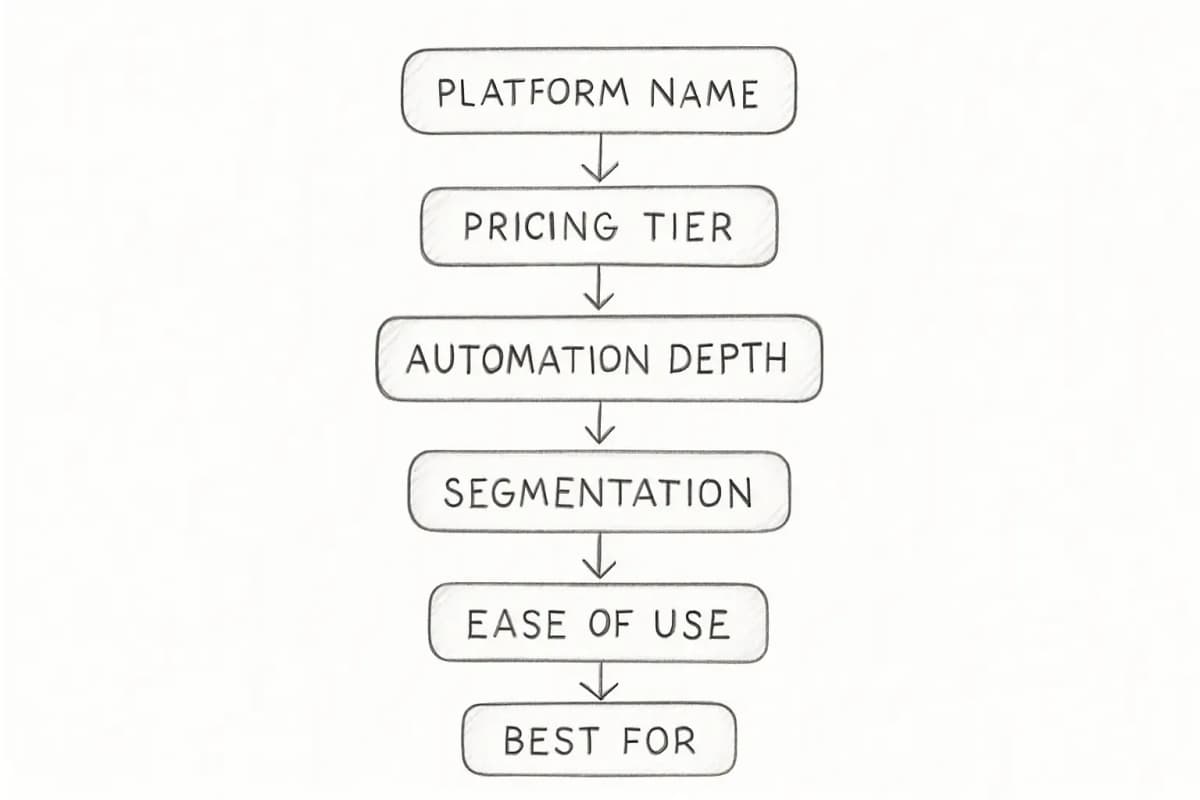
When evaluating any of the top email marketing automation tools, focus on these capabilities:
- Automation depth: Can you build multi-step, condition-based workflows, or are you limited to simple autoresponders?
- Segmentation: Segmented email campaigns generate 30% more opens and 50% more click-throughs, and 78% of marketers say segmentation is their most effective tactic. Check how granularly each platform lets you slice your list. Our full guide on Email List Segmentation Strategies covers this in depth.
- Deliverability: Inbox placement rates vary significantly between platforms. A tool with great features but poor deliverability will consistently underperform.
- Integrations: Does the platform connect to your CRM, ecommerce platform, and analytics stack without requiring custom development?
- AI features: 91% of marketers now use AI tools in their workflows as automation and personalization gain traction. Look for tools with practical AI, not just a chatbot wrapper on top of basic features.
Frequently Asked Questions
What is the best email marketing automation tool in 2025?
There is no single best tool for every business. ActiveCampaign leads for advanced automation and CRM integration. Klaviyo leads for ecommerce revenue attribution. Brevo leads for value and contact-based pricing flexibility. MailerLite leads for simplicity and low cost. The right choice depends on your business model, list size, and how sophisticated your automation needs are.
How much do email marketing automation tools cost?
Small businesses and startups can use free plans or affordable options like Brevo, SendGrid, Mailjet, MailerLite, or Sender at $8 to $15/month for basic paid plans. Medium businesses can expect to spend $15 to $50/month for more advanced features. Enterprise-grade platforms like HubSpot can cost several hundred to thousands of dollars per month depending on contact volume and features.
Do automated emails really perform better than manual campaigns?
Automated emails such as welcome messages and cart abandonment reminders can significantly boost ROI. Automated emails generate 320% more revenue than non-automated emails. The reason is relevance: automated emails trigger based on a subscriber's actual behavior rather than a scheduled broadcast sent to everyone regardless of intent.
What should I look for in an email automation platform for deliverability?
Look for platforms that guide you through SPF, DKIM, and DMARC setup, provide inbox placement data (not just delivery rates), and maintain strong sender reputations. ActiveCampaign achieves a 94.2% inbox placement in independent testing versus an approximately 83% industry average, and SPF, DKIM, and DMARC setup is guided by a built-in wizard. Beyond the tool, list hygiene, consistent sending cadence, and relevant content all directly affect whether your emails reach the inbox.