Email marketing delivers a higher return on investment than virtually any other digital channel. Email marketing campaigns have an average ROI of 36 times, meaning that businesses earn $36 for every dollar they spend on email marketing. If you're new to the channel and wondering where to start, this beginners guide to email marketing covers the core concepts, tactics, and decisions you need to get your first campaigns working and your list growing from day one.
Key Takeaways
- For every $1 spent on email marketing, businesses see a return of $36, an ROI of 3,600%.
- No matter what type of business you operate, an email list is the most important element of a successful marketing strategy.
- Segmented email campaigns generate 760% more revenue than non-segmented broadcasts.
- Welcome emails achieve an average open rate of 83.6%, making them one of the highest-performing automated email types.
- Regulations such as the CAN-SPAM Act in the U.S. and GDPR in the EU dictate rules for obtaining consent and safeguarding user data. Failure to comply can result in severe penalties and email deliverability issues.
What Is Email Marketing and Why Does It Matter?
Email marketing is the practice of sending targeted messages to a list of subscribers to build relationships, promote products or services, and drive conversions. It is a direct-owned channel, meaning you are not dependent on an algorithm or a platform's ad auction to reach your audience.
Global email users are forecasted to increase from 4.48 billion in 2024 to 4.97 billion by 2028, reaching over 60% of the global population. That reach is unmatched by any social network.
52% of consumers made a purchase directly from an email they received, making email the most effective channel for driving sales. It beats social media posts by 13% and social media ads by 11%.
For B2B teams, the case is equally strong. 59% of B2B marketers rate email as their most effective channel for prospecting.
Put simply: if you are not building and emailing a list, you are leaving a significant portion of your potential revenue on the table.
Step 1: Choose an Email Service Provider
Before you send a single email, you need an email service provider (ESP). An ESP handles list management, email design, delivery, and analytics. Common options include Mailchimp, Klaviyo, ActiveCampaign, Brevo, and ConvertKit.
When comparing platforms as a beginner, look for:
- An easy drag-and-drop email builder
- Automation and workflow features
- List segmentation tools
- Deliverability reputation
- Pricing that scales with your list size
The top five deliverability platforms in 2024 are ActiveCampaign (94.2%), Constant Contact (91.7%), GetResponse (90.9%), Moosend (90.1%), and CleverReach (90%). Deliverability matters more than most beginners realize. An email that never reaches the inbox cannot convert, regardless of how good the copy is.
If you want a broader comparison of tools and what each platform offers, the HootSuite Email Marketing: Features, Pricing & Better Alternatives guide covers how popular platforms stack up in detail.
Step 2: Build Your Email List the Right Way
Your list is the foundation of everything else. A small, engaged list consistently outperforms a large, disinterested one.
Build your list ethically through opt-in forms on websites, content upgrades such as e-books, lead magnets, webinars, and in-person sign-ups with clear consent. Make sure unsubscribe options are available and effective.
The most effective list-building methods for beginners:
- Lead magnets: Offer a free resource (checklist, template, mini-course) in exchange for an email address. Focus on one specific problem your audience is actively trying to solve.
- Website opt-in forms: Place signup forms at high-visibility points on your site, including the homepage, blog posts, and exit popups.
- Landing pages: Create a dedicated page for each lead magnet with a single call to action.
- Social media: Promote your lead magnet across your existing social channels to redirect followers to your list.
One critical rule: never buy an email list. Buying email lists is ethically questionable at best, as you are paying for access to an audience who did not directly consent to sharing their email with you. It often leads to low engagement, high spam complaints, poor deliverability, and can damage sender reputation.
To accelerate list growth, explore the 8 Lead Gathering Tools for Email Lists in 2024 for a practical breakdown of the tools that make list building faster.
Step 3: Understand Email List Segmentation
Sending the same email to every subscriber is one of the fastest ways to damage your results. Segmentation means grouping your subscribers by shared characteristics so you can send more relevant messages to each group.
Marketers who send segmented campaigns notice a 760% increase in revenue.
Common segmentation criteria for beginners:
- Demographics: Age, location, job title
- Behavior: Pages visited, links clicked, past purchases
- Engagement: Active openers vs. inactive subscribers
- Stage in the funnel: New leads vs. repeat customers
According to an email marketing survey from HubSpot, 65% of marketers say their segmented emails have better open rates.
You don't need a massive list or complex data to start segmenting. Even a basic split between new subscribers and existing customers will improve relevance and results. For a deeper look at how to structure this, the Email List Segmentation Strategies That Boost ROI by 760% guide covers proven approaches with specific examples.
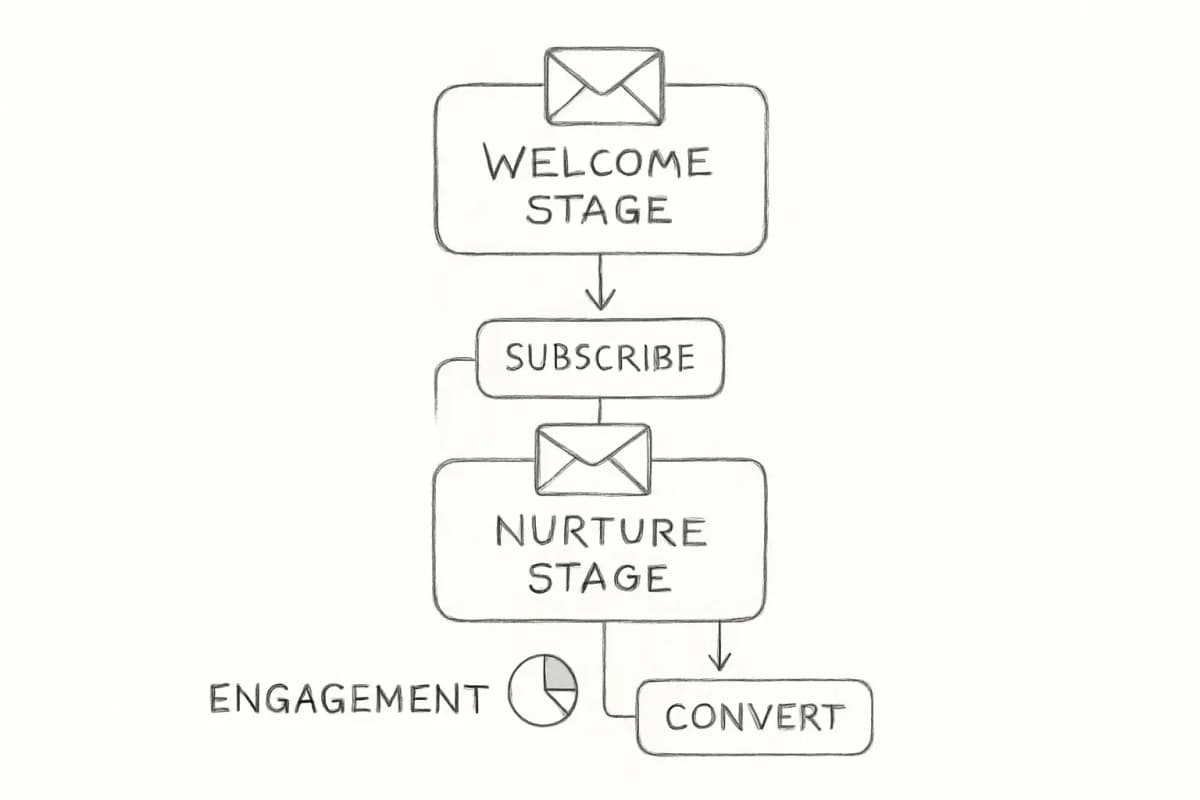
Step 4: Set Up Your Core Email Automations
Email automation sends pre-written messages triggered by subscriber actions or time intervals. It is not optional for a serious email program. Email automations deliver 30 times more revenue per recipient than one-off promotional campaigns. The average return per recipient for campaigns sits at $0.11, while automated flows earn $1.94 per recipient.
The automations every beginner should set up first:
Welcome Sequence
Welcome emails achieve an average open rate of 83.6%, making them one of the highest-performing automated email types. Your welcome email introduces new subscribers to your brand, sets expectations, and often delivers the lead magnet they signed up for. It is the highest-leverage automation you can build. See the Welcome Email Sequence Best Practices: 7 Proven Strategies for a step-by-step framework.
Abandoned Cart (for Ecommerce)
Abandoned cart emails recover 3 to 5% of lost sales on average. They achieve an average open rate of 50.5%, a click rate of 6.25%, and a conversion rate of 3.33%, with top-performing brands reaching conversion rates of 7.69%.
Re-engagement Campaign
Just because someone hasn't opened an email recently doesn't mean you need to remove them from your list. Give them another chance. Launch a re-engagement campaign and try to win them back first.
Step 5: Write Emails That Get Opened and Clicked
Great email content starts before the body copy. Subscribers decide whether to open your email in seconds, based on three things: the sender name, the subject line, and the preview text.
Subject Lines
47% of email recipients will open an email based solely on the subject line. Conversely, 69% of people report emails as spam because of the subject line.
Subject line best practices for beginners:
- Keep it under 60 characters for mobile readability
- Be specific about what the reader gets
- Avoid all-caps and excessive punctuation
- Test curiosity-based lines against benefit-based lines
Emails with personalized content (including the recipient's name, past purchase behavior, or browsing history) can lead to a 29% higher open rate and a 41% higher click-through rate.
For detailed subject line testing guidance, read the Email Subject Line Best Practices That Boost Open Rates by 27%.
Email Body Copy
Follow these principles for body copy that converts:
- Lead with the reader's problem or goal, not your product
- Use short paragraphs and one clear call to action (CTA) per email
- Write in a conversational tone that matches your brand
- When you include a call-to-action button in your emails as opposed to a text link, conversion rates can increase by up to 28%.
Mobile Optimization
50% of people will delete an email if it isn't optimized for mobile. Use a single-column layout, large tap targets, and test every email on mobile before sending.
Step 6: Understand Email Deliverability
Deliverability is whether your emails actually reach the inbox, as opposed to landing in spam or being blocked entirely. 1 in 6 marketing emails never reach the inbox, getting filtered to spam or blocked outright.
The primary factors that affect deliverability:
- Sender authentication: Set up SPF, DKIM, and DMARC records for your sending domain. Companies properly implementing DMARC see a 10 to 20% improvement in inbox placement rates.
- List hygiene: Stick to a regular cleaning cadence, whether every 3 months or 6 months, and remain consistent. Remove hard bounces immediately and re-engage inactive subscribers before removing them.
- Engagement signals: Inbox providers track whether recipients open, click, and reply to your emails. Low engagement over time can push your messages to spam.
- Spam complaint rate: Keep your complaint rate below 0.1%. Sending irrelevant content and making unsubscribes hard are the two fastest ways to accumulate complaints.
Bot-driven phantom engagement has made open rates unreliable, pushing high-performing teams toward revenue per email, list churn, and lifetime value as the metrics that matter.
Step 7: Track the Right Metrics
Many beginners focus on open rates as the primary success metric. That is increasingly unreliable. Apple Mail Privacy Protection (MPP) now affects roughly 50 to 60% of recorded email opens, inflating open rate data and making open rate a less reliable engagement metric.
Better metrics to track from the start:
| Metric | What It Tells You |
|---|---|
| Click-through rate (CTR) | Whether your content drives action |
| Conversion rate | Whether clicks become revenue or leads |
| Revenue per email | Direct financial return per send |
| Unsubscribe rate | Whether your content is relevant to your list |
| Bounce rate | List quality and sender reputation health |
Brands that regularly A/B test their emails achieve 83% higher ROI than those that never test. Start with simple A/B tests on subject lines, then move to CTA copy and send times once you have enough data.
Compliance: CAN-SPAM, GDPR, and Consent
Compliance is non-negotiable, even for beginners. The two laws most email marketers need to understand are:
- CAN-SPAM Act (USA): Requires honest subject lines, a physical mailing address, and a clear unsubscribe mechanism in every commercial email.
- GDPR (EU): Requires explicit, informed consent before adding someone to your list. Subscribers must opt in actively.
Being ethical about compliance promotes customer trust and best email marketing practices. Transparency about opting in or out adds value because the communication between you and the recipient is consensual. Abide by this and you've promoted a positive user experience and established your sender's reputation.
Using a reputable ESP will handle much of this automatically (unsubscribe links, address footers), but the consent piece is your responsibility at the point of sign-up.
Frequently Asked Questions
How often should beginners send marketing emails?
There is no single correct frequency. Gartner's research tells us subscribers prefer receiving emails from their chosen brands just a few times per month. The same study indicates excessive volume is the top reason for higher unsubscribe rates. For most businesses starting out, one to two emails per week is a reasonable starting point. Monitor your unsubscribe rate and adjust based on engagement data.
What is a good email open rate for beginners?
The average email open rate across industries in 2024 clocked in at 22.7%. If you are hitting that figure or above in your early campaigns, you are in line with industry norms. Note that Apple's Mail Privacy Protection inflates open rate figures, so use click-through rate and conversions as your primary performance benchmarks.
Do I need a large email list to see results from email marketing?
No. List quality matters more than size. The top 8% of email programs, those hitting 45:1 or higher ROI, most commonly send newsletters and onboarding emails, not promotions. A focused list of 500 highly engaged subscribers will consistently outperform a bloated list of 10,000 people who never open. Focus on building a list of people who genuinely want to hear from you, then grow from there.
What is the difference between a newsletter and a marketing email?
A newsletter is a recurring, content-focused email sent on a regular schedule. It typically covers updates, educational content, or curated resources. A marketing email is more campaign-oriented, often tied to a specific goal such as a product launch, promotion, or event. Most email programs use both formats. Customer retention and newsletters tied as the second most popular email campaign type, with 14.6% of email marketers choosing each one. As a beginner, a consistent newsletter is a practical place to start before layering in promotional campaigns.