
AI is no longer a bonus feature in email marketing. It is the baseline expectation. AI adoption has surged to 63% of marketers, with 87% of those adopters specifically applying AI to email campaigns. The platforms that win in 2025 are not just adding AI copy generation as an afterthought. They are rethinking how campaigns are built, segmented, sent, and optimized at a per-recipient level.
If you are evaluating the best AI-enabled marketing tools for email in 2025, this guide gives you a direct comparison of what actually matters: deliverability, personalization depth, automation intelligence, and total cost of ownership.
Key Takeaways
- The average email marketing ROI is $36 for every $1 spent, a 3,500% return, and AI adoption is accelerating those returns further.
- Automated emails generate 320% more revenue than manual campaigns, even though they represent just 2% of send volume.
- AI-driven email marketing produces a 13% boost in click-through rates, and AI subject line optimization can boost open rates by up to 10%.
- Organizations investing in AI report a sales ROI uplift of 10 to 20 percent, according to McKinsey research.
- The best AI-enabled tools differ significantly in how deeply AI is embedded: some assist, some automate, and some act autonomously on your behalf.
What Actually Makes an Email Tool "AI-Enabled" in 2025
Not all AI labels are equal. AI technology enables email marketing tools to draw insights from open rates, clicks, and customer behavior to tailor subject lines, send times, and message tone. In theory, this should make campaigns easier to run without losing a personal touch. In practice, many tools claiming to be AI-powered rely on basic automation rather than deep personalization.
There are three tiers of AI capability in today's market:
- Platform AI: Built into tools like ActiveCampaign, Klaviyo, and Brevo, adding smarter send times, behavior-based automation, and AI-generated copy.
- Specialist AI: Tools like Jasper and Lavender that excel at one specific dimension, such as copywriting quality or email coaching.
- Agentic AI: The emerging tier where AI operates across entire workflows, researching recipients, building segments, launching campaigns, and optimizing without requiring step-by-step human input.
When evaluating the best AI-enabled marketing tools for email 2025, focus on whether the AI learns from your specific account data over time, not just runs generic models.
ActiveCampaign: Best for Automation Depth and Deliverability
ActiveCampaign is the strongest all-around pick for teams that treat email as a core revenue channel.
With 900+ pre-built automation recipes, you can set up abandoned cart sequences, lead nurturing funnels, and re-engagement campaigns in minutes. ActiveCampaign scored 94.2% inbox placement in EmailToolTester's independent 2025 study, ranking number one among all platforms tested and 8 percentage points above the industry average.
The Active Intelligence AI suite includes predictive sending, AI-suggested segments, and an AI Campaign Builder. Active Intelligence analyzes billions of customer data points to give you clear, actionable recommendations for email campaigns, from send times to subject lines.
The predictive sending system analyzes each contact's historical open times and sends your campaign at the predicted optimal moment. Independent testing found a 5 to 12% open rate improvement across client accounts, with better results on larger lists that have more engagement data.
In 2025, ActiveCampaign became one of the first marketing platforms to integrate natively with external AI agents, including a dedicated Claude connector.
Best for: Growth teams, B2B businesses, SaaS companies, and agencies that need complex automations, strong CRM integration, and inbox placement they can rely on.
Pricing: Starts at $15/month. Costs scale significantly with contact volume. No free plan.
Klaviyo: Best for Ecommerce AI Personalization
Klaviyo is the autonomous B2C CRM and AI marketing platform that unifies customer data and automates email, SMS, RCS, WhatsApp, and mobile push to drive personalized, revenue-generating campaigns.
For ecommerce brands, Klaviyo's AI depth is the standout. Klaviyo AI analyzes your full product catalog and each subscriber's browsing and purchase history to insert personalized product blocks into emails. Instead of a static "Featured Products" section showing the same four items to everyone, each subscriber sees products selected for them individually.
According to Klaviyo's 2025 State of Email report, brands using Klaviyo AI-driven segments see revenue per recipient increases of 18 to 45% compared to traditional demographic segmentation.
Its Composer feature represents the agentic tier: a marketer describes a goal, such as "launch a summer re-engagement campaign for customers who haven't purchased in 90 days," and Composer identifies the right audience, drafts email and SMS content, sequences the timing, and queues everything for review, in minutes.
Klaviyo has been building AI features since 2017, with over 40 features available today.
Best for: Ecommerce brands on Shopify, WooCommerce, or BigCommerce that need deep behavioral personalization and cross-channel automation.
Pricing: Free plan available (250 active profiles, 500 emails/month). Paid pricing scales steeply: $150/month at 10,000 contacts and $720/month at 50,000 contacts for email alone.
If you want to explore how AI personalization integrates across the customer journey, see our guide on AI email marketing personalization techniques.
HubSpot (Breeze AI): Best for CRM-First Teams
HubSpot's Breeze is a comprehensive AI solution that powers the entire customer platform. It is the right choice when email is one piece of a broader marketing, sales, and service operation, not a standalone channel.
Breeze Agents are specialized AI workers designed to handle entire workflows autonomously, including the Content Agent, Prospecting Agent, Customer Agent, Knowledge Base Agent, and Social Media Agent. Unlike Copilot, which assists you, Agents operate independently on defined tasks. Breeze Intelligence is the data layer that enriches your CRM with buyer intent signals, company information, and contact data from external sources.
HubSpot serves over 248,000 customers in more than 135 countries, and its AI suite is tightly integrated with deal history, CRM records, and past customer behavior, making email personalization more contextually accurate than generic tools.
In 2026, HubSpot moved to outcome-based pricing for its Breeze agents. Breeze Customer Agent pricing dropped from $1.00 per conversation to $0.50 per resolved conversation.
Best for: Teams already on HubSpot's CRM who want AI that draws on their full customer history for email targeting and content.
Pricing: Most teams need the Professional plan ($890/month minimum) to access meaningful AI features. AI features are included with credits at all tiers.
Brevo (Aura AI): Best Value for Small and Mid-Size Businesses
Brevo offers one of the most competitive value propositions among the best AI-enabled marketing tools for email 2025, particularly for budget-conscious teams.
Brevo's AI agent is named Aura, the first product from the Brevo AI Lab, which was launched in May 2025 backed by a €50 million investment. Aura helps you create marketing content faster, from email design to subject lines, images, translations, and SMS messages. It uses AI to analyze data, trends, and language patterns and generate marketing content with emotional triggers.
For enterprise users, AI segmentation takes personalization further. Rather than manually configuring filters, you simply describe the contacts you want to reach in plain language. For example, "customers who purchased X in the last 30 days" prompts the AI to build the segment automatically using machine learning.
Unlike most email marketing services that price primarily by the number of contacts, Brevo charges based on the number of emails you send per month. This makes it uniquely cost-effective for teams with large lists that send infrequently.
Best for: SMBs and growing teams that need an affordable all-in-one platform with genuine AI features without enterprise pricing.
Pricing: Free plan allows up to 100,000 contacts and 300 emails per day. The Starter plan begins at $9 for 5,000 emails per month. 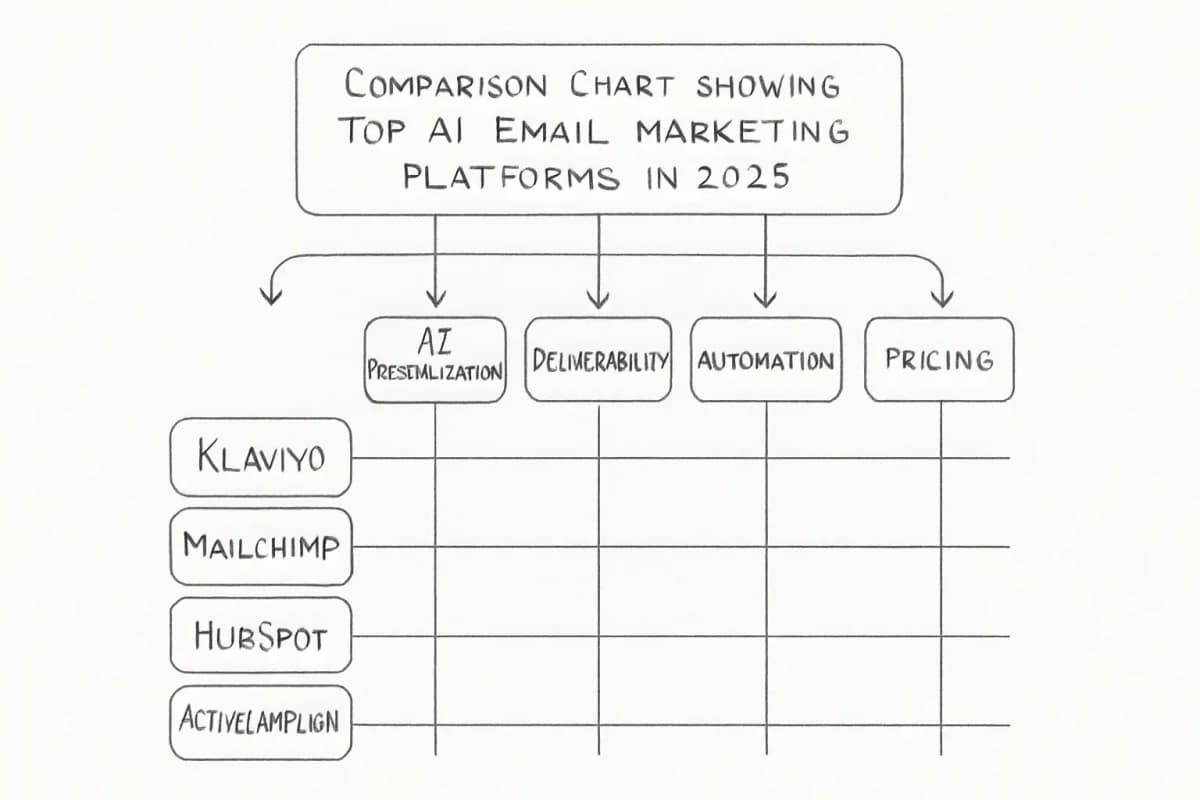
How to Choose the Right AI-Enabled Email Tool
The best AI-enabled marketing tool for email in 2025 depends entirely on your use case, not on feature count.
Use this decision framework:
- You run ecommerce: Klaviyo is purpose-built for behavioral personalization, predictive CLV, and product recommendation automation.
- You need deep automation and top deliverability: ActiveCampaign delivers the best inbox placement and most flexible automation builder in independent testing.
- You are already in HubSpot's ecosystem: Breeze AI adds significant value when your CRM, sales, and marketing data already live in HubSpot.
- You are an SMB watching budget: Brevo's Aura AI and send-volume pricing model make it the strongest value play without compromising core AI capability.
The strongest results still come from the combination of human creativity and machine intelligence. AI is a tool used by skilled marketers, not a substitute for them.
For more context on building campaigns that take full advantage of AI, see our detailed breakdown of how to leverage AI in your email marketing and our collection of successful AI-driven email marketing examples.
What AI Genuinely Improves (and What It Still Cannot)
AI in email marketing is measurably effective in four areas:
- Send-time optimization: AI figures out the best time to send an email to each person by learning individual behavior patterns, whether someone checks emails in the morning or late at night.
- Subject line performance: AI subject line optimization can boost open rates by up to 10%.
- Behavioral segmentation: AI groups users by actions like visits, trials, purchases, and inactivity rather than static list membership.
- Content personalization at scale: More advanced tools let you embed AI directly into workflows so emails can be personalized in real time, triggered by behavior, or adjusted based on sentiment and engagement.
Where AI still falls short: brand voice consistency, contextual judgment on sensitive topics, and building trust through genuinely human storytelling. Every AI-generated email should pass a human voice check before it goes out.
Frequently Asked Questions
What is the best AI-enabled email marketing tool for small businesses in 2025?
Brevo is the strongest option for small businesses. Its Starter plan begins at $9 per month, includes the Aura AI content generator and send-time optimization, and charges by email volume rather than contact count. This makes it uniquely affordable for teams with large lists that do not send at high frequency.
How does AI improve email deliverability?
AI improves deliverability in two ways. First, predictive sending increases open rates by hitting each recipient's optimal engagement window, which signals to inbox providers that recipients want your email. Higher open rates signal to Gmail and Outlook that recipients want your email, making predictive sending one of the simplest wins for improving inbox placement. Second, AI-powered engagement scoring suppresses disengaged contacts before they damage your sender reputation.
Is AI in email marketing worth the extra cost?
Yes, for most businesses. Automated emails generate 320% more revenue than manual campaigns despite representing just 2% of send volume. Businesses using AI in email campaigns report an average ROI increase of 21%. The break-even point comes quickly when AI reduces content production time, improves open rates, and drives more precise targeting.
What is the difference between AI-assisted and AI-autonomous email marketing?
AI-assisted tools generate suggestions that humans then review and approve, such as subject line variants or segment recommendations. AI-autonomous tools, now emerging in platforms like Klaviyo's Composer and ActiveCampaign's Active Intelligence agents, execute entire workflows independently, including building the audience, drafting content, scheduling sends, and monitoring performance, with humans setting the goal and reviewing output. By 2026, 89% of marketing experts expect up to 75% of email strategy operations to be fully AI-driven.